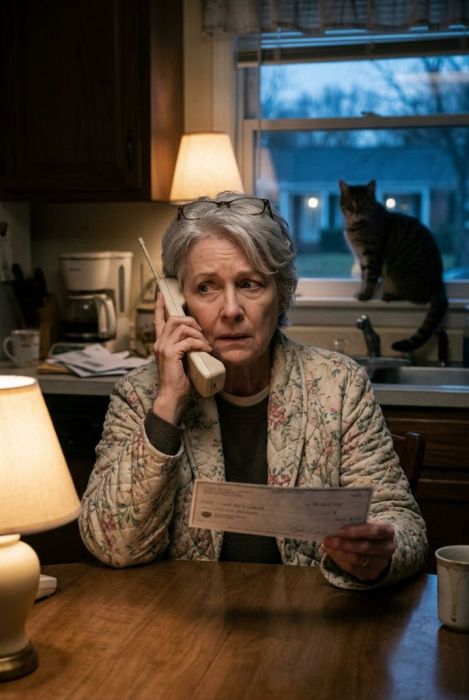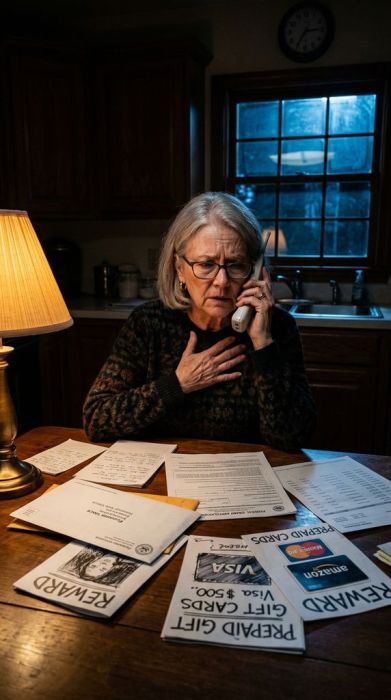

The call came at 9:47 on a Tuesday night, and Helen Whitmore nearly let it go to voicemail. Her daughter Sarah called at odd hours ever since the divorce, and Helen had learned that late-night phone calls from Sarah rarely meant good news. But something in the way the phone vibrated against the kitchen counter made her pick up.
"Mom, please tell me you haven't signed anything." Sarah's voice was shaking. "Please tell me you haven't given that man any money."
Helen set down the cup of tea she'd been nursing and looked out the window at the dark street where she had lived alone for fourteen months, ever since Leonard passed. Fourteen months of empty rooms, of setting the table for one, of a silence so loud she sometimes turned on the television just to hear another human voice.
"Sweetheart, I don't know what you're talking about."
"The Alder Circle, Mom. The group. I saw the bank statement they sent to your old address by mistake. Two thousand dollars gone. Then another five hundred. Mom, you have to come home. You have to get out of that place."
Helen laughed, a soft, tired sound. She was sixty-eight years old, a retired school librarian who had spent thirty-one years teaching children to think critically, to question what they read, to look for the telltale signs of a lie. She was not the kind of woman who got taken in by anyone.
That was what she believed, anyway. It was what everyone who loved her believed.
The Alder Circle met every Tuesday and Thursday in a converted warehouse on the industrial edge of town, a place with polished concrete floors and warm amber lighting and the faint smell of lavender that someone diffused near the entrance. Helen had wandered in one gray November afternoon, drawn by a flyer pinned to the community board at the grocery store. It showed a photograph of a woman laughing in soft golden light, and beneath it, four words that had reached into the hollow place inside her: You are not alone.
The flyer listed a phone number and a website. Helen had stood there for a long time, her cart half-empty, reading those four words again and again until they blurred. Leonard had been the one who knew how to fill a room, how to find the bright side of any weather. Without him, Helen had discovered that grief was not a season that passed but a tide that kept coming back, and she was tired of treading water.
She called the number that afternoon.
The man who answered introduced himself as Marcus Bell, and his voice had a calm, almost hypnotic quality that Helen found herself trusting immediately. He told her he understood loss better than most people. He told her the Circle had helped hundreds of people just like her find their way back to joy. He told her the first session was free, no pressure, just come and see for yourself.
So she went.
The warehouse was warmer than she expected, filled with chairs arranged in a loose spiral around a central stage where a single microphone stood. Around forty people were there, mostly women her age, a few couples, all of them nodding along to a low murmur of conversation. When Marcus Bell walked in, the room changed. People sat up straighter. Somebody near Helen whispered that he was a miracle worker, an angel sent to heal broken families.
Marcus was handsome in a way that Helen hadn't expected, mid-fifties, silver hair, deep brown eyes that seemed to look straight through her. He wore a charcoal suit with no tie and spoke without notes, his voice rising and falling like a tide pulling the whole room along with it. He talked about energy, about unlocking the authentic self, about the toxic people in their lives who were draining them of their purpose.
Helen found herself nodding. She found herself thinking about Sarah, who had grown distant since the divorce, who visited less every month.
"You all came here carrying something heavy," Marcus said, and the room seemed to exhale as one. "You came here because the people who were supposed to love you have failed you. And I want you to know, tonight, that it's not your fault. It was never your fault."
People wept. People reached for each other's hands. Helen felt a strange, aching relief wash over her, as if someone had finally looked at her and seen the weight she had been carrying alone.
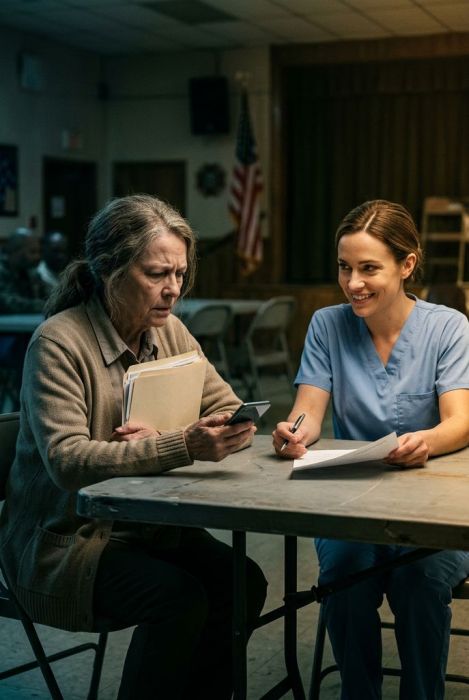
At the end of the session, a woman in a soft pink sweater approached Helen and told her about the donations. Nobody was required to give, she said, but the Circle survived on the generosity of people who had been transformed. Many members chose to donate a portion of their retirement income as a way of paying it forward, of funding the healing of others.
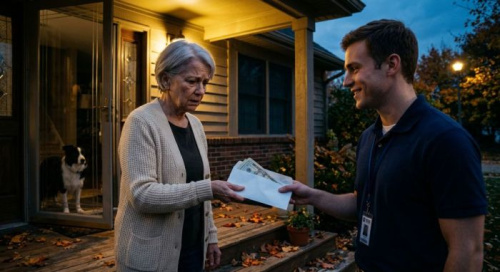
Helen wrote a check for a hundred dollars. It felt good. It felt like she was finally doing something meaningful again.
Within two weeks, she had given six hundred. Within a month, she was attending every session, helping set up the folding chairs, making coffee for the others. She had stopped calling Sarah as often, because every time she did, Sarah asked questions that made Helen feel defensive. Why was she spending so much time there? Why was she giving away Leonard's pension? Why did she keep defending a man she barely knew?
Because he understands me, Helen wanted to scream. Because nobody else does.
Instead, she told Sarah she was busy, that she had found a community that made her happy, and that Sarah should be glad for her instead of trying to drag her back into her loneliness.
There was a long silence on the other end of the line. Then Sarah said, very quietly, "Promise me you'll think about what I said, Mom." And Helen promised, and she meant it, and then she didn't.
The money kept flowing. Two thousand dollars became four thousand, then eight. Marcus introduced a "prosperity level" program, where members who gave more were given access to private sessions, to one-on-one mentorship, to the inner circle. Helen climbed the levels like a woman searching for something, and Marcus rewarded her with praise that lit up her whole body. He told her she had more to give than she realized. He told her the Circle was building a retreat center, a peaceful place where people like her could heal in nature, and that the members who contributed the most would be remembered as founders.
There was always another vision, always another milestone, always another level just out of reach. When Helen hesitated, Marcus would remind her of how far she had come, how the old Helen would have been too afraid to give so freely. The shame was a powerful lever. She did not want to go backward. She did not want to be the woman who had sat alone in a dark house every night.
Leonard's pension was substantial. Helen had more than she needed. She began to think of it as Leonard's gift to the world, a way to honor his memory, a way to prove that her loneliness had meant something after all.
And then, on a rainy Tuesday in February, Sarah showed up at the warehouse.
Helen saw her standing by the door, soaked and pale, and for a moment her heart did a strange, frightened skip. Sarah didn't look angry. Sarah looked terrified.
"Mom, you need to come with me right now."
"Sarah, I have a session."
"There's no session, Mom. There's no Circle. I've been digging." Sarah pulled a thick folder out of her bag and pressed it into Helen's hands. She had spent six weeks, she said, researching Marcus Bell. She had talked to four former members, all of whom described the same warm beginning and the same slow, grinding loss of everything they owned. She had found the shell company that owned the warehouse. She had found the retreat center registered in a state none of them had ever visited.
And then Sarah said the words that shattered the last of it.
"Mom, Marcus Bell isn't a healer. His real name is Raymond Cole, and he's served prison time for a Ponzi scheme in Ohio. He's done this before. He builds a group, drains them, and disappears. And the woman in the pink sweater who recruited you? She's his wife. They've been doing this for twenty years."
Helen read the documents with hands that would not stop trembling. She saw the mugshot, the court records, the names of victims whose stories mirrored her own almost exactly. She thought of Leonard's pension, of the relinquished savings, of the thousands of dollars she had handed to a man who had looked her in the eye and called her brave.
She thought about how clever they had been. How they had never once asked for money aggressively, had never pressured, had simply made her feel so safe and so seen that she had opened her own hand.
Helen did not drive away with Sarah that night. Not yet. She walked into the warehouse one last time, to the room where forty grateful strangers were settling into their chairs, where Marcus Bell was warming up his voice in the amber light. The room fell silent when she walked to the center, and Marcus's smile flickered for just a second, like a bulb losing power.
"Helen," he said warmly, "we were just about to begin."
"I know what you are, Raymond," she said, and she kept her voice steady because she had spent thirty-one years standing in front of rooms full of children who needed to believe her. "I've read everything. My daughter spent six weeks proving what I should have seen myself."
For a long moment, the whole room held its breath. People looked at each other, confused. And then someone in the back stood up — an older man Helen recognized from the Tuesday sessions — and said, in a small, ruined voice, "What is she talking about?"
Helen told them. She read from the folder, aloud, clearly, the way she used to read to her students. And by the time the police arrived, summoned by a member who had already dialed while Helen was talking, half the room was in tears and Marcus Bell had slipped out a fire exit into the rain.
The Alder Circle collapsed within days. Most members never recovered their money. Some, like Helen, got back a portion through the criminal proceedings that followed Raymond Cole's rearrest. Sarah moved home for three months and refused to discuss the hotel rooms, but she cooked Helen dinner every night, and eventually the silence between them began to feel like something other than a wall.
Helen Whitmore never got her money back in full. But she did get something else, something that took her a long time to name. It was the understanding that loneliness is not a weakness, and that the people who prey on the lonely are the most skilled actors in the world. She learned to be suspicious of anyone who made her feel too seen too quickly, to check claims against paper, to tell her daughter everything even when it was hard.
She learned, too, that the cure for grief was never a stranger who promised to heal it with a price tag attached. The real healing had been waiting for her all along, in the voice of a daughter who would drive through the rain to bring her home.
And every time Sarah called at an odd hour, Helen picked up.
"I'm here," she would say. "What's wrong?"
And mean it completely.