The first thing Leonard Oakes saw when he opened his eyes was the wrong ceiling. The lights were too bright, the air smelled of antiseptic, and a doctor in blue scrubs was holding a small white pill between his thumb and forefinger as though it might bite.
"You've been taking this every morning," the doctor said.
Len blinked. "That's my arthritis medicine."
"It's not medicine, Mr. Oakes." The name on the tag read OKONKWO. He set the pill on the tray table, beside a cup of water Len hadn't asked for. "We found lead, cadmium, and enough chalk to plaster a bathroom wall. There isn't a single milligram of the drug your rheumatologist prescribed."
Len stared at the pill. It looked exactly like the ones in the bottle on his nightstand. Smaller, maybe. He'd never noticed.
He had collapsed in the frozen foods aisle at Wegmans, four days before his sixty-eighth birthday, his cart still holding the eight-dollar rotisserie chicken he'd planned to eat alone. A teenager bagging groceries had caught him before his head hit the tile. Emergency crews found his heart racing at a hundred and forty beats per minute, his blood pressure collapsing, and his kidneys, according to the young nephrologist who introduced herself at dawn, "confused, like they'd been drinking poison for a long time."
Which, as it turned out, was exactly true.
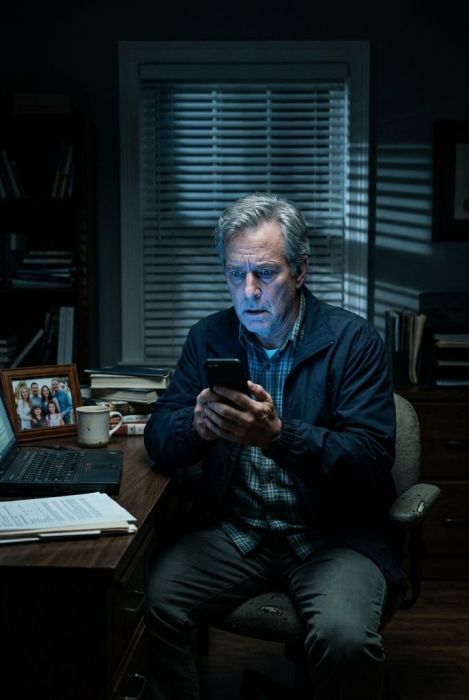
Len Oakes had spent thirty-one years carrying mail through the snow and heat of Rochester, New York. He was a man of small, steady routines: black coffee at six, the crossword with breakfast, a walk down to the corner for the paper, and his evening call with his daughter Maggie, who worked nights as an ER nurse across town. His wife Helen had been gone for two years, taken by pancreatic cancer so fast he still reached for her coat on cold mornings. He was not lonely, exactly. He was simply alone, and after a while the two began to feel like the same thing.
The rheumatoid arthritis had started in his hands four years earlier, a stiffness that crept into his knees and wrists until some mornings he had to brace himself against the bathroom sink just to stand. The medication Dr. Sandoval prescribed was good medicine. It was also four hundred and twelve dollars a month after his Medicare Part D plan did its accounting, which was a number that made Len wince every single time.
He found the ad on his tablet one rainy Tuesday night. A cheerful banner with a maple leaf and a slogan: "Why pay American prices? Licensed Canadian pharmacy, 90% off your prescriptions." It promised free shipping, no waiting rooms, and a toll-free number. Len had heard of Canadian pharmacies. His buddy Frank swore by one for his heart pills. The website was clean, the prices were beautiful, and there was a box to enter your medication and your insurance information.
He called the number. A woman answered on the second ring, her voice warm and unhurried, like a favorite aunt who had all the time in the world.
"Maple Leaf Pharmacy, this is Dana. How can I help you today, sweetheart?"
That evening, Len ordered three months of his arthritis medication for a hundred and nineteen dollars. He felt like he'd won something. He told Maggie about it on their evening call, and there was a pause on her end that he chose not to hear.
"That's a huge discount, Dad. Are you sure it's legit?"
"It's licensed, honey. Frank uses them."
"Frank also thought his neighbor was a CIA agent," Maggie said gently. "Let me look at the website when I come over Sunday."
The package arrived in four days, in a plain white padded envelope with a typed label and no return address beyond a post office box in Buffalo, New York. Inside was a white bottle with a simple amber cap and a typed label that said his name, his medication, and the words "Take as directed." There was no lot number, no expiration date, no pharmacy name, no NAPBP logo, nothing that looked like the bottles he got from CVS. Len noticed. He even turned the bottle over in his hands. But the price was so good, and the pills looked right, and he was so tired of being in pain that he put the bottle in his bathroom cabinet and took his first pill the next morning.
The pills were smaller than his old ones, and they had a faint, dusty taste. He told himself it was a different manufacturer. He told himself that for six weeks.
Dana from Maple Leaf Pharmacy called him the following Tuesday to make sure everything was satisfactory. It was such a small kindness — a stranger remembering his name — that Len found himself smiling into the phone. She asked about his hands, and whether the stiffness had eased. She told him she had arthritis herself, in her back, and that she understood. By the third call she knew about Helen, about Maggie the nurse, about the raccoon that kept getting into his garbage cans. She laughed at his jokes. She called him "my favorite patient," and even though Len knew that was just a phrase, he looked forward to Tuesdays more than he wanted to admit.
The knee pain, meanwhile, got worse. He attributed it to the weather, to his age, to the way he'd walked his mail route for three decades. His left ankle swelled one week; his chest felt tight after he shoveled the walk. He mentioned none of this to Maggie, because she worried too much, and because he'd paid good money for medicine that was supposed to be working.
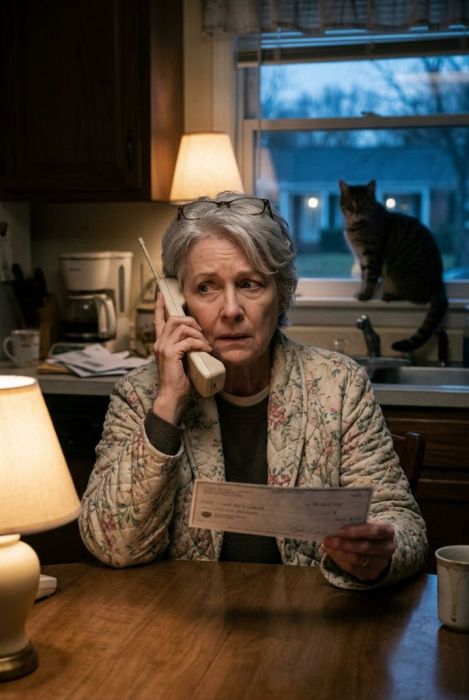
He did mention it to Dana, in a roundabout way, during one of their Tuesday calls. She told him it could take time to build up in his system. She suggested he might need a slightly higher dose, and that she could "adjust his file" and send him a new bottle at no charge, because that was the kind of service Maple Leaf offered. He read his bank card number out loud, slowly, so she could update the payment method on his file. She thanked him, sweetheart, and wished him a good night.
The second bottle arrived with a crumpled label and, tucked into the same envelope by accident, another patient's prescription: a woman named Marie Pemberton in Tonawanda, a different medication entirely. Len called Dana about it. She apologized for the mix-up, blamed a new packer, and offered him ten percent off his next order as a gesture of goodwill. He felt bad for causing trouble. He forgot he'd ever seen the name Marie Pemberton.
Three weeks later, his heart did something it had never done before. He was standing in the frozen foods aisle, reading the label on a bag of peas, when the world tilted sideways, his chest clamped down like a vise, and he went down hard enough to crack two of his ribs. His last conscious thought, before the fluorescent lights swam and went dark, was that he hadn't taken his pill that morning, and that was probably why.
When he woke in the hospital, Maggie was there, her nurse's scrubs still smelling of the night shift, her hand wrapped around his wrist like a lifeline. The tests came back slowly, and each one was worse than the last. Elevated lead levels. Kidney strain. Inflammation markers through the roof. The hospital's own pharmacist, a precise woman named Lee, brought his white bottle to his bedside and held it up to the light.
"There's no lot number, Mr. Oakes. No manufacturer. No registration. This bottle didn't come from any licensed pharmacy in the United States or Canada." She opened it and shook a pill into her palm. "And these aren't your medication. They're a mixture of binders, fillers, and heavy metals — packaged to look like medicine."
Pharmacist Lee ran the bottle through every database she had. There was no record of Maple Leaf Pharmacy anywhere. The toll-free number routed to a prepaid phone. The address was a UPS store. The charge on his credit card, which he'd authorized for $39.99 a month, was routed through something called Wellness Partners LLC, a company with a mailing address in a strip mall and, as the detective who arrived that afternoon put it, "a footprint roughly the size of a shooting star."
Detective Alvarez of the Rochester Police Department sat in the chair beside Len's bed with a notebook. He was young, patient, and very good at taking notes. Special Agent Brooks of the FDA's Office of Criminal Investigations made the trip up from Albany. It was Brooks who told Len the number that made Maggie stop breathing: the "pharmacy" had processed more than three hundred orders in the past year, across fourteen states, totaling close to a million and a half dollars in charges for pills that were, in some cases, literally powdered chalk.
"Your file was well kept, Mr. Oakes," Brooks said. "Whoever ran this operation knew your medication, your dosage, your doctor's name, and your payment information. They were very thorough."
Len closed his eyes. He thought about Tuesday phone calls and kind voices and a woman who laughed at his jokes. He thought about how easy it had been to hand over his card number, and how grateful he'd felt to be asked.
It took the investigators another six weeks to trace the money, boring through layers of shell companies and the digital equivalent of a hall of mirrors. It took a warrant and a stakeout and a trash can full of torn envelopes with no return addresses. And then, on a gray November morning, Special Agent Brooks drove to the hospital himself, holding a manila envelope, with an expression Len had never seen on a federal agent's face before.
"Mr. Oakes," he said quietly, "we'd like you to look at a photograph."
The photograph was grainy, pulled from a security camera across the street from a two-story office building in Greece, New York. It showed a woman in a beige coat unlocking the door to a small office unit on the ground floor, a cardboard box under her arm, her keychain catching the light of the parking lot. The sign above the door read EXCELLENCE BUSINESS CENTER, UNIT 9.
Len's hands began to shake. He didn't need to see her face clearly. He knew the beige coat. He knew the way she unlocked doors with her hip pushed against the frame, the same way she'd done it every day for eighteen years at the front desk of Dr. Sandoval's rheumatology practice, where she kept a candy dish on her counter and knew every patient's first name.
"Marsha," he whispered.
Marsha Delgado had been the office manager at his doctor's office since before Len was a patient there. She was the one who'd called him when a snowstorm delayed his appointment, who'd once given him a ride home when his battery died in the parking lot, who'd sent a sympathy card signed by the whole staff when Helen died. She was the kind woman who remembered birthdays, who cried at staff farewell parties, who had a son she doted on and a husband who'd lost his restaurant three years ago to the pandemic and his savings after that to what the investigators would later describe as "a deeply unfortunate gambling habit."
It was her son's debts, and her own fear, and the math of a mortgage on a single salary — the investigation would sketch it all out, sad and ordinary and entirely human — that had turned Marsha Delgado, sometime around the winter after the restaurant closed, into the woman who stole files, opened credit cards in patients' names, and built an empire of lies out of a rented office and a voice on the phone.
She had been "Dana Miller" for two years. She had collected the names and dosages and credit card numbers of hundreds of elderly patients, the sick, the lonely, the desperate, the trusting. She had sent them chalk and lead and poison, had charged them monthly forever, and had sounded, on every single Tuesday call, exactly like the kind of person you'd want to sit next to at church.
The arrest happened at 7 a.m. on a Tuesday. Len insisted on being there. Not to watch her handcuffed — he told himself that, anyway — but to look at her face, just once, and ask the question that had been keeping him awake for a week.
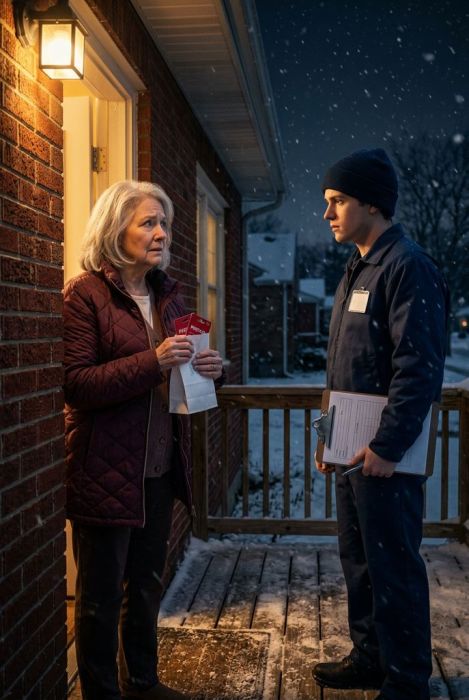
They brought her out of the office building in the middle of a light snow. Her wrists were cuffed in front of her, her beige coat was open, and her hair was the same neat gray it had always been. She saw him standing behind the police tape and stopped walking. For a long moment, neither of them said anything.
"I never meant for you to get sick, Len," she said finally. Her voice was exactly the same. Warm. Forgiving. Like a favorite aunt. "You were never supposed to get sick."
"You knew my file, Marsha." His own voice came out quieter than he expected. "You knew I was alone. You knew I had nobody to check on me. You made me feel like I had a friend, and you sold me poison."
She looked at the ground. "I didn't think —"
"No," Len said. "You didn't think about me. You thought about the money."
The trial was held in the spring. Len testified for an afternoon, and he told the courtroom about the Tuesday calls and the candy dish and the ride home in the snowstorm, and about how trust was the easiest thing in the world to sell to someone who'd forgotten what kindness felt like. Marsha Delgado pleaded guilty to wire fraud, identity theft, and multiple counts of selling adulterated drugs. The judge sentenced her to eleven years, and the courtroom was quiet when the sentence was read, because everyone in it had understood something about how close every senior in that room had come to being the person in the white envelope.
Len Oakes spent a month in physical therapy and a year on a new medication that he picked up, now, from the CVS on Monroe Avenue. It cost more. It also came with a lot number and a pharmacist who knew his name because she could read his chart, not because she'd stolen it. Maggie set up automatic refills on his phone, so he'd never have to read his card number to anyone again, and she made him promise, hand on his heart, that he would hang up on any voice that offered him a miracle.
He thought about Helen sometimes, in the evenings. He thought about the Tuesdays he'd spent waiting for a liar's call, and about how a real pharmacy never needed to call you to tell you it cared. When a man at his doctor's office complained about the price of his medication, Len told him about it — the pharmacy, the voice, the little white pills. "If it's ninety percent cheaper," he said, "it's not medicine. It's a sales pitch. And the person on the other end of that line already knows more about you than they should."
The new doctor's office has badges now, and audits, and a sign on the front desk about patient privacy. Marsha's candy dish is gone. Len doesn't miss it.
He still gets mail from pharmacies he's never heard of, glossy envelopes with promises of savings. He opens them the way a man opens a snake's cage — carefully, at arm's length — and then he drops them in the recycling bin, lot number or no lot number, and goes back to his crossword, with the phone in the other room quiet, and no one waiting on the other end of the line to ask how his hands are feeling today.