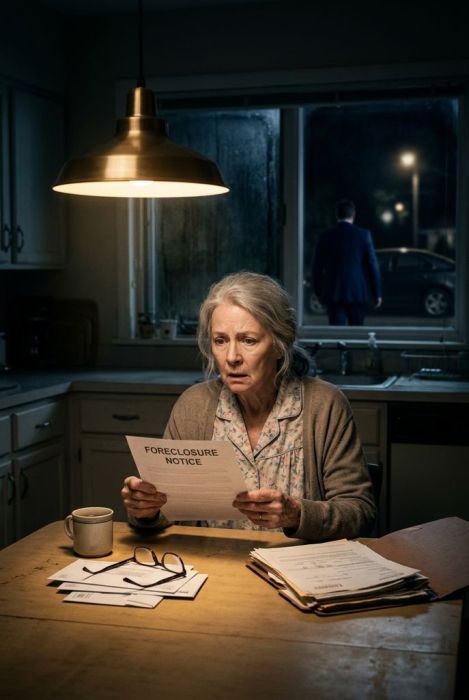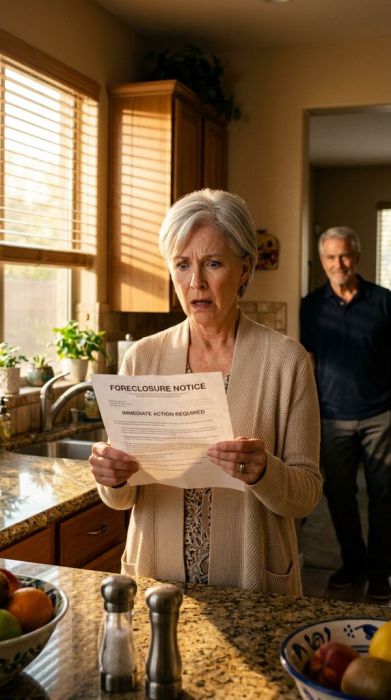
Frank Moretti woke up on a Tuesday in late September with the same routine he had followed for eleven years. Coffee in the hand-painted mug, the crossword in ink, then the drive to Kroger on North High Street for a grocery run he could have done in his sleep. The air had that first clean bite of autumn, and a dead branch had come down in the night. He did not know that a stranger had signed his name to a document forty miles away, or that the life he had built for fifty-two years was already gone.
The clerk at the register handed his debit card back with an apologetic shrug. "Declined, sir."
"That can't be right." Frank slid the card through again. The little machine beeped, patient and indifferent.
He called the bank from the parking lot, the heater blowing against his legs. The customer service representative had a bright, careful voice that Frank would remember for the rest of his life. "Mr. Moretti, I'm showing a freeze on all accounts associated with your Social Security number. The notation references a court matter. You'll want to speak with your attorney."
"Attorney for what?"
"I'm sorry, sir. That's all I can see."
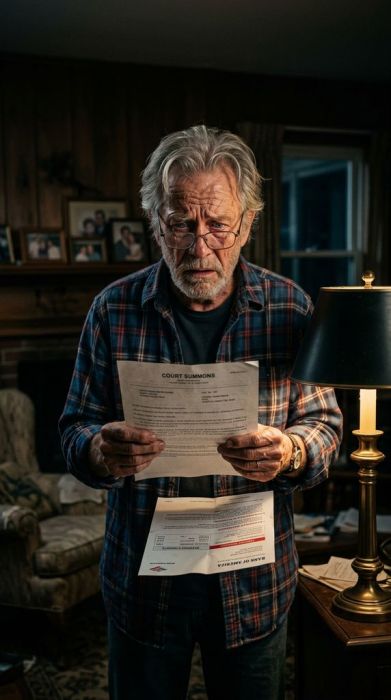
He sat in the parking lot, feeling something he had not felt since the night Marie died: the world sliding sideways out from under him. The shape of his new life arrived in pieces. A certified letter from the Franklin County Probate Court informed him that a guardianship hearing for his person and estate had already taken place, with a court-appointed attorney who had supposedly met him on September eleventh at a downtown firm. Frank had spent that afternoon at the VA clinic.
His brother's signature was on the petition. His brother's claim described a seventy-four-year-old man who had become "incapable of managing his own affairs," who had been found wandering, who had left a stove burner on and started a fire, and who was "actively dissipating assets" by mailing money to television ministries. The petition described a man Frank had never met.
"Ray filed this?" his daughter asked him from the doorway the next morning, and then again, ten minutes later, her voice cracking as she read to the end. Leah had flown in from Seattle on the first red-eye she could find. She was a paralegal, and she read documents the way other people read novels: with her whole face.
"He says he was looking out for me."
"There's no doctor's name here, Dad. There's just — wait." She flipped three pages. "There is a physician's statement. From somebody named Alan Voss, Riverside Geriatric Associates. Have you ever heard of this man?"
"No."
"Have you ever been to this office?"
"I Googled it," Frank said. "The address on the letterhead is a mailbox store on Cleveland Avenue."
Leah's face went through four colors before settling on a shade of white Frank had never seen on her. "Dad. They've already appointed someone. Emergency guardianship, granted ex parte. You're not just being sued. You're already legally somebody else's ward."
The words hung in the kitchen like smoke.
The woman who met Frank at the cream-colored office building was named Cynthia Rowe. She wore a beige suit and a smile that had been practiced until it fit perfectly. She introduced herself as his guardian of the estate, handling his finances under court supervision.
"It's really very routine, Mr. Moretti," she said, gesturing to a chair that sat lower than hers. "We'll make sure your bills are paid, your appointments are kept, and we'll keep the court informed. You'll find it takes a lot off your plate."
"My plate is fine," Frank said. "I want my accounts unfrozen. I want to see the doctor's report."
Cynthia's smile did not waver. "The physician's assessment is confidential, but I can tell you it was thorough. And this lovely place —" She opened a glossy brochure with photos of gray-haired people playing cards. "— is Cedar Hollow. It's a beautiful community, just twenty minutes from here. The transition would be covered by the sale of the house, of course, with the proceeds protected in your estate."
Frank held up a hand. "Nobody's selling my house."
"Mr. Moretti, the court has determined your home is an illiquid asset that exceeds your reasonable needs. It's my fiduciary duty to —"
"You don't know me. You don't know my house. I built that house."
Cynthia tilted her head, the way a person tilts her head at a child having a tantrum. "I understand this is upsetting. Change is hard at any age. But the court has made its decision, and my job is to keep you safe and comfortable. Perhaps we should talk about it when you're feeling more like yourself."
Frank went home and called every lawyer he could think of. Two told him guardianships were nearly impossible to reverse once granted. The third, a retired probate attorney named Harold Finch who spent his mornings at the public library, agreed to meet him for the price of a cup of coffee, because somebody ought to.
Harold read the petition, the order, and the exhibits with the slow, grim thoroughness of a man reading a weather report about an oncoming storm. "Here's your problem, Frank. The emergency petition was granted because the court believed you were in imminent danger. When that happens, they appoint a guardian immediately, and the ward gets notice after the fact. It's a protection mechanism. And it's the single most abused mechanism in the entire probate code."
"What about the fire?" Frank asked. "The stove he says I left on?"
Harold frowned, flipping pages. "There's a police report attached. The fire was at Ravenwood Gardens — that's on Ray's license — not at your house. Your brother reported a grease fire at his own apartment and told the officer he'd been visiting you three hours earlier. He just had to plant the seed of doubt about your judgment. A petition needs a supporting story, not a conviction."
"And the doctor?"
Harold slid the physician's statement across the table. "I called the number on the letterhead. It's a voicemail box that's full. I called Riverside Health's main line. They have no record of an Alan Voss, in geriatrics or anywhere else. Now — the court-appointed attorney who supposedly represented you, Benjamin Hart. I know Ben. We were in the bar association together for thirty years. He told me this morning he has never met you. He was told you were too disoriented to participate, and he trusted the petition. Somebody signed a waiver on your behalf, Frank. Somebody with access to your signature."
Frank went cold. He had not signed anything in months. The only papers he had touched all summer were a birthday card for his granddaughter and a maintenance release for the roofers who had replaced three shingles in August.
Ray called that night, for the first time in eleven months, and his voice was soft and wounded, the voice of a man doing something difficult out of pure love. "Frankie. Listen. I know this seems sudden. But you scared me, okay? You scared all of us. Cedar Hollow is a great place, I toured it myself. You're not losing your house, Frankie. You're gaining a life."
"Whose idea was Cedar Hollow, Ray? Yours — or Cynthia's?"
A pause. A breath. "She thought it would be good for you. She's on your side, Frankie. We're all on your side."
"Then unfreeze my accounts."
"I can't do that. It's a court thing. I'm just looking out for you."
Frank sat with the phone in his hand after Ray hung up, and for the first time in his life he understood what his brother actually was. Not a fool, and not a caretaker. A rowboat being rowed toward a waterfall, smiling the whole way.
Leah spent two days and three hundred dollars pulling public records on Lakeshore Guardian Services, on Cynthia Rowe, and on a holding company called Rowan Trust Group. When she came back from the courthouse records room, she sat down hard on the porch steps.
"Dad. Lakeshore has four hundred wards. Four hundred. That's not a guardianship service. That's a harvest."
"A harvest of what?"
"Them." She held up her phone. "Rowan Trust Group buys houses from guardianship estates at market value, which they set themselves by hiring appraisers who appraise low. The guardian approves the sale because the court rubber-stamps whatever the guardian recommends. Then Rowan sells the house four months later at the real price. I found a house out by Worthington worth two-ninety. Sold as part of an estate for a hundred-sixty. Re-sold for two-seventy-four eleven weeks later, to a couple pre-approved by a Rowan-affiliated lender. Dad, they're not stealing houses one at a time. They're running them through a machine."
Frank thought of the beige suit and the little smile and the brochure with its glossy photographs of happy old people. "Cynthia told me the house exceeds my needs."
"The petition says the same sentence, almost word for word. 'Illiquid asset exceeding the ward's reasonable needs.' I found that exact sentence in fourteen other estates. Same sentence, fourteen houses, all sold by Lakeshore, all bought and flipped by Rowan, all in the last two years. And the woman who 'helped' Ray find the guardian — a senior care coordinator at his church, Denise Okafor — her referral company has been dissolved. But before it was dissolved, it referred forty-one clients to Lakeshore."
"There's no such thing as that many coincidences," Frank said quietly.
The hearing was held three weeks later in a wood-paneled courtroom on the third floor of the Franklin County courthouse. Frank walked in with a folder under his arm and Leah at his side. Ray sat across the aisle with Cynthia, who wore the same beige suit and a slightly different version of the same smile. Harold Finch sat in the front row, and that was enough.
The judge was a woman in her sixties with reading glasses on a chain and the flat, patient voice of someone who had seen every version of human fraud. She reviewed the file for a long time in near silence. Then she looked up.
"Mr. Moretti. Your emergency guardianship was granted on September eleventh. Since then, you've had no access to your accounts, your mail has been forwarded to your guardian, and a plan has been submitted to sell your residence. The guardian's report states you are 'intermittently disoriented' and 'unable to manage banking tasks.' Is there anything you'd like the court to know?"
Frank stood up slowly. "Your Honor, I'm going to say this as plainly as I can. I have never met Dr. Alan Voss. I have never been evaluated by him. I never received any document from this court before my accounts were frozen. I never met the attorney who supposedly represented me — I spent September eleventh at the VA clinic, and I have the appointment slip. And I did not sign anything on June third, which is the date on the waiver that supposedly gives up my right to be present."
He set the folder on the rail. "I brought my neurologist's report from June, my bank records, and a video of me preparing my own taxes in April, if the court would like to assess my competence. And my daughter has records showing that Lakeshore Guardian Services has sold fourteen homes using the same sentence in the same petition, to the same holding company, at prices averaging forty-three percent below market."
The courtroom went very quiet. Out of the corner of his eye, Frank saw Ray's hands, folded on the table, begin to tremble.
The judge removed her glasses. "Mr. Moretti, the court's records show your signature on that waiver was notarized. Do you recognize the notary?"
"No, Your Honor. I've never heard of her."
"Nor have I." The judge turned to the bailiff. "Pull the notary bond file for Geraldine Pasko, please. And Ms. Rowe — I'd like the complete list of properties currently held or sold by Rowan Trust Group, along with the appraisals and the resale contracts. This court will recess for thirty minutes."
Cynthia's smile finally cracked. It didn't fall off her face exactly. It just stopped functioning, like a machine running out of power, leaving something pale and flat underneath.
Ray asked to speak to Frank in the hallway. He looked ten years older than he had in August, the way men look when the current finally stops carrying them.
"I didn't know about the houses," Ray said. "I swear. Cynthia and Denise, they told me you were sick. They showed me a report, Frankie. A real one, with your name on it. I was stupid. I was scared. I didn't check."
"You didn't check who was signing my name," Frank said. "You didn't check the doctor. You didn't check the house they were going to sell out from under me. But you checked the brochure for Cedar Hollow real careful, didn't you?"
Ray's mouth opened and closed. "They were gonna give me a finder's fee. Ten grand, when the house sold. I told myself it was for helping you. But it was for helping them take everything, and my name's on the petition that did it."
Frank looked at his brother for a long moment. "Ray. I've known you for seventy years. You're not a bad man. You're a man who thought ten thousand dollars was worth more than his brother's home. And that's the whole story of how this happens. That's how every one of these petitions gets filed — somebody closes their eyes when they should have opened them."
The judge returned forty minutes later with a different expression on her face, the one that means the paperwork has stopped being paperwork. She revoked the guardianship effective immediately. She ordered the return of all assets, accounts, and mail within five business days. She ordered an investigation of Lakeshore Guardian Services, Rowan Trust Group, and a notary whose bond had been purchased by a company sharing an address with Lakeshore's mailroom. And she looked at Ray Moretti, who had begun to cry without making a sound, and said there would be a separate hearing to determine whether the court should refer his case for criminal charges.
Frank got his house back. He got his bank accounts back, his pension, and his right to buy his own groceries. What he didn't get back was the three months of his life stolen by a machine built to harvest people like him, and he didn't get back, not entirely, the brother he had trusted since childhood.
He did something else instead. Six months later, in the community room at the library where Harold Finch still drank his morning coffee, Frank Moretti began teaching a free class called Guardianship: Know Before You Need It. He showed seniors the sentences to look for in any petition. He taught them to keep copies of every signature they ever made. He told them to appoint their own powers of attorney before anyone could appoint a guardian for them, to name someone they actually trusted, and to tell their families in writing who that person was.
"The hardest thing I ever learned," he told the room of mostly gray heads, "is that the people who steal your life don't look like thieves. They look like helpers. They carry brochures. They use words like safety and care. And the only way to beat them is to know exactly what you own, exactly what you sign, and exactly who you trust — before the day comes when you need somebody to stand up and say you're still you."
He didn't say it like a lecture. He said it like a man who had almost lost his house, his savings, and his name to a stranger with a beige suit and a practiced smile. And every person in that room went home that night and wrote down their own name in their own handwriting, just to be sure it was still theirs.