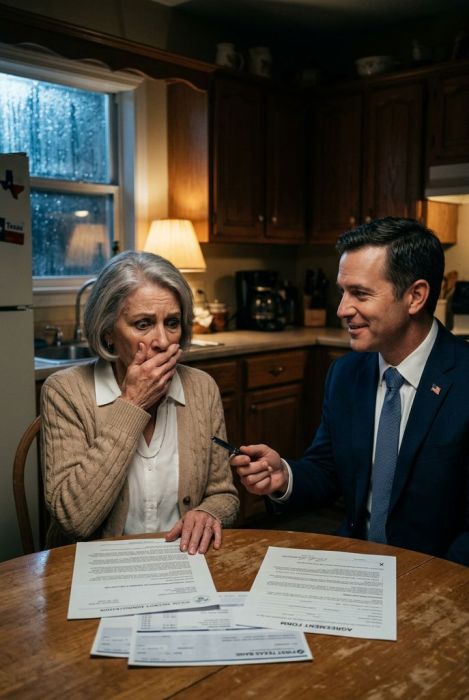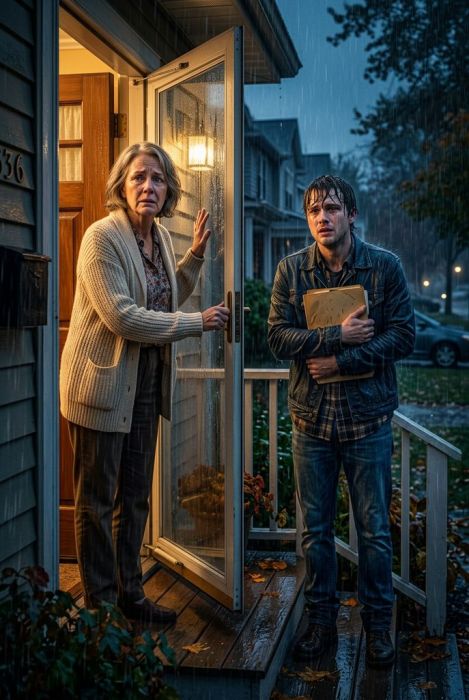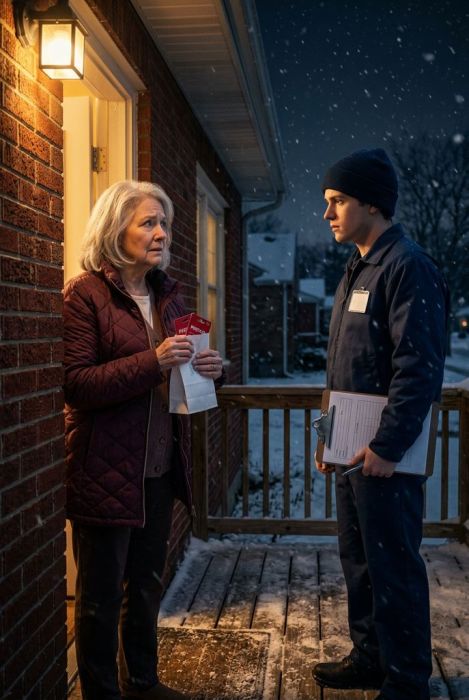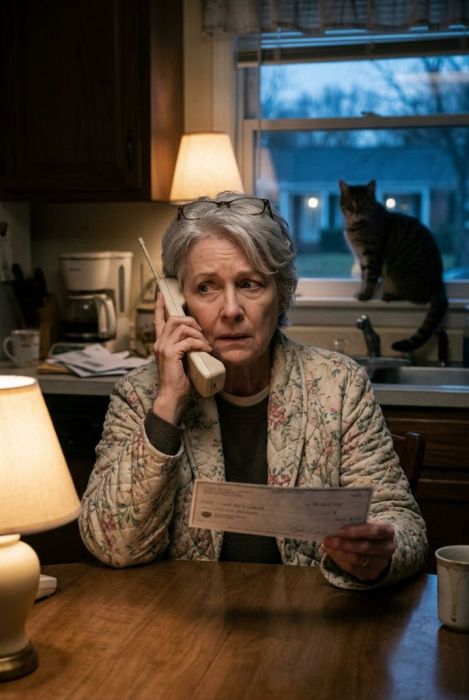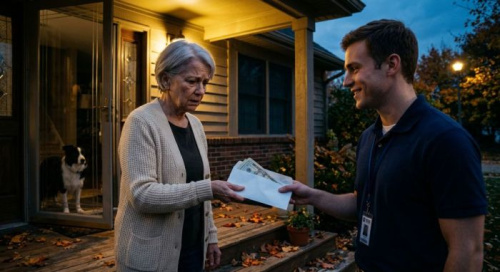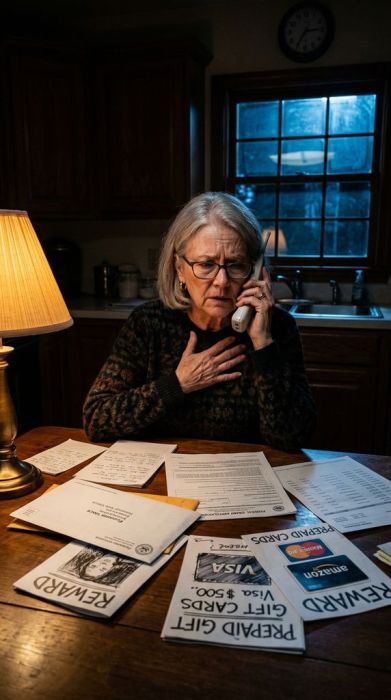
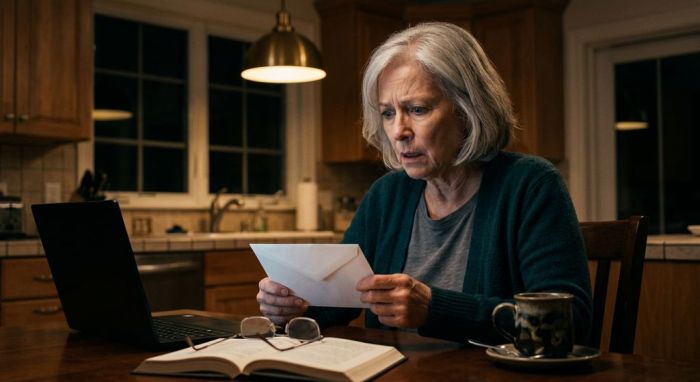
The envelope had no return address, which should have been the first sign that Eleanor Vance should have thrown it away. Instead she opened it at the kitchen counter, one hand still wrapped around a mug of coffee gone cold an hour earlier, because the words inside did not make sense. "We have received a tax return filed using your name and Social Security number," the letter said. "Our records indicate your refund has already been issued to an account ending in 8817." Eleanor had never opened an account ending in 8817 in her life.
She read it three times, then four. The kitchen tilted a little, the way it had on the morning of her husband Don's funeral. She caught the edge of the counter and told herself to breathe. This is what happens to other people, she thought. This is the story you read in the AARP bulletin and thank God it's not you. By the time her daughter Mara called that evening, Eleanor had already left two messages at the office of Whitlock Tax & Accounting, and the familiar, folksy voice on the answering machine had promised, in that warm Oklahoma drawl, that her refund would be sorted out shortly.
Gerry Whitlock had been Eleanor's accountant for twenty-seven years. He had done Don's taxes before she ever met him, and he had done hers through three career moves, two mortgages, and one devastating widowhood. When Don's heart gave out on a Tuesday in April, it was Gerry who drove to the funeral home with a thermos of coffee and a folder full of documents no one had asked for yet. "You don't have to think about a single number tonight, sweetheart," he had told her, patting her hand. "That's what I'm here for." In the years that followed, that folder had grown fat with her life — her pension statements, her Social Security letters, the records of her late husband's life insurance, the little IRA he had left her so she would never worry.
That was the thing about trusting someone with your numbers. It wasn't really about the numbers at all. It was about handing them the keys to your life and believing, with your whole heart, that they would keep them safe.
Mara, who was a nurse at Buffalo General and had a way of seeing bad intentions with equal clarity, was the one who first raised an eyebrow. "Mom, did you actually read the letter? Or did you just call Gerry to make it go away?" Eleanor bristled. "I read it. I just don't understand it." "Exactly," Mara said. "That's why we're going to read it together. Out loud." Eleanor loved her daughter, but there were mornings she loved her less, and this was shaping up to be one of them.
The letter was the standard IRS identity-theft notice, and translated, it said this: someone had filed a tax return in Eleanor Vance's name before she had filed her own. The fraudulent return had claimed her refund. The IRS, unaware that it was dealing with a stranger wearing Eleanor's name, had dutifully paid the money into an account the stranger controlled. The notice told her to call a number, file a form, and wait. "See?" Eleanor said, the relief practically leaking through the phone. "Gerry will handle the form. He'll fix it. He always fixes it." Mara did not say what she was thinking. She had learned, after thirty-eight years of a mother who gave everyone the benefit of the doubt, that some arguments were better left for the car ride home.
Two weeks passed. Gerry fixed the form and told her not to worry, and Eleanor tried very hard to do exactly that. But the world kept sending her little bills. A collection agency sent a letter about a credit card she had never opened, with a balance of nearly four thousand dollars. Her bank called about an unusual automatic payment set up from her checking account to an online retailer she had never heard of. And when she tried to switch her auto insurance to the cheaper company her friend Betty recommended, the agent's voice changed. "Ma'am, there seems to be a problem with your credit file. I can't pull your score at this time." Eleanor hung up and stood in her hallway, paralyzed, as if the walls themselves were watching.
She did what she had done every spring for nearly three decades: she drove to the strip mall on Transit Road and walked into Whitlock Tax & Accounting. But this time, the office felt different. The receptionist who had known her by name for years was gone, replaced by a young man with a headset who barely looked up. Gerry's door was closed, and when he finally came out, his smile did not reach his eyes. "Now, Eleanor, you're letting this thing spin you up," he said, guiding her toward the door with one hand on her elbow. "These identity thieves, they prey on ladies like you. It's a mess, but it's the IRS's mess, not yours. Go home. Have a cup of tea." She almost went. She had her hand on the door when something made her turn back. "Gerry," she said, "how did they get my information? Everything they used was exact. My pension. My interest. My deductions." He laughed, a little too loud. "Honey, that stuff's online everywhere. You'd be surprised what they can find." Eleanor nodded and walked out, and for the first time in twenty-seven years, she did not feel safe walking out of that office.
Mara made the call that Eleanor was too proud to make. She dialed the IRS Taxpayer Advocate Service — the number that is supposed to sound scary and is, in fact, the closest thing ordinary people have to a knight in shining armor — and she got Rosalind Hartman. Rosalind was a woman in her fifties with a voice like gravel and a desk covered in manila folders, the kind of public servant who had seen every scam the human mind could invent and had learned to be surprised by none of them. "Let me pull your account," she said, and within forty seconds the puzzlement in her voice had gone flat. "Ms. Vance, I'm going to show you something. Not because I'm allowed to, but because you deserve to see it."
The transcript Rosalind printed out was a single page, but it changed everything. The fraudulent return, it turned out, had not been filed from some hacker's laptop in a foreign country. It had been e-filed from a business internet connection in Amherst, New York. The IP address belonged to the strip mall on Transit Road. And the refund — Eleanor's refund, her hard-earned money — had been deposited into a savings account at Heartland Credit Union in the name of one Gerald Whitlock, Junior.
Eleanor did not cry. That was the strange part. She sat very still, the way she had sat when the doctor used the words "widow maker" to describe the blockage in Don's heart, and she listened to Rosalind explain the rest. The nephew's account was a decoy. The nephew, a nineteen-year-old kid who worked at the office in the summers and thought he was helping his uncle with a "client reserve fund," had signed the paperwork without reading it. And the uncle — Gerry Whitlock, her friend, her rock, the man who had held her hand at the funeral — had been running the same play for years. The IRS had flagged eleven other returns with the same deposit account, all belonging to elderly clients of the same small accounting firm. Eleven widows and retirees, their refunds quietly diverted, their identities added to credit card applications, their files kept in a drawer only Gerry could open.
The gambling debt explained it, Rosalind said, though she wasn't supposed to speculate. Twelve years of casino visits, three failed business ventures, a wife who had left him, a mortgage he was drowning in. Desperation had eaten the kindness in him the way moths eat wool. Eleanor listened, and she understood, and understanding made it worse, because you cannot hate a man you have watched weep at your husband's funeral. You can only sit with the betrayal and wait for it to calcify.
The federal building in downtown Buffalo was colder than she expected, all gray stone and echoing footsteps, and the elevator ride to the fourth floor felt like the longest of her life. Special Agent Patricia Fuentes of the IRS Criminal Investigation division met them in the hallway — Mara had insisted on coming, and Eleanor had not had the strength to say no. "He knows you're here," Fuentes said, not unkindly. "He asked for you. I want you to know that before we go in." Eleanor looked at her daughter, and Mara looked back, and neither of them said a word, because there are no words for the moment you are about to look into the eyes of the man who taught you what trust means and see the stranger who lived inside him all along.
The interview room was beige and windowless, with a table bolted to the floor and a camera blinking in the corner. Gerry sat with his hands folded, older than she remembered, his hair grayer, his smile gone. When Eleanor walked in, he started to stand, then stopped, as if the handcuffs had only just reminded him of the shape of his life now. "Eleanor," he said, and his voice cracked, and for one terrible moment she almost reached for him.
"Don't," Fuentes said quietly. "Let him tell you himself."
And Gerry told her. In a voice that grew smaller with every sentence, he told her about the first time — how it had started, he swore, by accident, how he'd needed seven thousand dollars in a week or lose the office, and how an elderly client's refund had been an unguarded door. Then the second time, which was easier. Then the third. "I told myself I was only borrowing," he whispered. "I told myself they could afford it. I told myself a hundred lies until I stopped hearing the difference between the lies and the truth." Eleanor sat across from him with the same posture she had held in that funeral home fourteen years ago, and she heard every word, and when he finished she said the only thing she could say. "You were the one who told me I never had to worry. You said that to me on the worst day of my life." Gerry closed his eyes. "I know," he said. "I know."
He pleaded guilty to eleven counts of wire fraud and aggravated identity theft. The sentencing took place in the same federal courthouse, four months later, on a windy October morning. Eleanor sat in the third row, between Mara and Rosalind, because the Taxpayer Advocate had asked to be there and because, against every instinct, Eleanor had said yes. The judge spoke about breach of trust, about vulnerable citizens, about the eleven families who had placed their futures in a man's sweaty hands. Gerry received eight years. Eleanor did not applaud, but she did not look away, and when the marshals led him out, she finally let herself cry — not for the money, not even for the betrayal, but for the fourteen years she had spent with a friend who had never really been there.
In the end, the law gave Eleanor something she had not expected. The IRS restored her refund. Her credit was repaired, slowly, the fraudulent accounts erased like pencil marks. And Rosalind gave her a stack of forms with a strange, almost tender instruction: "Every year, in April, you're going to request your tax transcript and read every line. It'll take seven minutes. It's the cheapest insurance you'll ever buy." Eleanor, who had spent her whole life trusting other people to read the fine print for her, began to read everything. Her bank statements. Her bills. The terms and conditions she had been clicking past for forty years.
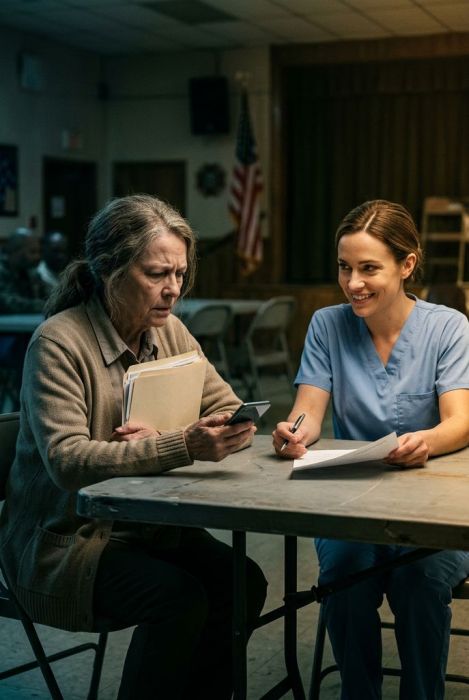
That winter, she started a twice-monthly workshop at the senior center on Delaware Avenue. She called it "Know Your Numbers," and she taught the same eleven things Rosalind had taught her: get an Identity Protection PIN from the IRS, sign up for alerts at the credit bureaus, never sign a blank form, never let a single person hold all the keys to your financial life, and above all — read the mail, even the scary letters, even the ones with no return address. Some of her students cried. Others took notes. And every one of them said the same thing she had said, the first time the IRS letter found her: "I never thought this could happen to me."
Eleanor always smiled at that. Because the truth she had learned, the one she now told them at the end of every class, was simpler and harder to hear than any scam warning. It could happen to anyone. It had happened to her, in the very office where she had always felt safest, at the hands of the very man she had trusted most. Trust is not a crime, she would say, and every room went silent. But handing someone the keys to your life without ever looking at the locks — that is the mistake. You don't stop trusting. You just start reading.