The two plainclothes officers reached the porch of the blue colonial house on Hawthorne Street at 6:47 on a Tuesday morning, and the moment Eleanor Rosen saw their faces through the frost on the front glass, she understood, with a cold settle in her stomach, that her nine days of private dread had all been leading to this exact second. The officer, a tall Black woman with a gentle voice and eyes that had seen a thousand front doors, studied the paper in her hand and said the name like a door she had already opened. You are Eleanor Rosen, she read aloud, her tone carrying no accusation and no warmth. We need to speak with you regarding a bank account opened in your name across state lines in Virginia.
Ellie's hand drifted to the kitchen counter and stayed there, because her legs would not move her any farther. She had not driven herself anywhere except the pharmacy in eleven days. She had not answered the phone. She had barely left the small colonial house on Hawthorne Street that she and her late husband, Paul, had bought the same week their only child started kindergarten. For thirty years this house had wrapped itself around her like a favorite cardigan, and now, with the officers standing in the morning light, she felt the seams of it open beneath her.
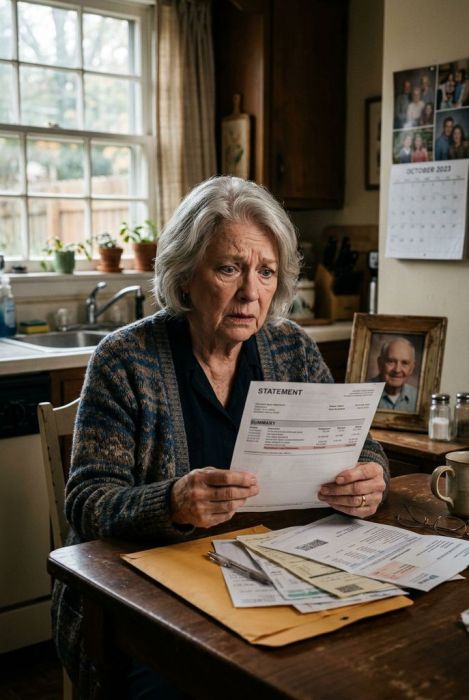
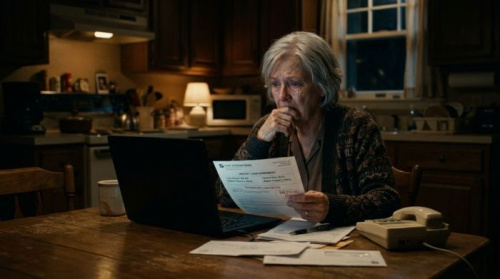
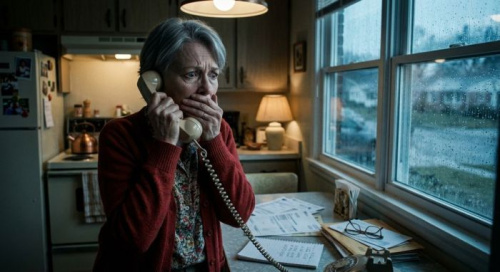
The trouble had started, as most ordinary disasters do, with a quiet Saturday and a cup of coffee going cold on the kitchen table. Her debit card had failed her at the Piggly Wiggly checkout the afternoon before; the little screen had flashed a red decline that felt strangely personal, and the cashier had looked at her with a pity that stung worse than the rejected amount. She had forty-three dollars in her checking account, and when she had called the number printed on the back of the card with her usual coal-shaped patience, the recorded voice told her something that turned her stomach to ice. Your card has been disabled, the recording said, due to suspicious activity. To verify, press one. And she pressed one, and explained her whole afternoon to a claim off about a team, and twenty minutes later she hung up the phone no less confused than she had been before she dialed.
Paul had always handled the money. That was the unspoken architecture of their marriage, the quiet contract she had trusted for thirty-seven years without a second thought. He had paid the car payment, the insurance, the funneature of bills that arrive monthly like weather. When he died of a heart attack in the parking lot of a Lowe's, the shirt he was buying for their Sunday dinner still folded in the fire, he left behind not just forty years of garage impulse and a hundred stamped envelopes, but also a woman who knew how to teach fourth graders the difference between a noun and a verb, and who knew dangerously little about the difference between a legitimate login and a trap. The bank, Martinelli & Seldon, a modest regional institution with two Hudson branch offices and a savings commitment to its aging-adjacent customers, had sent her a packet of forms after the funeral, and she had filed them in the wooden file drawer where Paul kept the receipts, and she had not looked at them again.
That gray, early-April Saturday morning, it is snowing the small town and her card goes the pointless way, she decided, with what she would later describe as the worst-flattered resolve of her life, to fix the problem on her own. She wanted to be the adult in her own life, to finally understand the number that had been dictated to her like an oath she never learned. She pushed her reading glasses up the bridge of her nose, typed Martinelli into the search bar of her borrowed neighbor's laptop, and clicked the topmost link with the small green Ad label beside it, because it looked neat and polished and exactly like the thing she had been taught to trust.
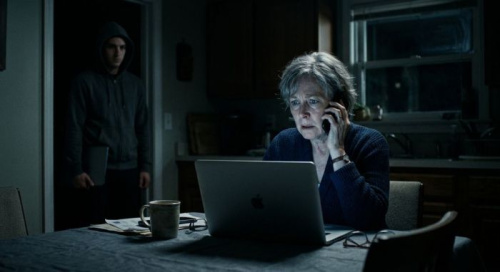
The man who answered her ringing call on the second ring presented himself as Trevor Blake, a senior security specialist for Martinelli, and his voice had the calm wood of a man who says this exact sentence eighty times a day. Before she could even say good morning, he told her not to worry, that her card had been disabled as a protective action because an unauthorized purchase attempt had been flagged in another state, and that he had already begun the process of restoring her access. He had a professional grip in his tone, warm and a hyphen border between reassuring and condescending, and Ellie, who had raised a daughter and taught over a thousand faces, recognized in him the specific voice of a man who had been trained to seem like he had no predatory intention at all. And him, her gratitude carried a shame she never fully named.
In the forty-eight minutes that followed, Trevor Blake walked Ellie through what she would later describe to officers as the most persuasive building of trust she had ever witnessed her whole life. He asked her to confirm her name, her address, the last four digits of her debit card, and the last four of her Social Security, each ask phrased correct and measured, the questions designed to feel routine rather than invasive. He told her that for her own protection she would receive a six-digit code on her phone, and asked her to read it back to him so he could confirm a live active session, and she did, because the code had arrived on her phone just as he had promised and because in that moment it felt like a miracle of civilization that a stranger could help her so efficiently. He then told her that the scammers who had tried her account had somehow breached into her records, and recommended she temporarily move her available balance to a newly opened safe savings account.
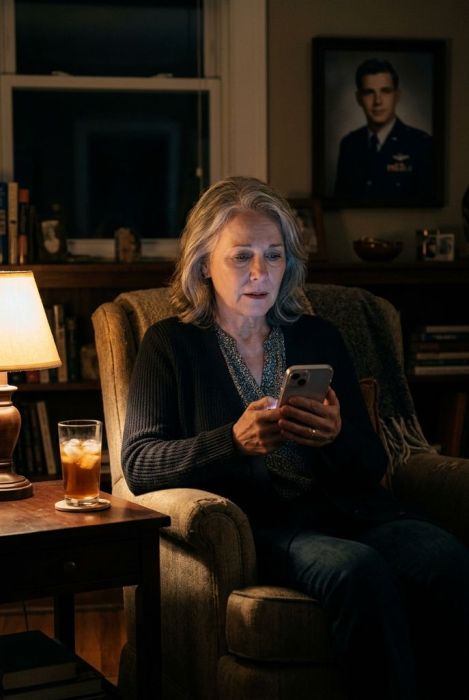
She should have said no. She would spend weeks believing that a smarter woman would have hung up, would have checked the actual number on the card, would have driven the twenty minutes to the branch office. But the branch office was closed on holidays and weekends and Trevor Blake never raised his voice, and he had used her own phone every step of the way, the codes arriving like a handshake, and by the time she hung up, she was more grateful than suspicious. She even told Paul, out loud, into the quiet of the empty house, as if he could hear her across the great arithmetic of the grave: I think I finally learned something, honey. I took care of it myself.
He was not a savior. Trevor Blake was the hundreds with a fake name and a scripted calm. The code she had read to him was the one code that should never have left her lips, a six-digit door into the emergency course of her whole digital life. He did not spend half her balance all at once, the way she imagined a thief does, the sudden blunt. He opened a new account in her name under her own signature, routed the available balance from her savings through a chain of shell, and then, in the careless final step of a scam barely touched by a guard, he used her name and her soft, exhausted trust to open a small checking account at a different institution in Virginia, which appeared overnight as three wire deposits arriving and leaving in the space of two days, passing through her name and flowing somewhere unlisted.
The destruction was not loud. It was bookkeeping. It was little green flags and transaction lines. The stranger who had unlocked her card had not taken her; he had washed money through her, and in doing so he had forged her a set of documents that would catch up with her at six forty-seven.
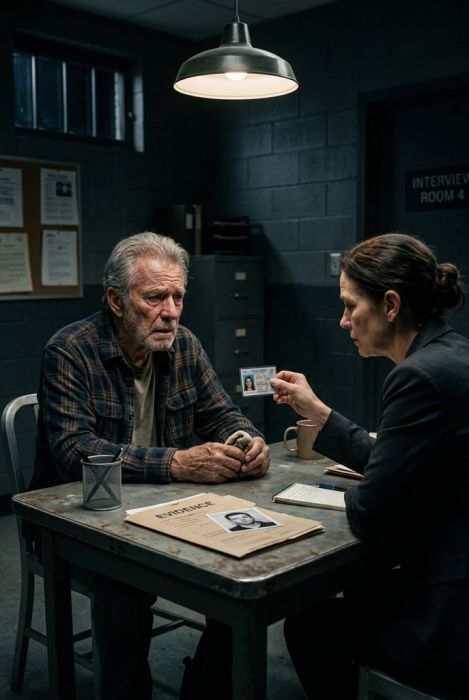
They found her at the cafe the money went silent, and it was the grief counselor at the senior center, poor Ms. Aguirre, who was the first person to say, in a voice meant to be gentle, that the local layer would ask about the Virginia account. The warrant at her door was not and not for the small fraud. The detective, Layla Hartfield, woman in a dark suit who did national and international tracking for the cybercrime unit based out of Richmond, told her in the kitchen that the account had been flagged as a mule account connected to a multimillion fraud, and that the electronic trail dead-ended in her name.
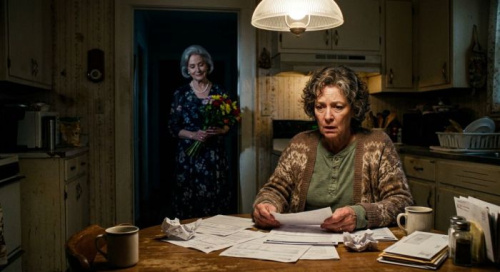
Ellie sat at the kitchen table while they took their notes, and the trembling traveled from her hand to the floorboards. She wanted to explain that she was not a criminal, that she was a retired fourth-grade teacher whose late husband used to handle the check register, that she had done exactly what the voice on the phone told her because she believed with her whole heart that the man on the phone was from her bank. She had no idea how to prove who she was to a stranger who was also proof. It was the great terrible irony of the whole afternoon: her entire life, her good name, her half-century of harm-free citizenship, had been hostage not by violence but by a phone call.
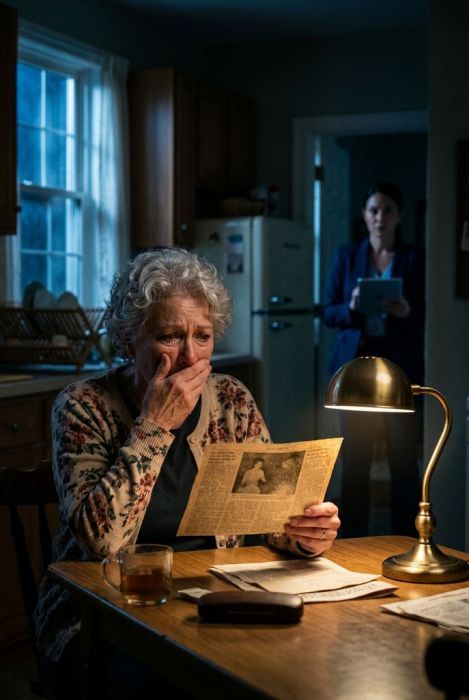
Over the next week, the weight of the accusation pressed down on her like a low ceiling, and it was her granddaughter, Nora, who finally understood. Nora was twenty-two, a cybersecurity student at the community college, with a crooked smile and a patience to never once let into her grandmother's shaky digital frontier. When Ellie finally told her, through tears and the whisper of shame, about the weekend of the transfer, Nora did not scold her or tell her she should have known. She typed in her own phone, did fifteen minutes of quiet work, and came back to the kitchen holding the smoking gun that would save them both: the blue ad her grandmother had clicked was a paid search result, purchased and publish as if it were the bank's own help line, and the domain behind it was registered in a country Ellie had no map for.
That was the moment the case changed, Nora reports the address and the URL to the detective, and with the Chicago investigator dug deep and found not just one old woman but a trail of them, a purchase of search results that had pointed a dozen elderly customers to a network of fake help lines on a Thursday afternoon. The same calm, smooth voice of Trevor Blake had answered for banks in three other districts. Within six weeks, the man behind the fake line, a twenty-six-year-old in another state whose script had been scripted to sound soothing, and who had never once looked at the women he had done this to, was arrested. The charges leveled against Ellie the wide laundering, the warrant that had walked, the dark was withdrawn, the records expunged.
But the money was gone. The forty-eight dollars of balance she had wanted to save, moved through her old account and out the other side, drained. And the deeper wound, the one that no warrant could leave behind, was the shame that gripped her every time she had to hold on to explain to a bank teller, to a bank manager, to a social worker with a clipboard, why that old card had been frozen. Some institutions never look you the same way.
The lesson was not that she should have known. The lesson, she would tell the small circle of her closest widowed friends a month later, as they sat on the church lawn, was about silence and speed. The scammers do not target the naive; they target the ones who will hesitate. They own a face of calm and a normal voice, and they use your own phone, your own name, your own trembling obligation to a single job, and by the time you understand what the clean buttons on the phone could have done, the account is already gone.
Now, when her phone vibrates with a text on a Saturday morning, whether from a bank or a government office or a stranger claiming to have accidentally sent money, Ellie Rosen pauses. She looks at her new card, stands, goes to the window, and picks up both hands. She does not call the number. She visits the branch. She speaks to a real human where the light overhead is warm and the person across from her has a badge and a downside. And at her own kitchen table that autumn, she tells the small classes of women, many of them her own age, the part she will never forget: The bank will never ask for the code that landed on your phone. The one the goon tells you to read back to him is the same one that will open the door to everything you have worked sixty years to build.