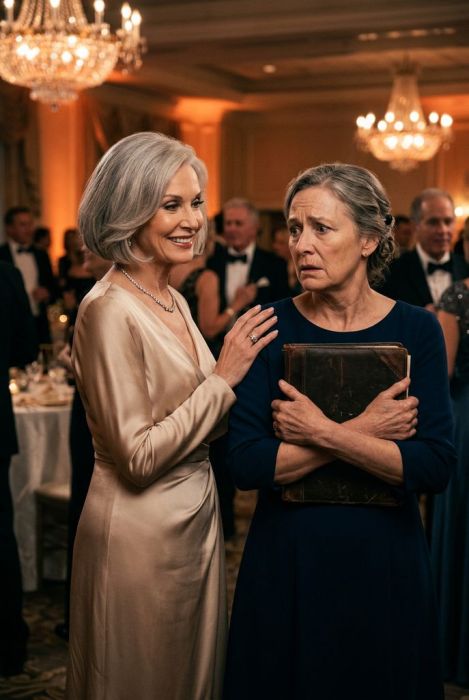
The first time Ruby Castellan laid eyes on Dale Whitfield, he was standing in the third row of folding chairs at her husband's memorial service, the only man in civilian clothes with no visible reason to be there. Tom had been gone twelve days. The honor guard had folded the flag, and Ruby was still holding the blue triangle against her chest like a shield, unable to let it go. When the crowd finally thinned, Dale approached her with a soft handshake and a lowered voice. "Ma'am, I served in the same battalion as your husband. Fort Hood, 2004. I owe SFC Castellan a debt I never got the chance to repay."
Ruby Castellan was seventy-one years old. She had spent forty-five years cutting hair at the Curl Up and Dye on Pat Booker Road, and she knew exactly how to read a face in a mirror. She read Dale's face that afternoon and saw only kindness: the laugh lines, the crinkled eyes, the way he swallowed before he mentioned Tom's name, like it hurt him. He told her he worked as an independent veterans benefits consultant. He told her he never charged widows. He told her Tom had talked about her on deployment, how she had sent care packages every single month for fifteen years. It was a detail Tom would never have shared with a stranger. Ruby did not know that yet.
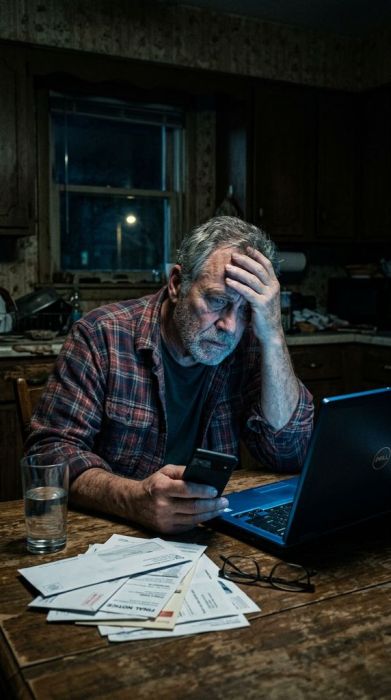
Tom had handled everything official in their marriage — the taxes, the insurance, the folders full of Army paperwork. When he died of a heart attack on a Tuesday morning in March, checking the mail like he had for nineteen years at that house in Converse, he left behind envelopes Ruby could not make herself open. The VA had sent forms she did not understand, in language that felt like another country. Her daughter Beth, a paralegal in Dallas, had offered to come down and sort through them. But Beth had twin toddlers and a husband who traveled, and Ruby had told her not to bother. "I'll figure it out, sweetheart," she had said. "I always do."
It was Eddie Marsh, Tom's best friend of fifty years and the commander of VFW Post 4423 on Culebra Road, who vouched for Dale Whitfield. "He's been helping our Gold Star families for two years now," Eddie said, handing Ruby a card with a gold embossed eagle. "He doesn't ask for a dime, Ruby. He just shows up. That's the kind of man he is." Ruby put the card in her coat pocket and forgot about it. But a week later, Dale appeared at the post's Saturday pancake breakfast with a tray of kolaches and a stack of VA brochures, and he sat down across from Ruby without being asked.
"I looked into your husband's file," he said quietly, and Ruby felt her chest tighten. "There's money sitting on the table that's been there since March, Miss Ruby. Dependency and Indemnity Compensation, a survivor's pension, even a bit of aid and attendance you may qualify for on account of your knee." He pushed his reading glasses up and smiled. "Your Tom would want you comfortable. Let me do the paperwork for you. Free of charge." When Beth called that night, Ruby told her about the kind man from the VFW, and Beth's voice changed. "Mom, nobody does VA claims for free," she said. "They get paid by the government, or they get paid by you. Which one is he?" Ruby laughed and told Beth she was cynical. "He's a veteran, baby. He served with your daddy."
Beth had asked the question that mattered, and Ruby had answered it with her heart. That was the whole trick of it. Dale Whitfield never needed to be an expert in the law. He only needed to be an expert in grief.
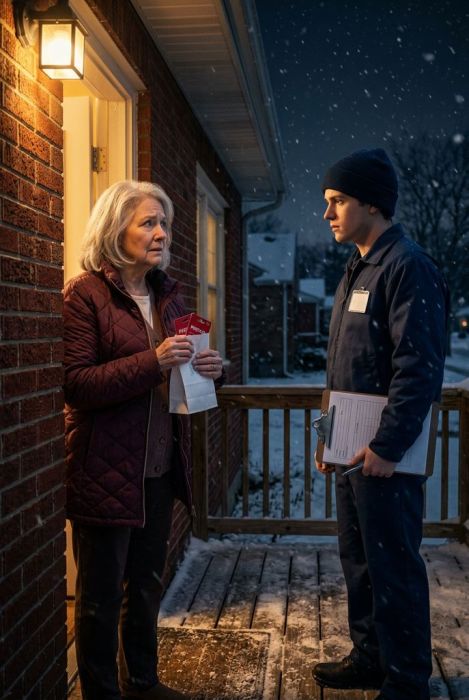
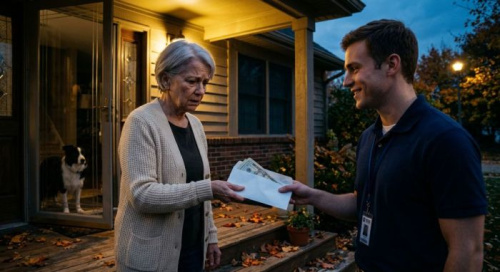
Over the next month, Dale became a fixture in Ruby's kitchen. He would arrive at ten with donuts and leave at noon with a stack of paperwork under his arm. He asked about Tom's childhood, his unit, his buddies — and Ruby, hungry to talk about the man she had loved for fifty years, told him everything. It never occurred to her that the questions were also answers, that every story she shared was a piece of a puzzle Dale was assembling in a spiral notebook. By the fourth week, he had her Social Security number "so we can check the file," her bank's name "for the pension direct deposit," and a signed medical release "so the VA can verify your knee."
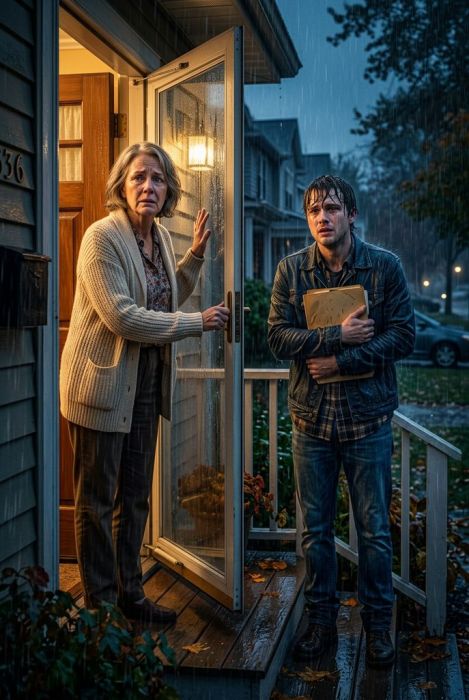
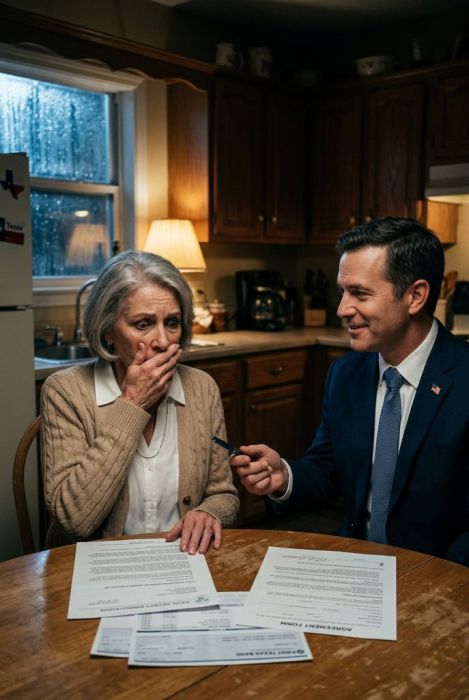
And then, one night in September, Dale brought her a stack of forms with yellow sticky notes on every page. "The VA just needs your signature in these four places, Miss Ruby. It's the release they require so I'm allowed to represent you." Ruby's reading glasses were on the nightstand, and the print was small, and Dale was in a hurry because his daughter had a soccer game. So she signed where the sticky notes pointed, four times, with the kind of trust you give a friend who has never once let you down. One of those forms, Ruby would later learn, was not a release at all. It was a request to appoint a fiduciary to manage her benefits because she was — the form said — "unable to manage her own financial affairs due to advancing dementia." Dale had typed that sentence himself. His wife Nicole had signed it as the notary.
The back pay hit her account three weeks later. More than nine thousand dollars, enough to fix the water heater and finally replace the old carpet. Ruby cried at her kitchen table. She called Dale, and he told her this was only the beginning. "There's a full survivor's pension coming, and back pay on that too. We're going to get you right, Miss Ruby." She paid him two hundred dollars in cash for his "printing and postage costs," and he tried not to smile too fast. When Beth called and asked why her mother's account suddenly had money, Ruby said Dale had worked a miracle. Beth said no miracle in her life had ever required her mother's bank to share her mother's business.
The miracle lasted six weeks.
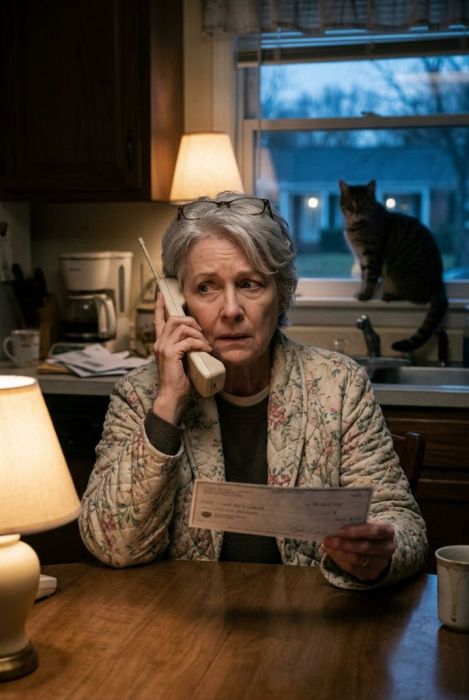
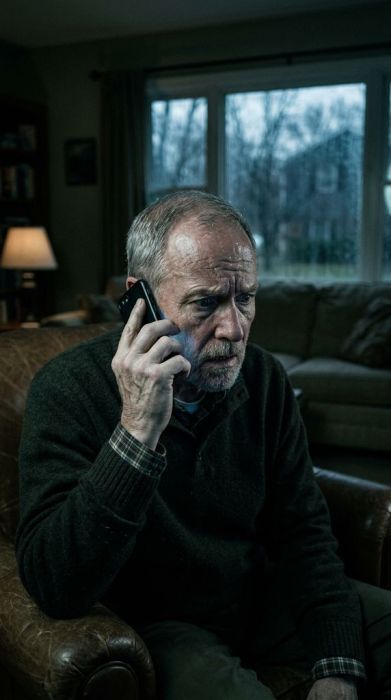
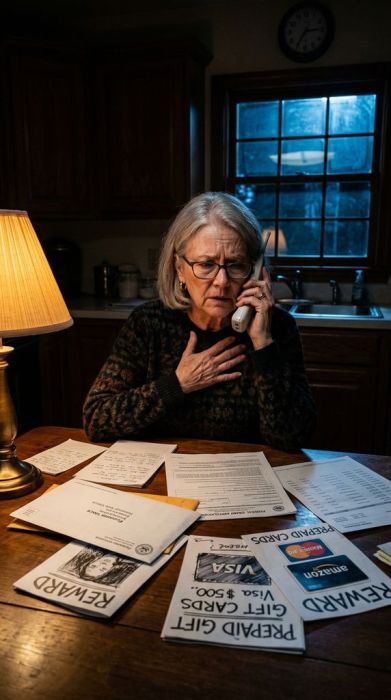
It was a Tuesday, just after nine in the morning, when Ruby's phone rang with a number she did not recognize and an area code she did: 512, Austin, the VA regional office. The woman on the line was brisk and official. She said her name was Ms. Hartley, and she needed to verify a change of fiduciary on file for Castellan, Thomas A. "I'm sorry," Ruby said, gripping the counter. "A what?" Ms. Hartley spelled the word, then read back the name of the appointed fiduciary. Ruby nearly dropped the phone. "I never appointed anybody," she said. "I never signed anything like that." The woman went quiet for a moment. "Ma'am, we have a signed, notarized form with your name on it. You should talk to our Office of Inspector General." Ruby hung up and called Dale with shaking hands.
"It's a mix-up, Miss Ruby," he said, his voice butter-smooth. "They do audits on new fiduciaries all the time. I'll drive up to Austin tomorrow and straighten it out. Don't worry your head about it." That night, her phone pinged with a bank alert. The automatic deposit that had arrived every month since April — four hundred and sixty dollars of Tom's small life insurance payout, the only check she still counted on — had been stopped, pending "verification of account ownership." Ruby called the bank in the morning. The young manager was gentle but firm. "Mrs. Castellan, we received a power of attorney notice yesterday from a Mr. D. Whitfield. That's why we froze the account." Ruby stood in her kitchen with the phone to her ear and understood, in a slow, falling way, that the man who had brought her donuts had her house key now.
Ruby was still standing there when someone knocked at the door. Through the window she saw a woman in a dark blazer and thought, for one dizzy second, that it was Dale. It was not Dale. The woman flashed a badge and said, "Special Agent Dana Reeves, Department of Veterans Affairs, Office of Inspector General. Mrs. Castellan, may I come in?"
Special Agent Reeves was fifty-two, a retired Army first sergeant from El Paso, with graying hair cut short and the patience of someone who had watched a lot of people lie. She asked Ruby one favor: "Before you call him again, listen." She played a recording from a previous case — a widow in Oklahoma, then a widow in Arkansas, then a widow in New Mexico. Each recording contained the same sentence, delivered with the same practiced tenderness: "I served in the same battalion as your husband. I owe him a debt I never got the chance to repay." Ruby listened to herself in other women's voices and felt the floor tilt. "He's your man," Agent Reeves said. "His name is Gerald Pemberton. He's the current fiduciary for four widows in three states, and he gave that exact speech to every one of them."
The forgery expert recovered something worse from the binder Dale had left in Ruby's guest room. Three of the pages he had claimed were "VA releases" had been blank when Ruby signed them — the sticky notes had covered not words, but empty lines. The real text had been printed afterward, on a home printer in San Antonio. The notary stamp had been pressed by Nicole Pemberton in a kitchen that smelled like vanilla candles. And the alleged dementia diagnosis had been typed by a man who had never once examined Ruby, by a woman who had never once met her.
The arrest happened on Veterans Day, at Post 4423, in front of seventy people who all believed the same thing Ruby had believed.
Dale — Gerald — had been asked to accept a community service award, a plaque honoring two years of "tireless work on behalf of our veterans and their families." Eddie Marsh was beaming at the podium. Dale was beaming back. Ruby sat in the third row, the same row where she had first seen him, holding the folded flag so tightly her knuckles were white. When Eddie called his name, everyone stood. Ruby stayed in her seat. Dale reached for the plaque with both hands, and that was when the door opened, and Special Agent Reeves walked in with two uniformed officers from the Bexar County Sheriff's Office.
The room did not understand at first. There was a moment, a horrible, suspended moment, where people thought it was a ceremony within a ceremony. Then Agent Reeves said, clearly enough for the back tables, "Mr. Pemberton, you're under arrest for wire fraud, identity theft, and elder financial exploitation." Dale's smile did not crack. "This is a misunderstanding," he said to the room, and his voice was the same smooth voice that had said, "I never charge widows." Agent Reeves answered him with a single sentence that landed like a rifle shot: "You've never served a day in your life, Mr. Pemberton." Eddie Marsh dropped the plaque. The applause died. Somewhere in the back, a man Ruby had watched laugh at every pancake breakfast for a decade quietly folded his napkin and left.
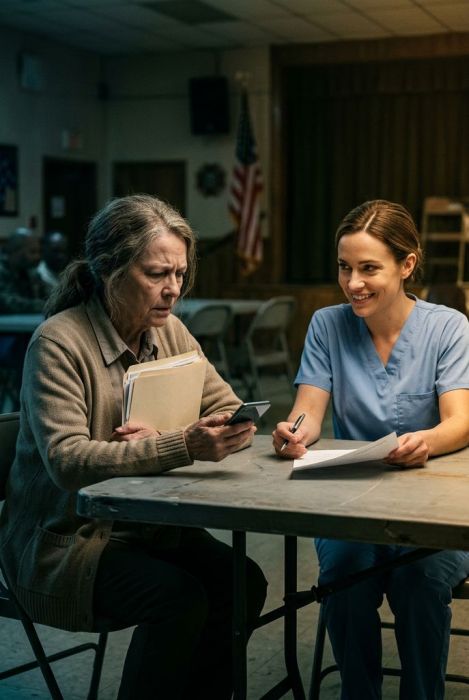
Ruby did not feel triumphant. She felt stupid, and then she felt angry, and then she felt something worse, which was the weight of every lonely night she had spent making coffee for a man who was writing down what she said. Dale had not only taken her money. He had taken her memory of grief and used it against her. She told that to Gwen Ortiz, months later, in a fluorescent-lit office above a printer shop, and Gwen Ortiz nodded like she had heard it a hundred times. Gwen was a service officer for the Disabled American Veterans, one of the good ones. She pulled out a single form. "This is the only piece of paper you will ever need," she said. "The DAV files it for free. The VFW files it for free. The American Legion files it for free. Anybody who charges you to talk to the government on your behalf is selling you the door you were already standing in front of."
It took eight months to undo what Gerald Pemberton had done. Because he had forged a fiduciary order, every benefit payment that went to him for those six weeks had to be traced, documented, and testified to. Ruby's savings came back in pieces, some of it from a federal restitution fund, some of it never. Tom's life insurance check resumed, and the bank manager who had frozen her account personally drove to her house to apologize, which she did not ask him to do. The VA assigned her daughter Beth as her fiduciary — a formality the case file required — and Beth flew in from Dallas and sat in Ruby's kitchen and said, "I told you, Mom." She did not say it meanly. She said it the way a daughter says it after nine months of being right and no satisfaction in it.
Gerald Pemberton pleaded guilty in federal court. His sentence was seven years and a public restitution order, and the prosecutor read into the record the names of all five women — Ruby, and the widow in Oklahoma, and the widow in Arkansas, and the widow in New Mexico, and one more who had signed a blank page in Missouri and died before her money was returned. Ruby did not attend the sentencing. She read about it in the newspaper over a cup of coffee that tasted like the ones she used to pour for a man who had never once refilled the pot.
Ruby still goes to the VFW, but only for the honor guard, and only when they stand for Tom. She keeps the folded flag on her dresser, and tucked beneath it, the card Gwen Ortiz gave her with the DAV's real number on it. "The real ones give you a government building," Gwen told her once. "The fake ones give you a contract." Ruby repeats that sentence to the new widow at church, the one whose husband died in November, because it is the only wisdom she owns that she cannot give away. She says it plainly, without drama, the way you pass along a recipe that cost too much to learn. And then she adds the part that cost her everything: "If a stranger knows your family's name, ask him how. If he never rolls up his sleeve, ask him why. And if he tells you to sign where the sticky note points, read the page. Every page. Especially the one that says you're not yourself anymore."