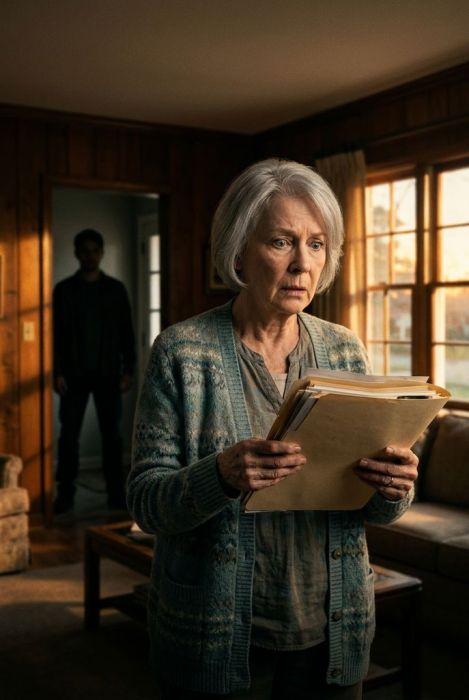
Florence Whitaker was drying the last of the breakfast dishes when the phone rang, and for one foolish second her heart lifted, because for forty-two years her husband Harold had called at nine forty-five every morning just to hear her voice. Harold had been dead for thirteen months now, and the silence in her little Columbus kitchen was still too loud.
The voice on the other end was warm and bright, younger than her own. "Mrs. Whitaker? My name is Dana, calling from the Sunrise Children's Fund. I hope I'm not catching you at a bad time."
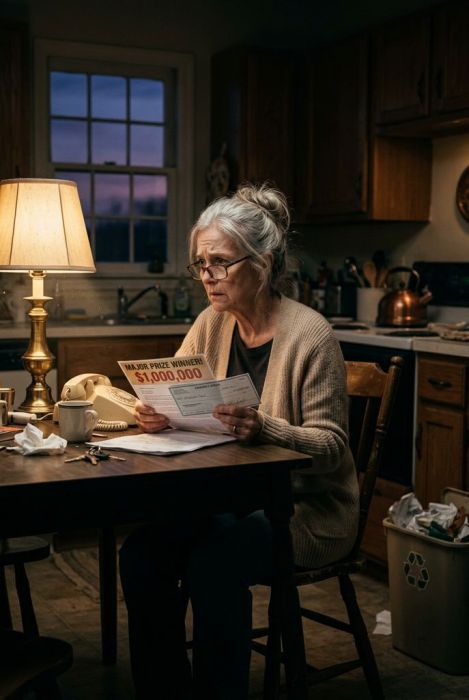
Florence should have hung up. The evening news had warned her a dozen times about phone scams, about lonely old people who gave away their life savings to strangers with honeyed voices. But Dana did not ask for money. Dana asked about her garden, about the peonies Harold had planted the spring before he died, about whether they had come up well this year. By the time Florence hung up twenty minutes later, she had told a complete stranger the story of her wedding ring, her late husband's favorite song, and the exact morning he had been diagnosed.
It was the loneliness that did it. That was what the detectives would say later, with the flat clinical certainty that made her feel like a specimen under glass. Florence had never thought of herself as lonely. She had her church, her bridge club, her neighbors who waved from their porches. But the empty space Harold had left behind was a different kind of silence, and Dana's voice filled it the way afternoon light filled a cold room.
The second call came the following week. This time Dana spoke of a little girl named Sophie who needed a heart transplant, a child whose mother cried herself to sleep every night. "We only need sixty more dollars," Dana said softly. "I know it's a lot to ask."
Sixty dollars. Florence could manage sixty dollars. She read her credit card number slowly over the phone, and Dana thanked her as though she had just saved Sophie's life with her own two hands.
The donations grew the way a garden grows, small at first and then unstoppable. Fifty dollars became two hundred. Two hundred became a sponsorship package for an entire ward, more than a thousand dollars, and Dana mailed her a framed certificate that Florence hung on the wall beside Harold's photograph. She began to feel important again, as if her money were stitching a net beneath children she would never meet.
Kevin called her on a Sunday, out of the blue, which in itself was a small miracle. Her grandson, twenty-two and sharp as a blade, had grown distant in recent years, swallowed by nursing school and a girlfriend Florence had never met. "Nana," he said, "are you okay? Mom said you've been— I don't know. Different."
Florence laughed it off. "I'm wonderful, darling. I'm helping people now. I joined a foundation."
The line went very quiet. "What foundation?"
She told him about Sunrise Children's Fund, about Dana, about little Sophie and the dozen other names she had collected like prayer cards. When she finished, Kevin's voice was strange and careful. "Nana, can you show me the certificate? I want to see it next time I'm home."
Florence was so pleased that he was taking an interest that she completely missed the alarm buried under his words.
Through the spring and into the summer, the calls kept coming. Dana had become, in Florence's mind, a kind of daughter — someone who remembered her birthday, who asked about her blood pressure, who wept with her on the anniversary of Harold's death. When Dana mentioned that the foundation was expanding and needed a legacy partner to secure its new children's wing, Florence did not hesitate. She sold the bonds Harold had left her, fifty thousand dollars, and moved it in four separate payments so the bank would not ask too many questions.
Her son William discovered it in July. The bank had flagged the transactions and called him as the emergency contact, and he drove to Columbus that same night with a fierce protective anger that Florence had not seen since Kevin was a small boy. "Dad's bonds," he said, holding up the statement. "You sold Dad's bonds, Mom. For a charity you've never visited and a building you've never seen."
The fight was ugly. Florence called him cruel and suspicious and greedy. William called her gullible, and the word cut deeper than he knew. She refused to believe that Dana could ever hurt her. And so when Dana called again the very next week, this time urgently, for a child who would die without surgery before the end of the month, Florence opened her line of credit and sent everything she had left.
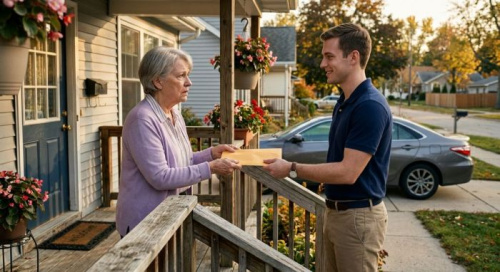
Kevin knocked on her front door on a Tuesday night, soaked through and trembling, and for a moment Florence thought he was sick. He looked like a boy who had seen something he would spend the rest of his life trying to unsee. He did not shout. He simply pulled out his phone and played her a recording, a call he had made to the Sunrise Children's Fund the day before using a number his mother had helped him trace.
On the recording, a warm bright voice asked how the caller's garden was coming along this spring.
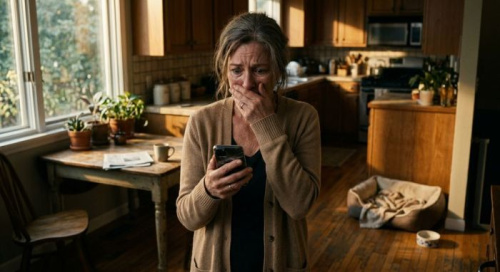
Florence's hand flew to her mouth. It was Dana. Except it was not entirely Dana. It was a script — a script engineered to sound like kindness, built to find lonely old people and drain them dry, and Kevin had recognized it because he had heard it read a hundred times before.
"Nana," Kevin whispered, setting the phone on the table between them, "I know that voice. I know exactly where those calls come from. Because I'm the one who makes them."
The world tilted. Florence gripped the edge of the table. "Kevin, that's not funny."
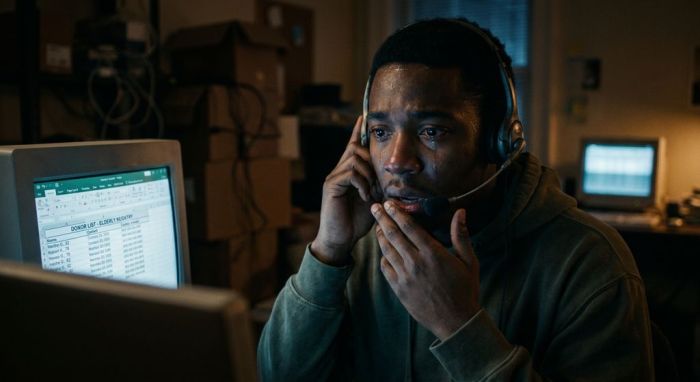
"It's not funny," he agreed, and his voice broke. "I took a job, Nana. A remote telemarketing job, before my last semester. I thought it was legitimate. A company called Pearl Line Solutions. They hired students, paid decent money, and they gave us scripts for a charity fundraiser. I was good at it because I believed in it. I believed I was raising money for sick children."
Florence stared at him, willing him to stop, knowing he would not.
"They taught us to use a different name on every call," he said. "A woman's name, always, because they found old folks trust a woman's soft voice. I was 'Dana' on Mondays and Wednesdays. I've been calling you for eight months, Nana. I didn't know. The leads are just numbers and addresses and little notes about who's lonely, who's grieving, who has bonds and savings and no one to check on them. I never put it together."
His shoulders shook. "Then tonight, about thirty minutes ago, I was on a call with a woman, an elderly woman, and she told me about her garden, about the peonies her late husband planted. And then she said — she said, 'my grandson Kevin, he studies nursing in Cincinnati, I'm so proud of him.'"
Kevin looked up at her, and there was a terrible wet apology in his eyes. "And I realized I've been robbing my own grandmother, and I didn't even know her voice, because I stopped calling her."
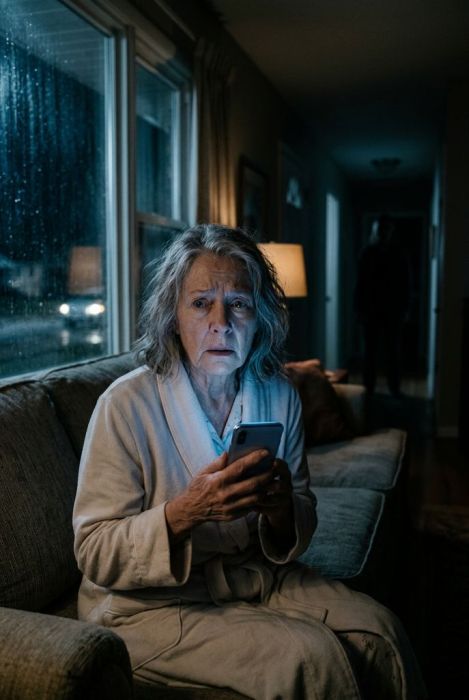
Florence sat in a chair that felt like it had been pulled out from under the world. The money was gone, most of it, sent up a chain she would never claw back. But it was not the money that broke her. It was that the warm voice that had held her through her worst year belonged to the boy she had loved since he was born, and that she had been so empty, so terribly empty, that she had given everything she had to a stranger's kindness in the dark.
The confrontation happened in the kitchen of her own house, at two in the morning, and there was nothing cinematic about it. Kevin called his mother, then the FBI's Internet Crime Complaint Center, then a detective whose nametag said Ruiz and who had seen a hundred versions of this grief. Florence learned that Pearl Line Solutions was a shell, that the money had been laundered through a half-dozen countries, that Kevin himself had been prey as surely as she had been — a broke, desperate student who had been recruited with a paycheck and a story he wanted to believe.
The real criminals were never caught. Not that week, not that year. But Kevin's confession — his phone records, the scripts, the voice files, the way he had been groomed and used — gave detectives a thread they had not had before, and it helped break open two other elderly-fraud rings in the same network.
What Florence did next surprised everyone, including herself. She began speaking at senior centers and church halls, standing behind a podium with her hands steady, telling the story of the charity that was not a charity and the grandson who had not known he was the thief. She taught them to look a caller in the eye of the phone and ask the one question that no scammer can answer: "Give me your official registration number, and I'll call you back on the number listed on the charity's real website."
She taught them that no legitimate charity sends someone to collect donations by wire transfer or gift card, and that no one should ever give money to a voice that calls them first. She taught them that the loneliest hour of the day is exactly when a stranger's kindness feels most like love, and that is precisely what the predators are counting on.
Kevin finished nursing school. On the day he graduated, Florence sat in the front row and cried, and afterward he took her to the peonies and told her he would pay her back every cent, a little at a time, for the rest of his life. She told him she did not want the money back. She wanted him to understand, without shame, that the best way to make it right was to spend his life helping people who could not help themselves.
The certificate with the gilded frame came down off her wall. In its place, Florence hung a photograph of her grandson in his white coat, and beside it she kept a faded copy of the script he had been forced to read, a reminder she refused to hide. Not as a punishment, but as a warning she wanted every visitor to see.
Awareness. That was the lesson, wrapped in the misery. Some thieves wear masks and some wear the faces of the people we love, and sometimes the cruelest theft of all is the one where the victim is too lonely to see who is holding the knife.