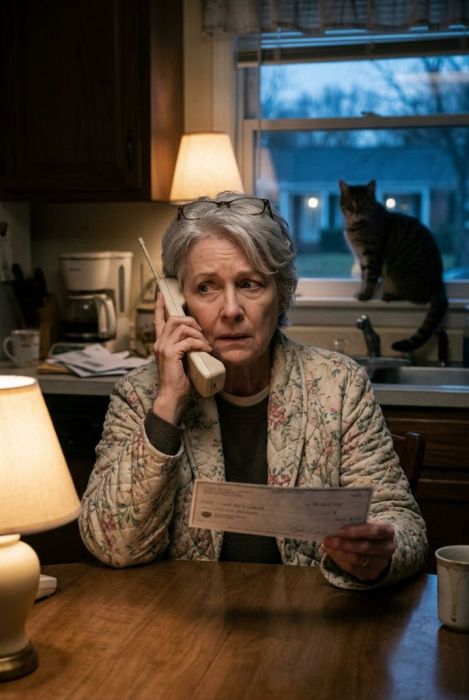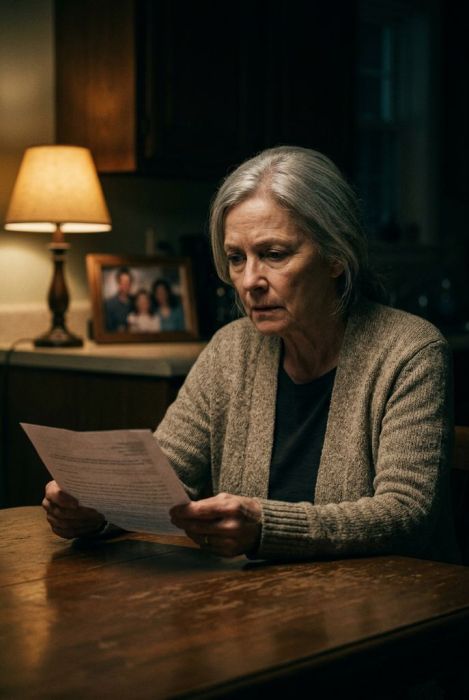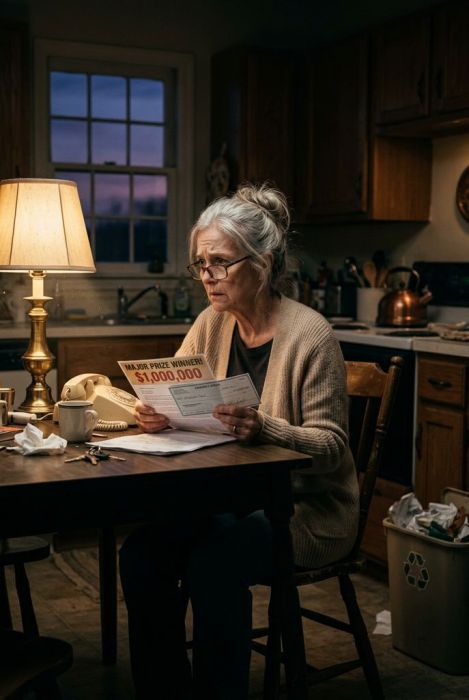
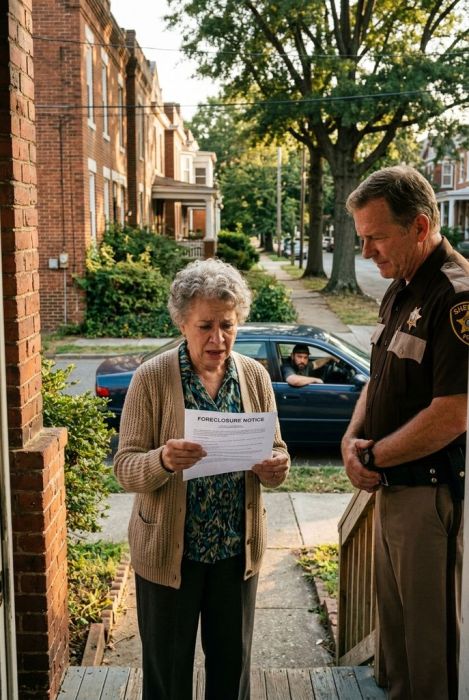
The notice was taped to her storm door like a summons from another life. Marlene Whitfield stood on the front steps of the little brick house on Floyd Avenue, a bag of groceries sagging in one arm, reading words that did not make sense. "Notice of Default. Property: 214 Floyd Avenue, Richmond, Virginia." Her house. Paid off since 2012, twenty-three years of mortgage payments finished, the deed crisp in a safety deposit box at Wells Fargo. And yet here was a document claiming she owed four hundred ten thousand dollars on a loan she had never taken, from a lender she had never heard of, signed by a notary whose name she had never seen.
The deputy from the Sheriff's Office arrived forty minutes later, because she had called the number on the notice, and the number had led her in circles, and finally she had simply called 911. Officer Delgado stood on her porch with the patient expression of a man who had seen this before and told her, gently, that her house was scheduled for foreclosure auction in eleven days.
"Ma'am, do you have any idea who might have had access to your personal documents?" he asked. Marlene's mind did a slow, terrible pan across the last nine months of her life, and it stopped on a friendly face.
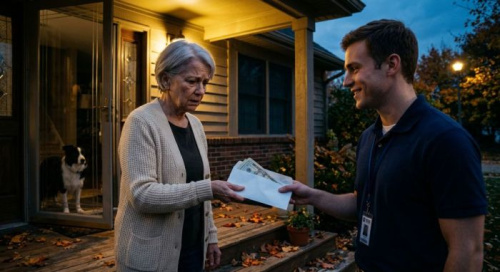
Derek Voss had arrived the previous October, on a cool Tuesday afternoon, with a laminated badge, a clipboard, and a smile that could warm a church basement. He said he worked for the city's Senior Home Safety Program, a new initiative to help older homeowners in the Fan District get free repairs and property tax exemptions. He was polite, unhurried, interested in her stories about teaching and about Thomas. He fixed the porch light on the very first visit, free of charge, and refused a tip.
Her husband, Thomas, had been at Rosewood Manor since August, his Alzheimer's having finally outpaced what Marlene could manage at home. The guilt of that decision sat on her chest like a stone. When Derek offered to handle the "homeowner paperwork" so she could focus her energy on her husband, she had actually wept a little, right there on the porch, and he had pretended not to notice.
Over the following months he performed small repairs around the house — a squeaky step, a leaking faucet, a gutter full of leaves — all billed to "the program." He photographed her identification for the "grant file." He asked to see the deed "to confirm ownership for the exemption." She had driven to the bank, retrieved it, let him scan it at her kitchen table, and driven it back the same afternoon. What could possibly be dangerous about a young man who brought his own ladder?
She had signed one form in March, a "program enrollment agreement," she believed, while the phone rang with a call from Rosewood about Thomas's insurance. Derek had been so patient, sliding the paper in front of her, pointing with a pen, and she had signed without reading. It was, the county recorder's office would later tell her, a quitclaim deed transferring her home to something called Harbor Point Properties LLC, registered in Nevada. The notary line bore the name Evelyn Hart and a stamp that looked, at first glance, official.
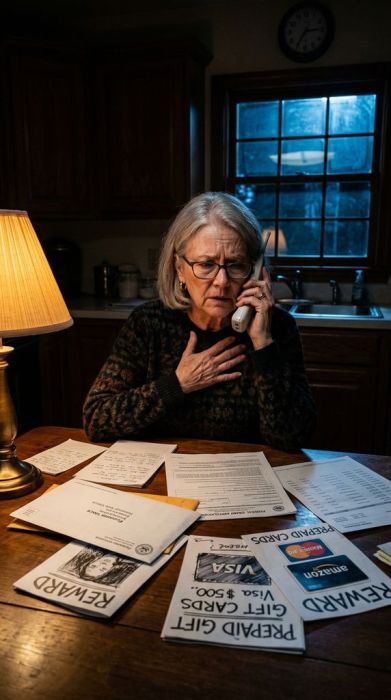
The next three pages of the county record were worse. The quitclaim deed was followed by a deed of trust — a mortgage of four hundred ten thousand dollars from something called Summit Trust Lending, secured against her house. The mortgage had gone into default, deliberately, in the tenth month, which was exactly how the scheme worked. The property would be auctioned to satisfy the debt, and Harbor Point Properties, the beneficiary, would buy it at a discount. The loser would be the woman who had lived in the house for thirty-seven years.
Marlene called Derek's number that afternoon. It had been disconnected. She drove to the address on his badge, a storefront on Broad Street, and found a shuttered space where a barbershop had been for years. She called the city's Senior Home Safety Program. There was no such program. She called the county recorder's office, the police department, and an attorney recommended by her daughter, in that order, and by the end of the week she had learned the following: her home had been stolen, legally on paper, and the machinery of eviction was already turning against her.
Her daughter Beth drove down from Raleigh the next morning. She was a paralegal, which felt like the one piece of luck in the whole disaster. She brought coffee, a yellow legal pad, and a look Marlene remembered from Beth's childhood — that narrowed, stubborn gaze she got whenever someone had wronged her mother.
"It's textbook deed fraud, Mom," Beth said, tapping the quitclaim deed. "They call it the quiet theft. The house looks fine from the outside, but someone takes the title and borrows against it, and by the time you find out, they've gutted the equity in nine months."
There was something else. When Rachel Kim, the real estate attorney Beth knew from Raleigh, ran Harbor Point Properties through Nevada's corporate registry, the registered agent came back as one Lowell Grimes, with a post office box in Reno. It took Rachel exactly one phone call to discover that Lowell Grimes was a disbarred real estate attorney — and that his name appeared in an old civil suit Marlene had almost forgotten.
Twenty-two years earlier, Marlene Whitfield had served on a jury. A small civil case, a roofing company that had taken advance payments from elderly homeowners and vanished. She had not thought about it in decades. But the attorney for the roofing company — the slick, red-faced lawyer who had called the elderly plaintiffs' claims "hysterical exaggerations" — had been Lowell Grimes. After the verdict went against his client, Grimes had sent angry letters to the jurors. Marlene's, she remembered, had been folded into her recycling bin without being read past the first line, a mistake she would relive a thousand times in the weeks that followed.
The last and most chilling piece arrived on a rainy Thursday, when Detective Marcus Bell of the Richmond Police Department's financial crimes unit called Beth back. Harbor Point Properties, he said, was a name that came up in his files. They had been watching it for two years. Three senior homeowners in the region had already lost their houses to the same funnel — quitclaim deed, phantom mortgage, silent default, auction. One of them, a woman named Agnes Whitfield, had died in a nursing home six months earlier, convinced she had left her family in debt, with nothing left in her estate.
Agnes was Thomas's sister.
Marlene sat very still on the couch for a long time after she heard that. She thought about how Agnes's letters had stopped coming after her stroke, how the family had assumed it was the nursing home eating her savings. She thought about how quiet theft was — how it made its way into a life without breaking a single window, without a single scream, without setting off a single alarm, and how it left the victim believing the disaster was their own fault.
The confrontation came on a Friday evening in May, at the little brick house on Floyd Avenue, in a scene that was equal parts farce and nightmare. A moving truck pulled up. Two men in plain clothes began unloading boxes labeled "office equipment," because Harbor Point Properties LLC — per Lowell Grimes's instructions — was taking possession of its newly acquired asset. Derek Voss was with them, clipboard in hand, wearing the same warm church-basement smile, until he saw Marlene standing on the porch with her daughter, two attorneys, and Detective Bell behind her.
"There's been a mistake," Derek began, and that was when Vern Okafor's camera across the street — the retired postal worker Marlene had dismissed as "nosy" for years — captured the whole scene. But they had better evidence than that. Rachel had obtained the original deed. The signature "Marlene Whitfield" had been traced, a forensic document examiner confirmed, from the utility bill Derek had photographed in her kitchen. The notary, Evelyn Hart, did not exist. The stamp was a counterfeit ordered online.
Derek Voss, twenty-three months into a four-year probation for a check-cashing scheme, flipped before the movers finished loading the truck. He sang Lowell Grimes's name like a hymn. He explained, proudly, the elegance of it: you never threaten an old woman, never break a window, never even raise your voice. You simply become useful to her. You bring a ladder. You fix the porch light. You photograph her driver's license. You let her sign a paper she is too distracted to read, and then you borrow half a million dollars against a house that took her a lifetime to pay off.
The judge in June voided the quitclaim deed and the phantom mortgage in nineteen minutes. Foreclosure fraud, he said from the bench, would not be tolerated in this circuit. Lowell Grimes was arrested in Reno a week later, already on the move, and charged with a dozen counts of wire fraud, identity theft, and elder exploitation. His bail was denied.
But the real verdict came later, in smaller rooms. At the senior center on Patterson Avenue, Marlene began to speak, three Tuesdays a month, to a circle of men and women who drank bad coffee and listened hard. She told them, in her flat way, the facts of it. Free and clear is not free. A house with no mortgage is a magnet. If anyone — anyone at all — asks you to sign something about your property, even a "form," you close the door and call the county recorder yourself. You get your own lawyer. You never let a stranger's photocopier touch your deed, your ID, your Social Security card. And you count your neighbors as blessings, even the nosy ones, because sometimes the man watching across the street is the only witness you are ever going to get.
People nodded. A man named Harold asked if she was angry. Marlene considered the question, then gave the only honest answer: she was angry at herself for eleven days — from the morning of the foreclosure notice to the moment Beth pulled the Nevada registry printout from her bag. After that, anger quieted into something more useful. She had almost lost the one thing she and Thomas had built together, and she had learned that the people who steal houses rarely look like burglars. They look like helpers. They carry clipboards and ladders and kind words, and they take everything you own while you thank them for it.
She drove to Rosewood Manor on the first anniversary of the notice being taped to her door. Thomas was having a good day, they told her; he was sitting in the courtyard, watching the birds. She sat beside him and took his hand, and he looked at her with the puzzled, grateful expression she had learned to read. He did not remember the house, or the mortgage, or the foreclosure, or any of it. But he remembered her. That was something.
"It's still ours, Tommy," she said softly, though she was not sure he understood. "Every brick of it."
He squeezed her fingers once, and she knew that somewhere beneath the fog, he understood enough.
On the drive home, Marlene Whitfield did not cry. She drove through the old streets of the Fan District with the windows down, past the row houses and the laundry on the lines and the porches full of old men reading newspapers, and she thought about how a half-million-dollar loan could be born from a pile of leaves and a friendly smile, and how the only protection that had ever really mattered was the ability to say, to anyone, "Let me call my lawyer first." She parked in her own driveway, in front of her own house, and sat for a long moment with the engine off, looking up at the porch light Derek had fixed — the one small honest thing he had done in nine months of lies.
She left it on, every night, from then on. It was a small thing, but it was hers. And every Tuesday at the senior center, when she told the story of the foreclosure notice, the neighbor's camera, and the man with the ladder, she ended the same way every time, with the same quiet sentence:
"If someone offers to help you with your house, ask yourself why. Because the only thing standing between you and your front door is your own signature — and the moment you give it to a stranger is the moment you stop being the owner of your life."