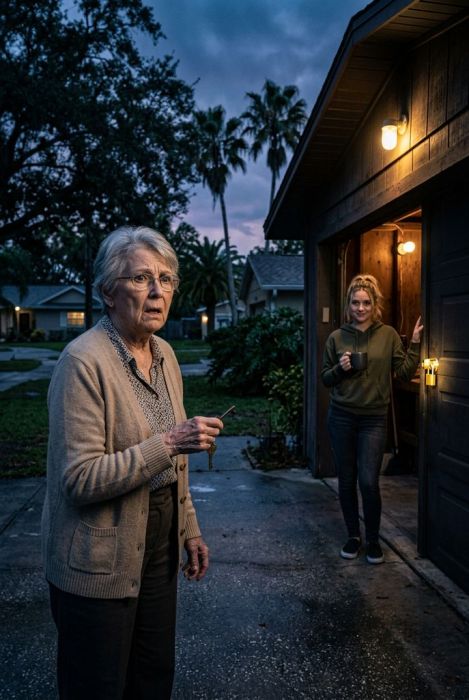
Dottie Vance heard the key turn, felt the deadbolt give, and knew in that shaking second that something in her life had gone very wrong.
The lock on Ray's workshop was brand new. Shiny brass, still carrying the sticker from a hardware store in its little plastic sleeve. Dottie's old key slid into it like a man stepping onto ice, then stopped dead. She tried again, harder, and the door swung open anyway — unlocked on the inside, which meant somebody had been living there, forty feet from the house she had shared with Ray for forty-one years.
Inside, nothing smelled like Ray anymore. The motor oil and sawdust were scrubbed away. Fairy lights dangled from the rafters above a secondhand futon. A pink duffel bag sat on the old workbench where her husband had rebuilt a 1979 Evinrude outboard. A laptop hummed beside a mug of cooling tea. And standing in the middle of it all, wearing a faded University of South Florida hoodie and a puzzled smile, was Jenna Whitfield.
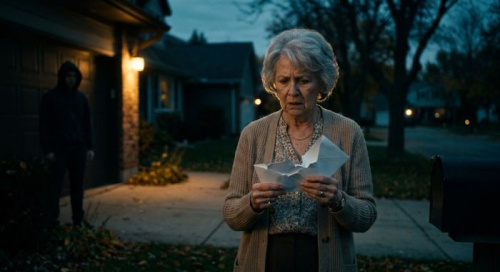
Dottie's heart knocked against her ribs like a key in a lock that wouldn't turn. For five months, Jenna had rented the workshop stall for four hundred dollars a month, cash, to fix up the old Honda Civic her grandmother had left her. She was twenty-three, sweet-faced, always apologizing for being a bother. She had helped Dottie carry groceries. She had pulled weeds from the front beds. She had sat on the porch swing and listened to stories about Ray as if she had all the time in the world.
"Jenna," Dottie said, and her voice came out thin. "Why did you change the lock?"
Jenna tilted her head, that gentle tilt Dottie had come to trust, and smiled. "I didn't change it, Dottie. I rekeyed it. For your safety. You know how this neighborhood gets."
"But it's my workshop. You rent the stall. Not the whole building."
"We talked about that a month ago, remember? When my apartment flooded." Jenna's voice stayed soft and patient, like a nurse explaining a diagnosis. "You said I could stay in the back office until I found a place. And you signed the lease so I'd qualify for the housing voucher. I have a copy in my bag. I'll show you tonight. We're good, Dottie. Promise."
Dottie didn't remember signing a lease. She remembered signing a get-well card for Jenna's grandmother in Georgia, the one with the bad hip, the one Jenna had cried about over tea on the porch three weeks earlier. Wilma Okafor, Dottie's neighbor for forty years, had been there that afternoon. Wilma had watched Dottie write a long, careful note in her best script, because that was the kind of woman Dottie Vance was. Wilma had watched Jenna thank her with a hug so warm it made the little gold cross on her necklace swing.
She had signed her name without reading the card. That's what kind people do.
"That was a card," Dottie said, trying to keep her voice steady. "Just a card."
Jenna's smile never wavered. "Sure it was, sweetheart. We'll sort it all out at the hearing. Courts love a fair, honest person. And you're the fairest, most honest person I know."
The word hearing hung in the air like smoke.
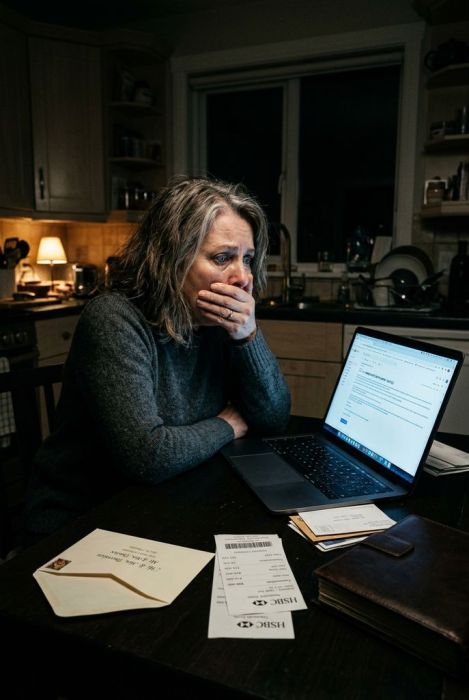
That night Dottie couldn't sleep. At two in the morning she finally opened the certified letter she had shoved into the cookie jar three days earlier, the one with the official seal she had been too rattled to read. It was a notice of a civil hearing in Hillsborough County — a tenant's claim that Dottie Vance had violated a written lease agreement at 2214 Sligh Avenue. Attached were two pages of "the agreement." Twelve months at six hundred dollars a month. Utilities included. Dated, witnessed, and signed with a signature that looked, to Dottie's terrified eyes, exactly like her own.
Retired bank tellers don't keep lawyers on retainer. Dottie had thirty-one thousand dollars in savings, a paid-off house, and a dead husband's pension. She had never been sued in her life.
Ray had died fourteen months earlier, on a Saturday morning, in that workshop, with a carburetor in his hands. The heart attack had been sudden and quiet. Dottie found him at noon with the radio still playing the ballgame. For months afterward, she couldn't go near the building. The smell of oil made her weep.
Her granddaughter Emma, the light of Ray's life, had moved to Portland three years before that, taking a job at a graphic design studio. She called every Sunday, but Sundays are long. Dottie had put a small printed card on the corkboard at the Winn-Dixie, mostly to have a reason to clean out the workshop, mostly to have company. Four hundred a month seemed fair for the stall and the tools.
Jenna called the next day, all excitement and gratitude. She came by with a bundle of gas-station flowers and a story: her grandmother's car, the last thing she had left of her, was dying, and there was nobody else who could save it. She had her nursing certificate to finish and no money to waste on a mechanic. Dottie, who had watched Ray turn wrenches for forty years, found herself saying yes before the tea was even poured. No lease. No application. No background check. Just a handshake and a promise.
By the time the second month's rent was late, Dottie already felt too foolish to ask for it. Jenna had explained the dead-end jobs, the payroll mix-up at the hospital, the medical bill that had eaten everything. She always paid in the end — a little late, a little less, always with a story attached.
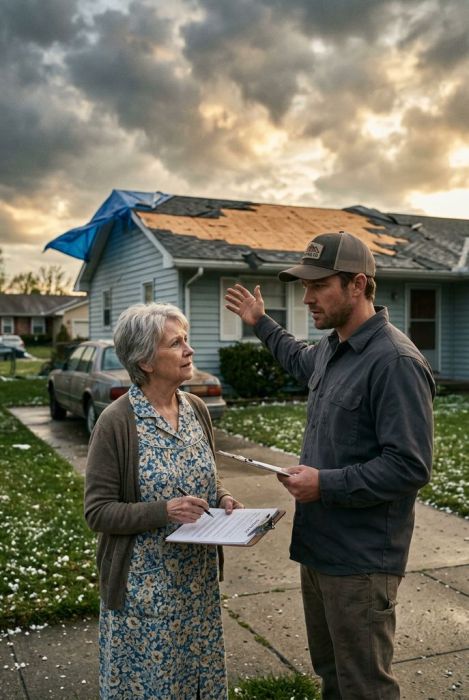
There had been signs, of course. Wilma pointed at least three of them out over coffee. The new girl wore expensive sneakers for someone who could never pay rent on time. The new girl knew a remarkable amount about Dottie's finances — her pension amount, Ray's annuities, the fact that the house was paid off — and always said she had learned it just by listening, because Dottie was an open book, and that was why she loved her. And then there was the afternoon Jenna showed up with a laminated "housing assistance ID card" that Wilma said looked like it had been printed on a home computer.
"Dottie, listen to your friend," Wilma said, pointing a spoon at her. "I clerked in this courthouse for twenty-five years. I have seen women like this eat sweet old ladies like you for breakfast."
Dottie laughed and said Jenna was different.
Three weeks before the hearing, Jenna stopped answering her phone entirely. The day after that, Dottie found a copy of the "lease" slid under her front door — one page, clearly photographed and reprinted at a copy shop, with a signature on the final line that she could now see, with her reading glasses on, had been traced and lifted from somewhere else. The loop of the letter D wobbled exactly the way her handwriting had wobbled on the get-well card. Because that was precisely where it had come from.
The hearing was in courtroom 4D of the Hillsborough County courthouse, a fluorescent room full of people in bad moods. Jenna sat on the other side of the aisle wearing a navy blazer and a strand of pearls, her blonde hair in a neat bun. She smiled at Dottie across the gap like they were old friends at a church picnic. Beside her sat a heavyset man in a rumpled suit who said he was her attorney, a real one with a laminated bar card he waved at the bailiff.
Dottie had no attorney. She had a complaint sheet Wilma had helped her fill out in the courthouse cafeteria, a folder of bank statements proving she had never deposited a single rent check in her life, and a clear plastic bag containing the get-well card. It felt like bringing a butter knife to a gunfight.
Jenna's attorney stood and laid out the story smoothly. His client, a hardworking nursing student, had entered into a lawful written lease with the defendant. The defendant had accepted rent for months, then tried to change the locks illegally. His client asked only that the court enforce the lease and stop the harassment. He held up the copy of the lease. "This document bears the defendant's signature, witnessed by one Marcus Greene."
Dottie stood up, her hands shaking. "That's not my signature."
The judge, Rosa Delgado, peered over her glasses. "Ma'am, do you have counsel?"
"No, Your Honor. But I have this." Dottie held up the plastic bag with the get-well card. "Three weeks before that lease was supposedly signed, I signed a get-well card for this young woman's grandmother. I brought it because I want the court to see the signature."
Wilma Okafor took the stand in a lavender cardigan she had pressed the night before. She testified calmly about the afternoon on the porch, the tea, the card, the pen, and the hug afterward. She testified that she had watched Jenna photograph the finished card with her phone before slipping it into her purse. "Your Honor," Wilma said, "I've authorized hundreds of signatures at this courthouse. That woman's name on that lease wobbles the same way Dottie's handwriting wobbles after three cups of tea."
Dottie's nephew Danny stood up in the back of the courtroom and raised his hand. Danny was thirty-one, quiet, a scanner of property documents at the county recorder's office. He had spent the week doing exactly what his aunt didn't know how to do. He handed the clerk two pieces of paper. The first was a quitclaim deed, dated nine days earlier, transferring 2214 Sligh Avenue from Dottie Vance to Sunshine Ridge Properties LLC, a company registered forty days prior. The notary signature on that deed belonged to a woman named Lucille Bates, who, Danny said quietly, had died in 2019.
The second piece of paper was a printout of an arrest warrant. It showed a photograph of a woman in a county jail jumpsuit with the same eyes as the smiling nursing student across the aisle. Brooke Halvorsen. Wanted in Georgia and South Carolina for tenant fraud and forgery, tied to a ring that targeted elderly homeowners with paid-off houses. The man in the suit wasn't an attorney at all. The moment a deputy touched Jenna's elbow, he slipped out the side door, and the deputy stationed there caught him before he reached the stairwell. He was Marcus Greene, and he had just been identified by the witness he had forged onto a lease.
Courtroom 4D erupted. Judge Delgado looked at the lease, looked at the card, looked at the deed, and then looked at Brooke Halvorsen with the expression of a woman who had seen every trick the county had to offer. She ordered the quitclaim deed flagged and voided. She found probable cause for an immediate arrest. And she told Dottie, in a voice that cut through the chaos, "Ma'am, you keep that card. It just saved your house."
Brooke Halvorsen was convicted four months later and sentenced to five years for forgery, grand theft, and scheme to defraud. Marcus Greene, who had run the operation from a rented office above a laundromat, pleaded guilty to leading the ring. Investigators linked him to eleven properties across three states, every one of them owned by a widow or widower over sixty.
Dottie learned later that the plan had been simple and terrifying. Establish a fake lease to prove residency. File a forged deed to transfer the title. Then take out a loan against the house or sell it to a cash buyer before anyone noticed. The get-well card wasn't a sideline of the scam. It was the entire engine. One signature, freely given, on a piece of paper nobody read.
She kept the card. She keeps it in the fireproof box where she now stores her deed, her will, and her bank statements. Wilma Okafor received a pound cake and a hug that lasted a full minute. Emma flew down from Portland for the trial and held her grandmother's hand through every word of the verdict.
The workshop still stands behind the house on Sligh Avenue. The lock is Dottie's lock now. The workbench is empty except for a framed photograph of Ray and a small brass sign his father had hung in the shop forty years earlier. Measure twice. Cut once. She pulled down the fairy lights, hung the sign back up, and this spring she rented the stall to a retired high-school shop teacher from her church — with a written lease, a signed application, references, and a handshake that came second, not first.
At the Tuesday coffee circle, when someone asks how she's doing, Dottie sometimes takes out the card and tells the story. A signature, she says, is a key. Once you hand it over, you don't get to choose which doors it opens. So read the paper before you sign the name — and if somebody makes you feel rushed, that's the biggest warning sign of them all.
She doesn't say it like a lecture. She says it like someone who used to sign birthday cards without looking, and who counts her blessings every single night that a retired court clerk lived next door, that a quiet nephew worked in the records office, and that the only lie Jenna Whitfield never bothered to polish was the one about needing that signature at all.