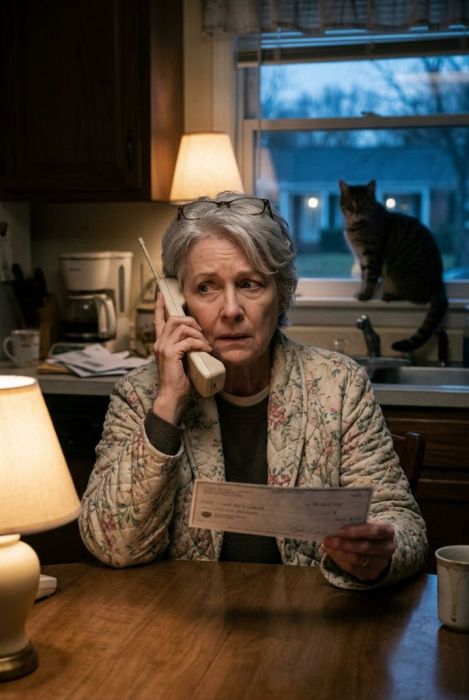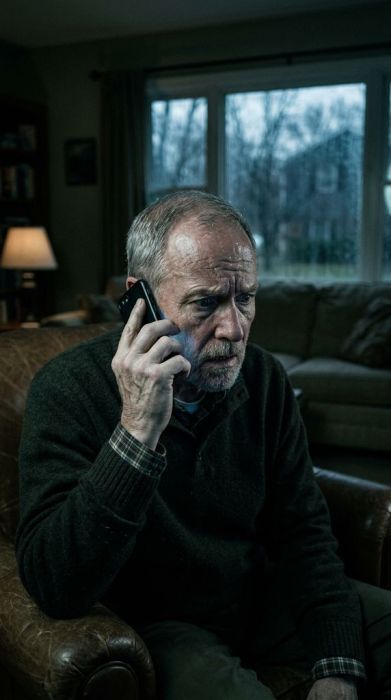
The Friday Hannah didn't call, the whole house felt wrong. For five years, ever since her mother died, my daughter and I had kept our ritual — a phone call after dinner, where she'd talk about her week and I'd pretend not to worry. That Friday, the phone rang twice and went to voicemail. I left a cheerful message and told myself she was just busy. By Sunday, I stopped pretending.
I'm Frank Keller. I spent thirty-two years as principal of Jefferson High in Davenport, Iowa, a job that taught me to read people — to spot the ones who were hiding something. Hannah was my only child, a bright, kind girl who taught elementary school before taking a year off to "find herself." That year, she found Dale Whitfield.
I met Dale exactly twice. The first time, at a diner halfway between Davenport and the little Arkansas town he called home, he shook my hand too firmly and smiled too easily. He was handsome in a worn-out way, older than Hannah by about a decade, with the callused hands of a man who worked construction. He talked about his contracting business, about how he was going to take care of my girl. I wanted to like him. For Hannah's sake, I tried.
The warning signs were there if I'd been paying attention. Within three months of meeting online, Hannah had packed her things, sold her car, and moved into his house at the edge of Pine Ridge, Arkansas. She quit her teaching job because, she said, Dale wanted her to help with his books. She stopped mentioning her old friends. When I asked to visit, she said the house was a mess, it wasn't ready, maybe next month. The calls got shorter. The stories got vaguer. And then they stopped.
On that Sunday I called her phone four times. On the fourth, a man's voice answered — Dale — and told me Hannah was at a friend's house, her phone had died, and she'd call me back. She never did. When I phoned the county sheriff's office in Pine Ridge, the dispatcher laughed. "Sir, she's a grown woman," she said. "There's no crime in her staying quiet for a few days."
I'd been a principal for three decades. I knew better than to make a scene. But I also knew, with a sick certainty that settled deep in my bones, that something was very, very wrong. So on Tuesday morning, I filled my truck with gas, packed a bag, and drove six hundred miles south through rain that never seemed to stop.
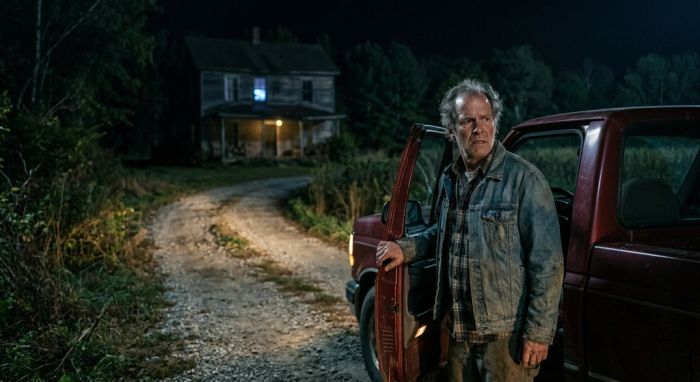
Pine Ridge turned out to be a single main street with a diner, a hardware store, and a sheriff's office the size of a double-wide. Dale's house sat at the end of a gravel road — a sagging two-story with peeling paint and a pickup truck with three different-colored doors sitting in the yard. I knocked. Dale opened the door wearing a tight smile and a stained t-shirt, and I watched the calculation move behind his eyes before he even spoke a word.
"Frank," he said, surprised, and not happily. "You should've called. Hannah's not here — she went down to see her sister in Little Rock."
I'd known Hannah her whole life. She didn't have a sister.
I stood on his porch and forced a pleasant tone. I asked when she'd be back. A few days, maybe longer, he said, casual and smooth, the way a man lies who's been lying a long time. I asked to wait for her, to call her, to see her room. Every request he deflected like water off a slick coat. That's when I started to really look. Through the screen door, on the kitchen counter, I saw it — Hannah's purse, the worn brown leather one I'd given her for her twenty-fifth birthday. I'd know it anywhere. And there on the floor by the stairs, half-hidden, lay her phone. The screen was cracked, the way it gets when someone throws it or stomps on it.
My heart stopped being entirely my own in that moment. It belonged to that phone, broken and abandoned on his floor.
I didn't want to leave, but I had no reason to stay. He watched me drive away from his window, smiling the whole time, I could feel it. I checked into a motel off the main highway, the kind with a flickering vacancy sign and carpet that smelled of old cigarettes. I sat on the edge of the bed and stared at the ceiling, trying to think like a principal instead of a terrified father.
I drove back to Pine Ridge that night, without calling anyone. I parked a hundred yards down the gravel road, killed my lights, and walked the rest of the way through the dark. The porch light was off. Every window was dark, except a faint blue glow from what might have been a television in the back room.
Before I could reach the side of the house, a voice came out of the shadows. "You're Hannah's father, aren't you?"
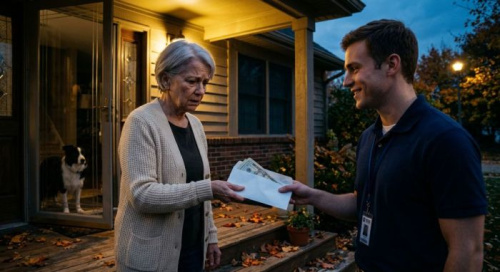
I nearly jumped out of my skin. An old woman in a cardigan stepped out from behind a hedge, a small dog on a leash at her feet. She introduced herself as June Whitaker, Dale's neighbor for the past twenty years. Her eyes were sharp and kind, the eyes of a woman who had watched too much and said too little for too long.
"Your girl's in there," she whispered, nodding at the dark house. "She's been in there for months. She never leaves, never comes to the window, never waves. That man of hers, he goes to town alone." She paused, and her voice dropped even lower. "Sometimes I hear her at night, through the wall. Not crying. Singing. Real soft, like she's afraid to be heard."
That detail undid me. My daughter, who used to sing at the top of her lungs while driving, humming in her kindergarten classroom, reduced to whispering in the dark.
June told me she'd called the sheriff's office twice. The deputy had come by, walked the grounds, and left. "He told me she's an adult and there's nothing to be done unless she asks for help herself." She looked at me with an apology in her eyes. "I'm sorry, Mr. Keller. I should have done more."
I crept around to the back of the house. There was a small window at ground level, the basement window, boarded over from the inside. And beside the back door, half-rotted, sat a dog bowl and a folded leash — for a dog Hannah had told me about, a golden retriever named Buddy, who she said was the sweetest dog she'd ever owned. But there was no dog. No barking. No Buddy. There was never any dog.
I had the back door open in under a minute. I'm not proud of the lock-picking — that was the one skill my father taught me I never expected to use. Inside, the house smelled of stale beer and old cigarette smoke and something chemical, like paint thinner. I moved through the kitchen, past the purse and the cracked phone, up the creaking stairs, every board groaning under my weight.
The bedroom door at the end of the hall was locked from the outside with a sliding bolt. A padlock. On the inside of a bedroom.
I slid it back and opened the door. She was lying on a bare mattress on the floor, curled into herself, thin in a way that made me want to weep. When the light from the hall hit her face, she flinched and pressed herself back against the wall like a frightened animal. Her left eye was bruised, a dark bloom of yellow and purple. She looked at me for a long, horrible second before her face crumpled and she said, barely a whisper, "Dad."
I went to her and held her, and she sobbed into my shoulder with a sound I will carry to my grave. "I'm so sorry," she kept saying. "I'm so sorry, I tried to leave, and he—" And then she went still, and her eyes went wide, and she looked past me toward the door.
The truck engine had pulled into the gravel drive.
Dale found us in the bedroom, and whatever mask he'd worn at the front door was gone. His face had gone flat and cold, the face of a man who'd been caught and decided not to pretend anymore. He was holding a crowbar, swinging it loose at his side. "I knew the old woman would run her mouth," he said. "I told that deputy if anyone showed up here again, I'd handle it myself."
Hannah stepped in front of me, shaking, and I saw something in that moment that humbled me — she was trying to protect me, even now, even after everything he'd done to her. "Dale, please," she said. "He's leaving. He's just leaving."
"You're both staying," he said softly, and he reached for her.
What happened next happened fast. I won't pretend I'm some kind of hero. I'm a sixty-four-year-old retired principal with a bad knee, and the only thing I had was a father's fury and about thirty seconds of surprise on my side. I hit him with the only thing I had — the heavy iron lamp from the hallway table — and I swung it just as he lunged. He went down hard on the top step, the crowbar clattering down the stairs, and for one frozen second there was only the sound of us breathing in the dark.
Then the front door slammed open, and a deputy's voice shouted, "Kessler! On the ground! Now!"
Kessler. Not Whitfield. I didn't understand, not then.
The deputy — a young man named Okafor, who June had called one last time as a Hail Mary — had recognized Dale the week before from a wanted bulletin cross-posted from Mississippi. Raymond Kessler, forty-one, wanted in two states for aggravated assault and a long, ugly history of domestic violence documented in court files going back twenty years. He'd been using the name Dale Whitfield and a fake contractor's license to keep moving, picking up and preying on women in small towns exactly like Pine Ridge. The roadblocks that never came, the sheriff who never called back — none of it mattered now. The deputy had probable cause, and he had Franklin Keller's daughter in a locked room to prove it.
Hannah spoke to the deputy for four hours that night, and to me for six. She told me how it started — how sweet and attentive he'd been, how he made her feel safe and seen after a lonely year. How he slowly chipped away at everything else in her life until she had only him. Her car, sold for the "business." Her teaching job, quit because he said the money was better and she needed to be home. Her friends, one by one, because he "didn't trust them." Her phone, taken the first time she tried to call me from the bathroom of a gas station on a drive back to Arkansas.
She told me about the singsong code she'd leave in the few messages she was allowed to send — "the garden's coming along," "the dog is doing great" — hoping, she said, slumping in the chair, that someday I would wonder why.
I sat in the hospital waiting room after they'd stitched her up and checked her over, and I let myself finally cry. Not from relief. Relief came later, cold and complicated. I cried because I had thought I was doing everything right — calling, checking in, being a steady, non-judgmental presence — and it had all been feeding the machinery that took her. My patience, my politeness, my fear of being the overbearing parent, had become the leash.
The deputy told me something I've thought about every day since. "Mr. Keller, the isolation is the whole game," he said. "They don't hit first. They charm first. They separate. They make the victim feel like the family is the problem and they're the only safe harbor. By the time the violence starts, there's no one left to see it, and no one the victim trusts enough to tell."
Kessler is in prison now, awaiting trial on charges in three states. Hannah is home in Davenport, in her old room, sleeping with the door open and a lamp on. Some nights she still sings, soft and low, and I listen at the top of the stairs and say a thank-you I don't know how to pray out loud. She's in counseling, and we're learning together what healing looks like when it's not neat or fast.
I don't tell people this story to scare them away from love, or from trusting their adult children. I tell it because of the thing the deputy said in the hallway, the thing I keep turning over in my hands like a worry stone: the isolation is the whole game.
If someone you love is slowly drifting out of their own life — giving up friends, jobs, phones, plans, or the things that once made them themselves — don't wait for the Friday call that doesn't come. Don't let politeness be the leash. Ask the hard questions. Show up at the door, even when it's inconvenient, even when it's six hundred miles away. Because by the time the signs are loud enough for the world to hear, the one person who needed you may have already been taught to be afraid of your knock.
If you or someone you know is being isolated, controlled, or hurt in a relationship, help is real and it is confidential — you can reach the National Domestic Violence Hotline at 800-799-7233, or text START to 88788. You do not have to sing your message in code. Someone is listening.