Maura Delaney had been a nurse at Concord Hospital for thirty-eight years, and she had learned to trust her instincts the way other people trust an alarm clock. The slight tremor in a patient's hand. The too-bright smile of a caregiver who was hiding something. So when her only child, Renee, announced she was moving back home to take care of her after Bernard's funeral, Maura told herself her instincts were simply being cruel.
"You're not settling into widowhood," Renee had said that snowy Tuesday, kneeling beside her mother's armchair with a tenderness so practiced it should have felt familiar. "You're seventy-one now. The snow is too much. The stairs are too much. You need somebody who actually sees you every day."
Maura's heart had swelled, and that was the dangerous part. Because grief leaves a door wide open, and sometimes the person who walks through it is the one who loves you, and sometimes they are holding a key they never meant to use.
Renee moved in by the first of December with four duffelbags and a filing box full of reasons why things had to change. The bank statements went into a drawer Renee said she would keep organized. The checkbook disappeared from the kitchen drawer where Maura had kept it for half a century, replaced by a small brown notebook her daughter carried everywhere. The medications, the appointments, the groceries, the pillbox, the phone calls all began, one by one, to flow through Renee's hands. And somehow it all felt like love because it came wrapped in love.
At first it was a relief. For the first time in months, Maura ate hot meals at regular hours, and somebody cleaned the gutters and shoveled the walk before she could even worry about it. Her daughter hummed in the kitchen every morning, and the house on Elm Street felt alive again in a way it had not since the winter before, when Bernard's cough had turned bad and the doctor had said those words nobody is ever ready to hear.
So when her best friend of forty years, Cora, called her phone only to have Renee answer it, Maura told herself the girl was just being helpful. When the mail began arriving at a post office box that Renee had opened "in case you're away," Maura reasoned it was practical. And when she asked about her savings, about the quiet balance her husband had left her, Renee would place a warm hand over hers and say, "Don't you worry about money, Mom. That's my job now."
That word, job, should have alerted her.
A subtle change began around the third month. Maura found her old friends calling and leaving no message, and then not calling back at all. She found the grocery list asking her to pay for things she did not recognize. She heard her daughter on the phone in the backyard, her voice clipped and businesslike, in a tone she had never used when the whole town thought they were running a household together.
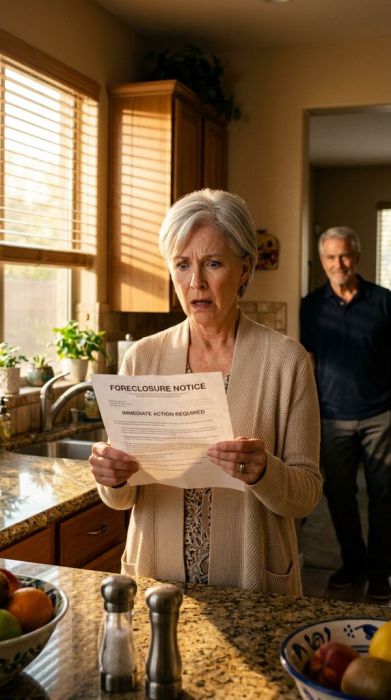
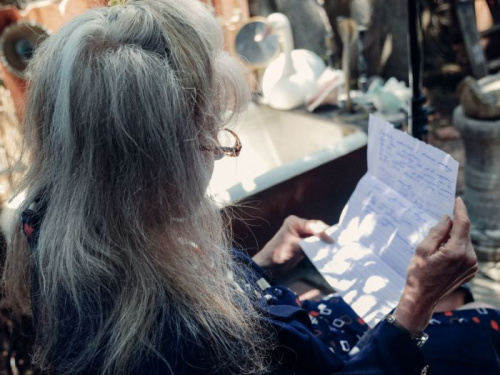
One Thursday, Maura walked into her own kitchen and saw Renee at the stove, and on the counter beside the pot of tea lay a letter, opened, from the First Independent Bank of New Hampshire. It was addressed to Bernard Delaney, and before Renee could smooth it away, Maura read the printed line at the top: AUTOMATIC TRANSFER AUTHORIZATION — NEW BENEFICIARY.
"Renee, why does the bank have you listed as a beneficiary on my account?"
Her daughter's smile did not waver. "That's just old paperwork, Mom. It means if anything ever happened to you, I could take care of things. You want me to be able to take care of you, don't you?"
It sounded reasonable, and Maura nodded, and she apologized for being paranoid. For days she told herself she was a fussy old woman spoiled by grief. But that line stayed with her, at the back of her teeth, the way the smell of something burning lingers when you cannot quite place the smoke.
She began to watch. Not obviously, because watching obviously would have been the thing that set everything off, and she had a nurse's low skill for observing without being observed. She noticed that Renee's phone was never more than a few feet away. She noticed that the pantry was full of things she did not remember ordering. She noticed that the hall lamp was on only at night. And she realized, with a small cold shock, that she had not seen the checkbook in so many weeks she had forgotten what it looked like.
One clear bright morning after the ice had begun to melt in April, while Renee went to the grocery store on what she promised would be a long hour, Maura put on her coat and took the bus downtown to the branch of the First Independent Bank where she had made her first deposit with Bernard at twenty-two. She asked to see her balances, and then she did not speak. She asked to see her statements, and she held them in the warm light of her trembling hands.
The savings account that had held her six-figure inheritance from Bernard was nearly empty.
Most of it was gone, moved in a quiet series of transfers. The house and a slim annuity, her Social Security, those remained. But the liquid money had been shifted a little at a time, in amounts small enough that she never noticed, and each transfer had been authorized under a clean, fresh signature that was not hers. The bank manager, a kind younger woman named Priya, went pale as she pulled the records across the screen.
"Do you know this woman, Mrs. Delaney?" Priya asked carefully, turning the monitor toward her. "Renee Delaney, power of attorney, signed six months ago."
Maura shook her head. "I signed nothing. Her father's power of attorney was for him, for when he was sick. I never signed anything over to Renee."
Priya's face fell the way a kind person's does when they realize the terrible thing sitting on their desk. "Mrs. Delaney, I'm sorry. There are seven transfers. Nearly everything," she said. "And the signature on here appears to match documents dated years ago. Fraudulent." She lowered her voice. "I'm going to flag this account and contact the authorities."
The twist was not that Renee had decided one day to steal from her. It was that she had wrapped the theft in care, moving it step by step, gently enough that Maura had drifted into a life she no longer controlled and told herself, over and over, that she was simply being taken care of.
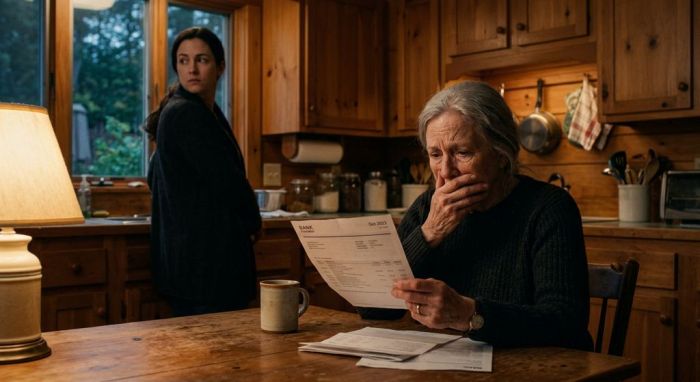
Maura returned home that afternoon. She set the statements on the kitchen table and her phone in front of her, and when Renee came through the door later that evening, full of warmth and grocery bags, Maura held up the balance page.
"What is this?"
The smile, then a flicker. "Why are you looking at those, Mom? I told you, I've taken care of it."
"You've emptied my savings, Renee. Seven transfers. New beneficiary. My signature is not anywhere on this."
Renee's arms crossed, and her voice took on that too-patient adult tone Maura remembered from her teenage years, as if Renee were the parent and Maura the child. "You're not well," she said. "You've been alone all this time living on your own. You're seeing things, imagining things. You're not well, Mom." It was gaslighting, plain and clear, the softest weapon in the world because it never once yelled at you and still pulled the ground from beneath your feet.
"No bank records don't dream, Renee," Maura said, her voice finally steady. "I asked. Where did the money go?"
A long, terrible silence. Then Renee set down the grocery bag and started toward the coat rack, and over her shoulder she said, "You're going to thank me someday. When you have nothing left and I'm the only person still here, you'll thank me."
But Maura had already sent her friend Cora the bank letter, and Cora had already called the elderly advocacy line, and Priya at the bank had already flagged the account, and the authorities moved quickly. Because an adult now flagged file and a forged signature and seven transfers out of a vulnerable person's account are enough for the system to act if someone only says the word.
At Renee's hearing on the small courtroom in Concord, Maura sat in the back with Cora's hand over hers. She did not say much as the judgment read out, but she did not have to. The records told the story: unauthorized transfers, coercive control, embezzlement from an older adult under her care. And in the end, Renee's fragile love had finally run up against the paper trail, the only wall she could not charm.
In the car on the way home, Maura cried for the daughter she had lost, and for the girl who had once climbed into her lap and held her finger, and for the love that had been so thoroughly rearranged into control. Some lines, her friends learned, she would not cross. Reconciliation, of the kind you read about in the farm valleys, was not coming, and she said so plainly and without self-pity. She had finally understood that love does not keep your signature in a drawer and whisper "don't worry," that a loved one who is honest with you is delighted to go to the bank together, and that anyone who needs you to keep it secret in order to keep their kindness has been hiding the part that matters most.
But she did rebuild, carefully, day by day. She revoked every authority, old and new. She closed the accounts and reopened fresh ones in her name alone. She took the mail into her own hands and read every envelope, and she taught herself to photograph each check with a little app her neighbor's granddaughter installed. She began to look at fine print the way she had once looked at a patient's chart, with patience and with a healthy measure of doubt.
And when a friend of hers, a widow in her eighties, asked her the question everyone was too polite to say aloud, "But you can't suspect your own child, can you?" Maura looked at her with the calm of a survivor.
"You can," she said quietly. "If it's your money, it's your signature. If a child wants to take over for reasons you don't fully understand, you go to the bank together and ask. If they love you, they will say yes. If they are using you, the reasons start piling up." She squeezed the woman's hand. "And trust me when I say this, the thing hidden in the drawer is never the thing taken care of."
The lesson at the end of Maura's story is quiet, as the best awareness always is. It is not about evil; it is about the checkbook, the envelopes, the gentle ways that control can creep into the life of a loving older adult. It is about asking questions and reading everything and keeping a second pair of eyes, and about the papers that should never be in a drawer that is not your own.
And on a cold morning that spring, when the sun rose over the thawing streets of Concord and the bank statements arrived in an envelope with no one's name but her own, Maura Delaney could finally breathe. Her instincts had come back, and with them, the quiet thing she had almost lost forever: the knowledge that she belonged to herself.