The night the school called me, I was slicing carrots for a casserole I would never finish eating. Ruth Callahan, fifty-four years old, school nurse for two decades, mother to one daughter I had somehow failed without meaning to. The assistant principal's voice on the line was tight, the way it gets when an adult is trying not to let a teenager hear them panic.
"I think you need to come in, Mrs. Callahan. Hannah is in my office. She won't say much to us, but I think you should see what she's shown me."
I drove the eight blocks to Westbrook High with my hands shaking on the wheel. It was a Tuesday. Hannah's senior year. Valedictorian track, first-chair clarinet, a future that hummed ahead of her like a well-oiled engine. I kept telling myself it was probably just a boy, just a fight with her best friend Emily, just the ordinary wreckage of being seventeen. I was wrong about all of it.
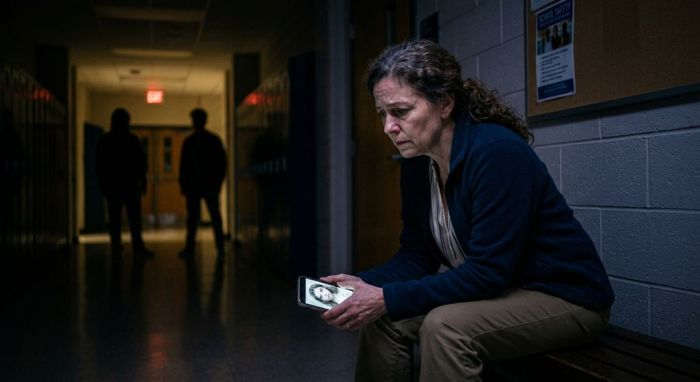
When the assistant principal handed me her phone, the screen was turned face down like it was something that might bite. "She won't unlock it for us," he said quietly. "She says she's too ashamed."
But Hannah did unlock it for me. She looked up with eyes that had been crying for a long time, eyes that had absolutely nothing left behind them, and she swiped once, twice, three times. And I saw my daughter's face — her beautiful, honest, freckled face — contorted into poses she had never made, wearing clothes she had never owned, in rooms she had never stood in.
The images were good. That was the horrifying part. They were so good that I almost believed them myself for one sick, breathless second. Her face had been grafted onto other bodies, other lives, other lies, and the seams were nearly invisible to anyone scrolling past at two in the afternoon.
"Where did these come from?" I managed.
"I don't know," she whispered. "They're everywhere. Emily's been trying to get people to stop sharing them, but it's no good. It's too late."
Even now, even with those images burning in my memory, it was Emily's name that gave me hope. Emily Whitfield, Hannah's best friend since the sixth grade, the girl who slept on our couch during thunderstorms, the girl I had fed grilled cheese to a hundred times. Of course she was fighting for Hannah. That was who Emily was.
The next morning, I made calls. I was a nurse, not an investigator, but I had learned a long time ago that a person who keeps records tends to survive the people who don't. The images, I discovered, had first appeared on a burner account with a fake name — a nameless handle with a grinning skull avatar and three thousand followers of high schoolers. The account had been created three weeks before, and its very first post had been a single cruel caption wrapped around the first doctored photo.
I should have been comforted that the district hired a cybersecurity firm. Instead, it only made me angrier. Because while the adults were politely investigating, while the assistant principal promised action and the school board issued a carefully worded statement about "responsible digital citizenship," my daughter was still walking those hallways. Still hearing the whispers. Still watching her classmates look at their phones and then look at her, and then look away.
Hannah stopped eating lunch in the caf pit on Wednesday. By Thursday she was eating in the nurse's office, with me, because I was the only adult she trusted not to say the wrong thing. She would sit on the cot with a granola bar she never touched and just stare at the wall.
"Do you know what the worst part is, Mom?" she said on that fourth day. "It's not the pictures. It's that I can hear them trying to figure out if it's true. Like they're doing the math in their heads. Like there's a version of me they can't decide whether to believe in."
I had no answer. I held her hand and hated every adult in that building, including myself.
The cybersecurity report came back on a Tuesday afternoon, exactly two weeks after the school had first called me. I was summoned to a conference room at the district office, a sad little room with motivational posters and a coffee machine that smelled like burnt regret. Three men in dark suits sat across from me, spreading printouts across the table like a dealer laying out cards.
"Mrs. Callahan, we've traced the original uploads," the lead investigator said. "The burner account was accessed consistently from a single device, and that device can be located with some precision to a home address in your neighborhood."
He slid a paper across the table. I looked down at the address and felt the floor tilt underneath me.
It was Emily Whitfield's house.
"I'm telling you, there's been a mistake," I said, and I could hear how desperate I sounded. "Emily is Hannah's best friend. She's the one who's been telling people to stop sharing those pictures."
The investigator was patient, the way professionals are when they've seen this exact scene a hundred times. "Mrs. Callahan, the evidence is fairly conclusive. Whoever created that account did it from that residence, and the file metadata on the original deepfake templates matches the editing history on a laptop that also, by the records, connects to that home's network. Children share a household network with their parents, so we can't say with certainty it was Emily herself, but the account originated there."
"No," I said. "It wasn't Emily. You're looking at the wrong girl."
I drove straight to the Whitfield house that evening. I had known Donna Whitfield for years; we had carpooled to softball practice, traded babysitting favors, complained about the same school budget at the same PTA meetings. She answered the door with her arms crossed, and I knew in that first heartbeat that something was wrong, because Donna Whitfield never looked at me without smiling.
"You need to leave, Ruth," she said flatly.
"Donna, the investigators traced those pictures to your house. To your family's internet. I need to talk to Emily."
"Emily's not home. And even if she were, I wouldn't let you near her. You come here with accusations because your daughter's in trouble, and you want someone else to blame."
The door closed in my face. And for one terrible, clear moment, I understood something I should have seen weeks earlier. Donna Whitfield wasn't furious at being falsely accused. She was furious that anyone had figured it out.
The answer didn't come from Emily, and it didn't come from Donna. It came from a twelve-year-old boy named Marcus, the little brother who Hannah had once taught to whistle. He found me in the parking lot of the 7-Eleven late that night, bicycle chain still in his hand, face pale and urgent.
"Mrs. Callahan, you have to understand," he said, his voice cracked and small. "Emily didn't make those pictures. She's been sick about it. She's been crying for two weeks. The person who made them used our Wi-Fi, but it wasn't Emily."
"Marcus, the investigators said—"
"They don't know," he cut in. "They don't know about the laptop. It's in the basement, in the old storage room behind the water heater. My mom put it there. She changes the passwords and she keeps it locked and she doesn't let either of us near it. But I saw it once. I saw what she does on it."
I stared at him. "Your mom?"
He nodded, and his face crumpled, and I think he started crying because he'd been carrying the secret for so long he didn't know what else to do with it. "Hannah's better than Emily at everything," he said. "Better grades. Better in band. She got the scholarship Emily wanted. My mom thought if people got mad at Emily, or got mad at Hannah's family, then maybe the scholarship would fall apart and Emily would get a second chance. She's been planning it for months."
His words hit me like a physical blow. Donna Whitfield, my old friend, the woman who had brought me casseroles when my own mother died, had spent months teaching herself to make those images. She had made a fake account to poison her daughter's own best friend, to butcher a girl's reputation in order to pry open a door for her own child. She had weaponized her expertise as a graphic designer — she'd worked in marketing for years — and she had aimed it at a seventeen-year-old girl who trusted her like family.
"Why?" I whispered, half to myself.
"Because she thinks nobody ever gets what they deserve," Marcus said, "unless they take it."
At two in the morning, the police retrieved the laptop from the Whitfield basement. It took them less than an hour to match the editing software, the file dates, the metadata, and the burner account's message logs to Donna Whitfield herself. She was arrested the next morning, still in her bathrobe, still insisting to the officers that she had only been trying to protect her daughter's future.
Emily didn't speak to me for a long time. I don't blame her. Her mother was gone, her family was in ruins, and the girl whose life she'd tried — however unfairly — to shield from her own mother's cruelty was my daughter. There was no clean version of that story, no villain who made it simple, because the real villain had been sitting in our PTA meetings and passing the potato salad.
But something else happened, too. Something I think about every single day.
When the truth came out, when the school finally did what it should have done in the beginning, the whispers about Hannah didn't stop right away. But then a remarkable thing happened. The kids who had shared the images, the ones who had done the cruel arithmetic, started to talk about who had made them. Started to understand that they had been the weapon, not the target. Started to realize that they had spread lies without ever once asking if they were true.
A senior boy named Colin — a boy Hannah barely knew — made a post of his own. He wrote that he had shared the pictures without thinking, and that he was ashamed, and then he listed every single reason Hannah Callahan was the last person in that school who deserved what happened to her. He listed the music she played, the way she helped freshmen with their homework, the time she stayed after a game to find the little sister of a teammate who'd wandered off.
That post changed everything. Not because it was eloquent, but because it was honest. One by one, the sharing turned into apologies. The whispers turned into silence, and then the silence turned into defense, and suddenly the girl everyone had tried to ruin had an army of people who were furious on her behalf.
Hannah never fully got those weeks back. She walked across that graduation stage with a weight in her that shouldn't have been there. She still checks herself in mirrors sometimes, still looks for the girl in the photographs that were never her, and I know some part of that will live with her forever. But she also learned something in that terrible season that most people never learn at all.
She learned that a photograph of you is not you. That a voice that sounds like yours is not yours. That the people who made that cruel, convincing lie were trying to replace her truth with their version of it — and that the only way to fight it was to be loud, to be patient, and to be surrounded by people who were willing to look past the pixels and remember her.
I think about Donna Whitfield sometimes. Not with hatred, though I'd be lying if I said I didn't feel it. I think about what a mother will do to believe she is protecting her child, and how easily that love curdles into something that hurts everyone it was meant to save. She destroyed her own daughter's best friend and her own family to win a race her daughter was never even in.
Emily wrote me a letter a year later, after the dust settled and her mother's trial had ended. She said she was sorry for what her family had done, and that she would understand if Hannah never wanted to speak to her again. But she also said something that stopped me cold. She said, "I spent years being told my mother had sacrificed everything for me. I think I was the last person to realize that I was the one she was sacrificing."
That letter is in a drawer in my kitchen. I don't read it often, but I keep it, because it reminds me that we are all somebody's story, somebody's version of the truth, and that the versions we don't check become the lives we live.
If you take nothing else from Hannah's story, take this: a fake image carries no truth, but it carries enormous power until someone stops it. When you see something that sounds or looks like a scandal, pause before you share it. Send it to the person it's about and ask them what's really going on. Be the Colin in somebody's life — the one who would rather be embarrassed by asking than be wrong by assuming.
Because my daughter almost lost her entire senior year to a lie so well made that even her own mother had to look hard to remember what was real. And the girl who made it was sitting right beside her at every lunch table, laughing at jokes she knew were about her, waiting for the lie to do all the damage she didn't have the courage to do herself.
Hannah is twenty-one now. She's in medical school, which is fitting, because she spent a year learning that viruses and rumors work the same way — they spread fast, they hide in plain sight, and they only stop when enough people refuse to carry them. She still plays the clarinet. She still helps people who need it. And she still knows, better than any of us, that you can't believe everything you see — especially when the face staring back at you from the screen was never yours at all.