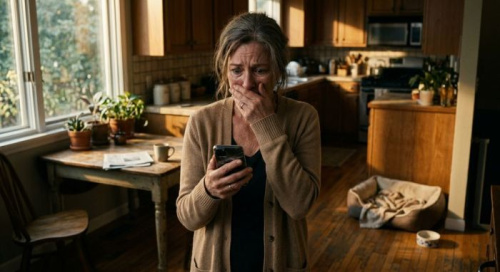
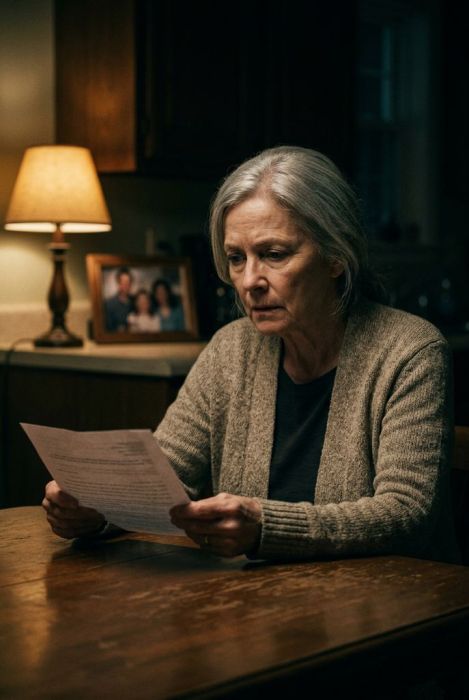
The bank teller who called Barbara Delaney that Tuesday morning had a cheerful voice and terrible news. A home equity line of credit in her name had just taken another withdrawal — forty-one thousand, three hundred dollars — and the automated system wanted her confirmation before the transfer cleared. Barbara held the phone at arm's length and stared at it. She had never opened a home equity line of credit in her life. She had owned the little Dutch Colonial on Ridgedale Drive outright for eleven years, ever since she and Tom made the final payment and toasted in the empty dining room with cheap champagne.
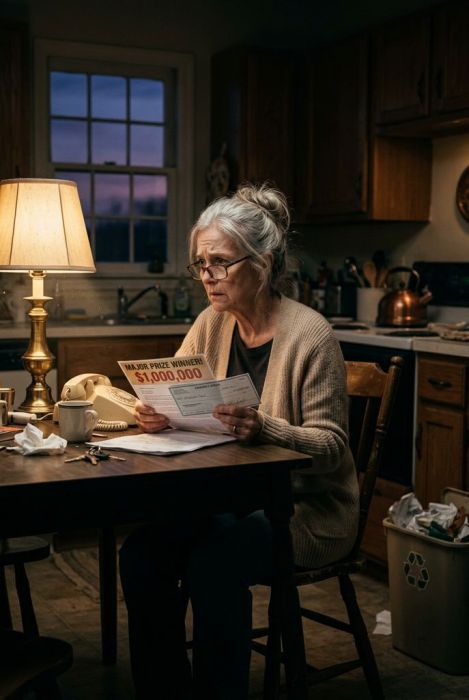
That was four years before Tom's heart gave out among the tomato cages. Barbara was sixty-eight now, a retired school librarian who still alphabetized her spice rack, and she was fairly certain she was not losing her mind. "I don't have a home equity line," she said. "There must be a mistake." The teller's voice softened the way voices soften for the elderly. "Let me pull up the account history, Mrs. Delaney. Can you hold?" Barbara held, and when the teller returned, the details made her blood run cold. The line had been opened eighteen months earlier, in person, at a downtown branch. The signature on the application matched hers, or came close enough to pass. Over the past fourteen months, more than a hundred and eighty thousand dollars had been drawn against it in a dozen quiet transfers.
She drove downtown that afternoon with her hands shaking on the wheel. The branch manager, a young man with kind eyes named Devin, confirmed everything and apologized three times. "It was a legitimate-looking application," he said. "Two forms of ID, utility bills, the works. File a police report and we'll escalate it to our fraud division." Barbara nodded and wrote the number down. She did not tell him what frightened her most: every piece of information on that application was real. Her Social Security number was genuine. Her date of birth, her address, the name of Tom's old credit union — all of it correct to the digit.
The fraud report took her to the front desk of the Columbus police station, where an exhausted sergeant took her statement and handed her a case number. "These take a while," he warned her, not unkindly. Driving home, she did what she had done her whole life when she was scared: she called her son. Scott was a CPA, a careful man who checked his work three times. If anyone would know what to do, it was Scott. But it was his wife Monica who answered, and Monica's voice had that smooth, concerned warmth Barbara had once found so soothing. "Oh, honey, I'm sure it's just a mix-up at the bank," Monica said. "You know how these things happen. Maybe Mom just signed something and forgot. The paperwork from the refinance was so confusing." Barbara felt her cheeks burn. "I didn't sign anything, Monica. I would remember a hundred and eighty thousand dollars." "Of course you would," Monica said quickly. "I'm just saying, don't worry yourself. Let Scott and me look into it. We'll take care of everything. That's what family does."
Barbara hung up feeling smaller than she had in years. And that was when she began to notice the pattern she had been too grateful to see.
Two years earlier, when Scott had announced he was being considered for a partnership at Brennan & Cole, Monica had arrived at Ridgedale Drive with a bottle of wine and a business card. It was her idea to "sit down with Mama Babs and make sure everything's in order" — a refinance of a mortgage Barbara no longer had, a bundle of estate documents, a power of attorney "just in case you ever need help." Barbara, flattered by the attention and relieved to have someone younger handling the grown-up paperwork, had signed where Monica pointed. She had signed tax documents she never read, insurance forms she trusted her daughter-in-law to summarize, and a specimen signature card "for the bank files." Monica had photocopied her driver's license for "the title company" and typed Barbara's Social Security number into the laptop she always kept closed. Barbara had thought it was love. That was the part that ached the most.
The warning signs had been there, scattered like dropped pins. The way Monica started calling twice a week and then gradually stopped returning calls. The way Noah's sleepovers at Grandma's house — every other Friday since he was five — quietly became once a month, and then "we'll see, buddy, maybe next time." The way Monica suggested, at Thanksgiving, that Barbara might be "safer" in one of those new memory-care villages near the freeway, just to be close to everyone. Barbara had laughed it off. The memory-care suggestion wasn't funny in hindsight, though. It was a first draft of a story Monica needed other people to believe.
What Barbara did not know, as the leaves fell from her maple tree that October, was how much work had already gone into that story. Monica had planted it seed by seed with Scott, over months of careful conversation. Mom seemed a little off at dinner. Mom forgot the name of her own granddog. Mom got confused about the mail. Each observation was small, plausible, and delivered with pity. Scott, exhausted from a merger audit and programmed to trust his wife, had started believing. And when Barbara began calling him about a phantom loan, Monica had stroked his arm and said the saddest words of all: "I think it's starting, honey. The thing we were afraid of."
The lunch that broke her was at a chain restaurant off the highway, chosen by Monica because it was quiet. Scott picked at his salad while Monica produced a folder. Inside were printouts from a clinic Barbara had never visited in her life, with her name at the top and a doctor's signature she didn't recognize, recommending a full geriatric assessment. "We love you, Mom," Monica said, reaching across the table. "That's why we need to do this now, before something bad happens. Just a few appointments. A little help around the house. And would you let Scott hold power of attorney? Just so we can talk to the bank for you?" Barbara looked at her son, and for one terrible moment, she saw the doubt in his eyes. "You think I'm losing it too," she said. Scott didn't answer. Monica's hand found his. "See, this is exactly what I mean," Monica murmured. "She's so defensive."
Barbara went home and did what she had always done with trouble. She made tea, and she made a list. She wrote down every date, every conversation, every "helpful" signature, every time Monica had been strangely sweet. She pulled her credit report for the first time in four years and sat down hard when she saw it: a second inquiry from a bank she didn't use, opened the same week Monica had helped her "consolidate." She called a forensic document examiner her neighbor's daughter had mentioned — a woman in Westerville who asked for a sample of Barbara's real signature, side by side with the one on the loan application. The examiner's report came back in six days. The signature was a simulation, carefully traced, with tremors of uncertainty the examiner called "worry lines." It was not Barbara's hand. And the IP address that had opened the application, the bank discovered, traced to a residential cable modem in Muirfield Village. Not Barbara's house. Her daughter-in-law's.
The detective who took over the case was a sturdy woman named Pemberton who had seen too many of these. "Mrs. Delaney," she said, "what you're describing is financial exploitation of an elderly person. In Ohio, that's a felony. But I need to know one thing before I arrest anybody." She set a photograph on the table. It showed the loan officer from the bank, a nervous-looking man named Gary, surrendering in the bank lobby. "He already confessed to the notarization," Pemberton said. "He's agreed to testify about who paid him." Barbara stared at the ceiling of the interview room and felt the whole weight of the past year settle around her like a cold coat. She had wanted to be wrong. She had prayed to be wrong. She had spent entire nights wondering if Monica had been right, if she really was a confused old woman imagining enemies. She was not confused. She had been stripped, methodically, by the person who called her "Mama Babs."
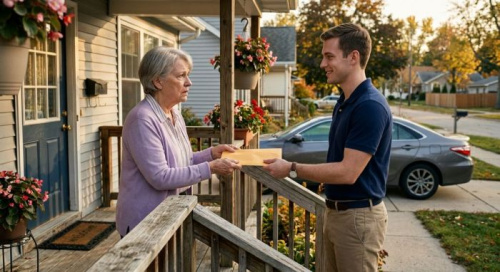
The end came the way it usually does in these cases — not with drama, but with paperwork. The bank froze the line. The county prosecutor charged Monica Hart Delaney with identity fraud and two counts of elderly exploitation, plus forgery. The hidden credit card debt and the failed house flips that had driven her to it all went into the record, and the record went into the news, and the news went into Scott's hands one Thursday morning. Barbara didn't call him. She didn't have to. He showed up alone three days later, in the rain, and stood on her porch for a long minute before he knocked. "The memory clinic was a lie," he said, his voice cracking. "All of it was a lie. She told me you were sick. She told me you were dangerous. She fed me fear the way you'd feed a dog scraps." Barbara met his eyes through the screen door. "I know, baby," she said. That was all she had. It was enough.
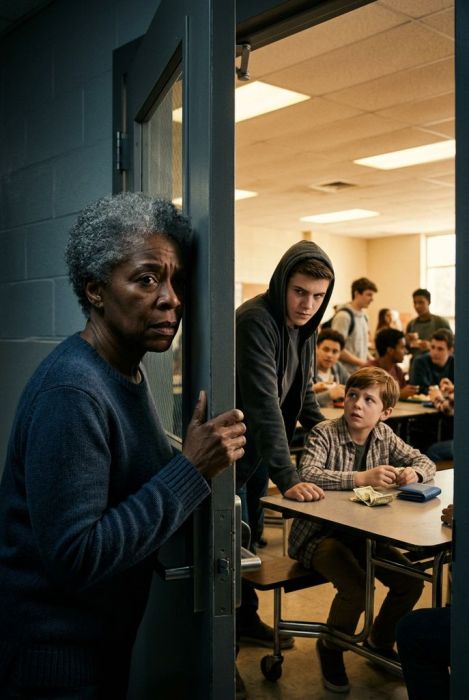
The hardest part was not the money — in the end the bank returned it, because signatures taken by fraud belong to the thief, not the victim. The hardest part was the year her grandson had lost. Noah was nine, too young to understand the words, old enough to understand absence. He had spent a whole year being told his grandma was "confused" and "sick," and he had mourned her like she was already gone. When Barbara finally saw him again, at the family tree presentation no one had cancelled, he stood at the front of the third-grade classroom with a poster board covered in photographs. Her photographs. The ones he had taken from the box in her attic during the last sleepover, months ago, while his mother was "helping" Barbara organize. "This is my grandma Babs," he said to the class, and he pointed to a picture of her holding a garden hose, laughing, twenty years younger. "She's not confused, I don't think. She remembers everything. She even remembers the first book she ever read me." The class clapped. Barbara, in the back row, could not see the board for the tears.
Sometimes the awareness lesson comes wrapped in a courtroom verdict, and sometimes it comes wrapped in a little boy's voice. Barbara got both. She checks her credit report now, every quarter, like some people check the weather. She has a freeze on her credit — the three little letters of safety she never knew she needed. She tells people the story at the library where she volunteers, not as a warning for the gullible, but as a promise to the trusting: the people who steal your life are rarely strangers behind dark screens. Sometimes they are the ones who call you "Mama." Sometimes they bring wine, and folders, and a voice so gentle it feels like love. That is what makes it so effective. And that is why Barbara Delaney still keeps the list she wrote that night over tea, in the shoebox where she keeps her important things, next to a photograph of a nine-year-old boy and his poster board.
The last time Monica's lawyer called to offer a plea deal, Barbara declined to attend. The law would do what the law does. Barbara had already found her own vindication, in a third-grade classroom, at a family tree project that had almost never happened. She would trust her own signature again someday. She would trust the bank's fraud department, and Detective Pemberton, and the forensic examiner in Westerville. But she would never again sign a document she hadn't read, and she would never again let someone else's kindness replace her own caution. Some doors you only open once, she told herself. The one on Ridgedale Drive stayed locked from then on, to everyone except the people who loved her enough to tell the truth.