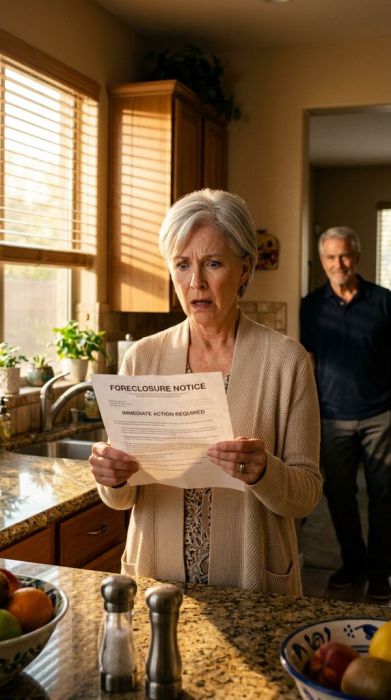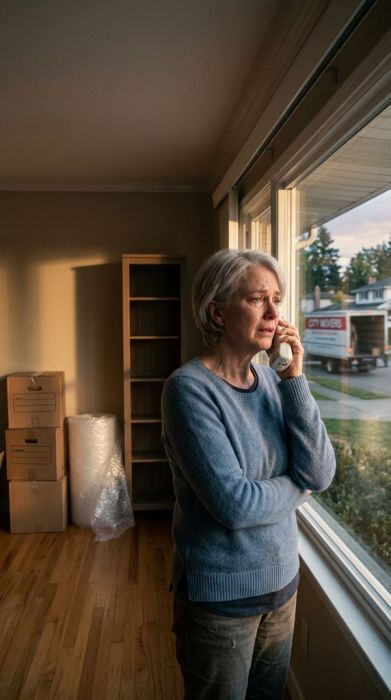
The call arrived at 10:47 on a Tuesday morning, and Gloria Dane answered it with one eye on the begonias she was watering and one eye on the clock. Caller ID read DANE COUNTY SHERIFF'S OFFICE. The voice on the other end was calm, unhurried, official. "Is this Gloria Marie Dane, born September fourteenth, 1959?"
She had not heard her full name spoken aloud in years — not her marriage license, her tax forms, her late husband's death certificate. "Yes," she whispered. "This is Sergeant Carter," the man said, "with the warrants division. I need you to listen very carefully, because what I'm about to tell you is going to frighten you, and I need you to stay calm."
She had failed to appear for jury duty, he explained. A bench warrant had been signed by Judge Raymond Okafor of the Dane County Circuit Court. A fine had been assessed — one thousand two hundred fifty dollars — and because she had ignored the court's summons, she now owed an additional failure-to-appear penalty. "A deputy is already on his way to your address, ma'am," Carter said. "If you can resolve the fine right now, over the phone, I can recall him. If you can't, he's going to knock on your door in about eleven minutes."
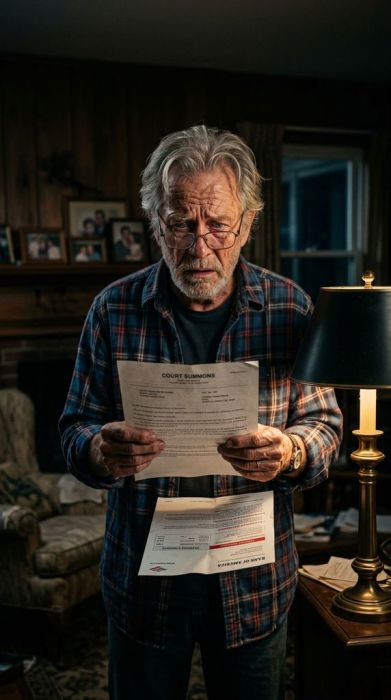
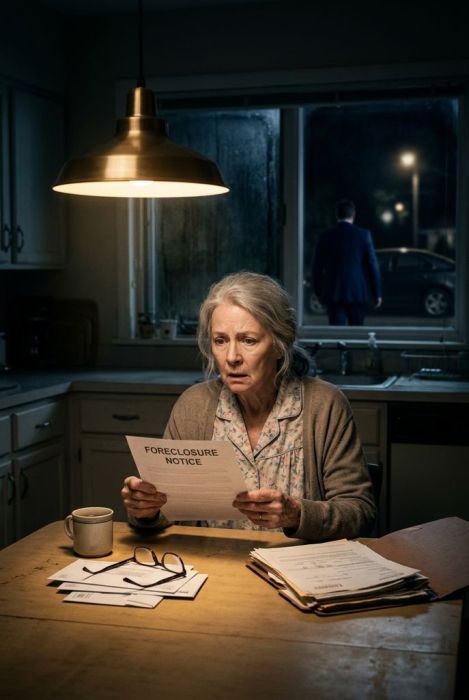
Gloria had, in fact, received the jury summons. She remembered exactly what she had done with it: she had thrown it in the recycling bin under the sink, assuming it was a mistake, certain she had served her time years ago in a different county. That alone would not have terrified her. It was what Carter said next. "I can see you signed for the notice on the fourth of April," he told her. "You opened it at the kitchen table, ma'am. It's all on the court record."
He couldn't have known that. And yet the details — the date, the kitchen table — were achingly, impossibly correct. She stood in her kitchen with the phone pressed to her ear, and the begonias outside the window blurred. "You're going to be okay," Carter said, his voice dropping to something almost tender. "This is a simple fix. We just need to get the fine paid and the warrant recalled before my deputy reaches your door."
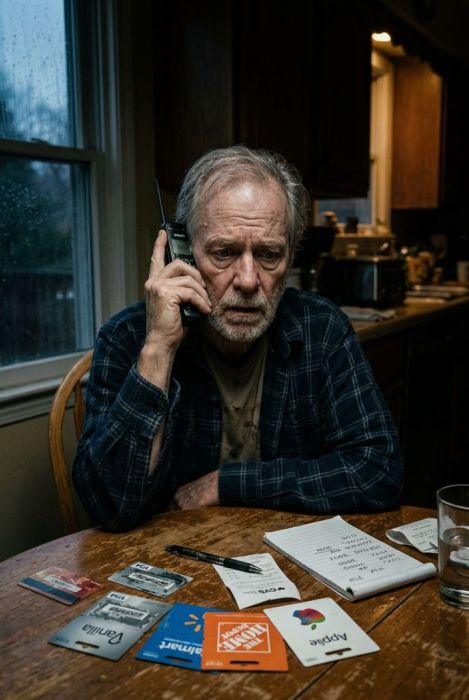
The payment, he explained, had to be made by gift card. It was a temporary protocol, he said, because the county's payment portal was down for maintenance — some kind of cyberattack the IT department was still untangling. She could buy the cards at any CVS or Walgreens, scratch off the backs, read him the numbers, and the warrant would dissolve on the spot. "How much?" Gloria asked. "One thousand, eight hundred seventy-five, with the penalty," he said. "That covers everything. One payment, and this is behind you."
Gloria Dane was a retired clerk from the university bursar's office. For thirty-one years she had balanced ledgers, reconciled accounts, and caught other people's arithmetic mistakes. She knew, with a part of her mind that was screaming and waving its arms, that no court on earth accepts payment in CVS gift cards. But the other part of her mind — the part that had not slept properly since Emmett died — was already replaying the image of a deputy knocking on her door, of neighbors' curtains twitching, of her name in the police blotter. So she grabbed her purse and her keys.
She drove to the CVS on Atwood Avenue with Sergeant Carter on the line, his voice a constant low murmur in her ear. He coached her in a friendly, patient way: buy the cards in denominations of two hundred and fifty, tell the cashier they were gifts for her grandkids, do not discuss the reason. The cashier that morning was a college kid named Dylan who asked, twice, whether she was sure she wanted five hundred dollars in gift cards, and Gloria smiled her bright, brittle smile and said they were for a birthday. "Lucky grandkids," Dylan said. She nodded. Her hands were shaking so badly she could barely scratch the cards.
She called Carter back from the car and read him the numbers, one by one, and when she finished he said, "Perfect. That's the last thing, Mrs. Dane. The warrant is recalled. You'll get a letter of confirmation from the court within ten days." Gloria sat in the hot car and wept with relief. She had saved herself from humiliation. She had handled it, like she handled everything since Emmett — alone, quietly, without burdening anyone.
She did not tell Jan. Jan was her older sister, a retired surgical nurse who lived two miles away and had been predicting catastrophe since 1999, when a man claiming to be a Nigerian prince relieved her of eight hundred dollars. Jan's paranoia had become a family joke — "Jan still waits for her prince" — and Gloria could not bear the idea of Jan's face as she explained the gift cards. She did not tell Nina, either. Nina was a pediatric dentist in Minneapolis who called every Sunday night, and Gloria always answered with the same two words: "Everything's fine."
The second call came Thursday, while she was watching the noon news. Sergeant Carter sounded apologetic. A clerical review had flagged her file: because the original failure-to-appear had moved into a second review cycle, there was an additional court processing fee of three thousand, two hundred dollars. Without it, the warrant would be reissued automatically, and this time there would be no recall. "I'm sorry, ma'am," he said, and he really did sound sorry. "This is the system. It's not fair, and I know it. But I'm here with you, and we can fix it."
Gloria drove back to the CVS. Dylan was not working that day, and a middle-aged woman with kind eyes rang up the cards without asking a single question, which felt almost worse. She read Carter the numbers from the car, then from her living room, then — because he claimed one of the cards had been wrongly activated — she went back and bought another eight hundred dollars' worth. By Friday morning, Gloria Dane had surrendered six thousand, eight hundred seventy-five dollars to a collection of plastic rectangles and a voice that called her by her full name.
The voice was the worst part. Sergeant Carter knew things. He knew she had a daughter in Minneapolis. He knew she drove a silver Camry. He knew about the begonias — he mentioned, on the third call, that the begonia on the east side of her porch looked like it needed water. "You must be sitting at the window," Gloria whispered. He laughed pleasantly and said, "Ma'am, I could read you your whole file. That's how thorough the court is."
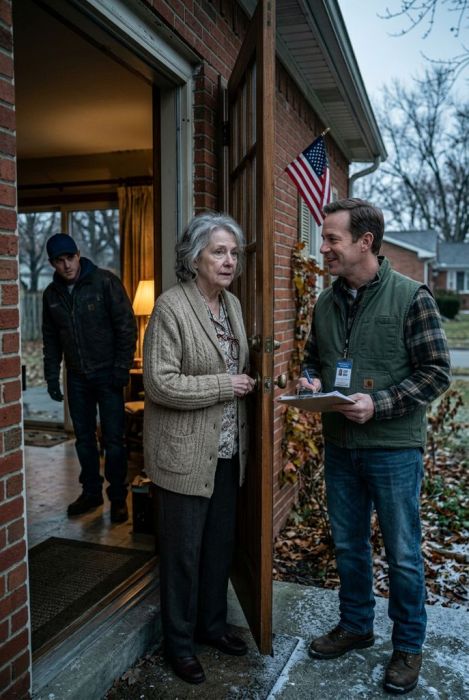
Then came Friday afternoon, and the call that changed everything. Carter told her, with quiet relief in his voice, that a court liaison would be stopping by her house to collect the physical cards, a final step in closing the file. "His name is Deputy Ellis," Carter said. "You're going to see a plain sedan, not a cruiser. Don't be alarmed. That's protocol for liaisons." Gloria hung up, and something she had been holding in her chest for five days finally cracked open: court liaisons do not collect gift cards from porches. She knew this. She had known it since Tuesday, buried under the fear.
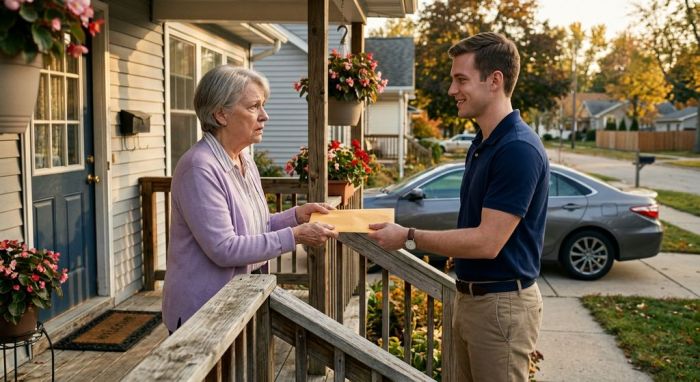
At 3:15, a gray sedan pulled into her driveway. The young man who stepped out was clean-cut, mid-twenties, wearing khakis and a polo shirt and carrying no badge, no folder, nothing. He introduced himself as Deputy Ellis with a warm, easy smile and took the manila envelope she had prepared — all the remaining cards, still in their store packaging — with both hands, like a man receiving something precious. "You've been very cooperative, Mrs. Dane," he said. "The court appreciates it." He shook her hand, got back in the sedan, and drove away. And Gloria stood on her porch with her arms hanging at her sides and understood, with a certainty that went all the way down, that she had just handed a stranger her savings. Court officers don't thank you for gift cards.
She called the sheriff's office herself, using a number she looked up, not one he gave her. A dispatcher named Linda listened, then transferred her to a detective. There was no Sergeant Carter in the warrants division — there had not been for years. There was no warrant in her name. And there was no Deputy Ellis. "Ma'am," the detective said, very gently, "how much did they take?"
Detective Teresa Niland had worked financial crimes for eleven years, and she heard the shame in Gloria's voice before she heard the numbers. "This is a jury duty scheme," she said. "It's one of the big ones, especially against women living alone. They don't hack your computer, Mrs. Dane. They study you." Niland sent a patrol officer over immediately — not to arrest her, Gloria learned, but to take a report and, more importantly, to make sure she hadn't hurt herself. And then she asked the question that made Gloria's blood run cold. "Do you know how he knew your birthday? Your address? Your daughter?"
Gloria didn't know. She hadn't told Carter anything but her name. Niland had Dennis Grover across the street pull his doorbell camera footage — Dennis, a retired engineer with three cameras and a legendary suspicion of anything that moved — and there was Deputy Ellis, clear as a movie still: the sedan, the face, the manila envelope. The plates came back to a rental company, and the rental came back to a credit card, and the credit card came back to a name that Niland already kept in a drawer labeled OPEN. But the identification that broke the case happened three days later, in a small room at the sheriff's office, when Niland slid a six-pack of photographs across the table.
"Take your time, Mrs. Dane." Gloria's hands were shaking as she looked at the photos — six men, similar ages, similar haircuts. Her eyes stopped on number four, and her mouth went dry. "This one," she said. "This is him. This is Deputy Ellis." Niland leaned forward. "Are you sure?" And Gloria said something that made the detective go very still. "I'm sure. He helped me with my forms. At the courthouse, last winter. He was the young man at the kiosk."
Three months earlier, Gloria had gone to the county courthouse to file for the widow's property tax exemption after Emmett died. A friendly young man in a blazer — not a volunteer, not a guide, but a man who looked like he belonged — had helped her at the self-service kiosk. He had scanned her driver's license, walked her through the signature pad, held her phone while she fumbled for her reading glasses. "He was so nice," Gloria whispered. "He saw me crying, and he was so nice." Detective Niland set her pen down slowly. "Mrs. Dane," she said, "do you know what's in that exemption file? It's public record."
The widow's exemption application lists every single thing a scammer needs: her name, her birth date, her address, her late husband's name, even her signature on a scanned document. And it sits, miles of it, in the public records room of the county courthouse — accessible to anyone who walks in the front door, no password required. The young man at the kiosk had not been a volunteer. He had been a scout, and he had not needed to break into a single database. He had read the files like a library book, picked the names of widows who lived alone, and sold them down the line to a call center that did the voices.
It was Ellis who broke in the end. He was twenty-four years old, a former county temp worker who had been fired for stealing office supplies, recruited by a man he knew only as "Mike" — a voice on a phone. His job was simple: pick up the cards, photograph them, send the photographs to Mike's number, and wait for the payment to land. Three hundred dollars a pickup. He had done it nine times. "Eight widows before her," he told the detectives without emotion, as if he were reciting inventory. "She was the ninth."
The money was gone. That's the part no one tells you about gift card scams: the instant you read those numbers aloud, they're spendable, and the network redeems them within minutes. Gloria's six thousand, eight hundred seventy-five dollars had been converted to untraceable currency before Deputy Ellis ever pulled into her driveway. Nina cried when she heard. Jan said "I told you so" exactly once, and then — to Gloria's astonishment — she sat down and cried too, because she had almost been a victim herself, and the only reason she wasn't was that her prince had been Nigerian, not judicial.
But something happened after the arrest that Gloria did not expect. The county assessor's office, mortified by the exposure, began scrubbing personal identifying details from public exemption records and moving the most sensitive files behind a log-in wall. And the sheriff's office — through Detective Niland, who had a soft spot for victims who had the courage to come in — asked Gloria a question: would she talk about it? Just once, on camera, for a public-service announcement about jury duty scams. She said yes.
The PSA ran on local news and in every senior center in the county. Gloria stood in front of her begonias, in a sweater the color of wet cement, and told the camera the things she wished someone had told her. No government agency asks for gift cards. Ever. No warrant is recalled over the phone. No judge calls to announce your arrest; that's what paper and a knock on the door are for. If the caller knows your birthday and your address and your dead husband's name, that is not proof they're real — that is proof they did their homework, and the homework was free. And the most important thing, she said, was the thing she had nearly died of: the shame. "I didn't tell my sister. I didn't tell my daughter. Because I didn't want them to think I was foolish. And that silence was the one thing the man on the phone needed from me." She paused, and her voice cracked on camera, and then she said: "Call the number you know is real. Not the number on the screen. The one you know."
Niland's task force, building on Ellis's cooperation, eventually linked the voice called Mike to a network that ran jury duty scripts in eleven states. The case made headlines and then, as cases do, faded. Gloria did not get her money back. She got something smaller and rarer: she got to stand in front of a room of her peers at the senior center on a Thursday afternoon, holding up a gift card like a badge of shame turned to armor, and watch the faces in the crowd go from pity to recognition. Because half of them, it turned out, had almost answered a call like that themselves. And the other half had already answered it, and never told a soul.
She tells them the rules now, the way she used to balance ledgers: one, courts send paper. Two, law enforcement never asks for payment by gift card, wire, or Bitcoin. Three, call back on a real number you find yourself — never the one the caller gives you. And four, the moment you're afraid to tell the people who love you, the scammer already has you. Her begonias are still alive, by the way. The man on the phone was never watching her from the street. He was reading from a public file, and the file was enough. In the end, that's what frightens Gloria most: he didn't need to watch at all.