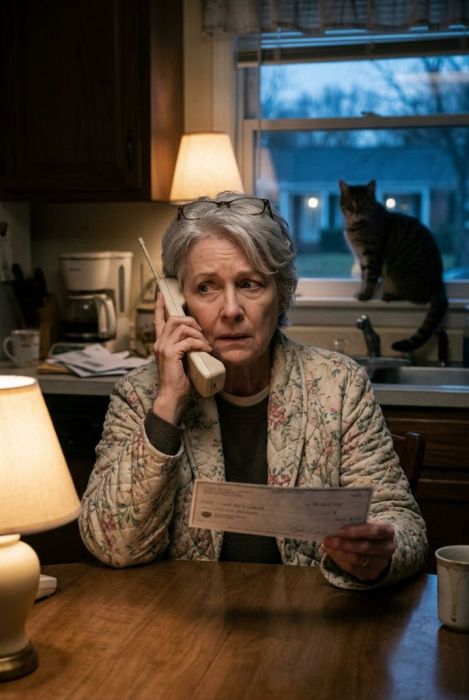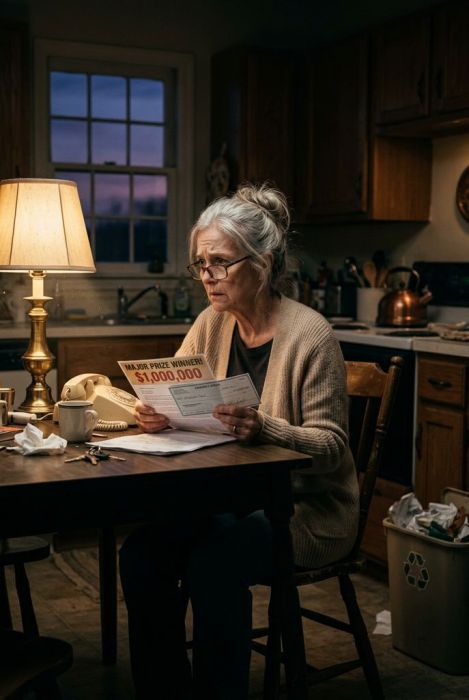
The rain that March night in Tucson came down so hard that Marion Hayes thought the sky itself had cracked open. She was seventy-two years old, two years into a widowhood she still had not learned to live inside, and the drip that had started in her kitchen ceiling had become a steady, hollow rhythm against the bucket she had set on the linoleum. It was nearly three in the morning. She sat at the small table with her hands wrapped around a lukewarm mug of tea, listening to the water fill the plastic pail, and she felt, for the first time in months, genuinely afraid.
Her husband Frank had always fixed these things. For forty-one years of marriage, when the roof leaked or the water heater groaned or the porch light sputtered, Frank had climbed up with his toolbox and his quiet certainty that nothing could break in a way he could not mend. Now the toolbox sat untouched in the garage, gathering dust beside a lawnmower that neither of them would ever push again, and Marion was alone with a ceiling that was slowly falling in on her.
The next morning she called three roofing companies. Two never returned her calls. The third sent a man named Danny Corbin, who arrived in a gleaming white truck with the words "Corbin Home Restoration" stenciled across the side. He was warm and easy, the kind of man who remembered your name and used it often, and he had a way of looking at her that made her feel seen in a way she had not felt since Frank died.
"Ma'am, this roof is in worse shape than you think," Danny said, standing in her kitchen with a flashlight pointed at the stain spreading across the ceiling. He shook his head slowly, the way doctors did in television shows before they delivered terrible news. "I'm not trying to scare you, but if we don't get to it soon, you're looking at mold, water damage, maybe a collapse in a bad storm. And honestly, the way these storms are getting, that's not that far off."
Marion felt her stomach drop. She had never dealt with any of this alone. Frank had handled the money, the repairs, the decisions, the whole quiet machinery of keeping a house standing. Now all of it had fallen to her, and she had no idea what anything was supposed to cost or who she could trust to tell her the truth.
"That sounds terrible," she said weakly. "What am I supposed to do?"
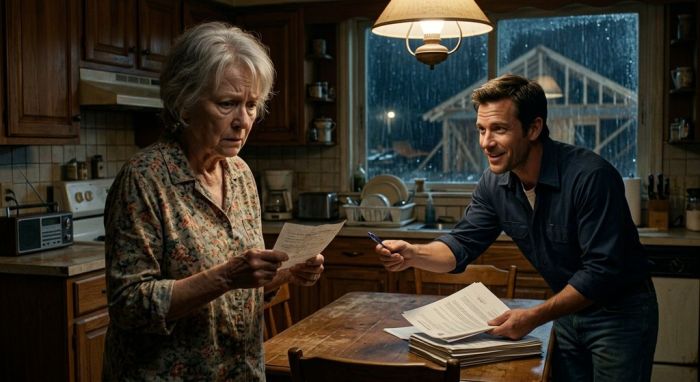
"Here's what we're going to do," Danny said, and he smiled a warm, reassuring smile. He spoke to her like she was family, like he had known her for years. "I'm going to take care of all of it, start to finish. You don't worry about a thing. I'll handle the permits, the materials, the crew, everything. You just sign a few papers so we can get the work started, and in about a week your roof will be good as new."
It sounded so easy. That was the first thing Marion would remember later, when she sat in the cold fluorescent light of the police station trying to explain what had happened. It sounded so easy, and she was so tired, and the thought of never having to think about it again was the most comforting thing anyone had offered her in two years.
The papers were numerous and dense. Danny explained them quickly, flipping pages with a practiced hand, pointing to lines and saying "that's just the standard permit form" and "this one's just confirming the materials" and "here's where we agree on the payment schedule." Marion did not read them. She trusted him, because he had been kind to her, and because kindness had been in such short supply that she mistook it for safety.
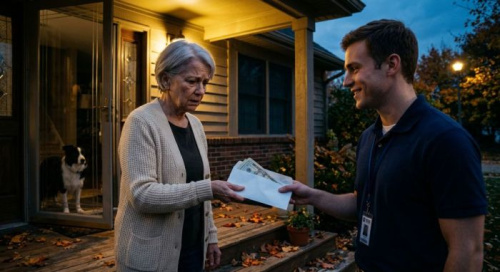
The work began the following Monday. A crew of young men in orange vests tore the old shingles off her roof, and for a few days Marion felt a strange sort of relief, watching her problems be dismantled piece by piece. Danny stopped by every afternoon, sometimes with coffee, sometimes just to sit on her porch and talk. He asked about Frank. He asked about her children. He told her about his own mother in Phoenix, and how he took care of her now that she was older, and Marion felt a swelling warmth in her chest that she did not want to name.
"You remind me of her," Danny said once, and he squeezed her hand. "Same kind of strength. That's why I take extra care with ladies like you. Nobody should have to go through this world alone."
The trouble started, as trouble often does, with small things. The crew stopped showing up. Days passed with no work, the roof half torn apart and covered with a tarp that flapped in the wind. When Marion called Danny, he sounded apologetic and harried.
"Supply chain issues, Marion. I'm on it, I promise. We had to order special underlayment, and it's stuck in a warehouse in Phoenix. Just give me a couple more days."
The couple more days became a week, then two. And then the invoices began. They arrived by email and by mail, each one larger than the last, and each one referenced work that Marion could see with her own eyes had not been done. She called Danny, her voice shaking.
"Danny, this bill for twelve thousand dollars — I don't understand. The roof is still just the tarp. Nothing's been done in weeks."
"Oh, that's just the materials invoice, Marion, I explained that. We had to order everything up front. The bank needed to see the purchase orders. Don't worry, it's all accounted for."
But it was not all accounted for, and Marion would learn that the hard way. She would learn that the papers she had signed without reading were not permit forms at all. She would learn that one of them was a power of attorney, drawn up in language dense enough that she had skimmed right past it, giving Danny the right to handle her financial affairs. She would learn that another was an agreement that assigned the proceeds of her late husband's life insurance policy as collateral for the "project."
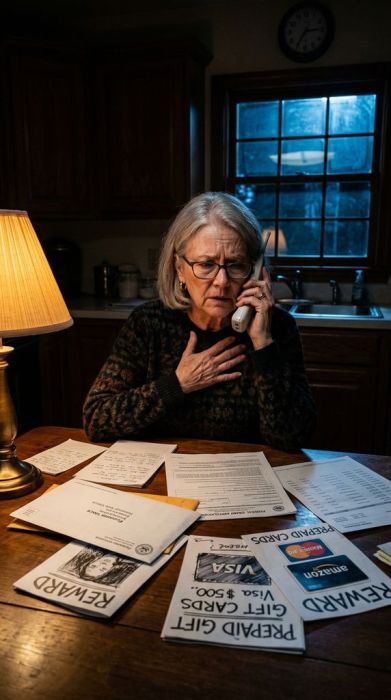
And she would learn that the friendly woman who started calling her the following week, a woman named Patricia who claimed to be a "senior financial advocate" from a government program, was not a government employee at all. Patricia was warm and maternal, and she convinced Marion that a small "processing fee" was necessary to unlock a government grant that would cover Danny's invoices.
"You qualify for it, honey, it's for widows in your situation," Patricia said soothingly. "We just need to verify your accounts first. It's standard."
It was not standard. It was a fishing expedition, a way to map out every bank account, every investment, every dollar Frank had worked his whole life to save. Marion gave her the numbers without hesitation, because Patricia had been kind to her, and because kindness had become a currency she paid with her own safety.
It was her son Mark who finally noticed. Mark lived across the country in Portland, and they spoke on the phone every Sunday. He had not visited in nearly a year, and guilt pulsed under every one of those Sunday calls. When Marion mentioned, almost in passing, that she had hired a lovely contractor named Danny and had everything under control, Mark heard something in her voice that made the hair on his arms stand up.
"Mom, who is this guy exactly?" Mark asked. "Can you pull up your bank statements and read me the charges from the last month?"
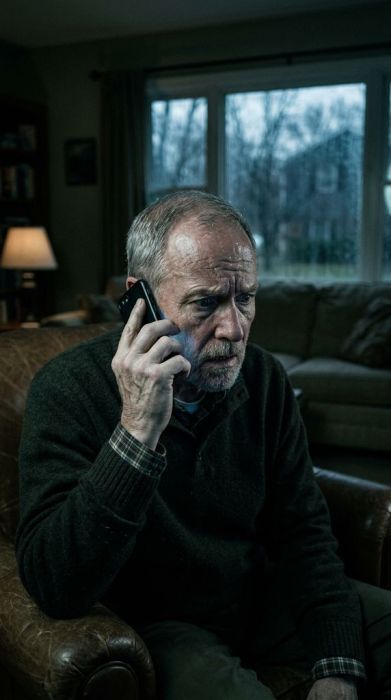
Marion laughed it off, but she did it anyway, and as she read the list aloud, the line went very quiet on the other end. There were charges she did not recognize. There was a wire transfer for eighteen thousand dollars to an account she had never heard of. There were credit cards opened in her name that she could not remember approving.
"Mom, listen to me very carefully," Mark said, his voice tight and low. "Do not sign anything else. Do not give that man any more money. I'm getting on a plane. I'll be there tomorrow."
It gave Marion a strange feeling, hearing her son sound so much like his father. But even then, some stubborn part of her wanted to defend Danny. He had been kind to her. He had sat with her on the porch. He had told her she reminded him of his mother.
The confrontation happened on a Thursday afternoon in the bank where Marion had kept her accounts for nearly thirty years. She had gone in to speak with the branch manager, a kind woman named Ruth who had known Marion and Frank for decades, and Ruth had pulled up the account and gone very pale.
"Marion, there's a notarized power of attorney on file here," Ruth said slowly, turning the screen so Marion could see. "It's dated three weeks ago. It authorizes the signature of a Daniel Corbin on all of your accounts. Do you know anything about this?"
The room seemed to tilt. Marion gripped the edge of the desk. "I signed papers," she said faintly. "He told me they were for the permits. He said they were standard forms."
Ruth looked at her with an expression Marion had never seen on her face before, a mixture of sympathy and alarm. Ruth had seen this before. She had seen it with other widows, other lonely people, other trusting souls who had been stripped piece by piece by charm and kindness.
The police came, and then the detectives, and then the cold realization that Danny Corbin was not who he had said he was. His real name, it turned out, was Dale Crandall, and he was wanted in two other states for the exact same pattern of fraud, targeting elderly homeowners he had charmed and then quietly bankrupted. The woman named Patricia was his sister. Together they had drained Marion's savings, opened credit lines in her name, and put a lien on her house that she had lived in for forty years, a house her grandchildren had been born and raised in, a house that held every memory she had left in the world.
The hearing was held six months later in a federal courthouse in Phoenix. Marion sat in the front row, small and gray in a navy blue dress, her son Mark beside her holding her hand. Dale Crandall sat at the defense table in an orange jumpsuit, and for a long moment Marion looked at him, trying to find the warm, kind man who had sat on her porch and told her she reminded him of his mother. She could not find him. That man had never existed. He had been a construction of smiles and sympathy, built to take everything she had.
The judge sentenced him to eleven years. The jury had heard from eleven other victims, men and women across three states, all of them lonely, all of them trusting, all of them undone by the same gentle voice.
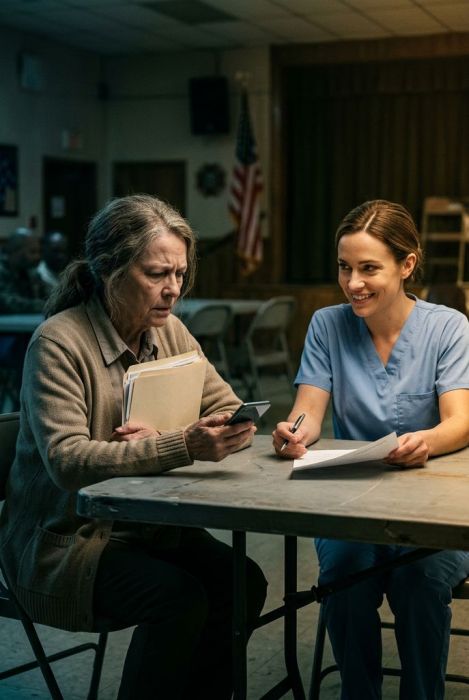
It took Marion two more years to get her house back, and longer than that to rebuild her savings, and she never fully got back the belief that the world was full of people who meant her well. But she learned something in that courthouse that she carried with her for the rest of her life, something she now tells every widow she meets at the senior center where she volunteers. She tells them that kindness is not proof of safety, that charm is not evidence of honesty, and that no one who loves you will ever pressure you to sign things you have not read or to hand over your money without a witness.
"You don't have to be cruel to protect yourself," Marion says now, patting the hand of a woman who has come to her with tears in her eyes and a story that is far too familiar. "You just have to slow down. You have to let someone you trust look at the papers. You have to remember that the people trying to take everything from you are very often the ones who made you feel safest."
It is not an easy lesson. Marion knows that better than anyone. But she tells it anyway, over and over, to every lonely heart who will listen, hoping that someday the warning will reach someone before the damage is done. Because she knows now that the hardest part of being kind is learning when kindness is being used against you, and the only way to survive it is to make sure you are never, ever alone in the room with the papers.