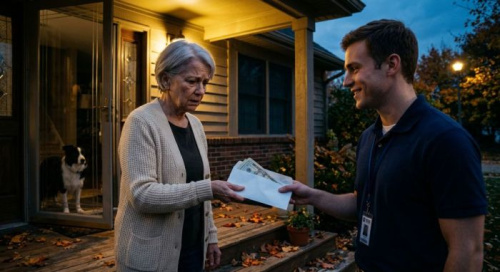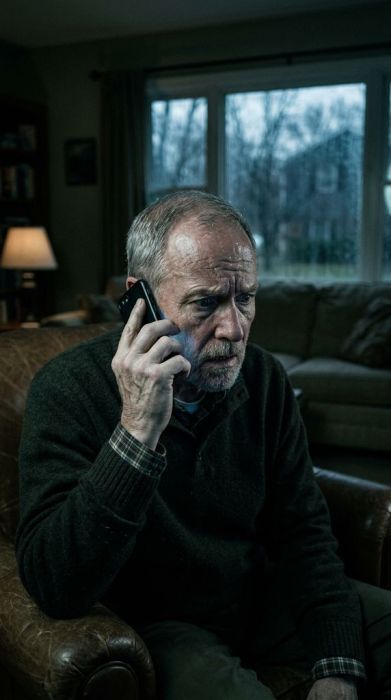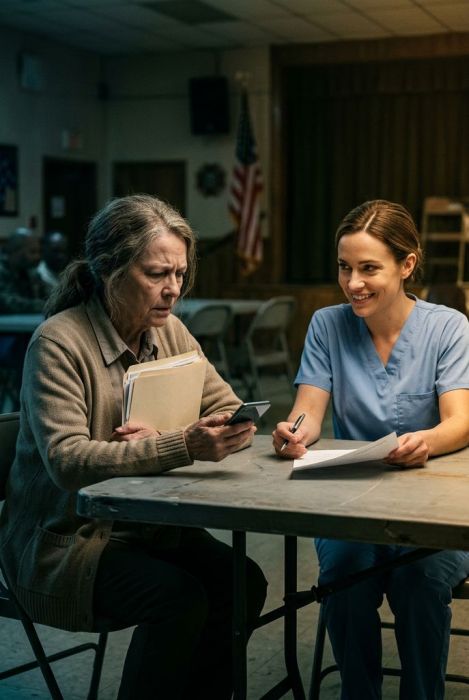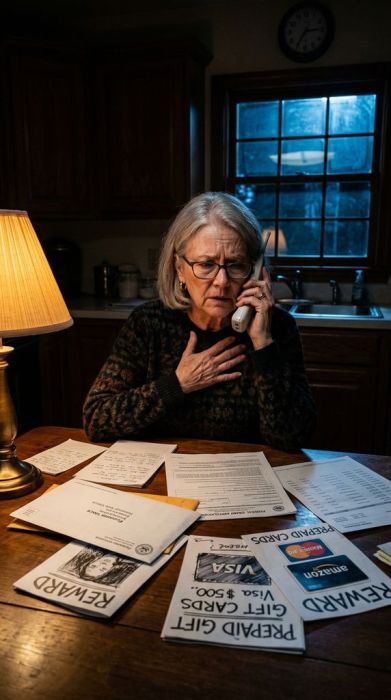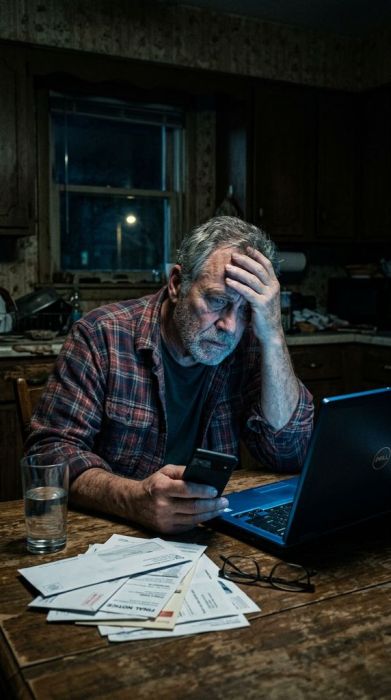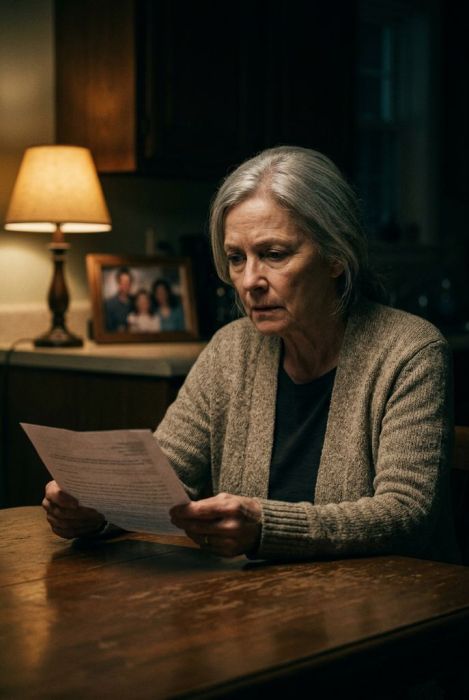
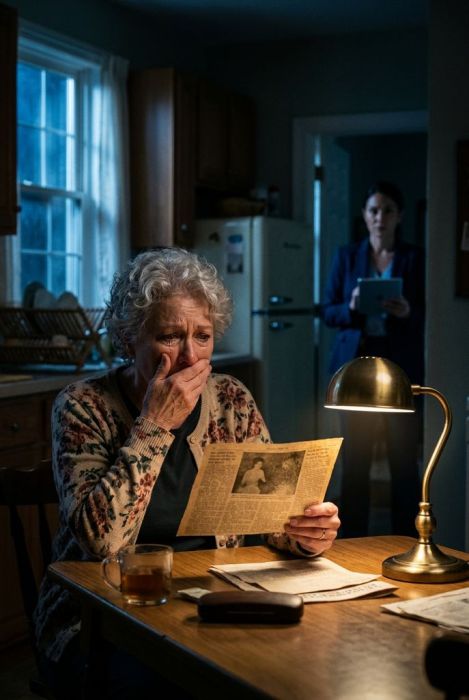
The detective showed up on a Tuesday, three weeks after Ruth Callahan's world had finally started to feel small again. She was folding laundry — Tom's old flannel shirt that she still could not bring herself to donate — when the knock rattled the front door. Two people stood on her porch: a woman in a sharp navy blazer with a badge clipped to her belt, and a young officer holding a tablet.
"Mrs. Callahan? I'm Detective Mara Osei, Columbus Police. May we come in?"
Ruth's first thought was Karen. Her daughter drove home from Chicago every six weeks, and she had not mentioned a trip. "Is my daughter all right?"
"She's fine, ma'am. This isn't about your daughter." The detective glanced down the quiet street, then back at Ruth. "We're investigating a man named Gregory Vance. Does that name mean anything to you?"
Ruth shook her head and invited them in because her mother had raised her to be polite, and because the word investigating made coffee seem urgent. She was filling the pot when the young officer turned the tablet around.
"Do you recognize this man?"
The photo was a booking photograph, grainy and old. A man with a kind face and tired eyes, salt-and-pepper stubble, a soft smile that looked out of place beneath an arrest number. Ruth's hand froze over the coffeemaker.
"That's Dale," she said. "Dale Mercer. He's my bereavement counselor."
The silence that followed told her everything she did not want to know.
Six weeks earlier, Ruth had buried her husband of forty-three years. Tom Callahan had been a high school football coach, a man who yelled encouragement from the sidelines and fixed every squeaky hinge in the house on Kenwick Road. He died on a Saturday afternoon in June, mowing the lawn with his shirt off, the way he always did, a heatstroke heart attack that took him before he hit the grass. The funeral at Delgado & Sons was beautiful and unbearable, and then the world moved on without him.
Ruth did not move on. She drifted through the empty rooms, opening closets and closing them, cooking for two and scraping half of it into the trash. Her daughter Karen called every night, but Karen was a CPA in Chicago with two teenagers and a husband who traveled, and Ruth could not bring herself to be another burden.
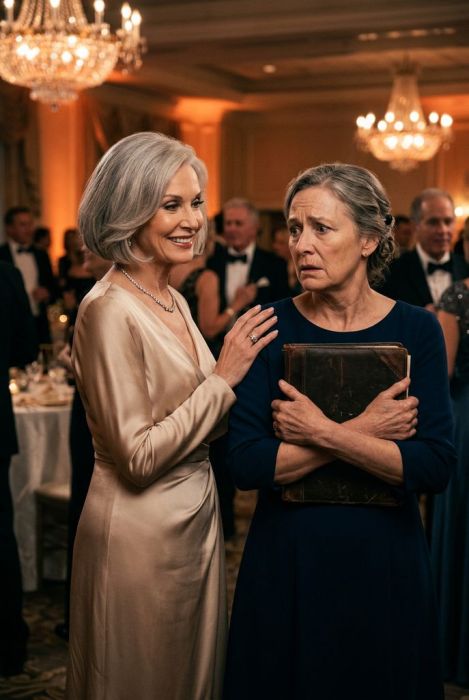
She met Dale Mercer at the cemetery. She had gone to sit by Tom's grave on a Thursday, and she was crying so hard she did not hear the footsteps on the path. A voice said, "Some days are harder than others." She looked up to see a man in a soft gray suit, maybe fifty, holding a single white rose. He introduced himself as Dale Mercer, a family care specialist, and explained, with gentle embarrassment, that he visited his own mother's grave on the fifteenth of every month. Two years ago, he said, he had handled her funeral alone, and the grief had nearly broken him.
Ruth did not know why she told him about Tom. Maybe because he was a stranger, and strangers are easier. She told him about the lawn mower and the flannel shirt and the way the house smelled different now, like dust and silence. He listened without interrupting, and when she finished, his eyes were wet.
"You're not alone, Ruth," he said. "That's the first thing nobody tells you. You're not alone."
They met again the following week, at the cemetery, and then for coffee at the diner on Morse Road. He asked about her grandchildren, her garden, her aching knees. He laughed at her stories and remembered every detail. And one afternoon, over decaf and pie, he brought up the thing Ruth had been avoiding.
"Can I ask you something personal?" He set down his cup. "Do you have a plan for yourself?"
"A plan?"
"I mean a funeral plan. Pre-need." He shook his head. "I know it sounds morbid. But my mother didn't have one, and I had to make twelve thousand dollars' worth of decisions in a week, during the worst week of my life. I don't want that for Karen."
He pulled a brochure from his jacket. Evergreen Memorial Services, it said in soft green letters. Pre-Need Peace of Mind. It offered cremation, a bronze urn, a memorial niche at Greenlawn Cemetery, and something called forever care — groundskeeping, annual remembrance events, a dedicated family liaison. The price was listed at eighteen thousand seven hundred dollars.
"Full payment this month gets you a locked rate," he said. "Fourteen five. It's a promotion we run in the summer, before people start thinking about the holidays. I did the same plan for myself. It's the most peaceful feeling in the world, knowing it's handled."
Ruth stared at the brochure. It sounded reasonable. Karen was always saying they should have end-of-life talks, and Tom had handled everything, and what would happen to her if she just... didn't prepare? She thought of Karen flying in from Chicago to clear out this house, making decisions alone at a funeral home, the way Ruth had done for Tom.
"Does this go through a real funeral home?" she asked.
Dale smiled. "We're partnered with the best in Franklin County. Delgado & Sons — the same place that handled Tom. They're listed right there in the fine print."
She looked. Delgado & Sons Funeral Home, the contract said, in small letters beneath the Evergreen logo. She had signed Tom's paperwork in that very building. It felt like a sign, like Tom whispering from somewhere that this was safe.
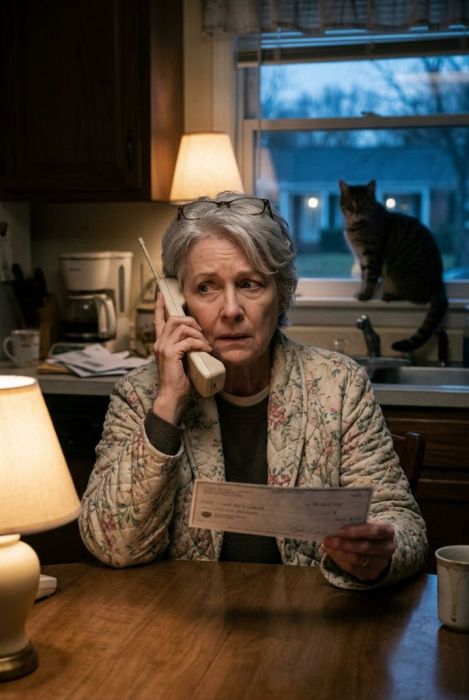
She wrote the check that afternoon. Fourteen thousand five hundred dollars from the rainy-day account she and Tom had kept for decades. Dale hugged her at the door, and she felt the wetness on his cheek.
"You just did the bravest thing," he said. "Now you can live."
Karen called two nights later. "Mom, who is this guy you keep mentioning?"
"He's my bereavement counselor, honey. He's been so kind."
"Mom." Karen's voice had that sharp accountant edge. "Funeral homes don't sell plans door to door like vacuum cleaners."
"He doesn't sell door to door. I met him at the cemetery."
"At the cemetery? Mom, that's the oldest scam in the book — a stranger approaches you at a cemetery—"
"He lost his mother too," Ruth said, and hung up, because it hurt to hear her daughter treat her like a child.
But the doubt had been planted, and it grew in the dark like everything else. Dale started coming by more often. He brought her groceries and drove her to her cataract appointment and sat with her at the diner, and he called her Ruthie, the way Tom used to. He talked about the future — their future, it seemed, though he never said so openly. He was warm, always warm, and he made the empty house feel less empty.
Then the questions began. Not pushy, never pushy. Just gentle, careful questions. Did she have power of attorney arranged? Did the kids know where she kept the deed to the house? What about the certificate of deposit her bank had mentioned, the one from her mother's estate? "Sixty thousand dollars just sitting there, Ruth. Earning nothing. You know Evergreen has a trust program — four percent, tax-deferred, protecting your legacy."
He brought a stack of forms. "This is just so your wishes are protected. Beneficiary updates. Nothing scary."
She almost signed. The pen was in her hand. She remembered thinking how safe she felt with him, how seen, how loved. And then, for no reason she could explain, she put the pen down and said she wanted to think about it.
The next morning, Ruth stopped by Delgado & Sons to pay the last invoice from Tom's service. Frank Delgado himself came out from the back, a big soft man with a florid face who had known three generations of her family. He looked at her over his reading glasses.
"Everything taken care of, Mrs. Callahan?"
"Oh, yes," she said. "I've actually got my own arrangements in hand now."
"That's good," Frank said. "Smart. Who'd you go with? I can tell you who's legit and who's fluff."
"Evergreen Memorial. A gentleman named Dale Mercer."
Frank's pen stopped moving. He looked at her for a long moment. "Evergreen," he repeated. "Mrs. Callahan, I've been licensed in Franklin County for thirty years. I know every pre-need provider from here to Delaware County. I've never heard of Evergreen Memorial Services."
"The contract lists your funeral home," Ruth said, and her voice sounded thin and far away. "Right in the fine print. You're their partner."
Frank went very still. He asked to see the paperwork, and Ruth drove home with her heart pounding and brought it back, and Frank spread it across his desk and stared at it for a long time. Then he picked up the phone and called a number she did not recognize.
"This is Frank Delgado," he said. "I need you to run a name for me. Gregory Vance."
Ruth sat in the chair and watched his face change. When he hung up, he looked at her with something close to grief.
"That stamp," he said, tapping the contract, "is a photocopy of ours. And the man you know as Dale Mercer — well. In 2011, a licensed funeral director named Gregory Vance was charged in Akron for stealing four hundred thousand dollars from pre-need trust funds. He served three years. The Ohio Board revoked his license. He's been unlicensed since."
The room tilted. "That can't be," Ruth whispered. "He cried at Tom's grave. He cried with me."
"He's good," Frank said gently. "That's the thing. They're always good."
She called Karen from the parking lot, and Karen drove down from Chicago the same night. Together, they found everything. An old Dayton Daily News article with Dale's face and a different name, and a second article from Cleveland, and a third from Indianapolis, each one a few years apart, each one about bereaved widows and money that vanished into a check-cashing store. Evergreen Memorial Services was a P.O. box and a rented suite in a strip mall on the west side of Columbus.
Detective Osei had been building a case against Gregory Vance for months. Three widows had come forward. Ruth was the fourth — the one who had the signed contract, the one whose daughter had saved every text.
The sting happened on a Friday afternoon. Ruth called Dale and told him, her voice shaking, that she had decided to move the certificate of deposit into the Evergreen trust program. She would bring the paperwork to his office. He was delighted. He promised to have fresh coffee.
The office was clean and nearly empty, one desk, two chairs, a box of tissues, a picture of a woman Dale said was his mother. Ruth sat across from him and opened her folder, and Dale was just reaching for the papers when the door opened and Detective Osei walked in, followed by two officers in plain clothes.
For one second, Dale Mercer kept smiling. Then he looked at Ruth, and the warmth drained out of his face like water from a sink.
"You called them," he said. "Ruthie. You called them."
"You told me I wasn't alone," Ruth said. Her voice did not shake anymore. "I believe you. I'm not."
They read him his rights and led him out in handcuffs, and for the first time Ruth saw the face under the kindness, the tired, ordinary face of a man who had done this many times before and would have kept doing it. At the courthouse, three months later, Ruth sat in the front row and watched him plead guilty to fourteen counts of theft from an elderly person. Frank Delgado sat beside her. Karen held her left hand.
The judge spoke for a long time about trust and vulnerability and grief. Gregory Vance was sentenced to seven years. Restitution was ordered, though everyone in the room knew the money was long gone — most of it, Ruth's fourteen-five, had been cashed the same afternoon she wrote the check.
Ruth never got the money back. But standing on the courthouse steps in the gray November light, her daughter's arm through hers, she realized something that felt more valuable. The house on Kenwick Road still smelled like dust and silence, and Tom's flannel shirt still hung in the closet. But she had stopped being afraid of the quiet, and she had stopped believing that kindness and proof were the same thing.
Her daughter squeezed her arm. "You okay, Mom?"
"I'm going to be," Ruth said. And for the first time in six weeks, she believed it.
She still talks to Tom every morning. She still keeps his shirts. But now she asks questions before she signs anything, and she calls her daughter before she writes a check — because grief opens doors, and sometimes the kindest strangers are the ones who know exactly how to walk through them. The awareness she carries now is simple: real funeral homes do not come knocking, no legitimate plan demands a same-day discount, and the people who love you most will ask hard questions. Listen to them.