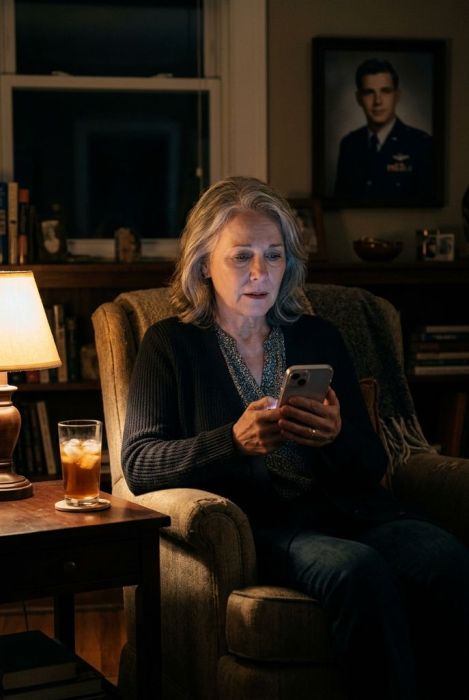
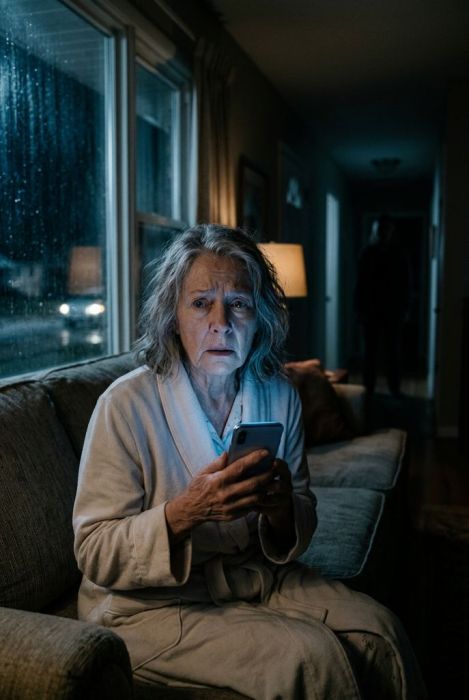
The text arrived at 2:13 in the morning, and for a full minute Nora Whitfield was certain she was still dreaming. She had been asleep in the dark of the bedroom she had shared with Tom for forty-one years, and the chime that woke her was not one she recognized. When she reached for her phone on the nightstand, the screen glowed with his name: Tom. Below it, three words that turned her blood cold: "Nora. It's me."
Tom had been dead for fourteen months.
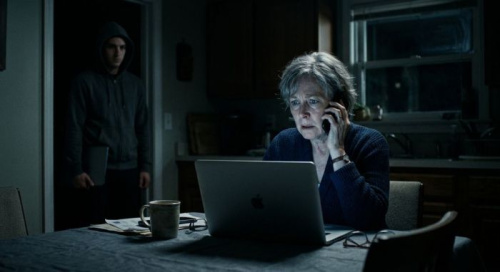
She sat up so fast the room spun. Her hands shook as she opened the message, certain it was spam, a spoofed number, a cruel algorithm mistake. But the number was his. The same number she had dialed a thousand times, the same line she still paid nine dollars and ninety-nine cents a month to keep active because she could not bring herself to cancel it. She pressed the call icon before she could think. It rang three times, and then his voice filled her ear — not a recording meant to deceive, but the actual, familiar sound of Tom clearing his throat the way he always did before he spoke.
"Hi, you've reached Tom. Leave a message and I'll call you right back."
She hung up without leaving one. The voicemail was fourteen years old; he had recorded it on an old flip phone. She had heard it a thousand times, and now it played in her chest like a blade. Then a second message vibrated against her palm.
"I know how this sounds. Please don't call anyone yet. Just read."
Nora Whitfield was sixty-eight years old, a retired school librarian who had spent her whole quiet life in Albany, New York. She was not a woman given to fantasy or superstition. She had seen Tom's body. She had held his hand in the hospital room while a machine breathed for him, and she had watched the doctor write the time of death on a clipboard — 3:47 in the afternoon, a Tuesday in July, in a garden full of roses he would never see bloom. Her grief was fourteen months old, and it had settled into her the way weather settles into old bones. But the messages that came from his number did not read like a haunting. They read like Tom.
"Nora-bear, I know you think I'm gone. I'm not. Not the way they told you."
"You remember the key under the oak? I never told anyone but you."
"Our song. The one from the wedding — not the one everyone thinks it was."
She had to lay the phone flat on the blanket to type, her hands shook so badly. Only two people in the world had ever known about the key under the oak: her and Tom. They had buried it in 1982, the summer they bought the house on Hone Avenue, and neither of them had spoken of it in thirty years. And the wedding song was a detail she had never told anyone — not Amy, not her sister, not her closest friend. If a stranger had somehow gotten Tom's old number, there was no universe in which they could know these things.
Unless Tom was alive.
She did not sleep that night. At dawn she walked to the backyard in her good coat and knelt at the oak with a garden trowel, and her breath caught when the metal hit something. The key was still there, rusted at the seam, exactly where it had always been. So how, she asked herself, how had a text message known about it?
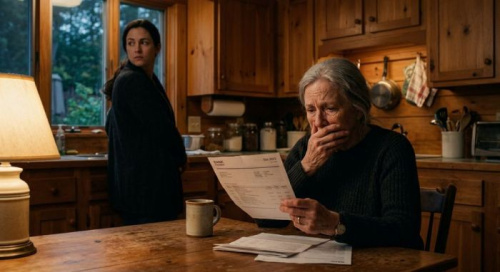
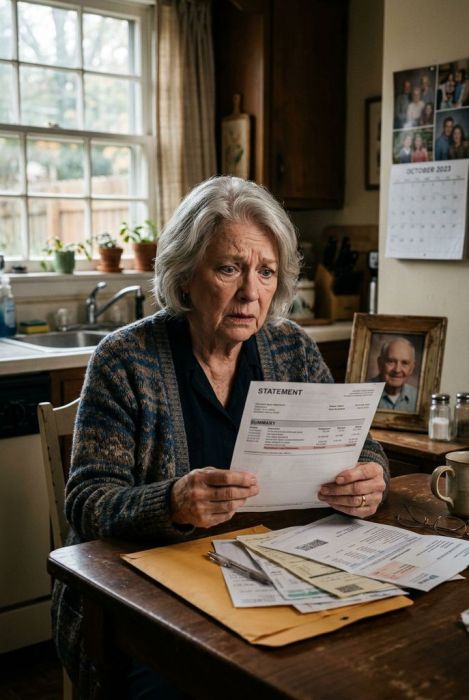
She went to the bank that morning and withdrew two thousand dollars in cash, because the man texting from Tom's number — the man who said he was Tom — had asked her not to tell anyone, not yet, not until he could explain. He said he was in trouble. He said the hospital had given him something that stopped his heart and then started it again, that the people who had helped him were dangerous, and that his own death certificate had been part of a deal to protect her. He said he needed her to move the insurance money — all two hundred and twelve thousand dollars — into an account where "they" could not reach it. Just for a little while.
It sounded insane. It sounded exactly like the fraud warnings she read in the AARP bulletin and saw on the evening news. And yet the texts kept coming, and they kept being right.
She almost called the police. Twice. Both times she typed the number and then deleted it, because what would she even say? That her dead husband was texting her? That a ghost and an oak tree key had convinced her to wire her savings to a stranger? She could hear the kindness in the dispatcher's voice, and she could not bear it.
So she called Amy instead, on Sunday night, three days after the first message. Amy was forty-four and lived in Boston, an administrator at a children's hospital, practical and exact, and she could always hear something in her mother's voice that no one else could.
"Mom? You sound strange. What's wrong?"
"Nothing. I just — I wanted to hear your voice."
"Mom. It's nine o'clock on a Sunday. What is wrong?"
Nora told her a little of it. Not the texts. She said she had been having strange dreams about Dad, that she was thinking about canceling his phone line, that maybe she needed to get out of the house. She could hear Amy's worry hardening into a plan, the way it always did.
"I'm driving down next weekend. We'll have dinner. We'll talk about it. Okay?"
"Okay."
The texts stopped for two days, and Nora began to believe she had imagined the entire thing. Then, at 1:47 in the morning on Thursday, a photograph arrived. It was her and Tom at their fortieth anniversary dinner, laughing at the little Italian restaurant on Lark Street, her hand on his cheek. She had never posted that picture. Never texted it to anyone. Never shown a soul. It existed only in the private cloud backup of Tom's old phone.
The old phone that Miriam had taken "to a shop" six months earlier.
Nora's stomach dropped. Miriam Vale. Sixty-one years old, soft-voiced, from the bereavement circle at St. Andrew's — the woman who had lost Frank to cancer and had become Nora's closest companion in the months after the funeral. Miriam was the one who had said, Don't you dare cancel Tom's number, sweetheart — I canceled Frank's and I've regretted it every day. Miriam had come over to help sort Tom's study, had held her while she cried, had gently taken the old iPhone from her hands and promised to see if a repair shop could recover the photos inside. Six months ago. Later, Miriam had said the shop found nothing; the phone was dead; it was probably for the best.
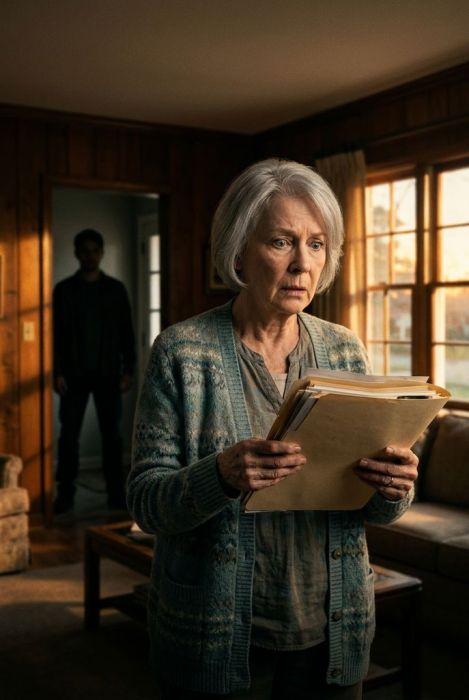
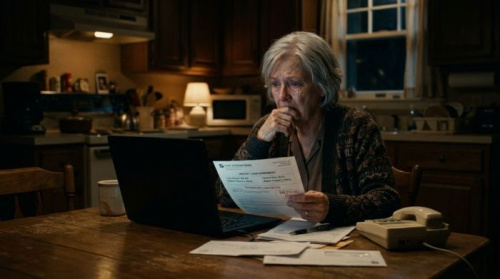
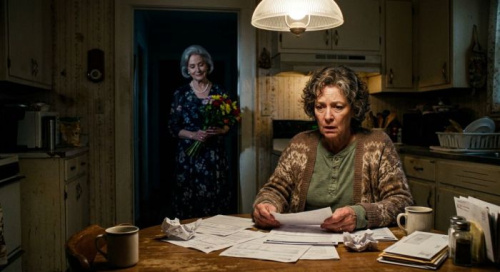
Nora opened the kitchen drawer and found the manila folder Miriam had organized so carefully — the life insurance policy, the payout statements, the account numbers, every page under a neat labeled tab. Miriam had photocopied every document. "For your records, sweetheart," she had said. "Paperwork is a monster when you're grieving."
The phone buzzed again. "Open the folder. Page four. The savings account. Move it tonight and this ends. I'll explain everything tomorrow. I promise."
Nora's hands were ice. She stood very still in her kitchen while the refrigerator hummed and the clock on the wall ticked, and she understood everything at once. Miriam had never taken the phone to a shop. She had kept it. She had replaced the SIM card in Tom's number through a lost-card request, using the details copied from the folder, and she had signed into his old cloud account — fourteen years of photos, playlists, saved passwords, and notes. The key under the oak: Tom had typed its location into a memo in his phone. The wedding song: it sat in his playlists, untouched for years. The anniversary photograph: his phone had synced it the night he took it. And Miriam knew Nora better than anyone on earth, because knowing the grieving was her job.
Nora called Ruth that night — the widow from the circle who had stopped coming in the spring. She called instead of texting, because suddenly texting felt like walking through a room she could not see. Ruth's voice was raw, and slowly, in pieces, Ruth told her that her own late husband's number had started messaging her in April. That she had moved a hundred and eighty thousand dollars into a "safe" account at the direction of the kind woman from the grief circle who had helped with her paperwork. That the money was gone. That the woman had stopped answering. That she had been too ashamed to tell anyone.
Nora hung up and sat down on the kitchen floor, and for the first time in fourteen months she did not feel grief. She felt cold, clean rage.
She called Amy first, then the police. She did not reply to the texts. She did not move a single dollar. Detective Ryan O'Brien listened to the whole story without interrupting, and when she finished, he slid a folder across her kitchen table. Three other names. Three other families. A pattern of widows receiving messages from the dead, every one of them tied to a grief circle led by Miriam Vale, that the fraud unit had been quietly tracking for the better part of a year.
The confrontation happened three weeks later, in the coffee shop on Lark Street, at a table by the window where the winter light came in gray. Two detectives sat at tables nearby. Nora walked in carrying a canvas bag with a decoy envelope inside, and she watched Miriam's face bloom with rehearsed worry.
"There you are, sweetheart. I was so worried about you."
"Drop it, Miriam. I know about the SIM card. I know about the cloud account. I know about Ruth."
Miriam's smile did not flicker, but something behind her eyes went flat — the smooth, patient calm of a woman who had done this before. "I don't know what Ruth told you, but —"
"He knew about the key under the oak." Nora's voice did not shake. "You went through his notes. His passwords. His messages to me. And you sat beside me at church and held my hand while you did it."
Detective O'Brien's hand closed on Miriam's arm before she could stand. At the table by the window, Ruth was crying quietly into a paper napkin. And on Nora's phone, the sweet, impossible texts from a dead man had gone silent at last.
They charged Miriam with wire fraud, identity theft, and forgery, and in the months that followed the investigation reached back into two other states, where she had run the same play under different names, different churches, different circles of freshly grieving women. Nora learned the mechanics of it all in pieces: how the number of the dead is quietly recycled by carriers, how a lost-SIM request backed by a few identifying digits is often enough, how a cloud backup never dies when its owner does, and how a grieving widow's passcode was written in the very folder Miriam had so kindly organized. The weapon had never been technology. The weapon had been kindness, aimed with patience.
Nora never moved the money. The two thousand dollars stayed in a kitchen drawer until she donated it, along with the rusted key, to the library's literacy fund. She canceled Tom's line on the first anniversary of his death, and the next morning she stood under the oak without a phone in her hand and listened to the wind move through the branches. She did not need a screen to remember the sound of his voice. She walked inside, made tea, and called Ruth to check on her, the way she did every Sunday now.
In the spring, she started a new workshop at the library — not a grief circle, a "digital life" class — where she taught other widows, patiently and without lecturing, that the dead leave more behind than memories. Bills. Accounts. Passwords. Numbers that can be resurrected. And that the living who truly love you will never, ever ask you to keep a secret from the police.