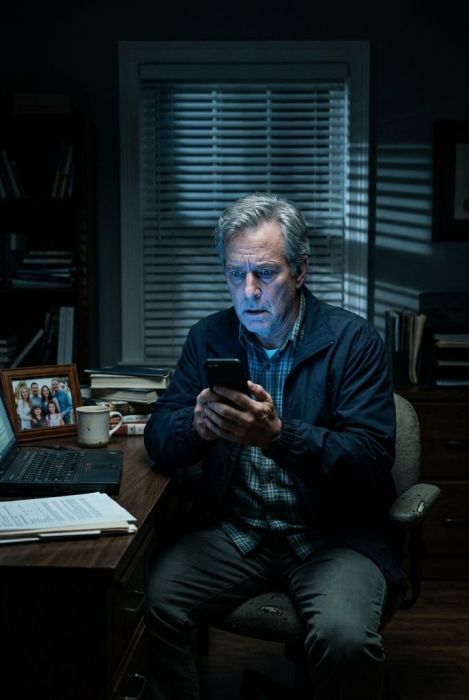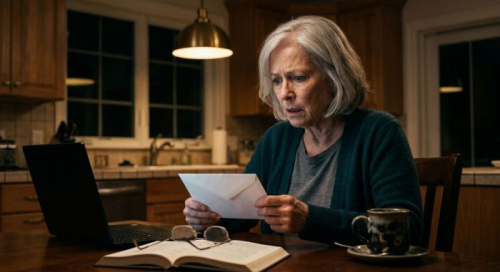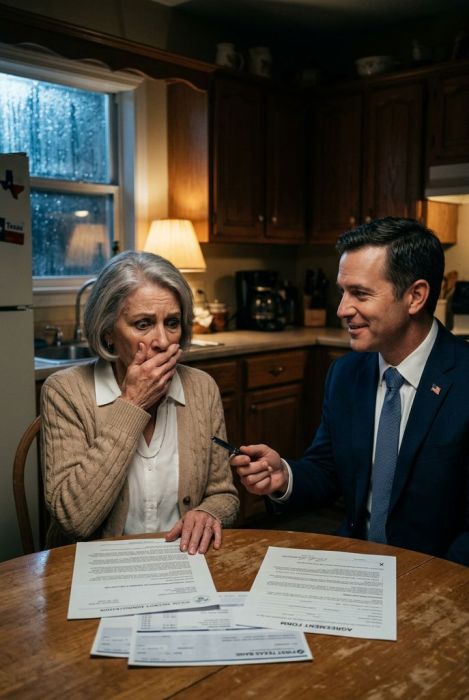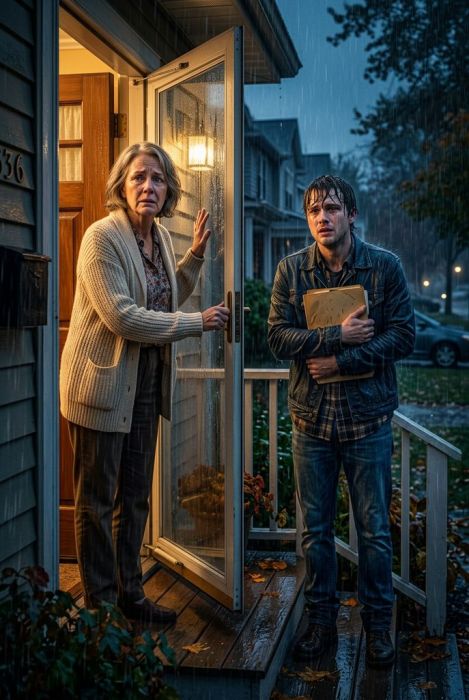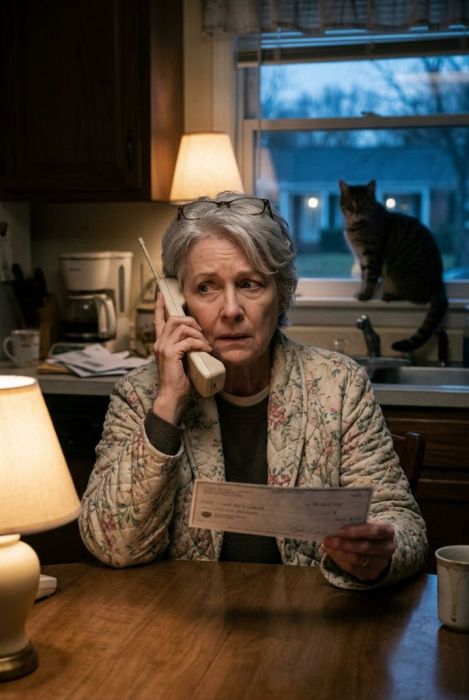

The call came at 7:14 on a Tuesday night, and Margaret "Maggie" O'Donnell nearly let it go to voicemail. She was sixty-eight, a retired school secretary, and she had lived by the simple rule that nobody important calls after seven. But the screen said Great Plains Credit Union, and Great Plains had never called her at night before, so she answered.
"Mrs. O'Donnell, this is Erin Bakke in our fraud department." The young woman's voice was careful, the way voices get before bad news. "We're holding a check for two thousand, one hundred fifty dollars, payable to a company called Omaha Home Services and drawn on your checking account. The signature appears to match yours. Can you confirm you wrote it?"
"I most certainly did not." Maggie pulled her reading glasses down from her head and stared at the calendar above the phone. "I don't even know a company called Omaha Home Services." There was a pause, and then Erin Bakke asked the question that would follow Maggie around for two months: "Ma'am, has anyone had access to your checks recently?"
The honest answer was that Maggie O'Donnell had never once thought about it. She had been married to Don for forty-one years, and Don had managed the checkbook until he died of a heart attack in the Bowl-A-Rama parking lot in 2017. After that, Maggie took over the way she took over everything else: carefully, stubbornly, and entirely by hand. She paid the electric bill by check. She paid the lawn service by check. And every March, she mailed a birthday card with a check inside to her sister Ruth, and every March Ruth called to thank her.
Except this year, Ruth never called.
When Maggie finally phoned her sister in late April, Ruth had answered in that drifting, dreamy voice that Alzheimer's had been stealing from her for three years, and she said something that lodged in Maggie's chest like a splinter. "Did you send me money? There's a lady here says I have to sign things." Maggie told her not to sign anything, that she would drive over first thing, and Ruth said, "Okay, Maggie," the way she said everything now, sweet and lost and already forgetting.
Ruth Carpenter was seventy-four, a widow who lived alone in the little brick house on Vinton Street in west Omaha, where she had raised two sons who now lived in Oregon and Florida. When her memory began to fail her in earnest, the sons had done what families do from a thousand miles away: they hired help. That help was Tina Reyes.
Tina was forty-one, warm and quick to laugh, with a soft voice and a way of smoothing Ruth's hair that Maggie had always found genuinely touching. She had been with Ruth for two years. She knew Ruth's medications, her blood pressure numbers, her allergies, her favorite hymns, the name of the pastor who visited, the name of Ruth's dog that had died in 2014. She was, everyone agreed, a godsend.
Tina also collected the mail.
You might wonder when Maggie started to connect the dots. That is the thing about stories like this: the dots never connect in real time. They scatter. And by the time someone gathers them up, the ground underneath is already gone.
The first fraudulent check was not the last. Two weeks after Erin Bakke's call, a second check appeared, this one for three thousand eight hundred dollars, payable to an "R. Alvarez," drawn on Ruth's account at the same credit union. Maggie was a signer on Ruth's account, had been for years to help with the bills, and when she walked into the branch to ask what on earth was happening, the manager's face told her everything she needed to know before he said a word.
"Mrs. O'Donnell, we've flagged about eleven suspicious checks across both your account and your sister's over the past six weeks," the manager said, spreading printouts across his desk like a losing hand of cards. "They all cleared with signatures that our examiners can't verify against file."
Maggie took the papers home and sat with them at the kitchen table for two hours. The signatures looked like hers. They looked like Ruth's. They looked like what someone who wanted to imitate both hands would produce with plenty of time and plenty of samples. And then, with a small, cold drop in her stomach, Maggie remembered the birthday card.
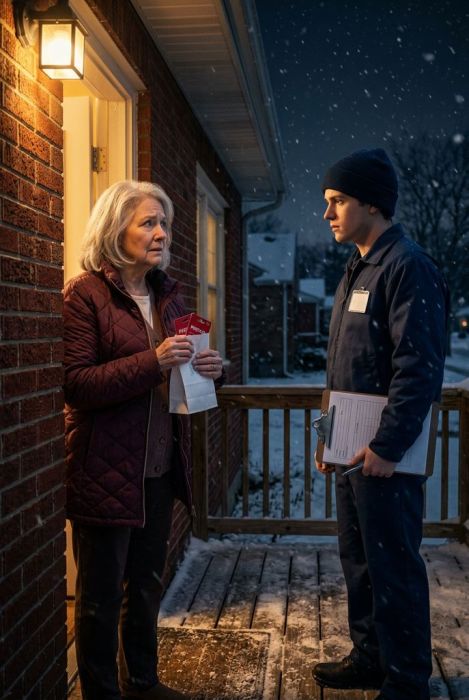
She drove to Vinton Street that afternoon. Tina met her at the door with a wide, sympathetic smile and a cup of tea already poured. "Oh, Mrs. O'Donnell, I heard about the checks. Ruthie told me, or tried to tell me. It's so awful. People pray on the elderly, pray on them, that's what they do. If it isn't the phone scammers, it's the mail thieves."
"Pray on," she said, not "prey on." Maggie noticed it, and then she felt guilty for noticing it, because Tina was being kind, and Maggie was a suspicious old woman with her nerves shot. Tina walked her into the living room, where Ruth sat in her armchair by the window, watching the world go by with the vague patience of someone who had forgotten what she was waiting for. Ruth lit up when she saw her sister. "Maggie! Did you bring me money?"
"No, sweetheart," Maggie said, kissing her forehead. "I brought you cookies." And Ruth nodded, content, the worry already gone like it had never been there. Maggie looked at Tina, who was watching them with those warm, careful eyes, and she told herself she was being foolish. Tina had been with Ruth for two years. Tina had never asked for a thing.
That was the thing about the good ones, Maggie would say later. They never ask for a thing.
Over the next month, the checks kept surfacing. The credit union froze both accounts and issued new checks with a chip and a tamper-proof coating, which helped a little. Maggie switched her own bills to online payments, which helped more. But Ruth's account still bled, because Ruth could not be trusted with a password and Tina was the one who helped her write checks to the grocery store. Maggie asked Tina to start bringing the grocery receipts, "just so I can keep the books straight." Tina smiled and said of course, and the receipts were never once complete.
Meanwhile, suspicion settled over the people around Maggie like dust. There was the mail carrier, Jared, a young man with a cheerful wave who had been delivering on Poppleton Avenue for four years. Maggie reported the missing birthday card to the local post office, and the postmaster's eyebrows had gone up in a way that made Maggie's stomach turn. There was her own grandson, Marcus, a sophomore at UNO who had once borrowed six hundred dollars and paid every penny back. Maggie found herself counting his visits and hating herself for it.
It was Marcus who finally said the thing nobody else would say, one Sunday when he came over to mow her lawn. "Grandma, you've got that look. The one where you're blaming everyone. Mom says you've been up half the night with the bank statements." Maggie had no answer. "Whoever it is," Marcus said, "they know what they're doing. And they're not a stranger. Strangers don't know your sister's birthday."
That sentence followed Maggie around for days. Strangers don't know your sister's birthday. And then, on a gray Tuesday morning in June, the United States Postal Inspection Service rang her doorbell.
Postal Inspector Dan Colter was a square-shouldered man in his fifties with a badge and a manner that suggested he had seen every version of human greed the mail could carry. "We're investigating a pattern of check washing in west Omaha," he said, standing in her doorway with his notebook out. "Someone is stealing checks, erasing the ink with chemicals, and rewriting them for larger amounts to different payees. Your sister's bank reported several. I understand you had a birthday card go missing in March."
Check washing. Maggie had never heard the term. She listened, horrified, as Colter explained the mechanics: a stolen envelope, a few ounces of acetone, a blank check that a thief could turn into anything. "The victims are always the same kind of person," he said, not unkindly. "People who still trust the mail. People who pay their bills with paper."
People like me, Maggie thought. Like Ruth. The inspector asked if she could think of anyone who would know that a check was in the mail on that particular week in March. Maggie thought of Tina, smoothing Ruth's hair, collecting the mail, and she said, "No. No one."
The break came from the strangest place: a dumpster behind a storage facility on L Street. Colter's team had been tracing a series of cash withdrawals made against Ruth's account at three different check-cashing stores, and the camera stills were waiting for Maggie at the police station when she arrived with her heart in her throat. The first showed a woman in a wide-brimmed hat at the counter of a place called L&L Check Cashing, cashing a check for two thousand dollars. The second showed the same hat. The third, from a camera angled just right, showed the chin and the smile beneath the brim.
"Do you know this woman?" Colter asked. Maggie stared at the image for a long time. The smile was familiar in the worst possible way. "I think," she said slowly, "that's my sister's caregiver."
Tina Reyes was arrested on a Thursday morning at the house on Vinton Street, with groceries in her arms and that same warm smile on her face. She denied everything for eleven minutes, which Colter later said was a record for a case with this much paper. Then Detective Okafor from the Omaha PD's financial crimes unit played the video from the check-cashing store and laid out the rest of the evidence: the utility bills opened at Ruth's address, the forged power of attorney document Ruth had signed "for the bank" in a moment of confusion, the prepaid phone, the envelopes stuffed in the trunk of Tina's car. The washed birthday check, payable to Ruth Carpenter for one hundred and fifty dollars, had been found in Tina's dresser drawer, neatly erased and waiting to be rewritten.
"I took care of her," Tina said finally, her voice cracking. "Two years. I gave her baths. I held her hand. I deserved more than ninety dollars a day."
And that was the whole confession, really. The entire two-year fraud, the drained savings, the forged documents, the stolen birthday cards, the sixty-one thousand dollars, reduced to a single sentence about what she felt she deserved.
Ruth was in the living room when they came to take Tina away. She watched the whole thing from her armchair with the vague alarm of a bird watching a window. And then, in one of those flashes of clarity that Alzheimer's allows its victims just often enough to make it cruel, Ruth looked at Maggie and said: "My Maggie wouldn't steal from me. I told her that. My Maggie wouldn't."
It took Maggie a moment to understand. "Who did you tell?" she asked, gently. "That lady," Ruth said, pointing toward the door where Tina had just been led out. "She said you were taking my money. She said you were the one." Maggie sat down on the arm of the chair and took her sister's hands. For the first time in months, she understood the shape of the whole trap.
Part of the evidence in the dumpster had been Ruth's own letters, letters Maggie had written her, opened and photographed, their signatures studied and copied. Tina had been using Ruth herself as the source of information: the details of Maggie's life, her address, her birthday habits, her bank's name. Everything the caregiver needed to forge the sister's hand had come from the sister's own mouth, in the soft, trusting conversations that Tina had always encouraged. "Tell me about your sister," Tina would say, and Ruth would tell her everything, because that is what you do when you love someone.
The charges hit the paper two weeks later: exploitation of a vulnerable adult, forgery, identity theft, and, because the checks had traveled through the United States mail, federal charges of mail theft and bank fraud. Tina Reyes pleaded guilty to the state charges and was sentenced to seven years. The federal case was held over her head like an axe, and the prosecutor made clear it would fall if she ever did anything like this again.
Maggie did not get the money back. That was the hardest part. The credit union returned what remained of both accounts, but the sixty-one thousand dollars, Ruth's savings, Don's life insurance, a lifetime of careful little deposits, was gone. The judge ordered restitution at a hundred dollars a month, so insulting a figure that Maggie left the courtroom before she said something she would regret.
What she did with the rest of that year was the part that changed things. She moved Ruth into Maplewood Memory Care, fifteen minutes from her own bungalow, where the staff wore name tags and the director had to show Maggie her license before Maggie would let her sister through the doors. She visited every day. She paid Ruth's bills online, with two-factor authentication and alerts set on her phone, and she checked both accounts every single morning, the way other people checked the weather.
She bought a locking mailbox and told everyone at the senior center about it. She switched to gel pens, which bleed into the paper fibers of a check and resist the chemicals that thieves use to erase ink, "the cheapest insurance you'll ever buy," she told them. She read her bank statements cover to cover, not because she didn't trust herself, but because she had finally learned that trust and proof are different things.
And she told the story. She told it at the senior center, at the church women's group, at the AARP meeting in the basement of the library. She told it the way the inspector had told it to her, starting with the birthday card and ending with the smile. "If you write a paper check to someone you love, hand it to them. Don't put it in the mail. If you hire a caregiver for an aging parent, have a second person review every single statement, every single month. If someone with power of attorney asks your loved one to sign 'just for the bank,' assume it is a lie until a lawyer says otherwise."
"And if someone tells you that the person you love is stealing from you," she says, and here her voice always drops, "ask yourself who benefits from you believing it. Because sometimes the kindest voice in the room is the one hiding the sharpest hands."
Ruth lived at Maplewood for two more years. On her good days, she would hold Maggie's hand and say, "You're my sister. I remember." On her bad days, she would ask where the lady with the warm voice was, and Maggie would tell her the lady had moved away, which was true in the only way that mattered. Ruth passed away peacefully on a Sunday morning in October, with her sister holding her hand, and at the funeral two hundred people heard the eulogy about a school secretary from Omaha who had learned, at sixty-eight, that the world could still surprise her.
Maggie still pays her bills online. She still checks her accounts every morning. She still has the washed birthday card in a drawer, the one that was going to be a hundred and fifty dollars to a sister who never saw it, a little piece of paper that turned into the most expensive lesson of her life. And whenever she hears about a caregiver, a charity, a grandchild in trouble, or anyone who says, "I'll just take care of it for you," she smiles the way you smile at a thing you have already met before, and she says, "Show me the paper. Show me the paper."