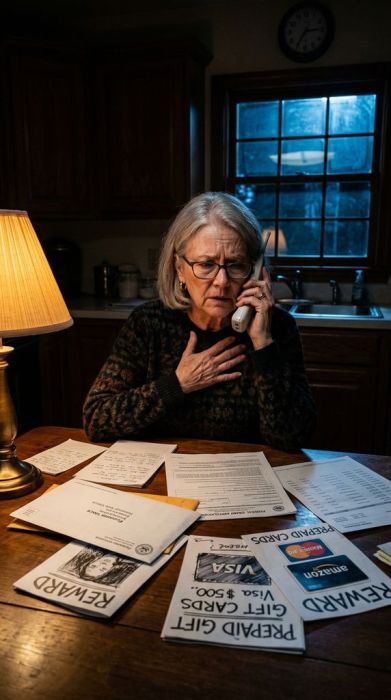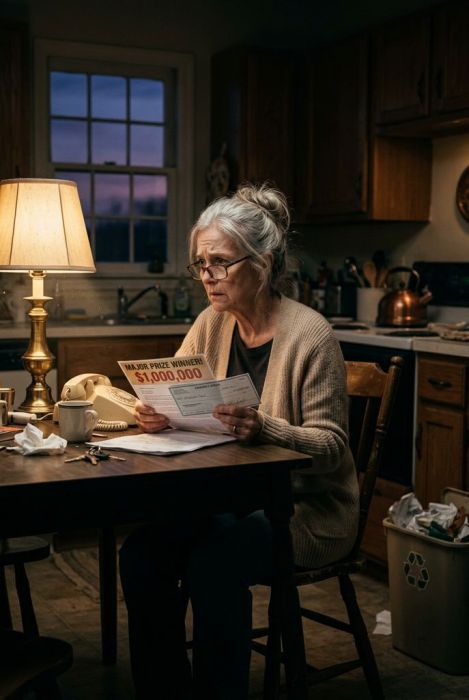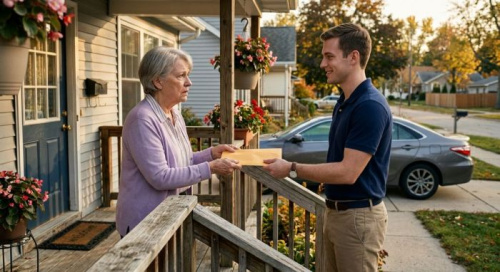
The flyer came taped to the storm door inside a plastic grocery bag, the kind of thing Evelyn Marsh normally recycled without a second look. FREE SENIOR WELLNESS SCREENING. Blood pressure. Balance. Memory. Light refreshments. It named the VFW hall on Pleasant Street, five minutes from her house, on a Tuesday morning when her husband Walter had nothing on the calendar. It should have gone in the trash. What made her keep it was the photograph in the corner — a young woman in blue scrubs smiling the way nurses smile in commercials — and the line beneath it that felt written for her alone. Early detection. Peace of mind. Because your family deserves to know.
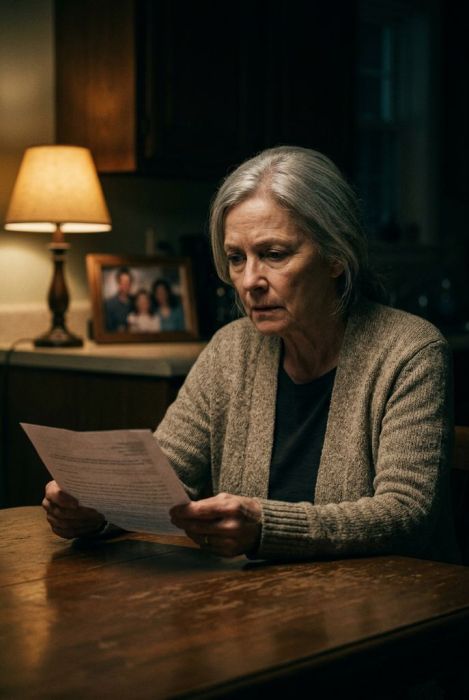
The truth was that Evelyn had been lying awake at three in the morning for months, counting Walter's small slips like beads on a rosary. Keys in the freezer. The garage door left open. Twice he had asked what day it was, and once, at Thanksgiving, he had called their niece by his sister's name. The doctor had said not to worry, that a little forgetfulness was normal at seventy-one, but the doctor hadn't watched him stand in the living room holding the remote control like he could not remember what it was for. Evelyn had told no one. Not Claire, their daughter in Chicago, who was a nurse practitioner and would only start making lists and phone calls. Especially not Claire. Because saying it out loud would make it real.
She had seen this road before. Her own mother had walked it, slowly, floor by floor, until she was a stranger in her own kitchen — and Evelyn had been the one to find her standing in the yard in her nightgown at two in the morning. The fear of that disease lived under her ribs like a tenant she could not evict. So when the Tuesday came, she talked her husband into the car with a lie so gentle it almost felt like the truth. "It's free, Walt. We'll get our blood pressure checked, eat a few free cookies, and be home before the lawn is dry." Walter grumbled about being treated like a lab rat but came along, because that was Walter — seventy-one years old, thirty years a letter carrier, and still helpless against his wife's optimism.
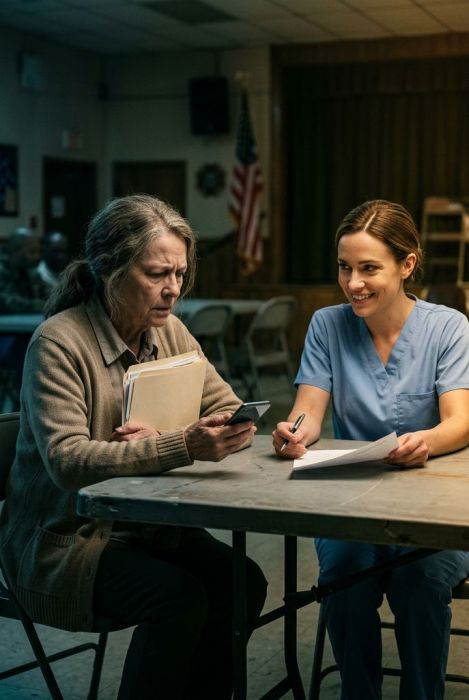
The VFW hall smelled of coffee and floor polish. Tables formed a horseshoe around the room, each staffed by someone in a teal polo shirt with a laminated name tag. At the far end, a young woman in blue scrubs stood beside a sign that read MEMORY SCREENING — DR. M. REYES, MD. Her name tag said Dana Whitfield, RN. She had the kind of smile that arrived a half-second before the rest of her face, practiced and warm, and she looked at Walter the way people look at a winning lottery ticket.
"Mr. and Mrs. Marsh." Evelyn blinked. "Have we met?" Dana's smile softened into something almost shy. "You probably don't remember me. I'm Ruth Callahan's granddaughter. Dani." And then Evelyn did remember. Ruth Callahan had been her best friend for forty years — the woman who had brought a little girl with dark braids into the library story hour every other Wednesday, the girl who grew into a teenager with braces and a backpack full of books. Ruth had died two years ago, quietly, of a stroke. Evelyn had cried at the funeral and then, like people do, let the friendship slip into the past where it could not hurt her anymore. "Your grandmother talked about you all the time, sweetheart," Evelyn said, and the last of her guard came down. A friend of Ruth's was a friend of hers. That was the arithmetic her whole life ran on.
Dana asked about Ruth's passing with just the right sadness in her voice. She asked about Evelyn's garden, which she somehow knew was full of hydrangeas, and about Walter's knees, which she somehow knew had been bothering him on the stairs. It was remarkable, really, how much Ruth's granddaughter remembered. Then Dana moved smoothly to the clipboard. "Before we start, I just need to confirm a few things for our records. Full date of birth, and your Medicare number, just for the file. Standard paperwork." Evelyn hesitated, because her mother had always said never to hand out that number, but Dana waved the clipboard like it was nothing, like she had seen a thousand of them, and Walter was already pulling his card from his wallet. Evelyn did not stop him. That would be the mistake she would replay for months — the first of a dozen small doors she opened because Ruth's granddaughter was the one asking.
The memory screening itself took ten minutes. Dana asked Walter to repeat five words, draw a clock, count backward from a hundred by sevens. She was encouraging, murmuring "good, good," while her pen moved across the paper. Then she studied the results for a long moment, her face shifting into something carefully concerned. "Mr. Marsh, I want to be honest with you. There are some inconsistencies here that I see in early cognitive decline. Now, that sounds frightening, but the reason we do these screenings is that early is the only word that matters." She leaned forward, her voice dropping to a stage whisper. "The good news is that Dr. Reyes has a program that has helped hundreds of patients in your exact situation. He's reviewed your file. He'd like to speak with you personally."
The doctor appeared on a tablet propped against a coffee carafe — a handsome silver-haired man in a white coat, stethoscope around his neck, a bookshelf of gold-embossed spines behind him. The video was slightly pixelated, the sound slightly hollow, like a man speaking from the other end of a long hallway. "Walter, Evelyn — I'm glad you came today," he said, using their first names with an intimacy that made Evelyn's neck prickle. "I've looked at Dana's assessment. We need to start the protocol as soon as possible. The window for intervention is measured in weeks, not years." He talked about neuroplasticity, about a proprietary supplement regimen and twelve months of "cognitive training modules." He quoted percentages. And then, because he was a man who understood fear, he told them the price: twenty-nine hundred dollars, a "senior community rate," available only if they enrolled before the end of the month. "Can you imagine," he said gently, "what that peace of mind is worth?"
Evelyn could imagine. She could imagine it so vividly that she heard her mother's voice saying the same things, in the years before the disease took her. The memory of the nightgown in the yard was only a breath away, and this man was offering her the one thing she wanted more than money or comfort or sleep. She signed the contract at the folding table, beneath the VFW hall's limp flag, while Dana beamed and said she had made the right choice. Walter signed too, because Walter would have signed anything that promised to stop the fear he saw in his wife's eyes. They paid with a check from the joint account. They went home. And for three nights, Evelyn slept better than she had in a year — a little ashamed of the relief, the way you are ashamed of buying the magnetic bracelet that promises to cure your arthritis, but relieved all the same.
The phone call came on a Friday morning. Dana's voice was tight, professional, apologetic in the way of someone delivering bad news she had to deliver. "There's been a compliance issue with the program, Mrs. Marsh. The FDA is doing an audit of the supplement batch, and our records show a discrepancy. To release your enrollment, they require a refundable compliance bond of forty-five hundred dollars. It's fully refundable — the moment the audit clears, it's returned to you. But we need it released today, or the enrollment window closes and we can't guarantee your protocol."
Evelyn's first instinct was to believe her, because belief was the muscle she had spent her whole life exercising. But Walter was at his brother's place in Springfield, and forty-five hundred dollars was most of what they had left in the joint account, and somewhere underneath the fear a small, dry voice was asking why the FDA would need money from a patient. She drove to the bank anyway, because Dana said she could wire it from the branch, and she stood at the counter with the wire form half-filled before something made her stop. The teller, a young woman named Maya who knew Evelyn's order by heart — two checks, one coffee, mint tea on Tuesdays — looked at the form, then at Evelyn, with the careful blankness of a person choosing her next words. "Mrs. Marsh, may I ask what this is for?" Evelyn told her. Maya did not say what she was thinking, which was that this had scam written all over it in capital letters. She just asked if Evelyn would mind waiting five minutes while the manager "verified the routing." The manager, a man who had stood at the back of Walter's retirement party, did not call the bank's compliance desk. He called Claire.
Claire drove from Chicago the next morning, arriving with a suitcase and a laptop and the set expression of a woman who has stopped believing in coincidences. She made calls while her parents made coffee. She talked to the Massachusetts Board of Registration in Nursing, which had no license listed for a Dana Whitfield, RN — no record at all. She talked to the Secretary of State's office, where Cornerstone Senior Wellness was a registered LLC filed six months earlier, with a registered agent address that turned out to be a UPS store mailbox in Auburn. She found the same "senior wellness" program operating under a different name in New Hampshire, and another in Vermont, each with its own smiling nurse and its own silver-haired doctor. Court records in Concord showed a civil restitution judgment against a woman named Danielle Croft. "Mom," Claire said, holding up her laptop like a smoking gun, "there is no program. There was never a program."
On the second day, Claire took her findings to the police, and the detective who caught the case — a patient woman named Sergeant Okafor who had seen a hundred versions of this dance — asked a question that made Claire go very still. "How did she know Walter's knees were bothering him? How did she know about the garden?" Claire replayed the screening in her head, the way Dana had mentioned the hydrangeas, the knees, the exact flavor of fear that lived in that house. None of it was public record. None of it was on a flyer. And then Claire found the connection that changed everything: Ruth Callahan's death notice, two years old, listing her survivors — including a granddaughter, Danielle Whitfield, of Manchester, New Hampshire. The same woman. And in Ruth's apartment, where her daughters had packed her things, there had been an old address book — Evelyn's name on the first page, with little notes written in Ruth's looped cursive. Walter's knees. Evelyn's garden. The year Evelyn's mother died. Dana had not stalked them. She had inherited them. Ruth, sweet, trusting Ruth, had spent forty years telling her granddaughter everything, and her granddaughter had spent those same years listening the way a fox listens to a henhouse. Everyone thought caring Danielle was visiting her dying grandmother at the library, pushing her wheelchair to story hour — and she was. She was also writing down the names.
The confrontation happened on a Wednesday, at the VFW hall, during a "follow-up consultation" Dana had scheduled for Evelyn alone. Sergeant Okafor waited in an unmarked car around the corner. Evelyn arrived early, sat in the same folding chair, and when Dana arrived with her tablet and her smile, Evelyn slid a manila folder across the table and opened it. Inside were the printouts: the empty license search, the UPS mailbox address, the New Hampshire judgment, the name Danielle Croft. "I want to believe there's an explanation," Evelyn said, and her voice was steady in a way that surprised her. "I want to believe Ruth's granddaughter didn't build a business on her grandmother's friends." Dana's smile held for a full three seconds, the way a candle holds before it gutters. Then she said, "You don't understand how it works, Evelyn. Nobody forced you to sign. Nobody put a gun to your head. People pay for peace of mind. It's the oldest business there is." And that was when Sergeant Okafor came through the side door with the warrant and the handcuffs, and behind her the tablet still played its loop of a silver-haired man with a stethoscope and a rented storage unit in Providence for an office.
Walter's money came back — the wire had never been sent, thanks to a teller who had been taught to look nervous customers in the eye, and the twenty-nine hundred was reversed by the credit union after Claire's documentation landed on the right desk. The silver-haired doctor turned out to be Dana's cousin, a college dropout who had never touched a patient in his life; they had been running the same play in three states. Neither would see the inside of a prison cell for long, which is how these things usually go, but that is a different kind of anger, and Evelyn decided not to feed it.
The story she tells now, when she tells it, is different. She volunteers twice a month at the senior center, and she talks about the screening, about the clipboard and the wire form and the way a stranger used her best friend's voice to open her door. She teaches the room the small armor: real screenings never sell anything in the same breath; real nurses have licenses the state can prove in ten seconds; nobody legitimate asks for a Medicare number at the door; and nobody — nobody — demands a bond they promise to refund. She tells them that the most dangerous sentence in the English language is the one that begins with, "You can trust me, I know your family."
As for Walter — his memory was fine. The battery of tests at a real clinic came back clean, and the doctor there, a tired man with a coffee stain on his tie, said the "early signs" were the ordinary noise of a long life, amplified by fear and a good sales pitch. Evelyn held her husband's hand in the parking lot and did not say the thing she was thinking, which was that she had almost paid forty-five hundred dollars to learn what she already knew: that Walter still sometimes put the keys in the freezer, and she still loved him enough to be afraid. Fear is the doorway, she tells the seniors now, and the people who know your name are the ones who can walk through it. She had Ruth's address book memorized now, every name on the first page. She called every one of them, one by one, and warned them. Some hung up on her. Some did not. The ones who listened, she likes to think, are the reason she finally sleeps through the night.