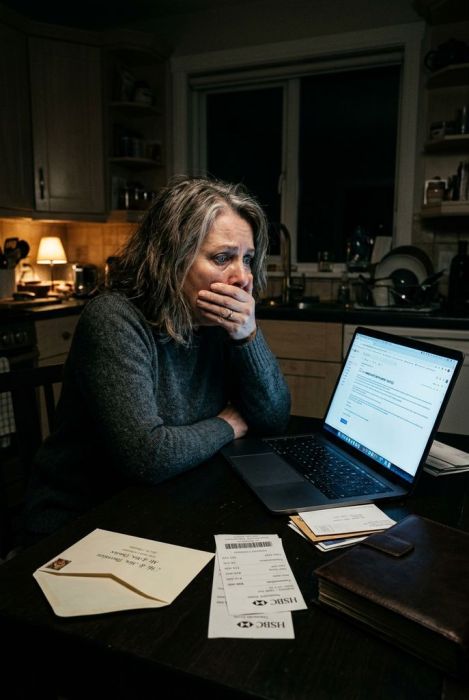
The website vanished at 2:14 on a Tuesday morning. Ruth Pendleton didn't watch it disappear; she was asleep, dreaming of peonies and weeping willows and the golden-hour photographs she had studied so many times they felt like her own memories. She discovered it at seven o'clock, when she poured her coffee and clicked the bookmark she had opened at least twice a day for three months.
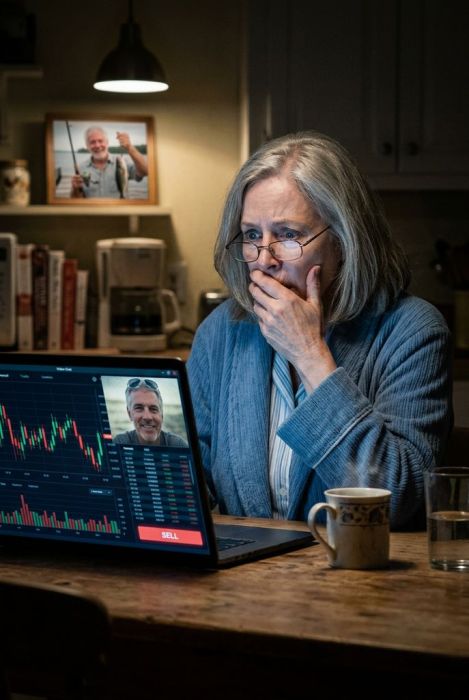
The McKinney wedding gallery was gone. In its place, a single line of gray text floated on a white screen: This account has been suspended.
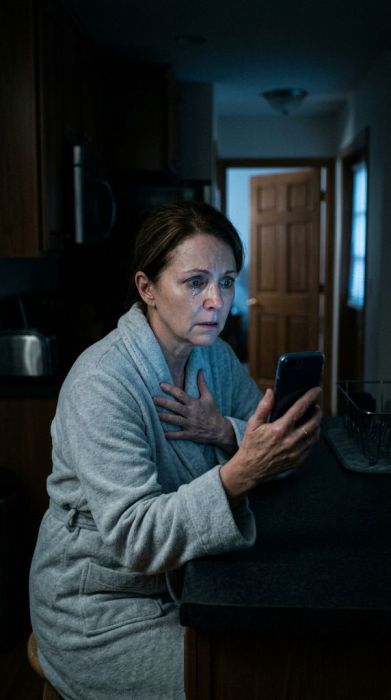
She refreshed the page. Then she refreshed it again. By the third attempt her hands were trembling, and she told herself it was only the caffeine.
"Frank," she called down the hallway. "Come look at this."
Her husband shuffled in wearing the old bathrobe she had tried to throw away four times. He squinted over his reading glasses at the screen. "Huh. Maybe he's redesigning the site."
"Redesigning doesn't suspend an account, Frank."
Thirty minutes and eleven phone calls later, Ruth had learned three things: Anthony Mercer's voicemail was full, his text messages went unread, and his email bounced back like a letter returned to sender. Anthony Mercer had accepted their six thousand eight hundred dollars eleven months earlier. Emily's wedding was nineteen days away.
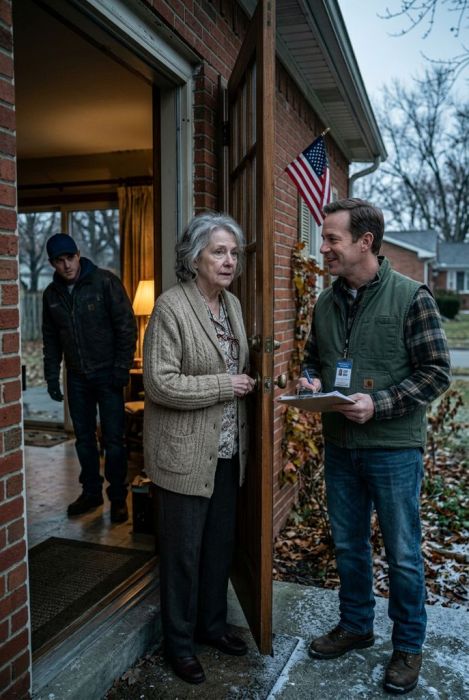
Ruth Pendleton was sixty-one years old, a retired school librarian who had spent three decades teaching children that the answer to an uncomfortable question was almost always hiding in plain sight. She had raised Emily alone after Frank's first illness, had budgeted every birthday and Christmas for twenty-seven years, and had never once missed a payment on anything in her entire life. That was exactly why the six thousand eight hundred dollars had felt so safe.
Anthony Mercer had been perfect. That was the word everyone used, and Ruth had repeated it like a prayer. He was fortyish and handsome in that rumpled way architects and artists were handsome, with silver at his temples and a soft Southern drawl that made every sentence sound like a compliment. His website was stunning, filled with albums of laughing brides and tearful fathers and golden light that seemed to pour out of the photographs like honey. He had won awards. His reviews were glowing, dozens of them, five stars from brides in Raleigh, in Savannah, in Charlotte. He had been profiled in a wedding magazine Ruth had bought at the grocery store just to see his name in print.
And he had been recommended by Tessa Whitmore, the young events director at Marshview Gardens, the historic venue where Emily and Devin were getting married. Tessa had mentioned Anthony over lunch at a café downtown, the way a friend mentions a favorite restaurant. "He's the only photographer we recommend anymore," Tessa had said, pushing a strand of blonde hair behind her ear. "His couples never stop thanking us."
That recommendation had meant everything to Ruth. She was not a woman who trusted the internet blindly; she was a woman who trusted other women, and Tessa had been so warm, so competent, so completely in control of every detail of Emily's wedding. Tessa had walked them through the venue with a clipboard and a smile, had remembered Ruth's name without being reminded, had hugged Emily at the tour like she was her own daughter. When Tessa vouched for Anthony Mercer, it was as if the universe itself had approved the selection.
Now the universe had suspended his account, and Ruth could not stop staring at the gray text on the white screen.
She called Emily at work, which she almost never did. Her daughter answered on the second ring, her voice bright with the particular energy of a woman planning her wedding. "Mom! I was just about to call you — Devin and I are meeting with the caterer tonight, you should come—"
"Emily." Ruth's voice cracked. "Did you check your email this morning?"
There was a pause, the sound of a keyboard clicking. "Why? Did you forward me something?"
"The photographer," Ruth said. "His website is gone. Suspended. And his phone doesn't work."
Silence stretched across the line. Ruth could hear her daughter breathing, could hear the exact moment the brightness drained out of her voice. "Mom, that's not funny."
"I'm not joking, sweetheart. I'm not."
Emily came over that night, and then Devin came, and then Frank made a pot of coffee nobody touched while the four of them sat in the living room trying to think of innocent explanations. Devin, who was an architect and therefore constitutionally unable to leave a problem unsolved, pulled out his laptop and typed Anthony Mercer's name into a search engine.
The results came back wrong.
There was no official website anymore, only cached fragments. There was no Instagram account, only a ghost page with the same suspended notice. The awards Anthony had won — Devin found the magazine spread, but the link to the photographer's own site was dead. And the reviews, the dozens of five-star reviews Ruth had read so many times, they were all still there, glowing and enthusiastic and dated across three years. But every single one of them had been posted in the same week, eleven months ago.
"Mom." Devin's voice had gone flat. "Look at this."
He had clicked through to a wedding photography forum, a message board where professionals talked shop. There was a thread from nine months back, buried under years of posts, titled Has anyone worked with Anthony Mercer in the Southeast? The responses were careful, professional, the kind of cautious lawyer-speak photographers used to avoid lawsuits. But one reply stood out, from a woman named Camille Royer in Nashville: His portfolio photos are from other photographers. Two of them are mine. I've reported him to the platform twice.
Ruth read the sentence three times. Then she read it a fourth time, and the room tilted slightly, and she understood that the ground beneath them had never been solid at all.
The next day changed everything.
Frank drove her to the bank where they had wired the deposit, eleven months ago, after Anthony said his studio preferred wire transfers for retainer fees. Ruth had not thought twice about it then; it was only money, and money had always moved in her life the way water moved, predictable and calm. The teller, a young woman with kind eyes and a name tag that read GRACE, printed eleven months of account statements. Ruth and Frank pored over them at a small table in the corner of the branch.
There it was. Eleven months ago. Six thousand eight hundred dollars, outgoing, to an account at a different bank, in the name of A. Mercer Studio LLC.
"Can you get me the rest?" Ruth asked. "The account owner's information?"
Grace looked uncomfortable. "We'd need a court order for that, ma'am. I'm sorry."
But Ruth was a librarian. She had spent thirty years teaching people to find things. She went home, opened her laptop, and began to dig.
What she found was a paper trail of almost unbelievable carelessness. A. Mercer Studio LLC had been registered in South Carolina, which meant its registration was public record. The registered agent on the filing was not Anthony Mercer. It was a company called Lowcountry Business Services, one of those cheap mail-forwarding outfits that existed to make the owners of other companies impossible to find. Ruth wrote down the address anyway.
She found the LLC's bank, a small regional credit union on the outskirts of Charleston. She called them, explained the situation, and was transferred four times before a supervisor politely told her the same thing Grace had said: they could not share account information without a court order.
She found something else, though. A scrap of public information she had almost missed, buried in a quarterly business filing: the credit union's account for A. Mercer Studio LLC had been opened with a signature on file that matched an incorporator named Darren Oakes, with a Greenville address. Ruth wrote that name on a sticky note and put it on the refrigerator, where it sat like a little black cloud between the magnets shaped like wine bottles and the photo of Emily at her college graduation.
"Darren Oakes," Frank read aloud that night. "Who's Darren Oakes?"
"I don't know," Ruth said. "But I'm going to find out."
She called the Nashville photographer, Camille Royer, and left a message. Camille called back within the hour, and Ruth apologized twice for crying on the phone with a stranger. Camille was gentle and matter-of-fact, the way strong women are when they have seen too much to be surprised by anything. She told Ruth that two of her photographs had appeared in Anthony Mercer's portfolio — a bride under an oak tree, a groom crying at a first look — and that she had recognized them instantly because they were her art, her exact angles, her lighting. "I've seen it happen three times," Camille said. "People steal portfolios to build fake studios for wedding deposits. They work the season and disappear."
"Three times?" Ruth whispered.
"It's a specialty in our industry. Google 'fake wedding photographer' and you'll find enough horror stories to fill a book. They target venues, get recommended, take big deposits in wedding season, and vanish before the dates arrive."
Ruth's hands were shaking as she wrote the words in her careful librarian's cursive: fake wedding photographer. deposits. vanish. She looked up from the notebook and stared at the sticky note on the refrigerator. Darren Oakes.
"Camille," she said slowly. "If this man used the name Anthony Mercer, and the real Anthony Mercer is a photographer in California who knows nothing about this, then who did I meet? Who hugged Emily at the consultation and told her she was going to make a beautiful bride?"
"I don't know," Camille said. "But whoever he was, he's done this before. Check the name Darren Oakes. Then check it everywhere."
Ruth checked it everywhere.
Darren Oakes, age forty-four, had a criminal record in two states: misdemeanor fraud in Georgia twelve years earlier, and a civil judgment in North Carolina for unpaid rent. He had been employed, briefly, as a sales associate at a photography equipment store in Greenville. And he had a Facebook profile, locked down tight, but with a public profile picture: a man with silver at his temples and a soft, practiced smile, standing in front of a backdrop of golden fall leaves.
It was Anthony Mercer's face. Ruth had memorized that face over three months.
She printed the photograph, slid it into a manila envelope, and drove to the Charleston County Sheriff's Office, where she asked to speak to someone about a fraud report. A patient detective named Miguel Santos took her statement, listened to the whole story without interrupting, and wrote Darren Oakes's name into his notebook. "This is a good lead," he said. "We'll see what we can find."
And then, because Ruth was who she was, she made the call that broke the case open.
She called Tessa Whitmore at Marshview Gardens.
Tessa answered with her usual sunny warmth. "Ruth! How are you? I've been meaning to reach out about the final walkthrough — is everything okay?"
"Tessa," Ruth said carefully. "I wanted to ask you about Anthony Mercer. How long have you worked with him?"
There was the smallest pause. So small that Ruth almost missed it. "Oh, wow, years now," Tessa said. "He's been doing the venue's recommended list forever. Is everything all right?"
"His website is gone. His phone doesn't work. We've lost sixty-eight hundred dollars, and I think he was never a real photographer."
The silence that followed lasted four full seconds. When Tessa spoke again, her voice was different — higher, thinner, scraped raw. "That's terrible. I'm so sorry. Let me think, let me think... I might know someone else who's available. I know a videographer who's wonderful, he could—"
"The man in the photographs," Ruth interrupted. "His real name is Darren Oakes. Does that name mean anything to you?"
She was expecting shock. She was expecting denial, confusion, maybe even a sympathetic offer to help. What she got was a soft, strangled sound, like a balloon deflating, and then the click of a call ending.
Ruth stared at the phone. Then she called Detective Santos back.
The pieces came together over the next two weeks with the slow, inevitable click of a lock turning. Detective Santos obtained the court order, and the credit union released the records for A. Mercer Studio LLC. The account had been opened by Darren Oakes, who had used the Greenville address on the business filing. But the account's secondary signatory — the person authorized to withdraw, the person who made every single transfer — was listed as Tessa C. Whitmore, with an address in Mount Pleasant.
Tessa Whitmore, the warm, competent events director who had recommended Anthony Mercer over lunch. Tessa Whitmore, who stood next to Ruth at Emily's venue tour and held her hand. Tessa Whitmore, who had moved the deposits from the fake studio into her own accounts — and who had done it at three other venues across the Southeast over the past five years, always as the trusted professional who knew just the right vendor to recommend.
The confrontation happened at Marshview Gardens, on a Sunday afternoon, in the middle of a bridal expo. Ruth walked through a room of white tents and champagne towers and found Tessa standing behind the venue's welcome table, smiling at a young couple, handing them a laminated list of approved vendors. When Tessa looked up and saw Ruth, the smile froze on her face.
"Ruth." She said it like a question, like a warning.
"I know everything," Ruth said quietly. "The bank records. Darren Oakes. The other venues. All of it."
Tessa's smile cracked. "I loved her wedding," she whispered. "I loved every minute of planning it. That's what I do, I make people's best days perfect—"
"You made Emily cry," Ruth said. "You made my daughter cry herself to sleep. That's what you did."
Two sheriff's deputies stepped out of the crowd, and Detective Santos read Tessa her rights while the bridal expo went on around them, oblivious and sparkling and beautiful. Darren Oakes was arrested the same afternoon at an apartment in Greenville, where deputies found a box of stolen portfolios, a stack of undeposited checks, and a wedding contract for a couple in Myrtle Beach whose date was still six weeks away.
Emily's wedding happened at Marshview Gardens on the date that had been booked for eighteen months, because the venue's owner insisted on honoring the contract and comped the entire space the day Tessa was led out in handcuffs. Camille Royer flew down from Nashville and shot the wedding for the price of her plane ticket, because, she said, "somebody should get to have a beautiful day in this story." Emily and Devin danced under string lights, and Ruth cried through the whole ceremony, and four hundred miles away, two prosecutors reviewed five years of financial records and began building a case against the woman who had made so many perfect days possible.
Ruth Pendleton still gets invited to bridal expos, not to shop but to speak. She stands at a podium with a printed bank statement in her hand and tells couples the things she wishes someone had told her: never wire a deposit, use a credit card with protection; reverse-image-search the portfolio photos; ask to visit the studio in person; call the venue and ask how long the recommendation has been on the list; look at the reviews and check whether they all arrived in the same week. "Fake photographers love wedding season," she says. "They love venues, and they love trust. Don't give them any of it without proof."
She still has the sticky note with Darren Oakes's name on it, pressed into the frame of a photograph from Emily's wedding. She keeps it there as a reminder that trust is a gift, not a requirement — and that some of the sweetest voices in the room are the ones telling the most careful lies.
The last thing she did before the wedding, after Tessa was arrested and before Camille arrived, was find the real Anthony Mercer in California. He was a real photographer, a kind man in his fifties who photographed surfers and sunsets in Santa Barbara. He had never been to Charleston. He had never heard of Marshview Gardens or Tessa Whitmore or the woman who had used his name and his stolen reputation to take six thousand eight hundred dollars from a retired librarian who had only wanted her daughter's wedding to be perfect.
He had, however, been very glad to hear the story. And when Ruth told him that Emily's wedding would go on, that the venue was free, that a stranger from Nashville had volunteered to shoot it, the real Anthony Mercer had laughed, the warm laugh of a man who understood that some stories have happy endings anyway.
"You got lucky," he told her.
"No," Ruth said. "I got receipts. There's a difference."