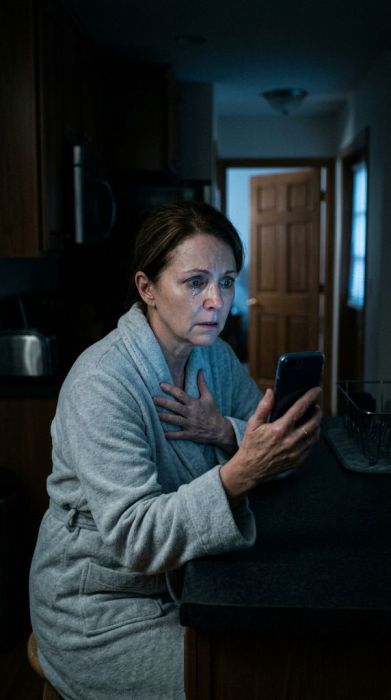
The man calling himself Special Agent Marcus Webb had a voice like warm syrup, and he used it to say the four words Lorraine Bennett had spent eleven days praying for. "We got your money back."
She gripped the phone so hard her knuckles went white. In the kitchen the teakettle began to scream, and she let it, afraid that if she moved, the voice on the line would vanish the way the other one had. He knew, she would understand much later, exactly how long to let a woman like her wait.
"Miss Bennett? You there?"
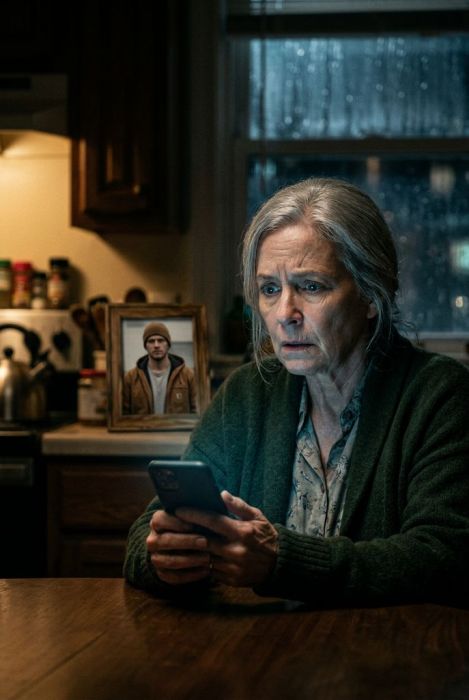
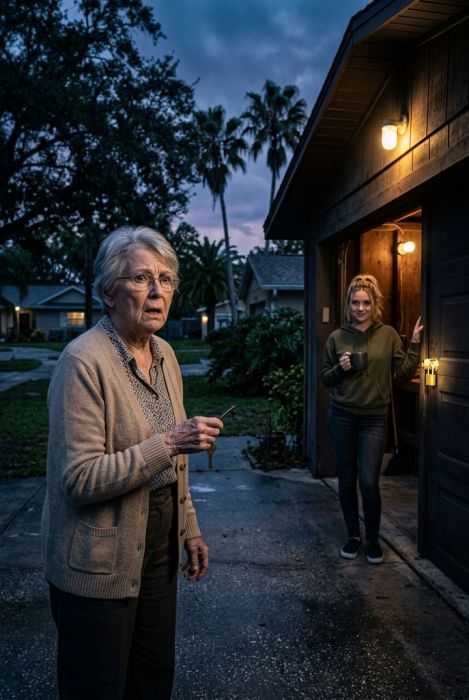
"Yes. Yes, I'm here." She sank into the chair by the window, eyes fixed on the framed photograph of Ray on the counter — Ray in his hard hat, grinning, taken on the last day of the interstate job. Five years gone this spring. She was sixty-three years old, and she had just given strangers everything he had left her.
What Agent Webb said next made her reach for her purse. What he didn't say was that he already had her money once — and that before the week was out, he'd be holding it again.
It had all started eleven days earlier, on a Wednesday night in April, with a famous face on her phone. She'd been scrolling Facebook after the ten o'clock news, the house too quiet to sleep in, when the video appeared in her feed like it had been waiting for her. There he was: Damon Reyes, the silver-haired billionaire who hosted The Wealth Frontier, his show a comforting constant in her living room for the last six years. He looked straight into the camera and smiled the smile she'd seen a hundred times.
"America, listen to me. I've spent my life building wealth, and I believe in giving it away. Tonight I'm launching the Freedom Grant — half a million dollars, no strings, to one hundred American families."
She sat up. The video kept going, and it felt like it was meant for her. "If you're watching this, you've been selected. Click the link below. Claim what's yours before the window closes."
The words moved a half-beat behind his mouth, she noticed, then the camera cut away. She watched the whole thing twice. The second time through, she was already reaching for the tablet to find the link.
The link took her to a page that looked exactly like his show's website — same red banner, same logo, same photo of Reyes shaking hands with a governor. A form waited in the middle of the page. Name. Address. Date of birth. So simple. Page two asked for her bank name; page three asked for "the last four digits of your Social Security card, for identity verification." The form had a countdown timer at the top — 04:11, 04:10, 04:09 — and she typed the numbers anyway, the way you rush through an airport when your gate is closing.
Eight minutes later, her phone buzzed with a WhatsApp message from someone named Kevin Cordova, "Compliance Manager, Reyes Foundation." "Miss Bennett! Congratulations! You've been confirmed for the Freedom Grant. I'll be your personal coordinator until your award is delivered."
She should have wondered why a foundation used WhatsApp. She should have asked why a manager wanted to be personal. Instead, she wrote back with a smile and told him — in a message she'd regret forever — that her Ray had always said she was the luckiest woman he knew.
Kevin was warm. Kevin was patient. He sent a selfie of himself with a golden retriever named Biscuit and laughed at her stories about thirty years in the school cafeteria, about the kids who always asked for seconds of her mac and cheese. For three days he called her "Miss Lori" and answered every nervous question she had.
Then, on Saturday, the window narrowed. "There's a small activation requirement, Miss Lori. The government escrow requires the grant to be 'matched' before release. You'll send your portion first — just to show good faith — and the foundation's portion lands within forty-eight hours. Standard procedure. I've done this for two hundred families."
The portion was twenty thousand dollars. She told herself it was an investment. She told herself Ray would understand, that it was exactly the kind of bold move he'd always admired. And when Kevin explained that the escrow account only accepted cryptocurrency, that she'd need to withdraw cash and feed it into the Bitcoin machine at the 7-Eleven on Vista Avenue, she told herself the government seal on the screen was proof enough.
The machine's own warning flashed in red letters: This machine is not affiliated with any government program. Do not send money to strangers. She watched the words, and then she watched her cash disappear into the slot anyway — three trips, twenty thousand dollars, then eighteen, then twenty more. Fifty-eight thousand, four hundred and twelve dollars. The pension Ray had built over forty-one years of early mornings and cracked knuckles.
"Forty-eight hours," Kevin promised. "Don't tell anyone. The IRS watches large distributions. This has to stay confidential until release."
That was the word that kept her silent: confidential. It gave the shame a name she could live with, a reason not to call the one person who could have stopped it — her daughter, Piper.
Piper Bennett was thirty-one years old and worked the county desk at the Valley Record, which meant she smelled a lie the way other people smelled rain. On the evening of the fourth day, she sat across from her mother in that same kitchen and asked the question she'd been circling since Tuesday. "Mom. You've been quiet. What happened?"
"Nothing happened. I just made a small mistake with an investment, that's all. Nothing for you to worry about."
"How small?"
"Small."
Lori smiled through the lie, and Piper let it go — because her mother had never once looked at her like that, like a child caught with her hand in the cookie jar, and because Piper's own phone kept buzzing with a source about a county clerk taking bribes. She had her own fires. She thought, I'll come back to this — not knowing the window for "later" was closing in a stranger's hands, one burner phone at a time.
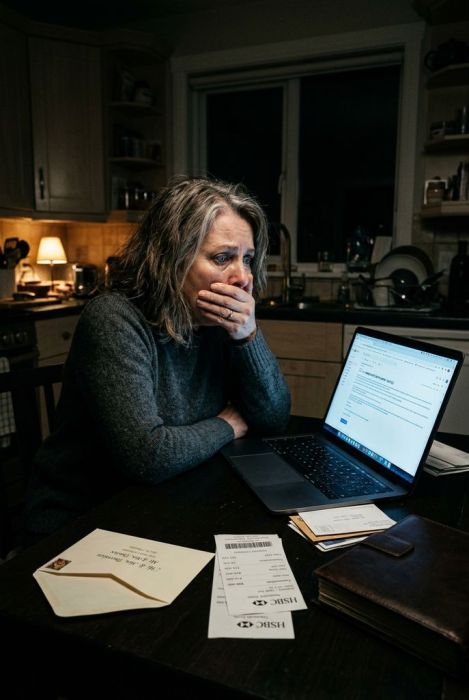
On the eighth day, Kevin stopped answering. The WhatsApp profile vanished. The red-bannered website dissolved like a sugar cube in rain. That night, Lori Bennett sat in her dark living room and did the math for the first time, and the number — fifty-eight thousand — sat in her chest like a stone.
She was too ashamed to call the police. That's what she told herself at two in the morning, sitting on the edge of her bed. Too ashamed to call her daughter. A grown woman who'd balanced the cafeteria books for three decades, and she had emptied her dead husband's pension into a glowing machine at a gas station because a famous man on a video told her to.
The shame, not the loss, was what nearly destroyed her. And it was the shame the voice on the phone knew exactly how to use.
"We got your money back, Miss Bennett. All of it. Fifty-eight thousand, four hundred and twelve dollars — every penny."
Standing there in her kitchen, her knees weak with relief, she didn't stop to ask how Special Agent Marcus Webb knew the exact figure. She didn't stop to ask how he knew about the 7-Eleven on Vista or the Circle K on Fairview — the two machines she'd fed her life savings into. He told her the Utah field office had frozen the wallet. He told her a man named Kevin Cordova was in custody in Provo — which was true, in a way: a man using that name had been arrested, only he was a decoy the real criminals had set up months ago to take the fall.
"Your money is in a secure evidence account," Agent Webb said. "But there are legal and accounting fees attached to the release. Nine thousand dollars. Cash, delivered in person, to guarantee the chain of custody. I know it sounds like a lot."
It sounded like a lot. But it was also nine thousand dollars to reclaim fifty-eight. That math was easy. That math was the whole trap.
"Come alone," he said. "Case confidentiality. If your family talks, the state can freeze the release and you'll wait two more years. You understand what I'm saying?"
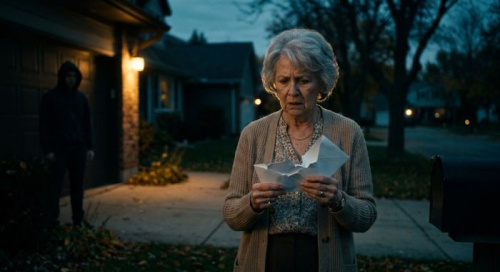
She understood. She wrote the words down on a scrap of paper — Java Junction, Monday, two o'clock — and folded it into her apron pocket like a secret.
She might have gone through with it alone. She almost did. What saved her was the "official notice" Agent Webb messaged her — a non-disclosure form she printed and accidentally left on the kitchen table.
Piper found it that Sunday afternoon, standing in her mother's kitchen, holding a federal-looking document with a forged seal, a case number that didn't exist, and a name — Special Agent Marcus Webb — that, when she looked it up, had never been an FBI agent anywhere in the United States.
"Mom," she said slowly, "who is Marcus Webb?"
And forty minutes later, sitting in her mother's living room with the curtains drawn, Piper listened to the whole terrible story come out in halting pieces: the video, the form, the countdown, the man named Kevin, the golden retriever, the ATM on Vista Avenue, the words "don't tell anyone" — and she felt the rage rise in her chest like a tide.
She did what she was trained to do. She dug. The case number was a dead end, manufactured. The "Reyes Foundation" had been registered eleven days earlier at a UPS store in Newark. But it was Kevin Cordova who cracked the whole thing open. A reverse search of the WhatsApp number led to a burner, purchased with a prepaid card — but the selfie he'd sent, the one with the golden retriever, led her to a mugshot. A Provo police report from January: a man arrested for a series of cryptocurrency ATM frauds in Utah, photographed in the county booking room with the same grin, the same dog tattooed on his forearm, under the name Kevin Ormsby.
Same man.
She printed the mugshot and put it beside the WhatsApp selfie and stared at them for a long time. Then she called her mother. "Monday at two o'clock," Lori said, her voice small, still half in denial. "He said he's going to give me my money back. He was so kind, Piper."
"Mom. Look at the picture. Look at the man you sent your life savings to. And then tell me that's not the same smile."
Lori looked. Lori cried. And then, finally, she picked up the phone — not to cancel the meeting, but to keep it.
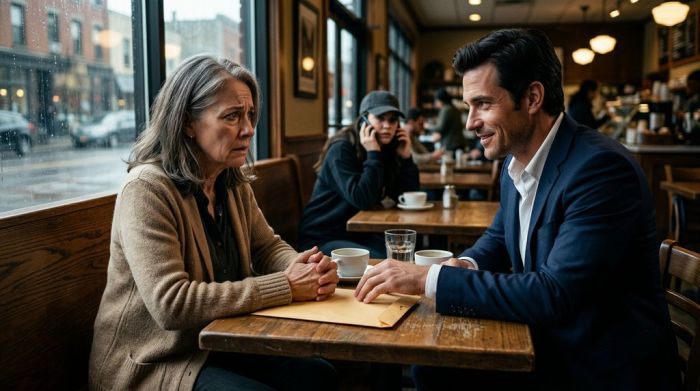
Monday afternoon, Java Junction was busy the way all coffee shops are busy at two o'clock — students with laptops, retirees with newspapers, the hiss of the espresso machine. Lori sat at a table by the front window, a white envelope on the table in front of her, her hands folded over it. In the corner booth, wearing a baseball cap she'd borrowed from her brother, Piper watched the door, her phone in her hand, the recording app running, two detectives from the Boise PD sitting outside in an unmarked car.
The door opened. A man walked in wearing a navy suit and a smile — a pleasant face, slightly different from the WhatsApp photos: different hair, glasses, the careful posture of a man playing a part. He crossed the room, hand extended. "Miss Bennett. Special Agent Webb. So good to meet you in person."
Lori took his hand. Her mouth had gone dry. She'd rehearsed a question — one small question — and she forced it out before her courage could fail. "Before we do anything," she said, "I just have to ask. How's Biscuit?"
The man's smile flickered, held, flickered again. "I'm sorry?"
"Biscuit. Your dog. The one in the picture you sent me. The golden retriever. He looked happy. Is he doing okay?"
Something in his eyes went flat, and for one long, terrible moment she saw the truth of what he was: not an agent, not a rescuer, not the kind man who'd laughed at her mac and cheese stories. Just a man who'd been paid to smile at widows.
"I think you have me confused with someone else, ma'am."
From the corner booth, Piper's voice cut through the coffee-shop noise, loud and steady: "Wrong tattoo, Kevin."
He turned. Everything happened fast then. His hand went for the envelope; Lori snatched it back. He bolted for the door, and the two detectives met him at the exit like they'd been waiting their whole shift. A chair tipped, a woman screamed — and Kevin Ormsby, twenty-six years old, three aliases, five states, was in handcuffs on the floor, his glasses askew, still insisting he was a federal agent.
In his pockets they found two burner phones, a fake badge, and a photo of a golden retriever.
Lori Bennett watched them take him away, and she felt something she hadn't felt in two weeks: air. Real air. The kind you breathe when the weight finally lifts — even if it takes everything else with it.
The aftermath was not a victory parade. Of the fifty-eight thousand, four hundred and twelve dollars, investigators recovered four thousand one hundred. The rest had been laundered through a dozen wallets in three countries. Kevin Ormsby had been running the same play in Utah, Nevada, Colorado, and Arizona — two victims a month, nearly two million in total, most of it gone. His victims, all of them, had one thing in common: they were good, lonely people who'd been asked to keep a secret.
Piper's story ran six columns wide under the headline The Grant That Was a Lie. Lori read it three times before she could finish it once.
And on a bright Saturday morning a month later, she stood at a folding table in the senior center on Jefferson Street, in front of forty people who'd come to hear how a widow lost her husband's pension and found her voice.
"I'm not here to tell you I was stupid," she said, her voice steadier than she felt. "I'm here to tell you how the trap works, so it doesn't spring on you. Famous people don't message you. No grant in America asks for money first. No real agent — no real anything — asks for cash in a coffee shop. And when someone says 'don't tell anyone,' that's the moment to tell everyone."
"Most of all? The first call was the trap. But the second call — the one that offered to help — that's the one that would have finished me. They don't steal from you once, folks. They steal from you twice. The second time, they're counting on your shame to keep you quiet."
Afterward, a woman named Eleanor took her hand and told her the same thing had almost happened to her cousin in Reno. Lori understood then that the story was never about her loss alone. It was about the moment she stopped carrying it by herself.
That night, her grandson Theo, all eight years old, sat on her lap with the tablet, and they scrolled through videos together. "Grandma," he said, tilting his head at a suspicious clip of a famous actor selling miracle pills, "his mouth moves after his words. That's a fake, right?"
"That's a fake," she said. "How'd you know?"
"You told me," he said simply. "You told me to watch the mouth."
She hugged him, and in the kitchen, the photograph of Ray in his hard hat watched over them from the counter, his grin catching the last of the evening light. Some lessons, she thought, get passed down even through the worst of days. You just have to be brave enough to be the one who passes them.