Carolyn Bell saw the video on the service advisor's phone and felt the floor tilt. There it was, grainy and dark, a swirl of metallic glitter in a pan of old oil — the death rattle of her transmission, the young man explained with practiced sympathy. Seven thousand two hundred dollars, he said. Plus labor. Plus tax. She had eleven thousand in savings and a pension that barely covered the winter heating bill.
She asked for a minute and stepped outside into the October air. Her car sat under the awning with the hood open, a 2012 Subaru Outback with a dent on the passenger door that Bill never got around to fixing. Bill had bought it four years before he died, promising they would drive it to Nova Scotia when he retired. He never made it. Two autumns ago, a heart attack took him in the garden shed, and she had been learning to live with a silent house and a suddenly loud car.
The shop was Buck's Auto on Forest Avenue, the place her husband had sworn by for thirty years. Ray Callahan — everyone called him Buck — had been Bill's fishing buddy. He had stood at the funeral in a too-tight suit and told Carolyn the shop was family, that anything she ever needed, she just had to ask. She had believed him. That was the thing about trust, she would think later. It does not expire on its own. It has to be shattered.
The truth was that she could not afford to be broke. Her pension came to nineteen hundred dollars a month. The house was paid off, but the roof had cost five thousand in July, and the furnace was making a noise the repairman called "character." Eleven thousand in the bank was everything — her emergency fund, her granddaughter's college money in a drawer, the last of Bill's life insurance. Seven thousand two hundred dollars would gut her.
She thought about calling her daughter Jenna. But Jenna had worries of her own — two boys, a mortgage, a husband named Gary who was always "between things." Carolyn did not want to be a burden. That was the trap, of course. That was exactly how they got you.
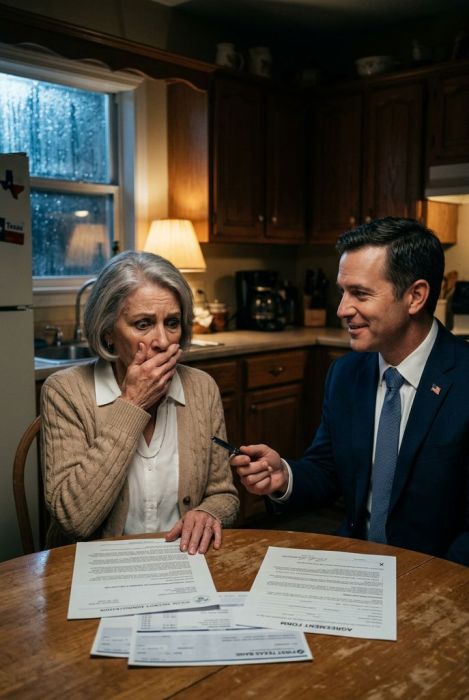
The young advisor's name was Kyle. He walked her back inside, sat her in a plastic chair, and laid out the estimate like a preacher with a Bible. Transmission assembly, torque converter, fluid, incidentals, and a "shop supplies" line that somehow totaled four hundred dollars. Then, almost as an afterthought: "Of course, we can't reassemble it until you approve the work order. There's a storage fee of forty-five a day after today."
She did not sign the repair order. She told him she needed to think, and she could see the disappointment flicker behind his kind face. Kyle warned her the car might not make it home — "don't be surprised if it strands you" — but he handed her the keys. She drove the ten blocks home with her heart in her throat, waiting for the transmission to die.
It never even stuttered.
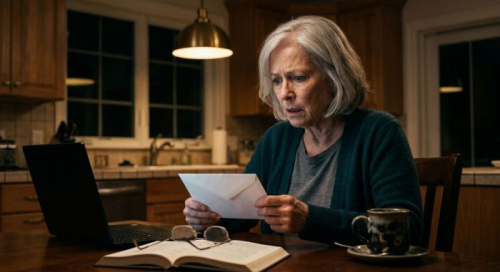
That night she could not sleep. At two in the morning she sat at the kitchen table with the estimate under a reading lamp, and her finger stopped on a line she had missed: Referral discount — minus $300. She had not been referred by anyone. She called the shop in the morning, and Kyle laughed, warm and easy. "Oh, that's just a computer line, ma'am. Standard on every work order." She let it go. She was good at letting things go.
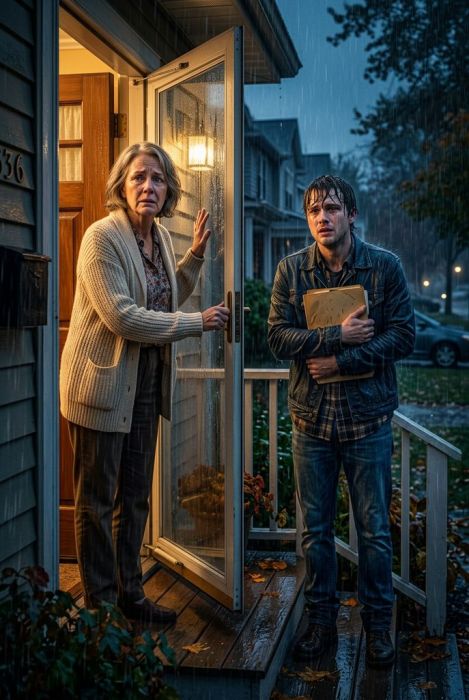
The note was under her windshield wiper when she went out for the paper. A folded square of lined paper, damp with dew, waiting for her in the gray dawn. Her first thought was terror — someone had been on her property while she slept, had stood in her driveway in the dark. She looked up and down the street and saw nothing. Then she opened it.
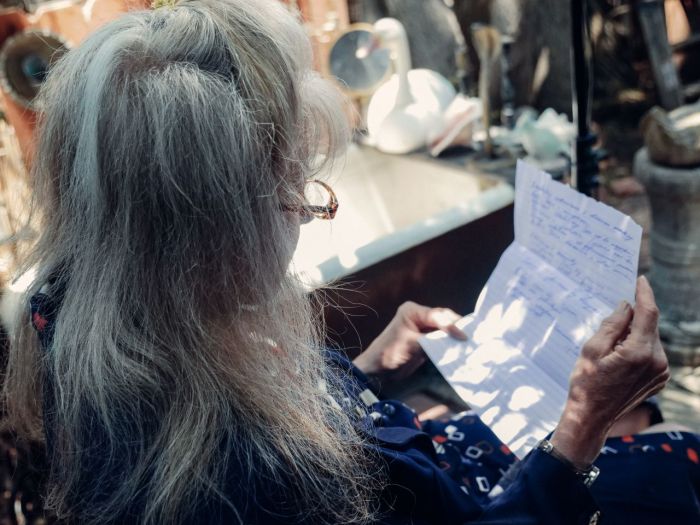
The handwriting was young, blocky, and the message was three lines: Get a second opinion. Ask for your old parts back. Don't sign anything else.
She read it four times. Then she recognized the handwriting from the clipboard she had seen in the shop, the one the young technician had been carrying when he nearly walked into her. Diego, his name was stitched on his shirt. He had looked her in the eye for half a second and then looked away, as if he were ashamed of something that was not his shame at all. He had looked up her address on the work order, she realized. He had driven across town in the dark to leave a warning under her wiper, like a secret admirer of the truth.
The next day the phone calls started. The core charge they said she would get back. The cooler lines. Then, mysteriously, a new battery, and wipers she had not asked for, and a headlight bulb. The total inched toward nine thousand dollars. Every call was warm, patient, gently amused, as if she were a child who did not understand that cars needed things. She began to second-guess herself. Maybe the car really was dying. Maybe she was just a foolish old woman who knew nothing about engines.
She went to the shop that afternoon, telling herself she only wanted to look at the car. The bay was dark, her Outback up on the lift, transmission pan off, parts laid out on a cart. Kyle talked about metal contamination and bearing failure. She nodded along, understanding none of it, and that was when she saw Diego at the far bay, watching them. He did not wave. He did not smile. He just looked at her, then at the estimate in her hand, then back to his work, and something in his face said: Read the note again.
She drove away from Buck's Auto and did not go home. She drove to Congress Street Auto, a two-bay garage run by a woman named Rosie Alvarez, who wore coveralls with her name embroidered and did not try to be charming. Carolyn told her the story and handed over the estimate, and Rosie did not laugh at her. Rosie ran diagnostics for an hour, then called Carolyn into the bay and showed her something on a tablet.
"Your transmission's fine," Rosie said. "Fluid's a little low, and somebody left the drain plug loose — that's how you lose fluid slowly and it looks like a leak. And that video they showed you? That's a filter from a different car. This is a common play." She pointed at the pan she had dropped. "They drain your fluid, let it run low, quote you a terminal failure, keep your car, and stack storage fees. They did the same thing to a lady on Munjoy Hill last spring. We put a camera in the lot and caught their guy loosening her hoses."
Somewhere in Carolyn, something snapped and then settled. She was not foolish. She had been targeted. There was a difference between those two things, and the difference mattered.
Rosie made one phone call, and that call led to a detective named Frank Osei, who worked out of the Maine Attorney General's Consumer Protection Unit. He had investigated Buck's Auto once before and never been able to make it stick. This time, with the drain plug, the estimate, the phantom referral line, and the note still folded in Carolyn's purse, they had enough to get a warrant. Carolyn learned that Diego had called the unit's tip line weeks earlier. He had been watching the operation for months — the doctored videos, the drained fluid, the widows who paid and paid and never complained. He had been afraid to give his name. But he had been writing that note in his truck at five in the morning, because some lines have to be drawn somewhere.
What they found in Buck's office made Carolyn's knees buckle. There was a folder — a real paper folder, as old-fashioned as a bank robber's duffel — labeled with a felt-tip marker: Seniors. Inside were copies of estimates, notes on bank balances, and a column of names crossed off when the money cleared. Her name was there. Under it, in Buck's handwriting, two entries: referred by G.W. — paid $500.
G.W. Gary Whitfield. Her son-in-law.
Gary, who had been so kind about her car troubles. Gary, who had mentioned Buck's Auto to her twice, warmly, like an old friend. "He's honest, Carolyn. He did right by Dad." The truth was the opposite. Gary owed money to the wrong people; Buck had found him in a bar off Riverside Street, bought him a drink, and offered five hundred dollars for every senior he sent through the door. Her own daughter's husband. Her grandsons' father. He had sold her for the price of a used television.
The confrontation happened in Buck's office on a Tuesday afternoon, with the fluorescent lights buzzing and Frank Osei standing against the wall with his arms crossed. Buck tried charm first — the big laugh, the big hands spread wide — then outrage, then silence. When the detective played the recording of the phone call in which Buck confirmed Gary's referral fee in code — "the part's in stock, tell your guy" — something behind Buck's eyes went out. He sat down, slowly, in his own chair, and for a long moment he looked like a man who had just realized the fishing was over.
"Thirty years," Carolyn said. Her voice came out steadier than she felt. "Bill trusted you. He loved you like a brother. And you waited until he was cold to start robbing his widow." Buck did not answer. What could he say? That he had needed the money? That the shop was failing? Bill had once loaned Buck five thousand dollars to keep that shop open — fifteen years ago, off the books, never repaid, never mentioned again. Carolyn knew because she had found the deposit slip in Bill's shoe box, with one word written in his careful hand: Buck.
She left before they took him out. She could not watch.
The hardest scene was not the shop. It was her kitchen, three days later, with Jenna's car in the driveway and Gary sitting at the table where he had eaten a hundred Sunday dinners. Jenna did most of the talking. Gary wept — real tears, or close enough. It was gambling, he said. It had snowballed. He had meant to pay her back. He was going to find a way. Carolyn looked at his wet face and felt something hollow where her love for him used to be.
"You carried the casket at Bill's funeral," she said. "You gave me a ride home from the hospital. And you sold me for five hundred dollars." Gary opened his mouth, but nothing came. There is no version of that story where he is not the villain, and he knew it.
Jenna filed for separation within the month. The district attorney charged Buck with organized theft by deception and elder exploitation. Kyle took a plea deal for testifying. And Gary — her daughter's husband, her grandsons' father — was charged as an accomplice. He had sold his family for a percentage, and the family was still deciding whether they could ever buy him back.
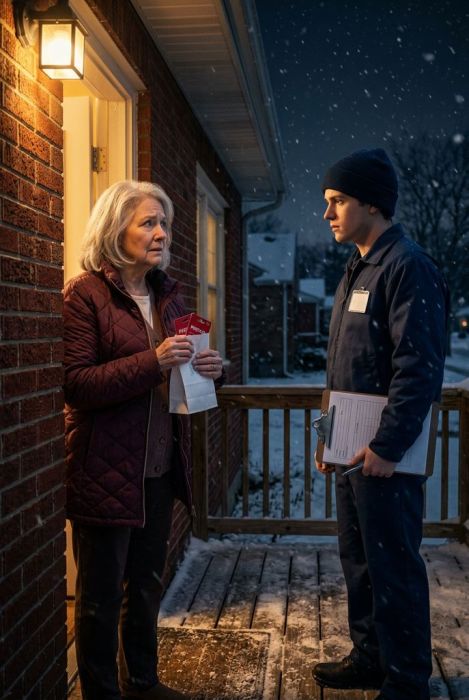
A few weeks later, Diego Torres came to her door with his grandmother, a stooped woman in a gray coat who gripped Carolyn's hand and said, in a voice thick with gratitude, that Diego had told her the whole story. She was proud of her grandson, she said. And now Carolyn had a number in her phone for a young man who could fix any car she was ever afraid to drive.
Carolyn still drives the Subaru. The transmission hums like a sewing machine, and the dent on the passenger door is still there, and she has no plans to fix it. It reminds her of Bill, of course. But it also reminds her that the shop her husband swore by was loyal to his truck for thirty years, and loyal to his memory for exactly zero days.
These days she keeps a folder of her own. Receipts, estimates, the fraud line at her bank, and a copy of the Maine law that says a shop must give a written estimate before it starts work and must return your old parts if you ask for them. She volunteers at the senior center on Tuesdays, showing other widows how to read an estimate line by line. Rosie Alvarez donated the time. Carolyn brings the coffee.
Last Saturday she drove to Casco Bay to pick up her granddaughter for the weekend. On the way home, the girl asked why grandma's car made that funny noise. Carolyn smiled, glanced at the folded note she still keeps in the glove box — three lines, blocky handwriting — and answered: "That's not a funny noise, sweetheart. That's the sound of asking questions."