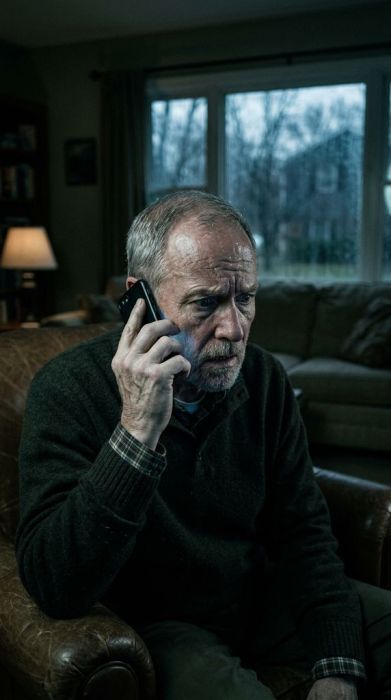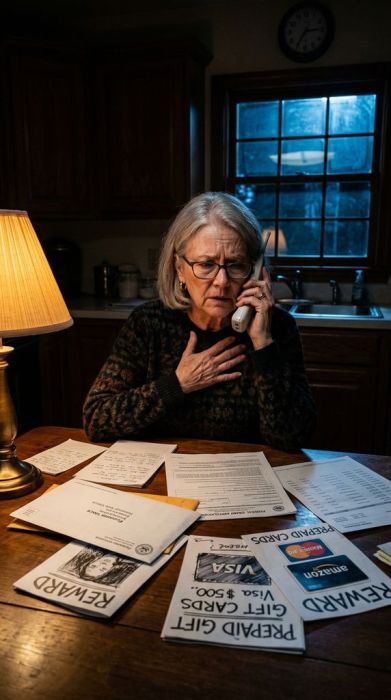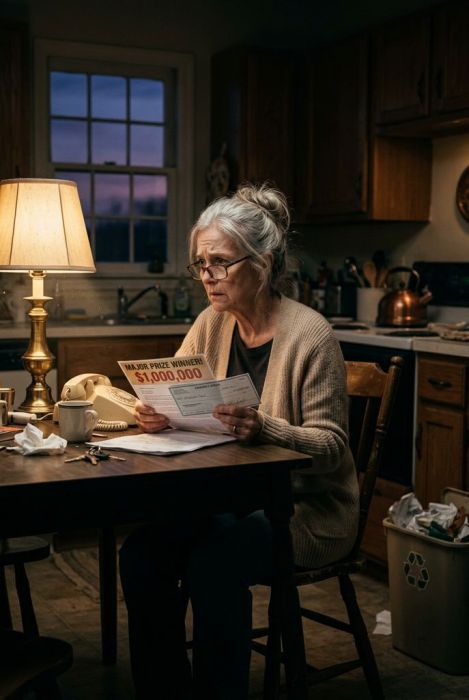
The phone rang at 9:14 on a Tuesday morning, and Dorothy Hensley almost didn't answer. The landline mostly brought two kinds of calls anymore — telemarketers who hung up the moment she said "no thanks," and her daughter Lisa calling from Phoenix to remind her about her blood pressure medicine. But the little screen on the cordless phone read GREAT LAKES BANK & TRUST, and that made Dot sit up a little straighter in her armchair.
"This is Officer Daniel Reyes with the fraud division," the man said. His voice was calm and professional, just shy of warm. "We've flagged suspicious activity on your checking account, Mrs. Hensley."
Dot's fingers tightened around the phone. She had banked at the same downtown branch for thirty-one years, ever since Earl's hardware store started keeping its books there. She knew the tellers by name. She knew which one had a daughter in ballet and which one coached Little League. The bank was not an institution to her. It was a place where people called her "honey" and asked about her garden.
"Can you tell me what's wrong?" she asked.
"I need to verify a few things first," Reyes said. "For your protection, of course. Can you confirm your full name?"
She gave it.
"Your address on Hemlock Court?"
"Corner of Hemlock and Grace," she said automatically. The house had been hers and Earl's for forty years.
"And the last four digits of your account?"
Seven-one-one-two. She read them off without thinking. The man on the phone already knew them — that was the thing. He recited them back to her, exactly right, and then he told her something that made her blood run cold.
"We believe a teller at your downtown branch has been skimming small amounts from senior accounts," Reyes said. "We've been tracking the pattern for six weeks. Your account was flagged because someone accessed it during non-business hours last Thursday — the same day you called us about a charge you didn't recognize."
Dot remembered that call. A $312 charge from an electronics store in Toledo she had never visited. The real bank had promised to investigate, and she had pushed the worry aside, trusting that someone, somewhere, was looking after her money.
"This is a federal matter now," Reyes continued. "The teller involved is being watched, but we can't move until we have physical evidence. That's where you come in, Mrs. Hensley."
Three hours later, Dot stood at the counter of her own bank branch and asked the young teller named Priya for nine thousand six hundred dollars in cash.
Priya's eyebrows lifted. "That's a big withdrawal, Mrs. Hensley. Is everything okay?"
Dot lied. She said she was buying a used car for her grandson. It came out of her mouth far too fast, and she could feel Priya's silence like a weight. The teller counted out the hundred-dollar bills and slid them across the counter in a thick manila envelope, and Dot took it with hands that were trembling inside her cardigan sleeves. She signed the receipt without reading it, the way you do when you are afraid your hands will give you away.
That night, at seven-forty, the doorbell rang.
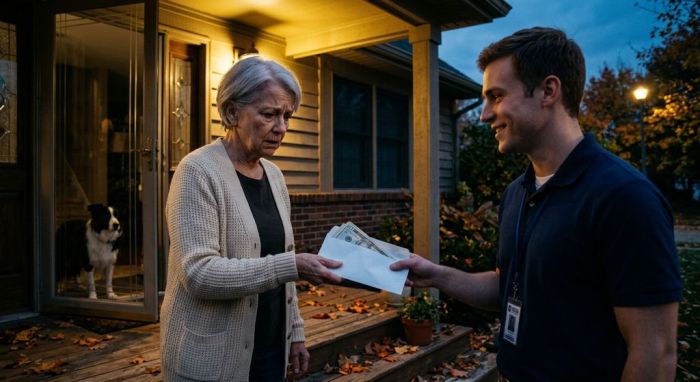
Standing on her porch was a young man she recognized instantly. Clean-cut, sandy hair, polite smile. Navy polo shirt, laminated badge clipped to the collar, tablet tucked under his arm. He was Caleb Mercer, the grandson of her next-door neighbor Alice — the boy who used to mow her lawn for twenty dollars and throw sticks for Buddy in the backyard until it got too dark to see.
"Miss Dot," he said warmly. "Field Operations. I'm here to collect the evidence."
The badge read GREAT LAKES BANK & TRUST — FIELD OPERATIONS, all blue and official. Caleb explained that Officer Reyes had sent him, that the bank was conducting a coordinated cash inspection across three states, that the serial numbers on the bills needed to be logged into evidence.
"That's procedure, Miss Dot," he said gently. "We do the examination off-site so the teller under investigation can't tip anyone off."
She let him in. Of course she let him in. He was the boy she had watched grow up, the boy who had eaten her oatmeal cookies and asked about Earl's woodworking after Earl died. He even knew Buddy's name, and Buddy wagged his tail and pressed against Caleb's leg, entirely happy.
He counted the money in her living room, every bill, with the ease of someone who had done it a thousand times. Then he signed a receipt — a real-looking form with a case number printed at the top — handed her a copy, and told her an investigator would call tomorrow with an update.
"You did a brave thing, Miss Dot," he said at the door. "Catching a thief is never easy. I know your Earl would be proud."
She closed the door, sat down in the armchair, and cried — not from fear, but from relief. She had helped. She had done something important. She had believed, for one full night, that justice was still a thing that could work.
The call came the next morning, right on schedule.
"Mrs. Hensley, this is Officer Reyes again. Good news — the teller was taken into custody last night. We need one final piece of evidence to close the case."
Dot's heart swelled. "Of course. Whatever you need."
"We discovered the teller had an accomplice at the Cedar Hills branch," Reyes said. "The accomplice is still active, and your account has already been flagged again. We need you to withdraw four thousand two hundred dollars this time, and a field agent will collect it this evening. If we don't act now, they'll destroy the records."
Something shifted in Dot's chest. A tiny voice — the same voice that had told her, thirty years ago, that Earl was going to be all right — whispered: ask a question.
"Why four thousand two hundred dollars? Why that exact amount?"
"I can't discuss the case details over the phone," Reyes said smoothly. "But I can assure you it's all part of the evidence chain. You'll be fully reimbursed once the investigation concludes."
She hung up. And then she did what her daughter Lisa had drilled into her a hundred times. She did not call the number on the caller ID. She called the number on the back of her debit card.
A woman named Diane Voss answered. She had been Dot's branch manager for eleven years, and her voice went tight the moment Dot explained why she had withdrawn nine thousand six hundred dollars in cash.
"Dot, honey, listen to me very carefully. No bank in America does this. Ever. We don't send couriers to people's homes. We don't ask customers to withdraw cash as evidence. And we certainly don't ask them to lie to tellers."
"But the badge," Dot whispered. "He had a badge. He knew Buddy's name."
"They always know something, Dot," Diane said gently. "That's how they build the lie. I'm calling Detective Marta Jimenez right now."
At seven-forty that evening, when the doorbell rang, Dot was ready. Detective Jimenez and two plainclothes officers were hidden in the kitchen, out of sight. Buddy had been closed in the bedroom, quiet but alert. The house smelled like coffee and nothing else, and Dot gripped the arms of her chair and waited, thinking about how young Caleb had looked, how proud of himself, how certain.
The man on the porch was not the same courier. He was older, mid-thirties, gray suit jacket, leather satchel. He smiled and produced the same laminated badge.
"Mrs. Hensley," he said. "Officer Reyes wanted me to escort the final evidence personally."
And Dot looked at him, and her stomach turned to ice, because she knew that face.
His name was Kyle Barlow. He was the nephew of Earl's bowling partner, Ted Barlow. As a teenager, he had come to their house for Sunday dinners for five straight years — pot roast and mashed potatoes at the kitchen table, Dot wiping his chin like he was one of her own. She had watched him grow up, and then she had watched him get fired from the bank six months ago, quietly, for a cash discrepancy the bank never explained.
He had sat in her kitchen for years. He knew Earl was gone. He knew she kept cash for emergencies, because she had told him once, laughing at her own old-fashioned ways. He knew her account numbers because, two years ago, she had let him help her set up online banking, and he had seen the statement page on her laptop.
The real thief hadn't been at her branch. The real thief had been eating her pot roast all along.
"Please," she said, and her voice came out steady, which surprised her. "Come in."
He stepped inside, and the lights came up, and Detective Jimenez read him his rights while Dot stood in the hallway with her hand over her mouth.
Caleb Mercer, questioned that same night, broke down completely. He had answered a courier job ad online — flexible hours, two hundred fifty dollars per pickup, no experience necessary. The recruiter's profile had used an old photograph of Kyle. Caleb had no idea he was collecting stolen money. He thought Miss Dot was a client of a legitimate financial services company, and he had been instructed, firmly, never to mention the pickups to anyone. Client confidentiality.
The case uncoiled quickly after that. Kyle's guilty plea spared the family a trial. He had built the whole scheme from his own history — a fired teller who knew exactly how the bank talked, exactly what seniors feared, and exactly which family he could trust to unwittingly help him. The restitution order took years to satisfy. The bank, after an internal review, reimbursed Dot for the full amount out of its fraud-loss fund, an outcome Detective Jimenez called unusual but deserved.
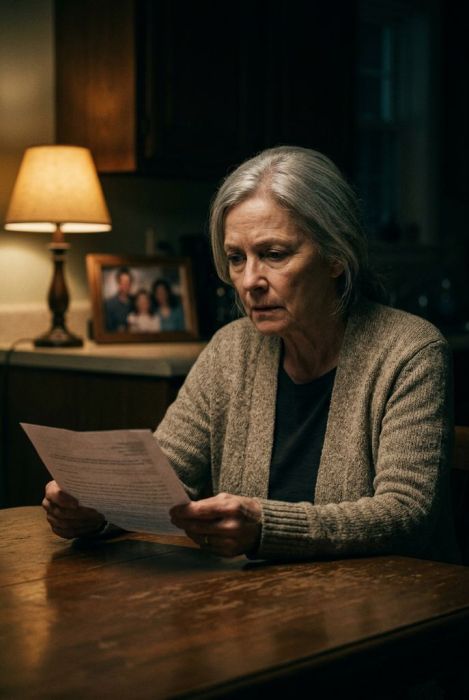
Dot keeps a sticky note on the kitchen phone now, in her own handwriting, next to a photo of Earl. It says: Banks never send couriers. Never call the number on the screen — call the number on the card. Nobody needs your cash as evidence.
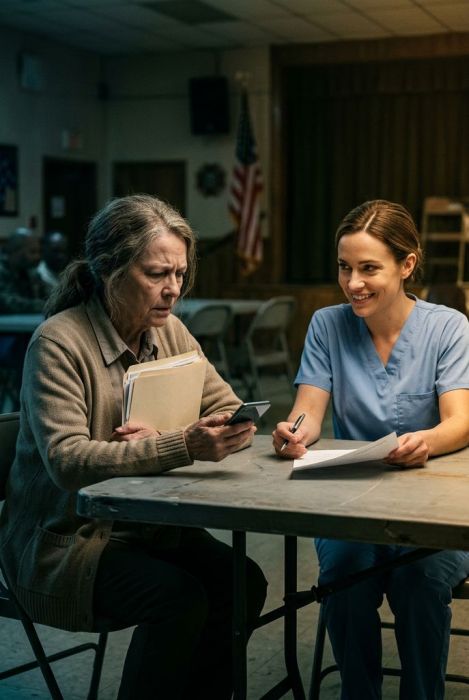
She volunteers at the senior center with the fraud watch network, and she tells her story often — not the version that makes people gasp, but the version that makes them nod. The warning signs, laid out plain: a stranger who already knows too much, an exact dollar amount, a hurry, a secret you're told to keep, a courier at the door.
Caleb mows her lawn again, and he pays for her gas with part of every paycheck. He speaks to high school students now, through a community-college program, about job ads that pay too well and ask for nothing but secrecy. Somebody has to tell the kids, he says. The thieves aren't always strangers. Sometimes they're just the people who know where you keep the good silver.
Sometimes the thief doesn't look like a thief at all. Sometimes he's already in your kitchen.