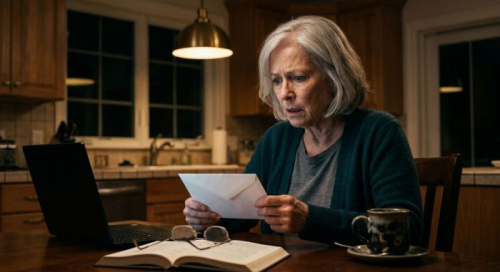
The text arrived at 9:14 on a Tuesday night. Helen, dear — I have been trying to reach you all evening. There is something I need to tell you about the cabin. Please don't be upset. — Margaret
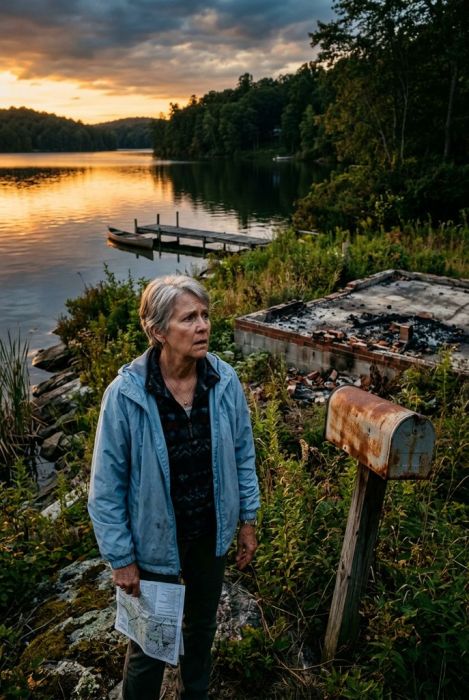
Helen Vance read it three times in the dark of her kitchen on Riverdale Road. Ten hours earlier, she had stood on a grassy point at Smith Mountain Lake, holding the printed confirmation in her hand, staring at an empty lot where an A-frame cabin should have been. There was no red canoe. There were no leaning pines. There was only a scorched concrete slab, a rusted mailbox, and a sheriff's deputy standing behind her with his notebook already open.
Her son Kyle had driven her two hours from Roanoke without complaint. They hadn't said a word for the last mile, because neither of them knew what to say to the other.
Fourteen months after Frank Vance's heart attack, cleaning out the garage had seemed like the healthy thing to do. Under the fishing rods and the half-empty paint cans, Helen found the brochure for the lake house they had almost bought — the A-frame her husband had fallen for on their forty-first anniversary. Frank had mailed the earnest money the morning he died. The sale fell through in the weeks that followed, the check came back, and the dream went into a cardboard box with everything else.
Helen retired from the library that spring, and the quiet nearly finished her. Frank had been the talker. He had chased squirrels off the bird feeder, argued politics with the mailman, and kept her laughing at the absurd way people filed things. Without him, the house felt like a museum of someone else's life. Her son Kyle came by every Sunday with a rotisserie chicken and a list of new security cameras he wanted to install. He worried about her falling, forgetting, being alone. She couldn't tell him the worst of it — that she wasn't lonely so much as unfinished. She and Frank had one plan left, and she couldn't let it die with him.
It was her neighbor Dorothy Fenwick who finally said the words out loud. Dorothy was sixty-nine, widowed eleven years, and she brought over a casserole the day after every milestone Helen wished she could skip. One Sunday in May, Dorothy sat on the back porch with her and asked, "If Frank was here, what would the two of you be doing right now?"
Helen told her about the cabin. About the red canoe, the pines, the sunset they had watched from the dock while some stranger's dog barked in the distance. She hadn't meant to cry. When she finished, Dorothy squeezed her hand and said, "Then go. See it. Rent it for a week. He'd want you to."
That night Helen opened her laptop and typed Smith Mountain Lake cabin rental into a search bar for the first time in her life.
The listing appeared at the top of a regional vacation site, and looking at it hurt. Same A-frame. Same red canoe. Same tilt of the pines over the water, the exact photo from the brochure Frank had fallen in love with. The owner's name was Margaret Rayburn, who described herself as a retired schoolteacher keeping her late husband's cabin for good renters. In the notes she had written: This was Walter's dream cabin. Since he passed, I only feel close to him when good people are on the porch, loving it the way we did.
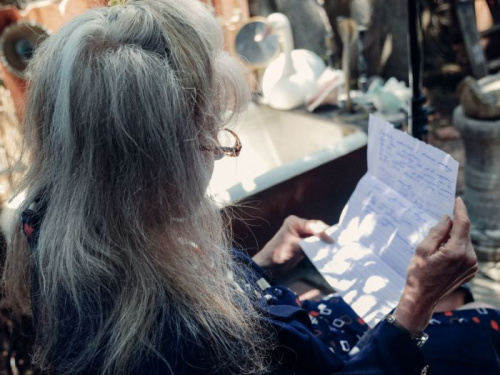
Helen wrote to her that night. Margaret wrote back within the hour, and her messages were warm and a little old-fashioned, full of gentle punctuation and the sort of hopeful patience Helen had not heard from anyone since Frank. Over two weeks they exchanged long letters the way people used to write letters. Margaret asked about Frank's fishing habits and Helen's favorite books. She mentioned that the cabin had new gutters and a propane stove that clicked when you lit it.
Kyle stopped by on a Thursday and found his mother reading her laptop with pink cheeks. "Mom, who are you emailing?"
"A widow named Margaret. She owns the A-frame, sweetheart. We're going to rent it."
He sat down with her and scrolled the listing slowly. "It looks great," he said carefully. "But we're not paying any deposit until you let me call her."
"She's old, Kyle. She doesn't like the phone," Helen said. "She said her grandson handles the payments because she doesn't trust 'those online machines.' You'd like him — he's a teacher too. He said he'd walk us through the property on video if we want."
Kyle frowned at that. "If there's a grandson, why didn't he put the cabin on Airbnb where there are protections? Why a backwater listing site nobody's heard of?"
Helen closed the laptop. "Because it's her family's private little corner of the internet, honey. Not everything is a trap."
She was forty-six years a librarian, a woman who had spent her career teaching children to check their sources. That was the part that haunted her later — how easily she had decided to trust a stranger who said the words she was starving to hear.
On the first of June, Margaret wrote that another family had asked for the same two weeks. A retired couple from Charlotte. They seem very kind, but I told them you had first claim. If you want the cabin, I need your deposit today. I'm sorry to rush you, dear.
Helen called the bank and moved twelve hundred dollars by Zelle to an account in the name of "T. Fenwick," because Margaret explained her own name was on an old savings account she couldn't access, and her grandson was helping her open a new one. The money left her checking account at 2:47 in the afternoon. At 2:50, Margaret wrote back that the cabin was hers.
The confirmation came as a printable letter with a little line drawing of an A-frame at the top and the address: 411 Blue Ridge Point, Huddleston, Virginia. Helen printed two copies. She put one in her purse and one on the refrigerator. She bought a new sun hat. She bought sunscreen. She told Dorothy all of it, sitting on the back porch with sweet tea, and Dorothy said she was proud of her for being brave.
Kyle kept trying. He found the county assessor's website and asked his mother if he could check the parcel number. Helen told him he was being paranoid. He asked Margaret's "grandson" for a video walkthrough, and the young man apologized, saying his grandmother was in the hospital and the cabin was locked for the season. When Kyle asked for a property manager's number, the grandson stopped replying for a day before blaming a broken phone.
Helen made excuses for them the way people make excuses for people they love. She had convinced herself the cabin could not be a lie, because if the cabin was a lie, then the dream was a lie too, and she didn't know what was left of her after Frank except that dream.
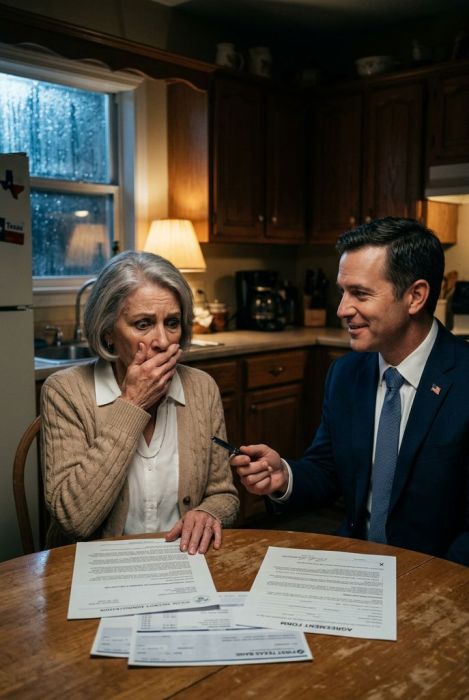
The second payment happened on a Tuesday morning. Margaret wrote that the roof had leaked and the insurance wouldn't cover the fix until the policy was updated, and could Helen wire the remaining three thousand dollars early? She swore the cabin was worth every penny. Helen wired it from the kitchen while Kyle was at football practice.
That Sunday, Kyle set his laptop down in front of her and pressed play. A grainy reverse-image search showed her listing photos resolving, one by one, into the photographs from the brochure — and beneath them, the original source: a 2018 real estate listing for 411 Blue Ridge Point, sold that September to a family named Crofton. The red canoe had been in the realtor's staged photos. Helen stared at the screen.
"How long have you known?" she whispered.
"Since Thursday," Kyle said. "I didn't want to be wrong."
At 8:00 the next morning they drove the two hours to the lake. A deputy from the Franklin County Sheriff's Office met them at the end of the gravel road because Kyle had reported the fraud the night before. Deputy Wade Holcomb was a young man with a patient face who had probably seen this a hundred times, and he was gentle about it. He walked them down to the point. The grass had grown over the foundation. The mailbox had no door. A green kayak sat on the neighbor's dock, but nothing else moved but the water.
"The cabin burned in 2019," Holcomb said. "Family sold the lot after. Nobody's lived here since. You're the fourth person this summer to show me this listing."
"Four people," Helen repeated.
"It's a ring," he said. "They reuse the old photos because dead properties don't call the police."
Back in Roanoke, the fraud unit traced the Zelle accounts. Both payments had landed in a checking account opened online in the name of Todd Fenwick, and that was when the world tilted. Helen read the name twice and put the phone down. Dorothy's son. The one who had moved back into the basement after his divorce, who came up for air around six, who always asked about her garden and her doctor's appointments and, that spring, whether Frank's insurance settlement had come through yet. She had told Todd all of it. She had told Dorothy all of it. Dorothy had told Todd all of it, because Dorothy believed her son was just being friendly.
Todd had listened to his mother repeat Helen's grief and Helen's plans and Helen's savings at the dinner table for a year. Then he had built a fake widow from the wreckage of her marriage — a woman who had lost a husband named Walter, who loved the library, who fished the same coves Frank had fished. Every detail Helen had shared with Margaret had come out of the Fenwicks' kitchen.
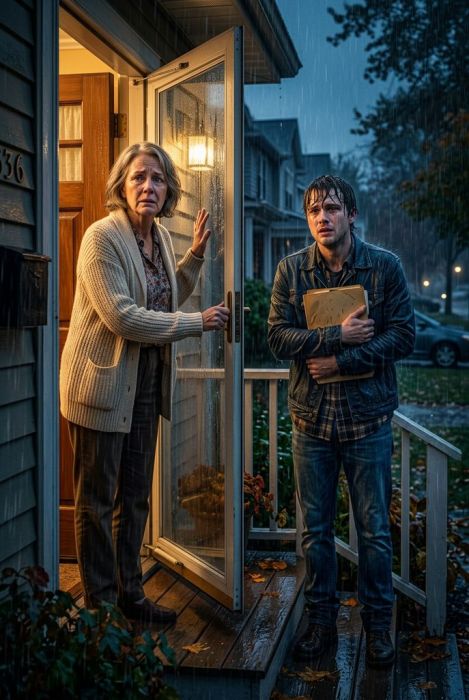
The confrontation happened at Dorothy's house on a humid evening with the porch lights on. Dorothy answered the door in her house slippers and looked at Helen with a confusion that turned to horror as the deputy explained. Helen had expected anger. She got something worse — Dorothy's slow, awful recognition that she had told her son about the insurance check, about the cabin, about every tender thing Helen had ever confided. Todd stood in the hallway behind his mother with his hands in his pockets, saying nothing.
"You used me," Dorothy said to him finally, her voice cracking. "You used me to rob my best friend."
They arrested Todd at his desk job downtown the next morning. He had, it turned out, done this before — two other grieving widows in neighboring counties, same photos, same sympathetic widow, same Zelle accounts. He cried in the police station the way Helen had cried at Frank's funeral, and watching him do it made her feel something she didn't have a name for.
Dorothy paid Helen back from her own savings in cash, count by count, at the kitchen table, apologizing each night the way Helen had apologized to Frank for every argument they never got to finish. It took Helen a long time to take that money. In the end she took it, because she understood that Dorothy needed to give it more than Helen needed to keep it.
Deputy Holcomb called later that month to say Todd had taken a plea deal. Restitution was ordered. It would come, slowly, in small court-ordered payments, like rain on a roof that no longer leaked.
Helen did not rent a cabin that summer. She bought a secondhand kayak instead and learned to paddle the still water of the lake near her own house, where the sun came down orange through the pines and there was nobody standing behind her with a notebook. Kyle came with her sometimes, and they didn't talk much, which was fine.
That fall, Dorothy's casseroles turned up again, and Helen let her leave them on the porch. Some things you don't forgive in a day. But some things you don't burn either.
What Helen learned, she learned slowly, the same way she had learned to kayak — by nearly tipping over. She learned to reverse-image-search every photograph of every place she ever thought she loved. She learned that a real owner always lets you call. She learned that Zelle is for people you know, and that urgency is the smell of a trap, and that the sweetest words in an email are often the most expensive ones. Most of all, she learned that grief is not a weakness that other people can smell — it is a door, and some people will knock on it pretending to be exactly what you lost.
She still keeps the brochure in the box under the garage workbench. But now she knows the difference between a photograph and a promise.