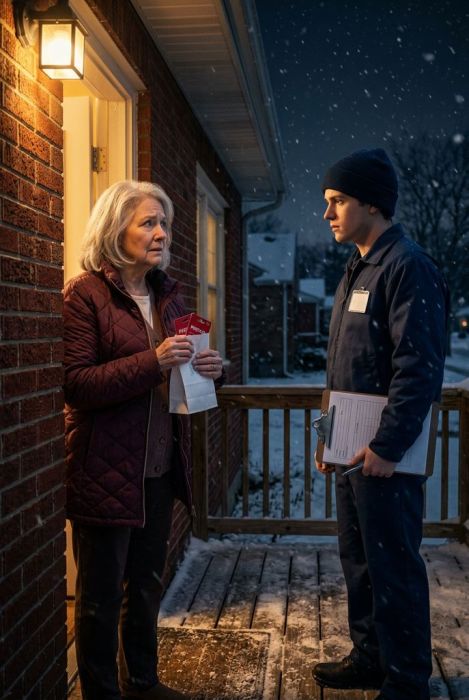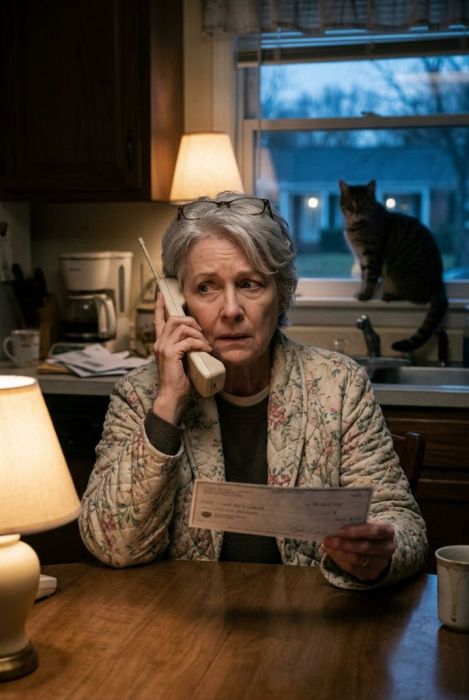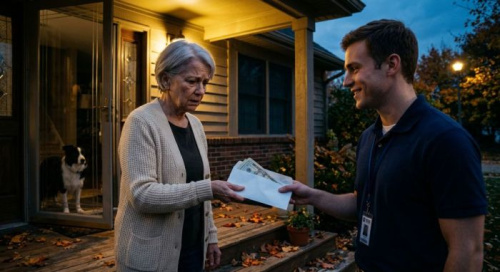
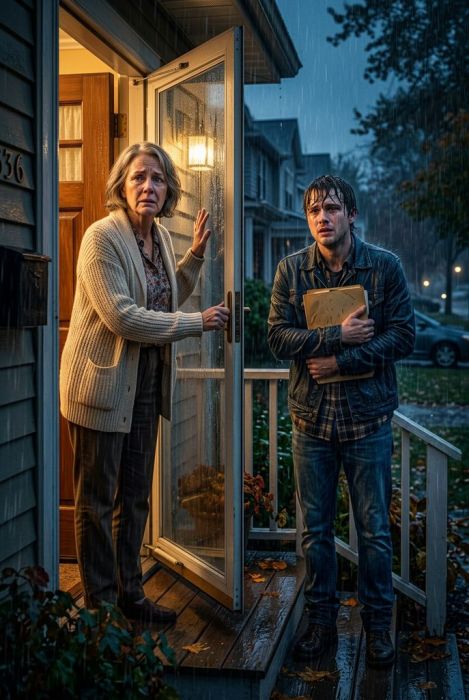
The rain had just found its rhythm when the knock came — three firm raps on the storm door that rattled the glass. Patricia Moran set down the cup of tea she hadn't drunk and peered through the sidelight, because that is what you do when you live alone at sixty-six, especially in the year after your husband dies. The man on her porch was drenched, a manila folder clutched to his chest like armor, his face carrying the look of someone about to say a sentence he had rehearsed a thousand times and still could not begin.
"Mrs. Moran?" His voice cracked on her name. "My name is Tyler Rouse. I'm so sorry to show up like this." He swallowed hard. "I believe your husband was my father."
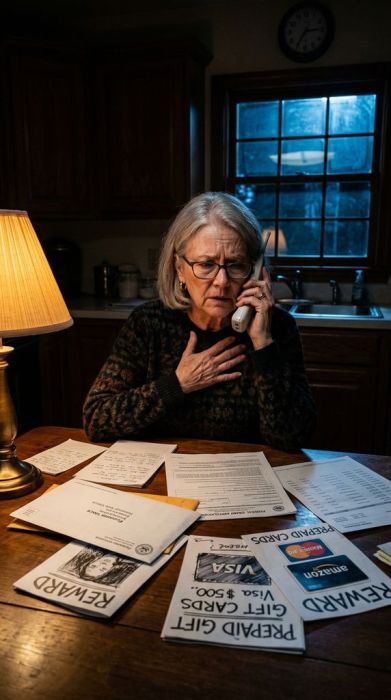
Pat's hand went to the doorframe. For a long moment she said nothing. Frank Moran had been gone fourteen months, taken by the pancreatic cancer that had shrunk him from a bear of a carpenter to a whisper in six months. They had been married forty-two years, raised a daughter, weathered a layoff and a knee replacement and a thousand quiet mornings. She had never once doubted that she knew everything there was to know about the man who snored beside her. Not once. Until now.
She did not slam the door. That was her first mistake, and she would replay it for weeks. Instead she stepped aside and let the soaked young man in, because he was shivering and because he was crying, and because the mother in her could not close a door on a boy who was crying.
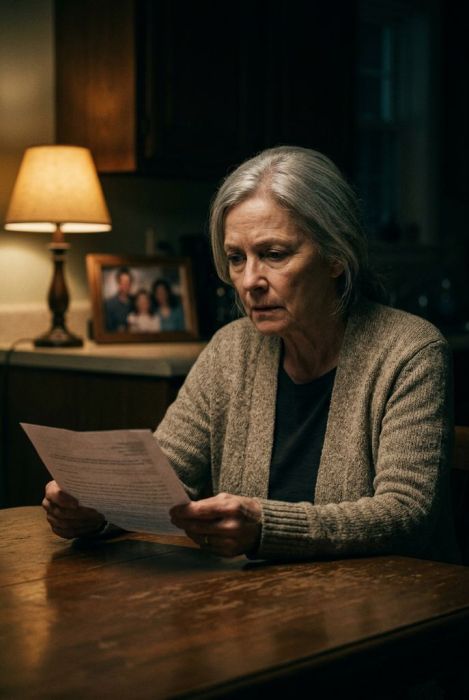
He told her the story in pieces, the way people do when they are afraid you will run. His mother, he said, was a woman named Rosa, whom Frank had met during a summer carpentry job outside Asheville, North Carolina, in the spring of 1997. It had been brief, he said. Rosa had never told Frank about the pregnancy, and she had died of a stroke two years ago. Tyler had taken an ancestry DNA test on a whim, and the results had lit up like a Christmas tree. The report he slid across her kitchen table, with shaking hands, declared in crisp letters that he and the late Frank Moran shared DNA consistent with a father-son relationship. Probability of paternity: 99.9 percent.
"I don't want your money, Mrs. Moran," he said, and maybe that was the most believable lie of all. "I just want to know who my father was. I've spent twenty-seven years wondering if I look like him."
Pat looked at the report. She looked at the young man's eyes — Frank's eyes, she would have sworn, that same gray-green that had met hers across a crowded fellowship hall in 1983. She felt the kitchen floor tilt. All those years, all the small silences she had chosen to forgive, all the secrets she had believed impossible. Now the paper said otherwise. And papers did not cry. Papers did not lie.
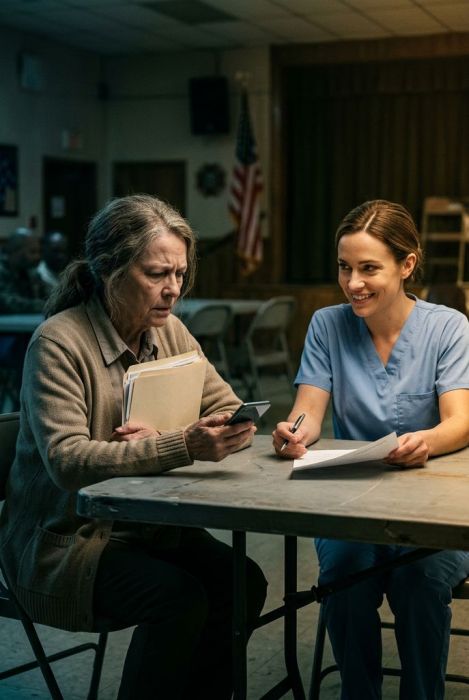
Her daughter disagreed. Megan Whitfield, thirty-eight, a paralegal at a Columbus litigation firm, had her father's stubbornness and a lawyer's suspicion, and she was at the house within the hour. She read the report twice, examined the letterhead, and noted the lab's address: a strip-mall suite in Texas that meant nothing and everything. "Mom," she said gently, "whatever else is true, Dad's estate belongs to you. Not to anyone who shows up with paperwork. I need you to remember that." Then she did what a good paralegal does. She started checking.
It was the details that began to smell wrong. Tyler Rouse had no digital footprint she could find, which was odd for a man his age. The phone number on the report's letterhead played a voicemail that mentioned no company name. And when Tyler returned to the house a week later — because Pat, drowning in grief and guilt, had invited him — he brought flowers and a story and, tucked casually into the conversation, a request. He would like a copy of his father's death certificate, he said, to understand his own history. If she had any family records, any old papers, he would be grateful just to look.
Pat gave him the death certificate. She let him look through an old photo album. She made him dinner, then apologized for the frozen lasagna as if he were her own child.
That was when Carol Weeks began to come around more often.
Carol was the home-health aide who had sat with Frank through his final weeks, the one who had held Pat's hand at the funeral, the one who still stopped by every few Thursdays to make sure Pat was eating. She had kind eyes and a voice like warm syrup, and she had seen every family photograph Pat owned — because Pat had shown them to her, desperate in those gray weeks to keep Frank alive in someone else's memory. "Tell me about this one," Carol would say. And Pat would tell her. And Carol would listen like a priest.
Megan's first real lead came from a notary. The young man's lawyer — a name on letterhead, never a face — had filed a formal claim against Frank's estate and attached a notarized affidavit of heirship. Megan's firm kept a database of local notaries, and one afternoon she learned that the notary on the document, a Janice Poole, worked out of a UPS store in northeast Columbus. Megan drove there on her lunch break. The clerk remembered the papers, of course she did, she said — it was the strangest notarization she'd ever done, because a middle-aged woman had brought them in alone, and the young man had never signed in her presence. The woman wore a polo shirt with a home-care company logo. The clerk remembered the car too: a red Chevrolet, older model, bumper sticker for a church in Worthington.
Megan called her mother that night, and together they went through the album Tyler had returned — page after page of birthdays and graduations and ordinary American sunlight. Near the back, there was an empty sleeve.
The missing photograph had shown Frank sitting on the back porch of the house on Mulberry Lane with Duke, the golden retriever, both of them half asleep in the late-afternoon sun. Pat had taken it herself in the summer of 2010, the year Frank finally agreed to retire. It was not a precious photograph. But it was theirs, and it was gone.
And then Megan remembered, with the cold clarity of a thing that has waited years to be remembered, that Tyler had shown her mother a photograph on his very first visit. A photograph of Frank with that dog. Duke had not existed in 1997. Duke had not existed anywhere on earth in 1997. No man in Asheville could have possessed a photograph of a dog that had not yet been born, on a porch he had supposedly never entered, in a life he had supposedly never shared.
The pieces locked together with a sound Pat would later describe as a light switching on in a very dark room. Only one person outside the family had ever set foot in that house. Only one person had ever sat on that couch and asked to hear Frank's stories, had ever lingered over that photograph where it hung by a thumbtack in the hallway. A middle-aged woman in a home-care polo, driving a red Chevrolet, attending a church in Worthington.
"I want you to come with me to her church," Megan said. "Not today. But soon. I want you to see her face when I ask about the notary."
Pat said no. She was afraid, of course, but it was more than that. Some part of her had wanted to believe Tyler so badly that she had almost forgiven Frank for a sin he never committed. She had grieved a betrayal on top of a grief. And now the truth was worse, because the truth meant that her husband had been faithful and she had let a predator into her kitchen, and predators in warm voices were the hardest kind to see.
The confrontation happened, in the end, not at the church but at Carol Weeks's own kitchen table. Megan had called the detective — the fraud unit at the Worthington division, a gray-haired woman named Detective Sandra Locke who had seen every con in the book and still winced at this one. The detective had obtained the UPS store's security footage. She had run the red Chevrolet's plate. She had subpoenaed the phone records of the "DNA lab" and found that every call routed to a prepaid phone that Carol Weeks had purchased at the same chain store, on the same day she printed the forged report at a public library.
They gave Carol one chance to tell the truth. She spent it refusing to look at Pat.
"I helped that boy, that's all," Carol said. "He's my sister's son. He showed up at my house with this story about a father, and I felt sorry for him. I drove him around. I witnessed a paper for him. What's the crime in that?"
"The lab doesn't exist, Carol." Detective Locke's voice was flat. "The report was printed at a library. The notary never saw Tyler sign. The photograph of Frank and Duke was taken from this woman's hallway. And we've got the footage of the day you paid the young man to pretend — footage of you handing him cash in the parking lot of the Save Mart on Wilson Road." She paused. "So let's stop with the sister's son."
Tyler Rouse, whose real name was Tyler Hodge, began to cry. Not the practiced tears he had used on Pat's porch. Real tears, the kind that come from a man discovering the ground under his feet was never solid. His mother had not died two years ago; she had left when he was six. He had no idea who his father was. He had believed, with the hungry faith of a boy who never got to ask, that Carol Weeks — his aunt, the only family member who paid him any attention — had found answers for him. She had shown him the same photograph she later showed Pat, and told him the man in it was his father. She had taken him to a lab to "give a sample." She had told him what to say, put cash in his hand, and watched him knock on a widow's door.
He had wanted it to be true so badly. That was what Carol had banked on. That was the engine of the whole machine: a boy's longing, a widow's grief, and a few forged documents in between.
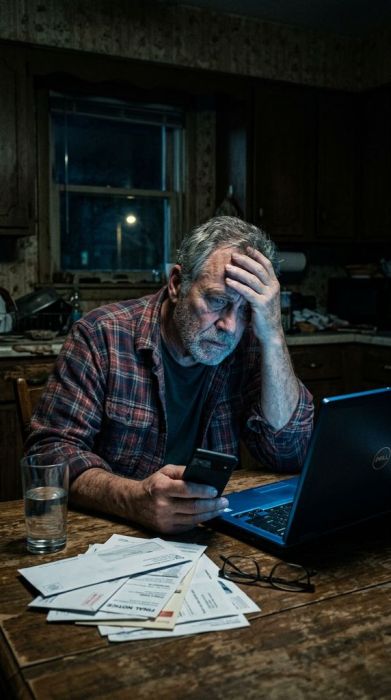
The criminal case drew out of the arrest, because fraud of this kind always does. Tyler testified against his aunt in exchange for a cooperating-witness agreement, his voice breaking as he described the exact moment he learned the DNA test had never been real. Carol Weeks sat at the defense table in a plain gray blouse, her kind eyes finally empty, fourteen felony counts stacked against her. The prosecutor told the magistrate that the scheme had targeted three other families before the Morans — three other widows, in three other states, who had paid Carol Weeks thousands of dollars in "estate fees" and "test fees" before a single thing ever went to court.
Pat did not testify. She sat in the second row and listened, and afterward, in the corridor, she did something no one expected. She asked the bailiff if she could speak to the boy.
Anyone with a heart knows what she said, or can guess. She told Tyler Hodge that Frank Moran was a real man who had loved one woman his whole life, and that Tyler had been robbed of a father twice — once by abandonment, and again by the aunt who used that wound as a door. "You don't owe me anything," she told him. "But you owe yourself the truth." She didn't press charges against him beyond the agreement. She didn't have the fury left for it. What she had left was the terrible, ordinary wisdom of a person who knows that grief makes you visible to wolves.
Carol Weeks was convicted and sentenced to fourteen years. The restitution order clawed back what it could from the three families she had ruined and the fourth she had only wounded. Pat's estate — her house, her pension, Frank's insurance — went untouched, held up against the world by a daughter who had not believed the paperwork for a single second.
The last time Pat saw Tyler Hodge was at the detention center, through safety glass, two months before she stopped visiting. He asked if he could write to her. She thought about it for a long time. In the end she said no, but she did not say it unkindly. "Send the letter to yourself," she said. "Tell yourself the truth about who you are. Then you'll know what to do."
Some nights, Pat still catches herself looking through the sidelight before she unlocks the porch door. She keeps the photo album in a drawer with a lock now. She verifies every charity, every cold call, every warm voice that asks to hear her stories. And when the phone rings at dinnertime and a stranger on the line says Frank Moran owed him money, she says "Hold on, let me get a pen" — and then she calls Detective Locke instead.
Grief is not a weakness. But it is a door, and some people carry keys. The lesson of Mulberry Lane is not that the world is full of monsters inside warm voices — it is that one phone call to the county clerk, one search for a real lab, one daughter who asks the second question, can turn a would-be victim into the person who shuts the door. Patricia Moran learned that the truth you verify is the only truth you can keep. She would tell you it cost her fourteen months and a cup of tea she never drank.