My name is Danny O'Malley, and for thirty-five years, I lived with a secret that shaped every single decision I made.
I couldn't read.
Not a menu. Not a road sign. Not a birthday card. Not even the get-well card my daughter Lucy made for me when I had the flu, the one covered in crayon hearts and wobbly letters that I pretended to read before taping it to the fridge where I could look at it every day without anyone knowing I had no idea what it said.
I got good at hiding it. Real good. When the guys at the construction site passed around a safety memo, I'd squint and say I forgot my reading glasses. When Maria handed me the electric bill, I'd nod and say I'd take care of it later. When Lucy brought home her first chapter book and asked if we could read it together, I told her daddy was tired from work and maybe tomorrow.
Tomorrow never came. Not for two years.
I told myself it didn't matter. I had a good job. Steady pay. A wife who loved me, a daughter who thought I could fix anything. I could build a deck, frame a wall, rewire a whole house. Who needed to read when you could do things with your hands?
But the truth sat in my chest like a stone I'd been swallowing since the third grade, when Mrs. Patterson asked me to read aloud from the science textbook and the letters swam on the page like minnows. The kids laughed. I stopped raising my hand after that. By sixth grade, I stopped going to school altogether when I could get away with it. By ninth, I dropped out.
My old man was a drinker who didn't care whether I went to school or not. My mother worked double shifts at the textile mill. Nobody noticed I was falling behind because nobody was watching. By the time anyone realized I couldn't read, I had already learned to pretend so well that it was easier to keep pretending than to admit the truth.
So I carried the secret. Through three different jobs. Through a wedding. Through the birth of my daughter. Through every PTA meeting where I smiled and nodded at the newsletters I stuffed in my pocket and threw away later. Through every night Lucy asked me to read her a bedtime story and I made up excuses until Maria took over.
I told myself it was fine. But it wasn't fine. It was eating me alive.
It started on a Tuesday in October, the kind of crisp New England afternoon that makes you forget summer ever existed. I was on the roof of a new development in Medford, nailing down shingles, when my phone buzzed.
It was Maria.
"Danny, can you pick up Lucy from school today? I'm stuck in a training until five."
"Sure," I said. No big deal. I picked her up most Tuesdays anyway.
But when I pulled up to the elementary school, I saw Lucy standing by the front gate with a piece of paper in her hand, waving it above her head like it was the most important thing in the world.
"Daddy! Daddy! Miss Rodriguez gave us a challenge!"
She climbed into the truck, her brown pigtails bouncing, her backpack thumping against the seat. She was nine years old, all energy and scraped knees and a smile that could make a grown man forget every bad thing he'd ever done.
"What kind of challenge?" I asked, pulling away from the curb.
"The Read Together Challenge!" She shoved the paper toward me. "Look! If we read together for fifteen minutes every night for thirty days, we get a certificate and a pizza party! And look, there's a list of books we can choose from!"
I stared at the paper in her hand. The letters blurred together the way they always did, dancing and shifting like they were laughing at me.
"That's great, sweetheart," I said, keeping my eyes on the road. "We'll talk about it when we get home."
But Lucy wasn't letting it go. She never let anything go. That's what I loved most about her and what terrified me the most in that moment.
"We can start tonight!" she said, her voice bubbling over with excitement. "I already picked our first book. It's called Charlotte's Web. Miss Rodriguez says it's about a pig and a spider, but it's really about friendship and sacrifice. Have you read it, Daddy?"
I gripped the steering wheel. Two blocks from home. I just had to make it two more blocks.
"Nope," I said. "Can't say I have."
"That's okay! We'll read it together! You can read one chapter and I'll read the next!"
My hands went cold.
"Lucy, I — "
"We can read in your big chair! Like you and Mom do with your books!"
I pulled into the driveway and put the truck in park. The engine idled for a moment before I turned the key and the whole world went quiet.
"Lucy, baby, listen."
She looked at me with those big brown eyes, so full of trust, so sure that her daddy could do anything.
"I have to tell you something."
I don't know how I said the words. I don't remember the exact sentence. I just remember the look on her face when I told her that daddy couldn't read. That he never learned how. That the letters on the page didn't make sense to him the way they did to her.
I expected her to be disappointed. I expected her to be confused. What I didn't expect was for her to put her small hand on my arm, the same way Maria did when she wanted me to know everything was going to be okay, and say, "That's okay, Daddy. We can learn together."
And just like that, the stone in my chest cracked, just a little.
That night, I did something I hadn't done in twenty years. I walked into the public library on Main Street, the one I'd driven past every single day of my life, with my nine-year-old daughter holding my hand.
The librarian at the front desk was an older woman named Mrs. Chen, probably in her early sixties, with silver-streaked hair pulled back in a bun and reading glasses hanging from a chain around her neck. She had the kind of face that looked like she'd spent a lifetime smiling at people, and the kind of eyes that told you she'd seen things most people hadn't.
"Can I help you?" she asked, looking from Lucy to me.
I opened my mouth. Nothing came out.
"My daddy wants to learn how to read," Lucy said, her voice clear and steady.
I've done some hard things in my life. I've worked twelve-hour shifts in the blazing sun. I've held a friend's hand while he came out of surgery. I've stood at the altar and promised to love Maria for the rest of my life. But nothing, absolutely nothing, was harder than standing in that library, a grown man in a flannel shirt and work boots, while a librarian looked at me with nothing but kindness in her eyes.
"Well," Mrs. Chen said softly, "you've come to the right place."
The adult literacy program met twice a week in a small room at the back of the library. There were six of us. A retired mechanic named Frank who wanted to read his grandkids bedtime stories. A young mother from Guatemala named Elena who could speak English but couldn't read it. A man in his fifties named Clarence who had never told anyone his secret, not even his wife of thirty years.
And me.
Mrs. Chen was our teacher. She started us on the same books Lucy was reading in school. Simple sentences. Big letters. Lots of pictures. And every Tuesday and Thursday, I sat in that room, my hands Calloused and rough, tracing my finger under words like "some" and "friend" and "home."
The first time I read a full sentence out loud, my voice cracked. "The pig... was... very... small."
Frank patted me on the back. Elena smiled. Clarence nodded, his eyes watery.
It was the hardest and best thing I'd ever done.
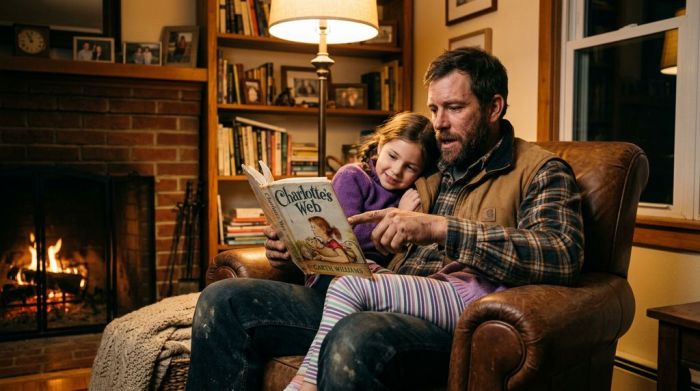
At home, Lucy became my reading partner. Every night after dinner, we'd curl up in my big armchair, her on my lap even though she was getting too big for it, and we'd take turns reading Charlotte's Web.
She'd read a page, and then I'd read a page, halting and slow, sounding out each word like I was back in the third grade. But she never rushed me. Never corrected me. Never once made me feel stupid.
"The... first... sentence... of... the... book..."
"Daddy, that's the title page," she'd say, giggling.
And I'd laugh too, because for the first time in my life, learning to read didn't feel like a punishment. It felt like a gift.
Three weeks into the challenge, something shifted.
I was reading chapter twelve, the part where Charlotte is explaining to Wilbur why she's going to save his life, and the words started to flow. Not fast. Not perfectly. But I wasn't sounding out every single letter anymore. I was reading. Actually reading.
Maria walked into the living room and stopped. She stood in the doorway, holding a cup of tea, watching us. When I looked up, she had tears running down her face.
"What?" I asked.
"Nothing," she said, wiping her cheek with the back of her hand. "I just... I've never seen you like this."
Lucy snuggled closer to me. "Keep reading, Daddy. Charlotte's about to tell Wilbur the best part."
I looked down at the page, at the words that had been my enemy for so long, and I read.
" 'You have been my friend,' replied Charlotte. 'That in itself is a tremendous thing.' "
On the last day of the challenge, Lucy and I finished the book. I closed it and sat in silence, holding my daughter, feeling the weight of what we had done together.
"Did you like it, Daddy?" she asked.
I thought about how to answer. About Wilbur and Charlotte. About friendship and sacrifice. About a nine-year-old girl who taught her father how to be brave.
"Yeah, baby," I said, my voice rough. "I liked it a lot."
She hugged me, her small arms wrapped tight around my neck, and whispered in my ear.
"I'm proud of you, Daddy."
And that was it. That was everything.
The next morning, I walked into the library and sat down across from Mrs. Chen with a new book in my hand. It was a simple novel about a fisherman and the sea, the kind of book an elementary school student might read. But it was mine, and I was going to read every single word of it.
"Same time next week?" Mrs. Chen asked.
"Same time next week," I said.
As I left the library, I passed a display table near the front entrance. It was covered with new books, the ones Mrs. Chen had recommended for adult readers just starting out. I picked one up and read the title out loud, not caring who heard me.
"Tuesdays with Morrie."
It felt good to say it. To know what it said. To know that I could take it home and read it, one page at a time, and understand every word.
I signed it out using my brand new library card. My name was printed right there on the front: Danny O'Malley.
I could read my own name now. And I couldn't stop smiling.
That night, Lucy found me at the kitchen table, reading my new book. She climbed onto the chair next to me and rested her chin on her hands.
"Can I read with you, Daddy?"
I looked at her, this little girl who had changed my life without even knowing it.
"I'd like that," I said.
She grabbed her copy of Charlotte's Web and opened it to the first page. We read side by side, both of us lost in our own stories, together in the silence of a home that finally felt whole.
And I realized something that I'd been too afraid to admit for thirty-five years.
Reading wasn't about proving I was smart enough. It wasn't about catching up or keeping up or being good enough.
It was about connection. To stories. To people. To a little girl who believed in me before I believed in myself.
I still have that worn-out copy of Charlotte's Web. It sits on my nightstand, the spine cracked, the pages dog-eared, held together with Scotch tape and love.
And every time I look at it, I remember what that little pig taught the spider, what my daughter taught me, and what I hope every person reading this will understand.
You are never too old to learn. You are never too far gone to start over. And the people who love you will wait as long as it takes for you to find your way back to them.
Read to someone you love tonight. You never know what it might save.