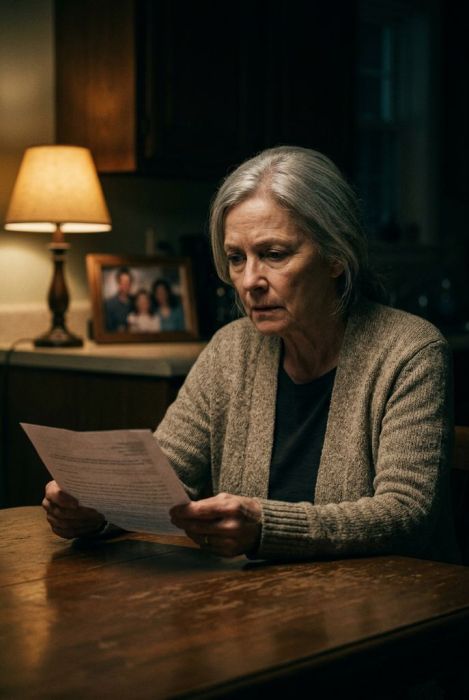
The first thing Vivian Ashworth said to Dottie Mayhew was the only honest thing she ever told her. "You look like you could use a friend." It happened on the second Tuesday of June, eleven days after Dottie moved into Unit 214 of Sunstone Village, a pastel community for the fifty-five-and-over set on the Gulf side of Sarasota, Florida. Dottie had come down from Columbus, Ohio, fourteen months after burying Frank, her husband of thirty-nine years. Meg, her daughter, a nurse at Sarasota Memorial, had promised her a winter without shoveling snow and without that kitchen table where Frank still wasn't sitting. So Dottie sold the house in Ohio, packed thirty-nine years of memories into a U-Haul, and drove south to a place where everyone waved with both hands.
Vivian Ashworth ran the Welcome Committee the way some people ran countries. She had silver hair cut in a perfect bob, a voice like warm honey, and a memory for birthdays, medications, and the names of grandchildren. She met Dottie at the clubhouse with cold sweet tea and a pointed question about whether she liked to read, because the book club, Vivian said, was the beating heart of the whole community. Within a week, Dottie had a seat saved at Bingo, a standing invitation to lunch, and a new phrase in her vocabulary: "my new sister."
Dottie didn't have a sister. She told Meg on their nightly phone call that she had never met anyone so endlessly kind. Meg was happy for her. "You deserve this, Mom. You've been lonely long enough."
The first crack appeared at the pool, on a July morning so bright it hurt. Dottie had worn her old navy suit, the one with the skirt panel she'd owned since before Frank died, because it still fit and covered the places gravity had quietly rearranged. Vivian, pristine in white, floated over and laughed, loud enough for the loungers to turn. "Look at you, sweetheart — dressed for a church picnic in 1987." Dottie laughed too, because what else do you do when a woman like Vivian makes a joke? Then Vivian put a hand on her arm and whispered, "Some people our age just don't know how to let go, God love them. Not you, of course. I'd never mean you." Dottie bought a new swimsuit that afternoon, and the old one went into the donation bin at the clubhouse without a second look.
By August, the pattern had a name that Dottie didn't say out loud. Vivian would lift her up at the mailboxes, then cut at her when no one else was close enough to hear it plainly. "You're the only one I can talk to in this place," she'd say, and later, "You're the only one who needs help with the thermostat too, poor thing." When Dottie flinched, Vivian looked genuinely wounded. "Sweetheart, I would never say that. You're imagining things. It's the heat, the change, the grief — you've been through so much, you're not yourself." Dottie began to doubt herself the way you doubt a staircase you've walked a thousand times. She started double-checking her purse, her keys, her calendar, the lock on her own door. When her orchid vanished from the clubhouse windowsill, she mentioned it over lunch, and Vivian smiled gently and said, "Dottie, you never brought an orchid. Lately you've been forgetting things more and more. Maybe we should mention it to the doctor."
Dottie mentioned that conversation to Meg, in the same phone call where she mentioned she wasn't sleeping. Meg heard the shift in her mother's voice before she could hear the words: a bright, nervous cheerfulness that did not belong to her. She worried. She said so. And Vivian, somehow, knew about that phone call by the next afternoon. "Meg called you worried this morning, didn't she? You see," Vivian said, smooth as glass, "the change has been hard on her too. Mothers forget to notice. I'm the only one who watches out for you now, sweetheart."
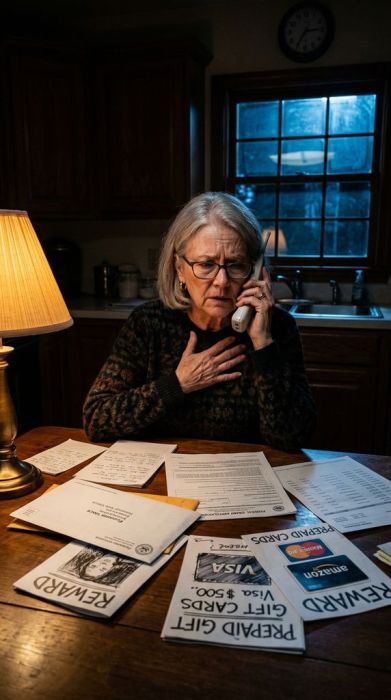
Vivian's son Brad was a thin, handsome man in his forties with teeth so white they seemed to glow, and he handled what he called "the financial side of things" out of an office on the mainland. Vivian brought him to Dottie's screened porch one evening in September, bearing a casserole and a business card with a golden embossed palm tree. "Sweetheart," Vivian said, "you told me you worry about outliving your money. Brad is going to fix that. He only takes clients he knows and loves." Dottie signed the papers for what Brad described as a guaranteed income vehicle. She didn't read all of it, because she felt foolish when she tried, and because Vivian held her hand through every dotted line with such bottomless patience. "Here, where it says eighteen thousand dollars. That's your safety net, honey. I'd have one too, if I wasn't unlucky enough to have a son who understands annuities."
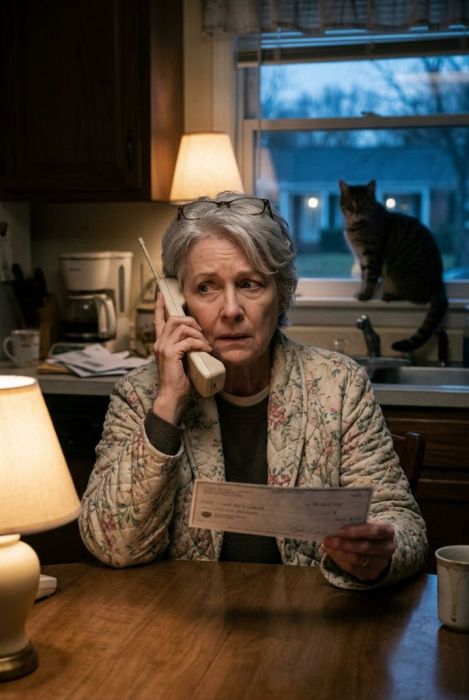
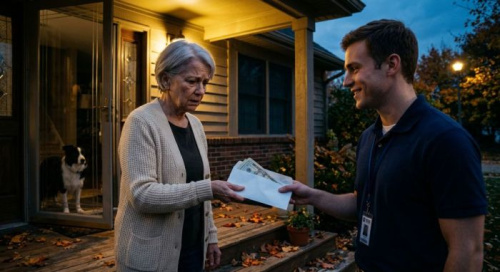
Around the same time, the Sunstone Arts Foundation, which Vivian had founded and which everyone described as a cornerstone of the community, began collecting Dottie's donations. The Foundation had a gala every November, and Vivian showed Dottie the guest list and told her she'd be seated at the head table, because she was practically family now. Dottie, grateful to be wanted, wrote the checks without counting them. Five checks. Eleven thousand dollars. Not one of them for anything that actually existed.
The fog was real, and that was the cruelest part. Dottie began missing book club even though she had written it on her calendar, because she had never been put on the signup sheet. She found her mail pile rearranged on mornings she was sure she hadn't touched it. She kept Vivian's number on the refrigerator under a flamingo magnet, because Vivian was the only person who called every single day, and Dottie was terrified of losing that, too. That was the trap, she would understand later. The loneliness was the door, the kindness was the key, and the lock was the fear of being alone again.
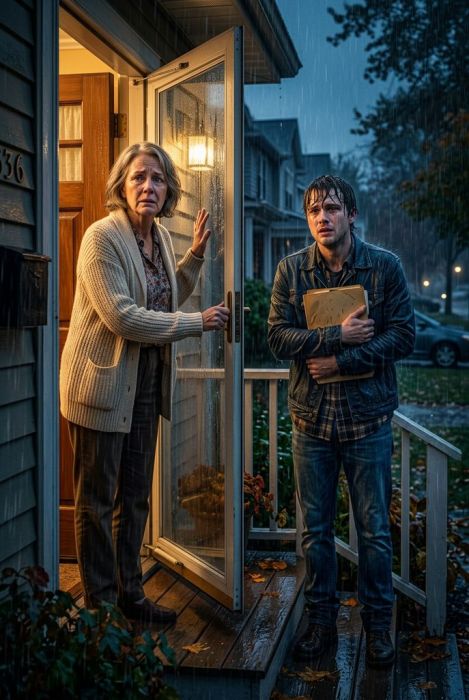
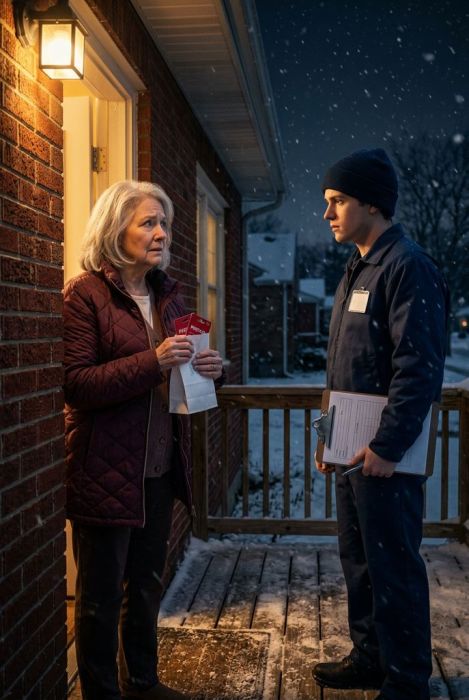
Then, in the third week of October, Ruth Kaczmarek knocked on Dottie's door. Ruth was seventy-eight and lived in number 442, and Vivian had warned Dottie that Ruth said terrible things about her at the card table and that she ought to stay away from her. So Dottie opened the door stiffly. Ruth didn't smile. "Vivian told me you've been calling me a gossip and a cheat," she said. "I don't believe it for a minute, and I'm going to tell you why." Ruth had been at Sunstone for eleven years, and she had watched Vivian do this twice before. She told Dottie about Peggy Wheeler, the year before, who had been Vivian's new sister and who had moved out overnight in March, with renters in by April and no one allowed to ask questions. And before Peggy there was Helen Marlow, a wealthy widow who left her estate to the Arts Foundation, died in August of the year before that, and whose memorial Vivian arranged beautifully, tearfully, entirely alone. "When they buried Helen," Ruth said, "she was still signing her name to checks she never saw." Ruth pulled out a plastic bin of old Sunstone newsletters, dog-eared and yellowed. On the cover of the 2019 Christmas edition, there was Vivian with her arm around a smiling woman in a red cardigan. "That's Camille. She was my new sister too. She lost fifty thousand before her daughter flew in from Oregon."
Dottie stood in her own doorway with her hand over her mouth. She wanted to defend Vivian. She wanted Ruth to be the liar, Vivian to be right about her, the world to go back to being warm and flattering and safe. And that was the moment she understood, with a cold and terrible clarity, which of the two women had been telling her the truth all along. The person who isolates you, she would later say, is never your friend. The person who needs you to distrust everyone else is always the danger in the room.
What happened next happened fast, the way everything does once you stop believing the gaslighter. Meg drove down on her day off and pulled the bank records. The eighteen-thousand-dollar annuity existed only on paper; the money had moved through Ashworth Wealth Partners into an account in Brad's name, then leaked out in four-thousand-dollar increments. The Foundation checks had been deposited into a branch account Vivian controlled, and the elegant guest list was a prop, printed on a home printer. Meg found something else buried in the stack: a notarized health-care power of attorney, dated three weeks earlier, naming Vivian Ashworth as Dottie's agent. Dottie's signature on it was shaky. Dottie's memory of signing it did not exist at all.
They called the Sarasota County Sheriff's Office, and a patient detective named Calderon listened to the whole story without interrupting once. A records search on Vivian Ashworth produced a mailbox store as a street address and a Florida driver's license issued six weeks before Dottie arrived in town. Calderon found civil judgments from three states — Arizona, Texas, Nevada — against a woman using the same first name and a long string of different last names, each one obtained by an elderly plaintiff who had befriended her first. He also found a family in Mesa, Arizona, whose mother had died the previous fall with a quietly rewritten will, and whose estate had gone, down to the last teacup, to a village foundation that could not be located anywhere in that county.
The gala was ten days away. Dottie's first instinct was to hide in her condo with the curtains drawn. But Meg said the sentence that changed her mind. "She took your memory, Mom, one month at a time. Tonight you take it back."
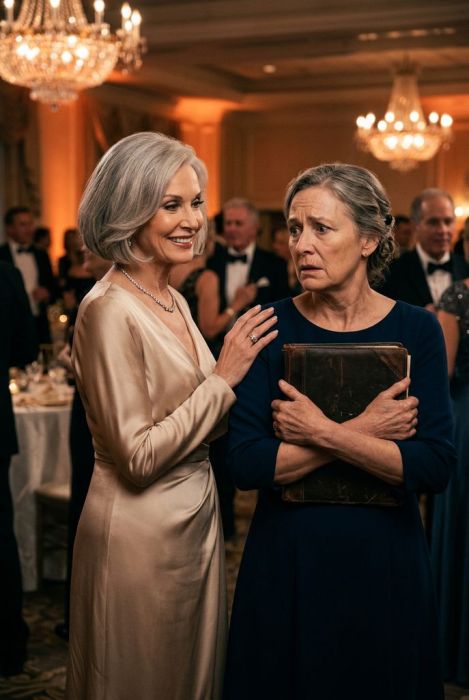
On the first Saturday of November, Dottie Mayhew walked into the Sunstone Village ballroom in a midnight blue dress Meg had made her buy, and the room glowed with candlelight and the particular hum of well-dressed people trying to have a lovely time. Vivian stood at the head table in champagne silk, holding court, touching shoulders, laughing with her head tilted exactly so. Dottie walked past her twice without looking at her. Then she found Ruth at the bar, and Ruth nodded once, and Dottie waited until the emcee announced that the night's honoree for the Arts Foundation would be, as ever, the incomparable Vivian Ashworth.
The applause was rolling and Vivian's smile was widening when Dottie tapped her glass. The silver note cut through the room like a knife on a dinner plate, and Dottie said, in a voice she hadn't used since her days teaching third grade, "Ask Vivian about her scrapbook." The room went quiet the way rooms go quiet when a car has just hit something. Vivian laughed — a bright, practiced, covering laugh — and said, "Darling, you've had too much champagne, and you're upset about something that never happened. Come sit with me and we'll sort it out." For one horrible second, Dottie could feel the crowd relax, because this, right here, was the move Vivian had rehearsed in a hundred different rooms. Nobody doubts the sweet woman comforting the confused one.
But Ruth stepped forward and said, "Show them the newsletter, Vivian. Show them the one with Camille." And from the back of the room, a clerk Dottie had never spoken to stood up and said she had processed a transfer for the foundation and had been instructed never to mention Helen Marlow's name again. And then Meg, near the double doors, holding her phone up to show the bank manager's face on the screen, said, "Mom put eleven thousand dollars into Vivian's personal account, and it's already gone." Vivian's smile held for three more seconds, and then it did something Dottie had never seen it do. It slipped. Somewhere behind it was a woman who was tired, and cornered, and furious. "You think you're the victim," she said, low enough that only the first tables heard it. "I gave you a family. I gave you a son who called you ma'am. I did more for you in four months than Frank did in forty years, and this is how you repay me?"
A sheriff's deputy stepped out of the hallway, and Detective Calderon followed. The arrest was so quiet it was almost gentle, which somehow made it worse, or better, depending on which woman you asked. Vivian Ashworth walked out between them in her champagne silk, and in the parking lot, over the screaming of a single gull, she turned her head and said, perfectly composed, "I'll see you in court, sweetheart. I always do."
The charges came in a thick envelope: exploitation of a vulnerable adult, two counts of forgery, identity theft. Arizona extradited her in the spring on paperwork that mentioned Camille's name. Bradley Hart, who was not, of course, Brad Ashworth, gave a statement in exchange for a lighter deal, and his testimony buried her. The Sunstone Arts Foundation had never legally existed. The gala, the guest list, the donations, the candlelight — they had all belonged to Sharon Delgado, formerly of Mesa, Arizona, and before that of an RV park in Mesquite, Nevada, where the paperwork showed she had once been called a friend by a widow named Cora.
Dottie got most of her money back, not all of it, because that is not how these stories usually end, and she decided that was fine. She had understood something larger than the math. The fog that had closed in around her that October did not lift all at once, but it lifted. She stopped needing the flamingo magnet. She started walking to the clubhouse with Ruth, who had opinions about everything and was not, as it turned out, a gossip about anyone except people who deserved it. Dottie learned to read every document to its last line, to keep a second set of eyes on her accounts, and to say the sentence she had needed to say from the beginning: "I'll take the paper home and look at it."
She also learned to listen to the shape of her own fear. She remembered how Vivian never asked for anything when anyone else could hear, and how she always knew exactly what medication Dottie took, and how the friendship grew in precise proportion to the distance growing from Meg. Real friends do not need you to stop talking to your daughter. Real friends do not make you doubt the table where you set your coffee cup. Real friendship does not feel like a rescue from your own family.
Meg lives in Orlando now, twenty minutes closer than she was, and on Sunday nights Dottie calls her and says, "Remind me what I told you about the power of attorney," and Meg laughs, and Dottie repeats it anyway, out loud, the way you say a thing you only need to say once. "Never sign anything with a hand that loves you and a head that doesn't know what it's signing."
Ruth passed away last spring at eighty, in her sleep, which Dottie considered a mercy. At the memorial, Dottie found Ruth's box of newsletters and slipped one into her purse: the 2019 Christmas edition, Vivian with her arm around Camille, both of them smiling for the camera. She keeps it in the back of a kitchen drawer — not to remember Vivian, but to remember Ruth, the woman who stood in a doorway and told the truth to a stranger, because she had once been that stranger herself.
The last page of that newsletter has a small poem about stars over the Gulf, and Dottie cannot read it without thinking how easy it is to mistake one kind of light for another. The pool lights, the porch lights, the gala lights — they all shine, and they all look like welcome. She had thought she was losing her mind that autumn, and she hadn't been. That is what it feels like when someone is quietly taking everything from you, she wants to tell every woman who sits alone long enough to believe a compliment that costs too much. It doesn't feel like being robbed. It feels, right up until the very end, like being loved.