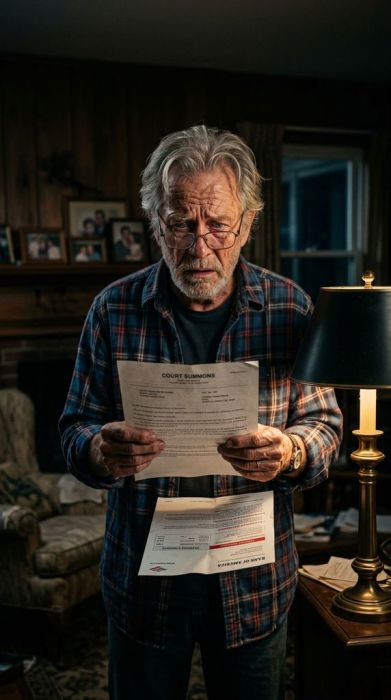
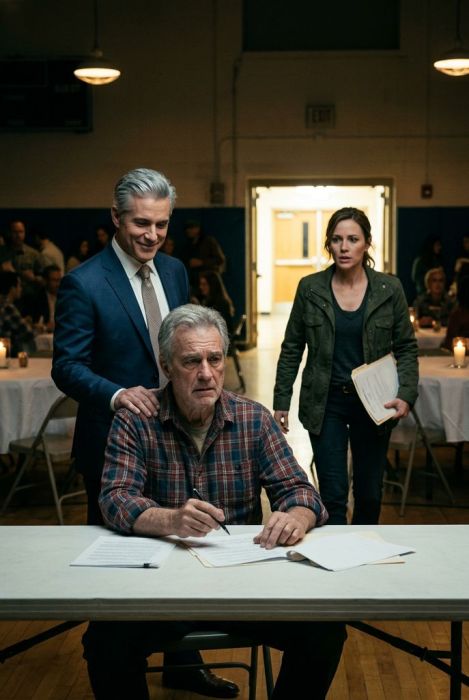
Frank Delaney was not the kind of man who signed things without reading them. For thirty-eight years he had worked the repair bays at Union Pacific in Omaha, a man who torqued bolts to the exact half-turn and checked his work twice. He balanced his checkbook with a pencil every Sunday, kept his tools in labeled drawers, and once drove ninety minutes to return a forty-cent overcharge on a hardware receipt. So when he stood at the folding table in the community center gymnasium, holding a pen over a deed, he would never be able to explain, even to himself, why his knuckles did not shake.
The deed was to the house on Cypress Street, the one he and Ruth had bought in 1989, the one where Claire learned to ride a bike and where Emily, his granddaughter, took her first steps in the living room. Ruth had been gone fourteen months. The cancer had moved fast, the way a prairie storm moves, and Frank had spent a year folding her clothes into donation bags just to have something to do with his hands. The silence in the house was a physical thing. Some mornings he talked to her photograph while he made one cup of coffee, one always one, because measuring for two felt like an insult to her memory.
Claire tried. She came over with casseroles and her husband Tom's fishing magazines, invited him to Sunday dinner every week without fail, and put Emily on the phone to tell him about her spelling test. Frank knew, somewhere under the fog, that he was lucky to have her. But grief had hollowed him out in a way that made even love feel like a chore, and a man who has spent his life fixing things does not know what to do with a wound he cannot reach with a wrench.
That was where Ray Petrosky found him. Ray lived four doors down, a retired car salesman with a salesman's gift for making you feel like the most interesting person in the room. He started walking with Frank in the mornings, for the circulation, his doctor said so, and on the third Thursday, over weak coffee at the diner, he slid a card across the table. The Morning Brotherhood. Meets 6:30 AM, the old community center on South 30th. No fees, first visit free. Just men. Come see.
Frank almost did not go. He told himself the coffee would be better than the coffee he made himself, which was a lie he was willing to accept. But the moment he walked into that gymnasium, something in his chest loosened. Forty men in folding chairs, mostly his age, some older, some younger and broken-looking. Someone had brought donuts, and they were laughing, actually laughing, the way men laugh when they stop performing. The leader stood at the front in a crisp blue suit, a trim man in his fifties with silver hair and a voice like warm gravel. "You're not here by accident, Frank," Eli said, shaking his hand, using his name, which Ray must have given him. "Every man in this room came through a door that looked like a mistake."
Eli called them brothers. He told stories about his own fall, a business that collapsed, a wife who left, a year when he slept in a storage unit, and the men leaned in, because it was the same story so many of them carried. The Brotherhood had saved his life, he said. The Brotherhood was a family for men who had lost their families. They did not preach and they did not push; they just showed up, every Thursday, and let a man belong to something again.
For Frank, that was oxygen. He started going to the Tuesday workshops too, and the Saturday breakfasts. He learned the phrases: leave your armor at the door, the brotherhood holds no secrets, invest in the circle. He started calling Ray his brother, and Ray beamed at him like a proud father. Claire noticed the change and was relieved at first, because her dad was smiling again, wearing actual shoes instead of slippers, shaving every day. Whatever that group is doing, Tom said over dinner, it's good for him. Claire nodded and passed the green beans.
The first money request came in March, six weeks in. A blessing pledge for the Brotherhood's new center, every man gives what he can, no judgment, no minimum. Frank gave two hundred dollars and felt like a king. The requests came monthly after that, always framed as gifts, always voluntary, always with a hand on the shoulder from Eli or a bear hug from Ray. Frank started skipping his weekly chess game with the retired guys from the rail yard. Then he skipped Claire's Sunday dinners twice in a row. Sorry, sweetheart, Brotherhood retreat, he would say, and Claire would hear the joy in his voice, that old crackle that had been missing since Ruth died, and she did not have the heart to be angry.
The cracks appeared slowly. That was the worst part, Claire would later tell the detective, how slowly it happened, how reasonable each step seemed. Frank mentioned the Brotherhood's stewardship program, where brothers could contribute their savings in the circle's care and receive a guaranteed return, one brother helping another. The number made her stomach drop: forty-one thousand dollars, nearly all of Ruth's life insurance. "Dad, that's not how investing works," she said carefully. Frank's face closed like a door. "You don't understand the Brotherhood, Claire. They're not like other people. They'd never hurt me. They're the only ones who never did."
Her father had never spoken to her that way. Not once in thirty-nine years.
What Claire did not know yet was that Frank had already signed a durable power of attorney, in case anything ever happened, so the circle could protect his affairs, naming Harmony Trust LLC, the Brotherhood's parent company, as his agent. She did not know about the withdrawals: five thousand in April, eight in May, the CD cashed early in June. And she did not know about the retreat in July, the three-day Vision Quest at a rented church camp near the Platte River, where Frank, sleep-deprived and exalted after forty-eight hours of testimonials and pep talks, told the circle he would deed them the house so they could build the new center. The men had wept with him. Ray had wept the loudest.
The invisible line was crossed on a Sunday in August. Emily had her first solo piano recital at the community music school, a real recital, with a rented gown and her hair in braids, and she had asked for Pop-Pop specifically to be there. Frank had promised. But the Brotherhood's family renewal weekend had been moved up at the last minute, and when Claire called the house that morning, Frank sounded almost annoyed. "I'll see her at Christmas, sweetheart. The brothers need me this weekend."
Claire hung up, and something inside her went quiet and very, very cold. She had been patient. She had been understanding. She had watched her grieving father fall in love, and that was the only word for it, with a group of men who had slowly, perfectly, replaced the family he had built. For the first time, she asked herself the question she had been avoiding: what kind of group makes a grandfather miss his granddaughter's first recital, and then makes him feel guilty for even mentioning it?
She started with the obvious. The Morning Brotherhood had no website, no phone listing, no registered address except a PO box. The community center rented them the gym for cash. The state of Nebraska had no record of Harmony Trust LLC. The new center they kept raising money for did not exist anywhere in the county assessor's records. Claire made copies of everything, the way her father had taught her, keeping receipts, documenting every step, and she drove to the Omaha Police Department, where a skeptical fraud detective named Amelia Torres listened with her arms crossed, then uncrossed them, then started taking notes.
Detective Torres had a file. Of course she did. Eli Vance, real name Elias Vanek, had a paper trail stretching back twenty years: a men's ministry in Des Moines that dissolved under civil suits, a brotherhood of veterans in Wichita that left eleven widowers short nearly three hundred thousand dollars, and a restraining order from a daughter in Topeka who had recognized her father's face in a brochure. And Ray Petrosky, as Claire was beginning to suspect, was not a retired car salesman at all. His real name was Raymond Vanek, Eli's older brother, a convicted forgery artist out of Iowa who had spent five years at Anamosa State Penitentiary. The walking partner, the warm voice, the golden-retriever friendliness, it had all been a script, refined over two decades, practiced until it felt like love.
That was the part that broke Frank's heart more than the money ever could. Not the forty-one thousand. Not the CD. Not the power of attorney. It was Ray. The man who had walked beside him in the cold mornings, who had listened to Frank talk about Ruth until Frank's voice went hoarse, who had told him that a brother never lets a brother carry his grief alone. That man was a ghost. Frank had confessed his loneliness to a man who was paid, or perhaps just practiced, to harvest it.
The confrontation happened on a Thursday in late September, the very Thursday the Brotherhood had scheduled its Circle of Commitment ceremony, where Frank was to sign the deed and formally welcome Harmony Trust as steward of his home. The gym was dressed in white cloth, candles on every table. Forty brothers, and thirty of them were marks, men who had no idea they were marks. Frank sat at the front table in a borrowed jacket, the pen in his hand, and across the room, the gymnasium doors swung open so hard they bounced off the wall.
Claire walked in with Detective Torres behind her. In her other hand she carried a manila folder, and she did not say a word to Eli. She walked past the candles, past the shocked faces, and set the folder on the table in front of her father. "Read it, Pop-Pop," she said. "You taught me to read everything."
Eli moved to Frank's shoulder, his voice smooth as ever: "Brother, you don't have to do this now. These people are not your family. We are your family." Ray stood at the back, suddenly looking very old, very pale. Frank opened the folder. Inside were the annual reports from Des Moines and Wichita, the prison photo of Raymond Vanek in a gray jumpsuit, the corporate registration showing Harmony Trust had been dissolved for fraud in two states, and a copy of the warrant a judge in Kansas had issued for Elias Vanek the previous spring. The room was so quiet you could hear the candles burning.
Eli never got to finish his speech. The doors opened a second time, this time for two uniformed officers with a Kansas extradition warrant, and Detective Torres read Elias Vanek his rights in front of all of them. What Frank did next surprised everyone, including himself. He turned to Ray, Raymond, and asked, very quietly, "Was any of it real, Ray?" And Raymond Vanek, handcuffed and gray-faced, looked at the floor and said, "The part about you, Frank. That was the worst part. That part was real."
Claire thought her father might shatter when he heard that. Instead, he did something that made her love him more than she ever had: he reached across the table and held Ray's hand, just for a moment, before the officers led him out. "I'm not going to hate you," Frank said. "Because I know what I was. I was a man so hungry to belong that I'd have fed anything that looked like love."
In the weeks that followed, the Brotherhood dissolved like a paper lantern in rain. Three men went to jail, and dozens of widowers and retirees slowly, shamefacedly, got their lives back. Frank got most of his money back, eighty cents on the dollar, the court-appointed receiver said, which was more than some brothers got. He moved in with Claire and Tom for a while, and Emily played her recital piece for him every single night until he knew it by heart. He never went to another group, another meeting, another anything that smelled like belonging. When Claire asked if he was lonely, he said, "I've got you, sweetheart. That's not lonely. That's home."
But there was one more lesson Frank carried, and he told it to a room full of seniors at the library one Tuesday, because a detective named Amelia Torres asked him to, and because he discovered that telling it made it lose some of its power over him. "Grief made me blind," he said. "But grief didn't make those men evil. They were evil before I ever met them. The wolf doesn't come to your door with fangs. He comes with a warm voice, a story about how much he suffered, and a hand on your shoulder when you're lowest. If a group asks you to spend more time with them and less with your family, if they handle your money with special arrangements, if every question you ask is met with a reason why you're not a true brother for asking, run. Not walk. Run."
The money healed in months. The heart took longer, but it healed too. Claire still visits the house on Cypress Street, now kept bright by its new owner, a young couple with a baby; Frank drives past it sometimes and feels nothing but the old, familiar warmth of a good memory. And every Sunday, at dinner, Emily plays the piano, badly, proudly, perfectly, while her Pop-Pop sits with his eyes closed, tapping the rhythm with his fingers, the way a rail man does, keeping time with the life he almost lost and somehow found again.