Jenna noticed the changes in late November. Little things at first — Marcus staying later at work, picking at his dinner, staring at the television without really watching it. She told herself it was just the winter blues. Everyone got them in Ohio, where the sky turned gray in October and didn't brighten up again until April.
But then the Tuesday and Thursday nights started.
It began gradually. Marcus would come home from his shift at the warehouse, shower, and say he needed to run errands. "Got some things to take care of," he'd say, grabbing his coat and not meeting her eyes. He'd be gone for two, sometimes three hours. When he came back, he seemed lighter somehow, but he never talked about where he'd been.
Jenna asked him about it once, gently, while they were doing dishes. "Where do you go on Tuesdays and Thursdays?"
Marcus's hands paused in the soapy water. "Just helping a friend with something."
"What kind of something?"
"A thing. It's nothing." He dried his hands and walked out of the kitchen, ending the conversation.
That was six weeks ago. Now it was January, and the silence between them had grown heavier than the snow piling up outside their apartment on Broad Street.
Jenna was thirty-one years old, a dental hygienist who spent her days in a small room with good lighting and polite conversation. She was good at reading people — at noticing the small tells that revealed what they weren't saying. And Marcus was telling her, very clearly, that he was hiding something.
She didn't want to believe it could be another woman. Marcus was a good man. He'd been a construction foreman until a fall from a scaffold two years ago shattered his wrist and his confidence. The warehouse job paid less and felt like a step backward, but he never complained. He just quietly carried the weight of it, the way he carried everything.
But the secrecy was eating her alive. She started checking his phone when he was in the shower — something she had never done before and felt sick about afterward. She found nothing. No strange numbers. No deleted messages. Just an empty call log that told her he was being careful.
On a freezing Thursday night in mid-January, Jenna made a decision she knew she would regret, but she made it anyway.
When Marcus pulled out of the apartment parking lot at 7:15 PM, she waited exactly sixty seconds, then started her own car. She followed his old Ford F-150 through the snow-covered streets of their small Ohio town, past the closed diner and the darkened storefronts, past the high school where the football field lights still glowed.
He didn't go to a bar. He didn't go to a motel. He pulled into the parking lot of Northwood Community College.
Jenna parked at the far end of the lot, killed her engine, and watched. Marcus got out of his truck, adjusted his coat, and walked toward the main building with the easy confidence of someone who had been doing this for a long time.
She followed him, keeping her distance, her heart pounding so hard she could hear it in her ears. Through the glass doors. Down the hallway. Past the bulletin board covered in flyers for tutoring services and lost cats.
He stopped at Room 204. She watched from the end of the hallway as he pushed open the door, and a warm burst of light spilled out into the corridor. She heard voices. Laughter.
Jenna crept closer and peered through the narrow window set into the classroom door.
And what she saw stopped her cold.
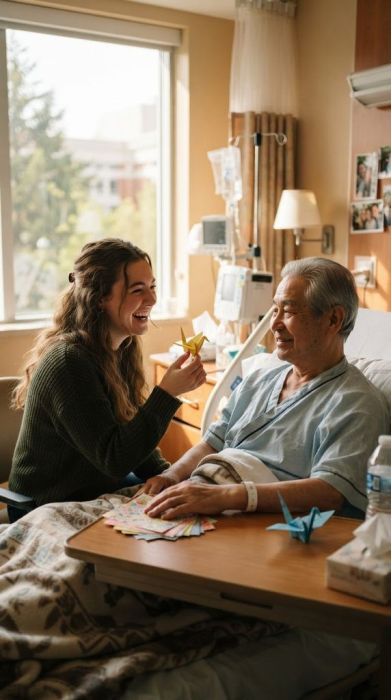
Marcus was sitting at a small desk beside an elderly Asian man with silver hair and kind, tired eyes. The man was holding a piece of paper, frowning at it with deep concentration. Marcus leaned over, pointed at something on the page, and said something that made the old man's face light up with understanding.
It was an ESL class. English as a Second Language.
And Marcus wasn't a student. He was a tutor.
She watched for another thirty minutes, hidden in the hallway like a spy in her own life. She watched her husband — her quiet, hardworking husband who had dropped out of high school at seventeen and never read a book for pleasure in his entire life — patiently teach an elderly man how to pronounce the word "thoughtful."
She watched the old man, whose name she would later learn was Mr. Tran, struggle with the "th" sound, his tongue pressing against his teeth in ways that were foreign to his Vietnamese mouth. She watched Marcus demonstrate the sound over and over, never once showing frustration, only encouragement.
"Good!" Marcus said, his voice carrying through the door. "That was perfect. Say it again."
"Thoughtful," Mr. Tran said, carefully.
"Yes! You got it!"
They high-fived, and Jenna felt her knees go weak.
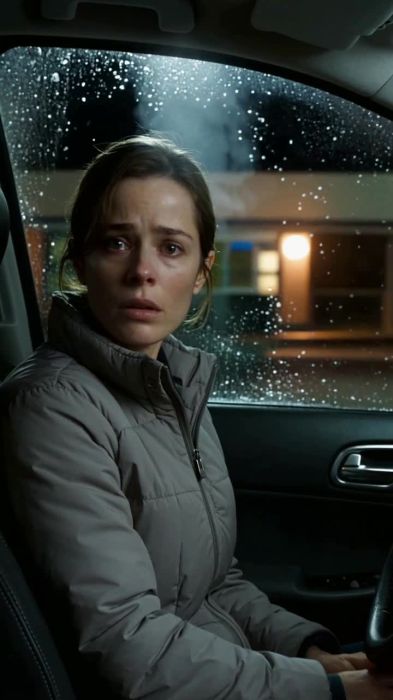
She went back to her car and sat in the dark, her hands trembling on the steering wheel. She had been prepared to discover an affair. She had steeled herself for the worst. Instead, she had found her husband doing something kind, something beautiful, and he had been too ashamed to tell her.
Why? Why would he hide this?
She got her answer two hours later, when Marcus came home.
He found her sitting at the kitchen table, waiting for him. The look on his face when he saw her — the guilt, the fear — told her everything.
"How long have you known?" he asked, his voice barely above a whisper.
"I followed you tonight," she said. "I'm sorry. I just... I didn't know what else to do."
He sat down across from her, his shoulders sagging. "I was going to tell you. I just didn't know how."
"Why didn't you tell me from the start?"
Marcus was quiet for a long time. When he finally spoke, his voice cracked.
"Because I'm embarrassed," he said. "I dropped out of school. I can barely spell. I've never been the smart one, Jenna. You're the one with the degree, the good job, the words that come easy. And here I am, trying to teach someone else how to read, when I can barely get through a newspaper without looking up every other word."
"Marcus..."
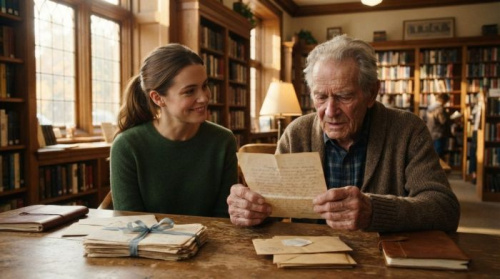
"I met Mr. Tran at the hardware store," he continued. "He was trying to buy a lightbulb, but he couldn't explain which one he needed. I helped him. We got to talking. He told me his wife died three years ago, and he found a box of letters an American soldier wrote to him during the Vietnam War. He never learned to read English properly. He wanted to understand those letters before he died."
Jenna felt tears streaming down her face.
"The volunteer coordinator at the college said I wasn't qualified," Marcus said, his voice dropping. "They wanted someone with a degree. So I lied. I told them I had a teaching certificate. I've been faking it for two months, and every night I come home terrified that I'm going to mess up, that I'm going to teach him the wrong thing, that someone's going to find out I'm a fraud."
He looked up at her, his eyes wet. "I didn't tell you because I was scared you'd see me the way I see myself. As someone who isn't good enough."
Jenna got up from her chair, walked around the table, and wrapped her arms around her husband. She held him while he cried, the way she should have held him years ago, when he first hurt his wrist and lost his job and started believing he wasn't enough.
"You're not a fraud," she whispered into his hair. "You're the best man I know."
The next day, Jenna called the community college. She spoke to the volunteer coordinator, a kind woman named Patricia, and explained the situation. She didn't expose Marcus's lie. Instead, she asked if she could volunteer alongside him.
"I have a degree in health sciences," she said. "I'm not an ESL teacher, but I can read lesson plans. I can help."
Patricia was quiet for a moment. Then she said, "Your husband is one of the most dedicated volunteers we've ever had. The students love him. Mr. Tran in particular has made more progress in two months than some of our students make in a year. Whatever he's doing, it's working."
Jenna smiled. "He's just being himself."
That evening, she told Marcus what she had done. He looked at her with an expression she couldn't quite read — a mixture of surprise, relief, and something that looked almost like wonder.
"You'd do that? Spend your Tuesday and Thursday nights at a community college, teaching English to strangers?"
"I'd spend them with you," she said. "That's all that matters."
Marcus and Jenna started volunteering together every Tuesday and Thursday. Jenna helped with lesson planning and pronunciation drills. Marcus handled the conversations, the patience, the human connection that no degree could teach.
Mr. Tran finished reading his first letter — a short one from a soldier named David who thanked him for sharing his food during the war — on a snowy evening in February. He read it aloud, slowly, stumbling over words, tears streaming down his face.
When he finished, he looked at Marcus and Jenna and said, "For thirty years, I carried these letters without knowing what they said. I thought they were secrets. But they are not secrets. They are love."
Marcus and Jenna held hands under the table, and neither of them said a word. They didn't need to.
Some secrets are not secrets at all. They are gifts waiting to be opened. And sometimes, the things we hide about ourselves — the parts we think make us small or broken or unworthy — are the very things that make us extraordinary.
The Tuesday and Thursday nights that nearly broke Jenna's marriage became the nights that rebuilt it, stronger than before. And she learned a lesson she would carry forever: the people we love are often braver and kinder than we give them credit for. They are not hiding from us. They are hiding for us — protecting us from the parts of themselves they think we won't love.
But we would. We always would. If only they would let us.