Claire Morrison never imagined she would be back in River Falls, Wisconsin, at twenty-eight years old, living in her childhood bedroom and working at the town public library.
Three months ago, she was a marketing coordinator in Chicago with a corner office and a view of the lake. Now she was reorganizing the gardening section and checking out large-print novels to retirees.
The layoff came without warning. Her boss called her into a conference room with HR on the line, and seventeen minutes later, she was carrying a cardboard box through the lobby. She called her mother from the train station, trying to keep her voice steady, and heard the words she dreaded: "Honey, just come home."
River Falls had a population of four thousand people, one stoplight, and a Main Street that had not changed since 1987. Everyone knew everyone, and everyone knew that Claire Morrison had returned with her tail between her legs.
The library was the only place that did not make her feel like a failure. Mrs. Higgins, the head librarian who had known Claire since she was six years old, gave her a temporary position without asking questions.
"You will be fine, dear," she said. "Sometimes the universe needs to slow us down before it can show us where we are supposed to go."
On her third day, she met Arthur Patterson.
He shuffled in at exactly nine-oh-three in the morning, wearing the same brown cardigan he would wear every single day for the next three months. He was tall and thin, with wiry gray hair that stuck up in the back. His hands were large and knotted with arthritis, the kind of hands that had worked hard for a lifetime.
He walked straight to the newspaper section, pulled out two papers, and sat at the same table in the corner. He stayed for exactly two hours, never spoke to anyone, and left without acknowledging a single soul.
"Don't mind Mr. Patterson," Mrs. Higgins said. "He has been coming here every day since his wife passed. Five years now."
Claire shrugged and went back to shelving books. She had her own problems to worry about.
But she could not stop noticing things about Arthur Patterson.
He never turned the pages of the newspaper.
Every morning, he would open the paper to the same section, spread it flat on the table, and stare at it. His eyes moved slowly across the page, stopping frequently, his lips barely moving. But he never turned to the next page. An hour would pass, and he would still be staring at the same spread.
After a week, Claire's curiosity got the better of her.
She approached his table with a cup of coffee. He looked up at her with sharp, suspicious eyes.
"I don't drink coffee," he said.
She set the cup down anyway and glanced at the newspaper in front of him. It was open to the obituaries section.
"Are you looking for someone?" she asked softly.
Arthur's face hardened. "I'm reading," he said defensively. "That is what people do in libraries, isn't it?"
She turned to leave, but something stopped her. She had seen the way his finger traced the lines of text, slowly, painfully, like a child learning to sound out words for the first time.
Arthur Patterson could not read.
The next morning, Claire arrived early. She found a children's book and placed it on the return cart near his table. When Arthur came in, he scowled at the book but sat down anyway.
She did not approach him that day. Or the next.
But on the third day, she sat down across from him.
"Mr. Patterson, I think you are one of the bravest people I have ever met."
He stared at her like she had lost her mind.
"I have been watching you," she continued. "You come here every day, and you sit with that newspaper for two hours. And I think you are teaching yourself to read."
Arthur's face went pale. His hands trembled on the table.
"That is none of your business," he whispered.
"You are right," Claire said gently. "But if you ever wanted help, I am here."
For a week, Arthur did not look at her. But on the eighth day, she found a note on the return cart.
It was written in shaky, uneven handwriting.
I was a farmer. I never needed to read. My wife read everything for me. She passed away five years ago. I found letters she wrote me. I don't know what they say. I want to know.
Claire read the note three times, her eyes filling with tears.
The next morning, she was waiting for him at his table with a stack of books about farming and Wisconsin history.
"Are you ready to start?" she asked.
Arthur sat down heavily. "I am eighty-two years old. Seems like a silly time to learn."
She smiled. "I am twenty-eight, and I just lost my job and moved back in with my mother. We are both starting over."
He looked at her for a long moment. Something shifted in his eyes.
"Alright," he said. "Show me what to do."
So began the most unlikely classroom in River Falls, Wisconsin.
Every morning from nine to eleven, Claire taught Arthur how to read. They started with simple words, then sentences, then paragraphs. Arthur was slow but determined. He slammed his hand on the table when he could not remember a sound he learned the day before.
"I am stupid," he would mutter.
"You are not stupid," Claire would say patiently. "You never had the chance to learn. That is different."
She learned his story in pieces. Arthur grew up on a dairy farm in the 1940s. His father died when he was nine, and he left school in the third grade to work the farm full-time. He never learned to read. He carried the shame like a secret weight for seventy years.
His wife Eleanor had been his everything. She read him the newspaper every morning. She read him letters from their son in Oregon. She read him novels at night while he rested his head on her shoulder.
When she died, Arthur lost more than his wife. He lost his eyes to the world.
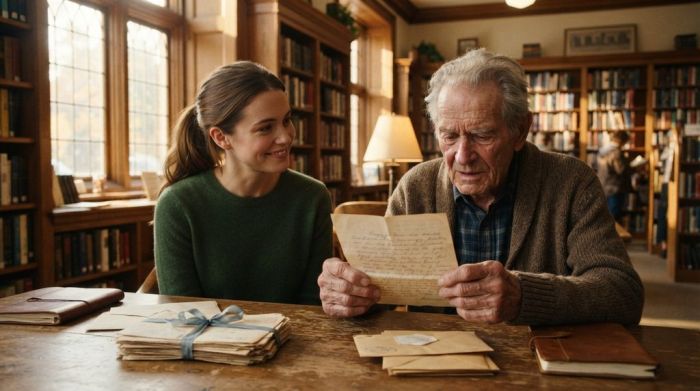
And then he found the letters. Eleanor's letters. Tucked inside her nightstand, tied with a faded blue ribbon, addressed to him in her graceful handwriting. Seventy-three letters spanning fifty-five years of marriage. And he could not read a single word.
After a month, Arthur could read at a first-grade level. The pride in his eyes made Claire's heart ache.
In the second month, Claire brought him the first letter.
It was short, written on yellowed stationery.
My Dearest Arthur,
Today is our tenth anniversary. You forgot again, but I don't mind. You remembered to fix the back porch steps, which means you were thinking about me, even if you didn't know it.
I love you. I know you can't read this, but I will read it to you tonight, like I always do.
Forever yours,
Eleanor
Arthur read it slowly, his finger tracing each word. When he finished, he was silent for a long time.
"She knew," he whispered. "All those years, she knew I could not read. And she never said a word."
He cried for the first time in fifty years, right there in the River Falls Public Library.
The third month changed everything. Claire stopped applying to jobs in Minneapolis. She stopped counting the days until she could leave. She started looking forward to nine o'clock every morning. She helped Mrs. Higgins organize a summer reading program. She started a book club for seniors.
Arthur, meanwhile, progressed to reading short news articles. He read the entire River Falls Gazette from front to back and discussed the stories with Claire.
One Tuesday, Arthur arrived carrying a small cardboard box. "These are the letters," he said. "All of them. I want to read them here with you."
They spent the morning reading Eleanor's letters. Love letters about everyday life. About the cow that trampled the garden. About the apple pie she burned. About the time Arthur fell asleep on the couch and she covered him with a blanket and watched him for an hour, just because she loved the way he looked when he was peaceful.
Then they reached the last letter. Dated three days before Eleanor passed away.
My Dearest Arthur,
The doctors say I don't have much time left. I am not afraid. I have had the best life because I had you.
I know you have been going to the library. I know you have been trying to teach yourself to read. I have known for years. I saw the children's books hidden under your side of the bed. I saw you practicing your letters when you thought I was asleep.
I never said anything because every man needs something that is just his own.
But I want you to know this: You are the strongest, bravest man I have ever known. You worked a farm with your bare hands since you were nine years old. You built a life from nothing. You loved me every single day.
And now you are learning to read at eighty-two years old. You are doing something most people would never have the courage to try.
I am so proud of you.
Read this letter, Arthur. Read it and know that I loved you exactly as you were.
Forever yours,
Eleanor
Arthur read the letter three times. Then he folded it carefully and looked at Claire with eyes that held seventy years of love and loss and quiet triumph.
"Well," he said, his voice steady. "I guess I learned to read just in time."
Six months later, Claire was still in River Falls. She was head of community programming at the library, and she had expanded the adult literacy program to serve twelve students. Arthur was her most dedicated volunteer.
One evening in late autumn, Claire found Arthur sitting on a bench outside the library, watching the sunset paint the Wisconsin sky in shades of orange and gold.
"Thank you," he said without looking at her.
"For what?"
"For not giving up on a stubborn old man."
Claire sat beside him. "You know what I learned from you, Arthur?"
"What?"
"That it is never too late to start over. I came back to River Falls thinking my life was over at twenty-eight. And then I met a man who decided to learn to read at eighty-two."
Arthur chuckled. "Sounds like a fool."
"Sounds like the bravest person I know."
They sat in comfortable silence, watching the sun sink below the horizon.
"I read Eleanor's letters again last night," Arthur said quietly. "All seventy-three of them. It took me four hours, and I still had to sound out some of the big words. But I read them. Every single one."
"How did it feel?"
Arthur smiled, a real smile that reached his eyes and softened the lines on his face.
"It felt like she was right here beside me. Reading them to me one more time."