My name is Tom Benson, and I never expected my nine-year-old daughter to teach me what it really means to be strong.
We live in Willow Creek, Wisconsin — a small town where everybody knows everybody, and winter arrives like an uninvited relative who overstays for five months. That December was supposed to be just another cold season. But Lily had other plans.
It started on a Tuesday morning when the temperature had dropped to eleven degrees. I was scraping ice off the windshield of my old Ford F-150, the one with 187,000 miles on it and a heater that only worked on the driver's side. Lily came out the front door, backpack slung over one shoulder, her pink hat pulled down over her ears.
"Daddy," she said, her breath forming little clouds, "can I ask you something?"
"You just did, munchkin." I grinned at her, trying to keep things light despite the pit in my stomach. I'd been laid off from the construction site three weeks earlier, and the savings account was getting dangerously thin.
She didn't laugh. She just stood there, her small hands buried in her coat pockets, her eyes fixed on the ground. "At school, some kids don't have winter coats. They wear hoodies in the snow and they shiver at recess. Marcus Reed had to borrow a coat from the lost and found yesterday. It was too small for him."
I stopped scraping the ice. "That's tough, sweetheart. But there are people who handle those things. The school, the church..."
"But nobody is handling it," she said quietly. "Mrs. Patterson said the school budget doesn't have money for coats this year."
I didn't know what to say. I could barely afford to keep our own heat on. The thought of buying coats for other kids felt like a luxury I couldn't even dream about. So I did what I had learned to do when life got hard. I changed the subject.
"We'll talk about it later. You don't want to be late for school."
I thought that would be the end of it. But Lily had inherited her mother's stubbornness — the kind of quiet determination that doesn't argue, it just acts. Her mother, my wife Sarah, had passed away when Lily was three. Ever since, it had just been the two of us, navigating a world that didn't always make sense. And in many ways, Lily had become the one who held our little family together.
That evening, I came home from a fruitless job search to find the kitchen table covered in construction paper, markers, and glitter. Lily was sitting cross-legged on a chair, her tongue poking out the corner of her mouth the way it always did when she was concentrating.
"What's all this?" I asked, hanging my coat on the hook by the door.
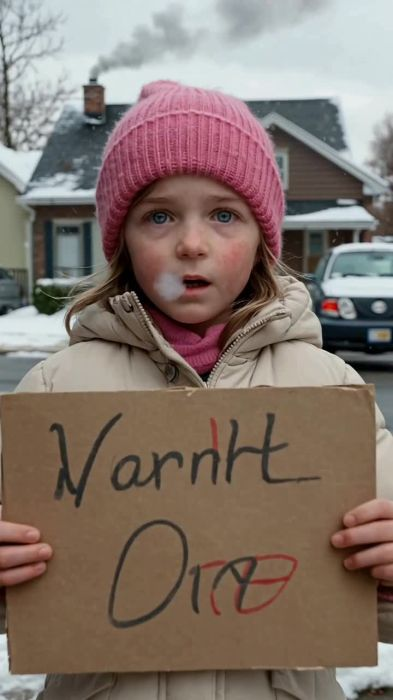
"It's my sign," she said, holding up a piece of cardboard with the words "Warmth Drive" written in purple crayon. The letters were big and uneven, and there was a drawing of a coat with hearts coming out of it underneath. "I'm going to collect coats for kids who need them. I'll stand outside the community center after school."
I stared at her. "Lily, you can't just stand outside in the cold."
"Why not?" She looked up at me with those big brown eyes that had seen too much for a child her age. "Mrs. Kowalski said I could use her old coat rack. And I already talked to Pastor Jim at the church. He said he'd spread the word."
My first instinct was to say no. To tell her that life didn't work that way, that people were too busy with their own problems to care about a little girl with a cardboard sign. I was tired, I was scared about money, and I didn't have the emotional energy for what felt like a setup for disappointment.
But something in her expression stopped me. It wasn't naivety. It was hope — the kind of pure, unbroken hope that only exists in children who haven't yet learned that the world can be cruel. And I realized that if I told her no, I wouldn't just be stopping a coat drive. I would be teaching her to stop hoping.
"Fine," I said, rubbing my face. "But I'm coming with you."
And that's how I found myself standing in the cold outside the Willow Creek Community Center the next afternoon, watching my daughter hold a cardboard sign and shiver.
The first hour was brutal. The wind cut through my jacket like it wasn't even there. Lily's cheeks turned bright red, and her nose started running. She didn't complain once. She just stood there, holding her sign, looking down the street with those hopeful eyes.
Nobody came.
Not one person.
I watched her face fall as car after car drove past without stopping. She looked down at her sign, then back at the empty street. My heart cracked open. I was about to suggest we go home when I saw a figure shuffling down the sidewalk — our next-door neighbor, Mrs. Helen Kowalski.
Mrs. Kowalski was seventy-two years old, barely five feet tall, and had been a first-grade teacher for forty-three years before retiring. She walked with a cane but moved with a purpose. In her free arm, she carried a heavy-looking bag.
"Lily Benson," she called out, her voice raspy from the cold. "I heard about your little project."
She set the bag down at Lily's feet. Inside were three winter coats — one red, one blue, one green — all in perfect condition. "These belonged to my late husband's grandchildren. They've been sitting in my closet for years. It's time they kept someone warm."
Lily's face lit up like I hadn't seen in months. "Thank you, Mrs. Kowalski!" She threw her arms around the old woman's waist.
Mrs. Kowalski patted her head and winked at me. Then she leaned closer and whispered, "I made some phone calls. You'll see."
She was right. By the end of that week, something incredible happened. It was like a switch had been flipped in the heart of Willow Creek.
It started slowly. A woman from the next block dropped off three coats and a bag of hats. The owner of the hardware store, Mr. Patterson, showed up with a brand-new metal coat rack. "Can't have those coats sitting on the cold ground," he said, setting it up himself.
Then came the newspaper. A young reporter named Kevin from the Willow Creek Gazette showed up with a camera. He took a picture of Lily holding her sign, standing next to the growing pile of coats. The next morning, the front page read: "Nine-Year-Old's Warmth Drive Brings Town Together."
After that, it was a flood.
People came from every corner of town. They brought coats — new ones, gently used ones, expensive North Face parkas and simple fleece zip-ups. They brought gloves, scarves, hats, and earmuffs. A lady from the Baptist church brought boxes of hand-knitted sweaters. The high school wrestling team showed up with a donation from their fundraiser.
I stood in the community center gymnasium, watching piles of winter clothing grow higher and higher, and I felt something I hadn't felt in months. I felt hope.
But the moment that broke me came on Saturday morning, when the distribution was set to begin.
Lily had organized everything. She had sorted the coats by size — small, medium, large — and arranged them on tables with labels she had written herself. She had color-coded the hats and gloves into separate bins. She was eight years old going on forty, and she was in her element.
Families started arriving at nine o'clock. Some of them I recognized — parents from Lily's school, folks I'd seen at the grocery store. Others were strangers, people who had driven from neighboring towns after hearing about the drive.
I watched a mother with two young boys walk up to the table. Her coat was thin, and her boys were wearing hoodies that were clearly not warm enough for a Wisconsin winter. Lily greeted them with a smile and led the boys to the coat table.
"This one would look great on you," she said, handing a blue coat to the older boy. "And this red one matches your hat!" she told the younger one.
The mother's hands were shaking as she helped her sons zip up their new coats. She turned to Lily and said, "Sweetheart, I don't know how to thank you."
Lily looked up at her with those earnest eyes and said, "You don't have to thank me. Just make sure your boys stay warm."
That was when I lost it. I turned away, pretending to adjust a pile of scarves, while tears streamed down my face. I was supposed to be the parent. I was supposed to be the one taking care of things. But my nine-year-old daughter had done what I couldn't — she had brought an entire town together to take care of each other.
By the end of that day, we had distributed 247 coats, 183 hats, 156 pairs of gloves, and enough scarves to wrap around the entire town square. Every single person who came left with something warm.
That evening, Lily and I sat on the steps of the community center, eating hot dogs from the concession stand. The sky was dark, and the streetlights cast warm orange circles on the snow. She was exhausted but glowing.
"Daddy," she said, leaning her head against my arm, "do you think Mommy would have been proud of me?"
I wrapped my arm around her and pulled her close. "Lily, I think your mother saw everything you did today. And I know she was smiling."
She was quiet for a long moment. Then she said, "I want to do another one next month. A food drive. Mrs. Kowalski told me some kids don't have enough to eat on weekends."
I laughed — a real laugh, the kind that came from somewhere deep. "You know what, munchkin? I think that's a great idea."
And right there, on the cold steps of the community center, with snowflakes starting to fall again, I made a promise to myself. I would never again tell my daughter that she couldn't make a difference. Because I had seen what happens when one small person decides to care about something bigger than herself.
The next week, I got a call from a local contractor who had read about Lily's Warmth Drive in the paper. He offered me a job — a good one, with benefits. "Any man who raised a kid like that," he said, "is the kind of man I want on my crew."
I took the job. And every evening when I came home, Lily would ask me the same question: "Daddy, did you help anyone today?"
And every evening, I tried my best to say yes.
Sometimes the people who change the world are the smallest ones. They don't have fancy degrees or deep pockets. They just have a cardboard sign, a purple crayon, and a heart that refuses to accept that some kids have to be cold. And if you're lucky enough to be standing next to them when the world proves them right, you'll never be the same again.
The Warmth Drive became an annual tradition in Willow Creek. Every December, the community center opens its doors, and the donations pour in. They named it after her, you know. The sign above the coat rack reads: "Lily's Warmth Drive — Because Every Child Deserves to Be Warm."
Lily is sixteen now. She's tall and smart and still stubborn in the best way. But sometimes, late at night, I walk past her room and see that old cardboard sign propped up on her bookshelf — the one with the crooked purple letters and the hearts coming out of the coat. And I remember that the most powerful force in the world isn't money or influence. It's a child who hasn't yet learned that some problems are too big to solve.
Because the truth is, they're not.