Piper Collins never expected to find the courage to chase her abandoned dream in a pair of arthritic hands that had spent fifty years pulling crab pots from the Pacific. But that is exactly what happened on a foggy Tuesday morning in Astoria, Oregon, when a retired fisherman named Cap walked into her salon and changed everything.
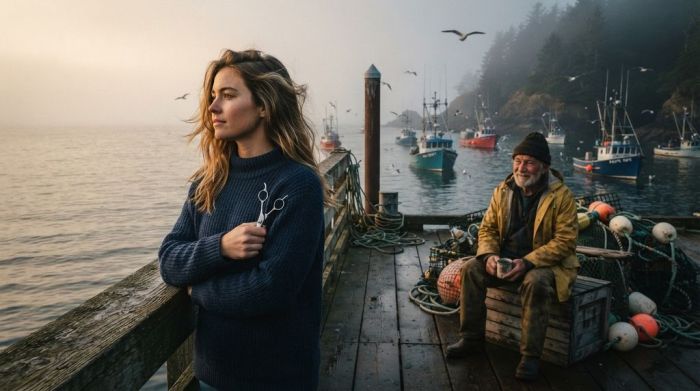
She was twenty-seven years old, and she had been cutting hair at Shear Perfection on Commercial Street for five years. The salon sat at the edge of downtown, two blocks from the Columbia River, where the morning fog rolled in off the ocean and wrapped itself around the buildings like a shroud. Piper had grown up in that fog. She had learned to drive in it, learned to navigate by the sound of the foghorn from the Coast Guard station, learned that some things — like the grief you carry for someone you could not save — never really lifted.
Her scissors were the only things that felt natural in her hands anymore. She had discovered that at twenty-two, when she dropped out of Oregon State University halfway through her junior year, her marine biology textbooks still open on her desk, her half-finished research project on the migration patterns of Chinook salmon sitting in a folder she had never opened again. Her mother had been diagnosed with pancreatic cancer three weeks after Piper's twenty-first birthday. By the time Piper made it home to Astoria, her mother was already too weak to stand. She had lasted fourteen months. Piper had spent every single one of them by her bedside, reading her articles about whales and tides and the microscopic plankton that formed the base of the ocean's food chain — the things her mother had always loved hearing about.
After the funeral, Piper did not go back to Oregon State. The semester had already started, and the scholarship money had run out, and the apartment she had rented in Corvallis had been sublet to someone else. She applied to the local beauty school on a whim, graduated in eight months, and took the first job she was offered at Shear Perfection. It was not the life she had imagined. But it was a life. And she had convinced herself that it was enough.
A Life Measured in Haircuts
The salon was owned by a woman named Diane, sixty-three years old, who had been cutting hair in Astoria since 1985 and had seen every hairstyle trend come and go like the tides. Diane was kind in a brisk, no-nonsense way, the kind of woman who told you the truth whether you wanted to hear it or not. On Piper's first day, she had looked at the young woman's trembling hands and said, "You're going to be fine, kid. You just need something to hold onto." Piper had not understood what she meant at the time. Five years later, she understood completely. Her scissors were the only things that had kept her from drifting away entirely.
The regulars at Shear Perfection were the backbone of Astoria. There was Mrs. Patterson, the retired schoolteacher who came in every Tuesday for a wash and set and talked about her late husband as if he had just stepped out for a walk. There was Lena, the waitress from the diner down the street, who was saving up to open her own bakery and tipped in homemade cinnamon rolls. There was Marcus, the deckhand who worked the fishing boats and needed his hair short enough to fit under a hard hat but long enough to keep his ears warm in the winter.
And then there was Cap.
Arthur Hendricks had been called "Cap" for so long that half the town did not know his real name. He was seventy-six years old, a retired commercial fisherman who had worked the waters of the Bering Sea, the Gulf of Alaska, and the mouth of the Columbia River for five decades. His hands were a map of his life — knuckles swollen with arthritis, fingers that no longer straightened fully, palms calloused from a thousand haul-backs. He came into Shear Perfection every six weeks, on the dot, and sat in the chair at the end of the row, the one by the window that overlooked the river.
He was not like other customers. He did not make small talk. He did not complain about the weather or ask about Piper's weekend. He sat in the chair, closed his eyes, and let her work in silence. The first few times, Piper had found it unsettling. But she had learned to appreciate the quiet. There was something calming about cutting a man's hair when he trusted you enough to close his eyes.
The Question That Opened a Door
It was a Tuesday in October when Cap broke the silence for the first time in three years.
"You have steady hands," he said, not opening his eyes.
Piper paused, the scissors resting mid-snip. "Thank you."
"You ever think about what you would do if you weren't cutting hair?"
The question hit her like a wave she had not seen coming. She stood there, holding the scissors, the fog pressing against the window, the distant sound of a foghorn echoing across the river. No one had asked her that in years. She had stopped asking herself.
"I used to want to study the ocean," she said quietly. "I was in college for marine biology. But my mom got sick, and I came home, and I never went back."
Cap opened his eyes. They were pale blue, the color of winter sky over open water. "The ocean will wait for you," he said. "It's been waiting for four billion years. It can wait a little longer."
Piper did not know what to say. She finished his haircut in silence, the way she always did. But something had shifted. A door that had been closed for five years had cracked open, just slightly, and a sliver of light was seeping through.
The Gift He Left Behind
Cap came back six weeks later, as regular as the tide. He came back after that, and after that. And every time, he asked her a question. Not about her day or her plans — about the ocean. About what she remembered from her classes. About the thing she had given up.
"Do you remember what the deepest part of the ocean is called?" he asked one day.
"The Challenger Deep," she said. "In the Mariana Trench. Almost seven miles down."
"Do you remember the fish that live there?"
"Anglerfish. Giant squid. Creatures that make their own light because no sunlight reaches them."
Cap nodded, a slow, approving nod. "You remember," he said. "You remember because you never really left it behind."
He started bringing her things. A photograph of a whale breaching off the coast of Depoe Bay, taken by a friend of his who still worked the charter boats. A worn copy of a book about tide pools, which he found at a used bookstore and bought for three dollars. A small jar of sand from a beach he had visited as a young man, the label faded but still readable: "Cannon Beach, 1968."
The Day Everything Changed
On a rainy January afternoon, Cap walked into Shear Perfection without an appointment. He was not wearing his usual calm expression. He was holding an envelope, and his hands — those arthritic, calloused hands — were trembling.
"I need to tell you something," he said.
Piper led him to the chair by the window. She sat down across from him, suddenly afraid.
"I have a daughter," he said. "Her name is Rachel. She lives in Seattle. She's a biologist. She studies killer whales." He paused, his voice catching. "We haven't spoken in twelve years. I was not a good father. I was at sea more than I was home. I missed her recitals, her graduations, her whole life. She stopped talking to me after her mother died. She said I had chosen the ocean over her, and she was not wrong."
Piper did not interrupt. She let him talk.
"I have been coming to your chair for three years because you remind me of her. The way you hold your scissors. The way you tilt your head when you are concentrating. The way you carry a sadness you think no one sees." He held out the envelope. "This is a letter. I wrote it last night. It says everything I should have said twelve years ago. And I want you to read it. Not because I need you to — but because I want you to see what courage looks like when you finally decide to use it."
Piper took the envelope. She looked at Cap, at the tears running down his weathered face, at the hope and fear and love that were all tangled together in his eyes.
"I think," she said slowly, "that you should mail it."
"I know," he said. "But I needed to tell you first. Because watching you walk into this salon every day, cutting hair when you should be studying whales — it made me realize that I have been doing the same thing. I have been hiding. I have been punishing myself for mistakes I made thirty years ago. And I am tired of hiding."
He mailed the letter the next day. Three weeks later, his daughter called him for the first time in twelve years. Piper was in the salon when his phone rang. She watched his face break into a smile she had never seen before — a smile that seemed to contain every sunrise he had ever witnessed at sea.
"She's coming home," he said, his voice thick with emotion. "Next month. She's bringing her son. My grandson. I have a grandson I have never met."
Epilogue: The Tide That Always Returns
That was two years ago. Piper Collins is twenty-nine now, and she is finishing her degree in marine biology at Oregon State University — online, part-time, one course at a time, because she still works at Shear Perfection and she still pays her own rent. She will graduate in eighteen months. After that, she has an internship offer at the Hatfield Marine Science Center in Newport, studying the same Chinook salmon she had written about in her abandoned research project.
She still cuts Cap's hair every six weeks. He is seventy-eight now, and his hands are slower, and his steps are shorter. But he walks into Shear Perfection with his head high, and he sits in the chair by the window, and he tells her about his grandson — a seven-year-old boy named Leo who wants to be a fisherman when he grows up, just like his grandfather.
Last week, Cap brought Piper a gift. It was a framed photograph, taken by his daughter Rachel during her visit. It showed a killer whale breaching in the waters of Puget Sound, water droplets frozen in midair, the animal's sleek black-and-white body arcing through the gray Washington sky. Beneath the photograph, Cap had written a note in his careful, unsteady handwriting:
"Piper — The ocean never stopped waiting for you. You just had to be brave enough to turn back toward it. Thank you for teaching this old fisherman that it is never too late to come home. — Cap."
The photograph hangs on the wall of Shear Perfection, right above the mirror at the chair by the window. Piper looks at it every morning before her first appointment. It reminds her that dreams do not expire. They wait, patient as the tide, for the moment when you are ready to wade back into them.
And sometimes, the person who helps you find the courage to go back into the water is not a teacher or a mentor or a family member. Sometimes, it is a seventy-six-year-old fisherman who walks into your salon, sits in your chair, and asks you the question that changes everything: "You ever think about what you would do if you weren't cutting hair?"
The scissors in Piper's hands are still steady. But now they are not the only things holding her together. Now she also holds a photograph of a whale, a jar of sand from Cannon Beach, and the knowledge that it is never too late to follow the tide back to the person you were always meant to become.