The first time I noticed Mr. Chen, I was carrying a laundry basket across the hallway and nearly tripped over a newspaper that had been sitting outside his door for three days.
I didn't think much of it at first. People go on vacation. People visit family. But something about that stack of newspapers made me pause. I counted them. Five. The mail slot was overflowing too — envelopes, catalogs, a postcard with a picture of the Taipei 101 tower on it.
I live in apartment 3B. Mr. Chen lives in 3D, two doors down. In the eight months since I moved into this old brownstone in Boston's Back Bay neighborhood, I had probably exchanged no more than ten words with him. A nod in the hallway. A mumbled "excuse me" when we passed each other by the mailboxes. He was a small man, maybe in his mid-seventies, with silver hair that he kept neatly combed and kind eyes that always seemed to be looking at something far away.
I didn't know what to do. So I did what any twenty-year-old journalism student would do — I called my mom.
"Check on him," she said without hesitation. "Call the landlord if you have to. Better to be embarrassed than to be sorry."
The landlord, a gruff but good-hearted man named Mr. Kowalski, gave me the emergency key with a warning. "He's a private man, that Mr. Chen. Don't go snooping around his things."
I wasn't planning to snoop. But the moment I unlocked that door, I froze.
The apartment was filled with paper.
Not stacks of newspapers or magazines. Art. Delicate, impossibly intricate paper sculptures. There were origami cranes hanging from the ceiling by invisible threads, dozens of them, catching the afternoon light like a flock of birds frozen mid-flight. A Chinese dragon with hundreds of tiny scales sat on the bookshelf, its body curling around a globe. A full cityscape — I recognized the Boston skyline — was displayed on the dining table, complete with miniature trees and streetlights, all made from folded paper.
And there, on the floor between the sofa and the coffee table, lay Mr. Chen.
He was conscious, but barely. His face was pale and beaded with sweat. "I fell," he whispered. "Two days ago. I cannot get up."
I called 911 immediately. The paramedics said he had broken his hip. He was dehydrated. If I had waited another day, things could have been much worse.
At the hospital, I sat in the waiting room for three hours before a nurse told me Mr. Chen was stable and resting. I left my phone number and went home, but I couldn't stop thinking about him. About those paper birds hanging in his silent apartment. About the life I knew nothing about.
The next afternoon, I visited him.
He was awake when I walked in, his eyes fixed on the ceiling tiles like they held secrets only he could see. The room smelled of antiseptic and wilted flowers.
"Hello, Mr. Chen," I said softly.
He turned his head slowly. For a moment, he looked confused. Then recognition flickered. "The girl from 3B."
"Emma," I said, pulling up a chair. "My name is Emma."
He nodded, a small, careful movement. "Emma. Thank you for what you did."
"I didn't do much."
"You called for help. You sat with me. That is not nothing."
The silence that followed was the kind that could have been awkward, but somehow it wasn't. It felt like we were both trying to figure out how to begin a conversation that had been waiting to happen for eight months.
"I saw your sculptures," I said finally. "The origami. Mr. Chen, they're incredible. I've never seen anything like them."
Something shifted in his face. A guardedness, maybe, or surprise that anyone had noticed. "They are just paper."
"They're not just paper. The dragon alone — how long did that take?"
He was quiet for so long I thought he wasn't going to answer. Then he said, "Seven months. After my wife passed, I needed something to do with my hands. The mind was too loud. The paper made it quiet."
His wife. I hadn't known he had a wife. I hadn't known anything about him at all.
"What was her name?"
"Lillian." He said her name like it was a prayer. "She was American. She loved the cranes. In Chinese tradition, the crane represents longevity and peace. She said she wanted a thousand of them at our wedding. I only made twelve. I was young and impatient." He smiled, a sad, distant smile. "After she was gone, I had all the time in the world."
I visited him every day for the next two weeks.
At first, our conversations were short. I'd tell him about my classes — I was studying journalism at Boston University, trying to become a writer. He'd listen more than he talked, nodding occasionally, his eyes never leaving mine. But slowly, he began to open up.
He told me he was born in Taipei in 1949, the youngest of five children. His father was a tailor who could barely afford to feed them. He came to America in 1971 on a student visa, studied architecture at MIT, and spent forty years designing buildings he never signed his name to because he was always too cautious to start his own firm.
"This country gave me everything," he said one afternoon. "A career. A wife. A daughter. But I never felt like I belonged. I was always the quiet man in the corner. The foreigner who kept his head down."
"But your art," I said. "That's how you express yourself, isn't it?"
He looked at me for a long moment. "You are the first person who has asked me that."
That afternoon, I asked him to teach me how to fold a crane.
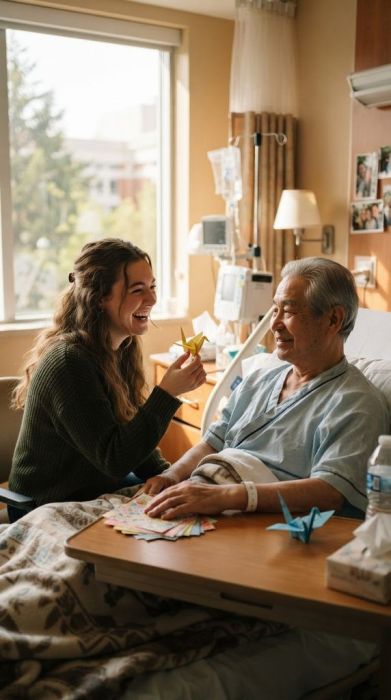
He made me wash my hands first. Then he took a sheet of paper — ordinary printer paper I had grabbed from the hospital's front desk — and began to fold. His hands moved with a grace that belied his age and his injury. Each crease was precise, deliberate, almost ceremonial.
"It is about patience," he said as I fumbled with my third attempt. "Not forcing the paper to do what you want. Listening to what the paper wants to become."
I laughed at that. "The paper doesn't have a will. It's paper."
He smiled. "That is what I used to think. But after forty thousand cranes, you learn that everything has a spirit. Even a piece of paper."
I messed up seven times before I finally produced something that vaguely resembled a crane. It was crooked, lopsided, and looked more like a deformed duck than a bird.
Mr. Chen held it up and examined it with the seriousness of an art critic. "It is beautiful," he declared.
"You're lying."
"I am not. It is beautiful because it is your first. The first of anything is always beautiful."
That was the moment I knew I had to help him share his work with the world.
I didn't tell Mr. Chen what I was planning. I didn't want to get his hopes up in case nothing came of it. But I spent three days photographing every piece in his apartment with my phone. The cranes, the dragon, the cityscape, a magnificent phoenix with feathers that seemed to shimmer in the light, and a small, heartbreaking sculpture of two hands reaching for each other through a folded paper frame.
I wrote an article for the university paper. "The Man in 3D: Discovering Boston's Hidden Origami Master." I posted it online. I added his story to a local Boston community group on Facebook.
I didn't expect what happened next.
Within twenty-four hours, the article had been shared over five thousand times. A reporter from the Boston Globe called me. A curator from the Museum of Fine Arts sent an email. People were commenting, sharing, tagging. They wanted to see more. They wanted to meet the man who had been living quietly among them, creating masterpieces they had never known existed.
I was thrilled. I rushed to the hospital to tell Mr. Chen the news.
He didn't react the way I expected.
"No," he said, his voice firm. "I do not want an exhibition."
"But Mr. Chen, the Museum of Fine Arts —"
"I know what the museum is." His eyes, usually so gentle, had turned hard. "I do not want people looking at me. Looking at my private work. I make the paper for myself. For Lillian. Not for strangers."
"But they could see how talented you are —"
"That is your dream, Emma. Not mine."
The words stung. I left the hospital that evening feeling foolish and defeated. I had been so focused on what I thought was best for him that I hadn't stopped to ask what he actually wanted.
The next morning, I sat at my desk and stared at the lopsided crane he had called beautiful. I thought about what he had said — that I was the first person who had ever asked him about his art. I thought about the postcard I had seen in his mail pile, the one with Taipei 101.
I found the postcard in the pile of mail I had been holding for him. It was addressed to Mr. Chen, and the return address had a name: Mei-Lin Chen, Taipei, Taiwan.
His daughter.
I spent three hours writing an email that I deleted and rewrote at least a dozen times. What could I possibly say to a woman who hadn't spoken to her father in seven years? What right did I have to insert myself into their family's wounds?
But I thought about Mr. Chen lying on that floor for two days. I thought about his wife's name, how he said it like a prayer. I thought about how many years had already been stolen by silence and pride.
So I wrote the email. I told Mei-Lin about her father's fall. I told her about his art. I attached the photographs. I said, "I don't know what happened between you, and it's not my place to know. But I think your father has been waiting. Maybe not for forgiveness. Maybe just for a sign that you remember."
I sent it before I could change my mind.
Then I waited.
Three weeks passed. Mr. Chen was discharged from the hospital and moved to a rehabilitation center, where he was learning to walk again with a walker. I visited every weekend. We never talked about the exhibition again. We just folded paper together. He taught me how to make a lotus flower, a butterfly, a rabbit.
I had almost given up hope that Mei-Lin would respond.
Then, on a rainy Tuesday afternoon in November, I walked into the rehab center and found a woman sitting beside Mr. Chen's bed.
She was in her late forties, with the same silver-streaked hair and same kind eyes. She was holding one of Mr. Chen's origami cranes — one of the small ones from his wedding — and she was crying.
Mei-Lin had taken a red-eye from Taipei.
She had arrived that morning, walked into the rehabilitation center without calling ahead, and found her father doing his physical therapy exercises in the common room. She told me later that she almost turned around and left. She stood in the doorway for ten minutes, watching this frail old man shuffle across the room with a walker, and she was flooded with memories of the father who used to carry her on his shoulders through the night markets of Taipei.
"Seven years," she said to me, her voice breaking. "Seven years I didn't call him. Because he didn't approve of the man I married. Because he said things he shouldn't have said. Because I was stubborn and proud and I thought I had all the time in the world to fix it."
"But you came," I said.
"I came because a stranger wrote me an email and reminded me that time is not something we can fold back. You cannot uncrumple the paper. But you can start with a new sheet."
The exhibition happened.
Not at the Museum of Fine Arts — Mr. Chen still wasn't ready for that. But at the Boston Public Library, in a small gallery room on the second floor. Mei-Lin and I organized it together. We hung his cranes from the ceiling. We arranged his sculptures on pedestals. We printed copies of my article and pinned them to the wall.
The night of the opening, Mr. Chen stood at the entrance in a suit he had bought in 1995, leaning on a cane, looking terrified.
I took his hand. "You don't have to go in if you don't want to."
He looked at me. Then he looked at his daughter, who was adjusting a display of paper flowers across the room. "When I was a young man," he said quietly, "I believed that the world was cruel and that the safest thing was to be invisible. I built walls around myself. I let pride and fear steal years from me that I will never get back."
He paused, his voice trembling.
"But this girl from 3B showed me that the world is not as cruel as I thought. She unfolded me. And I am still learning how to be seen."
We walked in together, the three of us — an old man, his daughter, and the college student who had just wanted to return a stack of newspapers.
The gallery was full. People from the neighborhood, students from BU, art lovers from across the city. They crowded around his sculptures, asking questions, taking pictures, marveling at the patience and precision of his hands.
Mr. Chen sat in a chair by the window, surrounded by his paper birds, and for the first time since I had known him, he smiled. Really smiled. Not the sad, distant smile of a man looking backward. A smile that looked forward.
Before I left that night, he gave me something. A perfect origami crane, folded from a single sheet of golden paper.
"This is for you, Emma," he said. "The first of many."
I still have it. It sits on my desk, right next to my crooked first attempt. Every time I look at them, I remember that the quietest people in the building often carry the most beautiful worlds inside them. And sometimes, all it takes to unlock those worlds is a knock on the door.