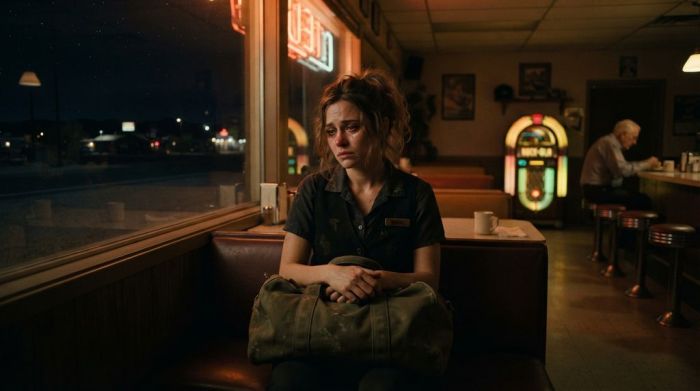
Chloe Martinez never expected to find a test of her character in a dirty duffel bag left behind at a truck stop. But that is exactly what happened on a sweltering August night in Battle Mountain, Nevada, when a stranger's mistake forced her to choose between the money that could change her life and the honesty that would define it.
She was twenty-eight years old, a single mother to a six-year-old boy named Leo, and she had been working the overnight shift at the Dusty Boots Diner for three years. The diner sat at the intersection of Interstate 80 and a state road that led to nowhere in particular, a lonely outpost in the high desert where the only company was the occasional trucker and the sound of the wind across the sagebrush.
The duffel bag was sitting on the counter of the men's restroom, a worn olive-green thing with a broken zipper and a strap that had been repaired with duct tape. Chloe found it at 2:47 AM, when she went in to restock the paper towels. She almost left it there. She was about to take it to the lost and found, where it would sit untouched for weeks until someone threw it away. But the bag was heavy, and curiosity got the better of her.
She unzipped it. Inside, neatly stacked in bundles held together by rubber bands, was twenty thousand dollars in cash.
Chloe sat down on the bathroom floor, the bag in her lap, her heart pounding so hard she could hear it in her ears. Twenty thousand dollars. It was more money than she had seen in her entire life. It was the rent on her trailer for a year and a half. It was the medical bills she had been ignoring. It was the braces Leo needed. It was a down payment on a used car that would not break down every other month. It was everything she had been praying for, sitting in a duffel bag in a bathroom at 2:47 in the morning, with no one watching and no one to know.
She could take it. She could walk out of the diner, drive home, and never tell a soul. The owner of the bag was probably a hundred miles away by now, driving toward some destination he would never reach with his money. He would assume he had lost it. He would never know that a waitress at the Dusty Boots Diner had found it and decided to keep it.
Chloe sat on that bathroom floor for a long time, holding the bag, feeling the weight of the money and the weight of the choice pressing down on her from both sides. She thought about Leo, asleep in their trailer, his small chest rising and falling under the blanket with the spaceships on it. She thought about the eviction notice that had been taped to their door last week. She thought about the way her mother had raised her — on a diet of canned soup and food stamps and the unshakeable belief that honesty was the only currency that mattered.
She closed the bag. She stood up. She walked back to the front of the diner and placed the duffel bag behind the counter, in the safe that the owner never used, and she waited.
The trucker came back at 6:15 AM, just as the sun was beginning to paint the Nevada sky in shades of pink and orange. He was a big man, maybe sixty-five, with a gray beard and eyes that looked like they had seen too much of the road. He walked through the door with the desperate, shuffling steps of someone who had just realized he had lost something irreplaceable. He was holding his wallet, his hands shaking, his face pale.
"Ma'am," he said, his voice rough, "I left a bag. A green duffel bag. In the bathroom. I drove forty miles before I realized. I came back as fast as I could. Please tell me it’s still here."
Chloe reached under the counter and pulled out the duffel bag. She set it on the counter between them. "This one?"
The man let out a breath that seemed to come from somewhere deep in his chest. He grabbed the bag, unzipped it, saw the money still inside, and his legs gave out. He sat down on the floor of the diner, right there in the middle of the aisle, and he cried.
Chloe did not know what to do. She came around the counter and knelt beside him. "Sir? Are you okay? Do you need water?"
He shook his head, still crying, his shoulders shaking with the force of emotions he had been holding in for a long time. "That money," he said, his voice barely above a whisper. "That was my wife’s. She passed away six months ago. Cancer. We were supposed to go to the Grand Canyon together. It was her dream. She wanted to see it before she died. We never made it."
He looked up at Chloe, his eyes red and swollen. "I sold our house last week. That money is all I have left. I was driving to the Grand Canyon to scatter her ashes. I stopped here to get gas, and I left the bag in the bathroom. I drove forty miles before I realized. I thought I had lost her all over again."
Chloe sat down on the floor beside him. She did not say anything. She just sat there, the way you sit with someone when words are not enough, the way she wished someone had sat with her on the nights when she felt like she was drowning. After a long moment, the man wiped his face with the back of his hand and looked at her.
"What’s your name?" he asked.
"Chloe."
"I’m Frank. Frank Morrison. And I owe you something I can never repay."
She shook her head. "You don’t owe me anything. I just did what anyone would do."
Frank looked at her, really looked at her, and he saw something in her face that he recognized. He saw the exhaustion of someone who had been running on empty for too long. He saw the kindness of someone who had been given nothing and still chose to give. He saw the weight of a life that was heavier than it should have been.
"When do you get off shift?" he asked.
"Seven."
"I’ll be here. I want to buy you breakfast."
Chloe almost said no. She was tired. She wanted to go home, check on Leo, fall into bed. But something in Frank’s eyes made her stop. "Okay," she said. "I’ll be here."
They sat in a booth by the window, the Nevada sun rising over the desert, casting long shadows across the cracked asphalt of the parking lot. Frank ordered two plates of eggs and pancakes, and they ate together, two strangers connected by a duffel bag and a moment of grace. Frank told her about his wife, Eleanor, a schoolteacher who had spent thirty-seven years shaping young minds and had dreamed of seeing the Grand Canyon in every season. He told her about the life they had built together, the children they had raised, the quiet, steady love that had carried them through fifty-two years of marriage.
Chloe told him about Leo. About the father who had left before Leo was born. About the night shifts and the secondhand clothes and the way she had learned to make a dollar stretch until it screamed. She told him about the eviction notice, about the moment she had sat on the bathroom floor holding his money, about the temptation that had almost swallowed her whole.
Frank listened. He did not judge. He did not offer advice. He just listened, the way people listen when they understand that the greatest gift you can give someone is the space to be heard.
When they finished eating, Frank reached into his pocket and pulled out a hundred-dollar bill. He set it on the table. "This is for you," he said. "I know it’s not much, compared to what you could have taken. But it’s a start."
Chloe started to refuse, but Frank held up his hand. "I’m not doing this because I feel sorry for you. I’m doing this because you reminded me that there are still good people in this world. And I want to be one of them."
She took the money. She folded it carefully and put it in her apron pocket. "Thank you," she said. "For breakfast. For the conversation. For reminding me why I didn’t take the bag."
He smiled, a slow, warm smile that transformed his weathered face. "You want to know something funny? I was going to give up. After Eleanor died, I lost the will to do anything. I sold the house, took the money, and planned to scatter her ashes at the Grand Canyon and just keep driving until I ran out of road. But then I met you. And I realized that the world is still full of people worth sticking around for."
Chloe felt tears prick at her eyes. She reached across the table and took his hand. "Drive safe, Frank. And when you get to the Grand Canyon, say hello to Eleanor for me."
"I will," he said. "I will."
That was three years ago. Chloe Martinez is thirty-one now. Leo is nine, tall for his age, with his mother’s stubborn chin and his own passion for building things with Legos. She still works at the Dusty Boots Diner, but she works the day shift now, because a certain regular customer made sure she could afford to be home with her son in the evenings.
Frank Morrison drives through Battle Mountain every few months, even though his route no longer takes him that way. He always stops at the Dusty Boots Diner, always orders the same breakfast, and always leaves a tip that is far too generous. He tells Chloe about his new life — about the RV he bought, about the national parks he has visited, about the way he has learned to carry Eleanor’s memory not as a weight, but as a guide. He found a reason to keep going, and that reason was a waitress who chose honesty over desperation, and the friendship that grew out of a duffel bag left behind in a Nevada restroom.
On the wall of Chloe’s trailer, in a simple frame, hangs a photograph. It shows a sixty-five-year-old man and a twenty-eight-year-old woman, sitting in a booth at a diner, the morning sun streaming through the window. They are both smiling the way people smile when they have just discovered that the world is still full of kindness. Beneath the photograph, in Frank’s careful handwriting, is a note: "To Chloe — the woman who reminded me that the road is worth traveling. With gratitude, Frank."
Chloe looks at that photograph every morning before she leaves for work. It reminds her that the hardest choices are often the ones that define us. It reminds her that honesty is not a weakness — it is the rarest form of courage. And it reminds her that sometimes, the most valuable thing you can find in a duffel bag is not money. It is the reminder that you are still the person you wanted to become.
She never told Leo about the twenty thousand dollars. He does not need to know. But she tells him about Frank. She tells him about the power of doing the right thing when no one is watching. She tells him that the people we help often end up helping us right back. And she hopes, with everything she has, that he will grow up to be the kind of man who returns the bag.
Because that is the legacy of a duffel bag at a truck stop in Nevada. It is not a story about money. It is a story about a woman who had every reason to take what the world owed her, and chose instead to give back what she never had to give. And in doing so, she found something worth far more than twenty thousand dollars. She found a friend. She found a purpose. She found proof that the world is still full of people worth believing in.