Diana Chen had been PTA president for three years, and in all that time she had never said a word about herself.
Not during the back-to-school night introductions, not during the holiday fundraising meetings, and certainly not during the emergency board sessions when parents argued about the color of the new gymnasium curtains. She simply sat at the long folding table with her laptop, her perfectly organized spreadsheets, and her quiet smile. She nodded. She took notes. She moved the agenda forward with the efficiency of someone who had learned long ago that the safest way to exist in a room full of people was to be useful without being noticed.
The other PTA mothers liked Diana. They really did. She was reliable, thorough, and never late. She remembered every child's name, even the ones whose parents never showed up to meetings. She organized the book fair so smoothly that the school librarian told Principal Morrison it was the best one in fourteen years. But when the mothers gathered in the parking lot after meetings, standing in small circles under the buzzing fluorescent lights, they spoke about Diana in the same hushed, curious way they spoke about the new family on Birch Street.
"She's just so quiet," whispered Karen Mitchell, whose son was in fifth grade. "I mean, I've been on this board with her for two years, and I still don't know where she's from."
"From Cincinnati," said Lori Patterson, who had once seen Diana's driver's license when they carpooled to a district training. "She's from Cincinnati."
"Well, before that, I mean," Karen said, lowering her voice as if she were about to say something shameful.
Nobody ever asked Diana directly. That was the strange part. They asked everyone else. When Jennifer Walsh moved from Colorado, the PTA threw her a welcome brunch and spent the entire afternoon asking about her old house, her husband's job transfer, her kids' adjustment to a new school. But with Diana, there was an invisible barrier — a politeness that felt more like exclusion than respect.
Diana noticed, of course. She noticed everything. She noticed how conversations around the snack table would shift when she approached. She noticed how the other mothers frequently interrupted her during meetings, or how they'd look at each other with tiny, almost imperceptible smiles when she pronounced a word with the faintest trace of an accent — an accent that only appeared when she was nervous, and she was always nervous around them.
She had moved to Oakwood, a quiet, predominantly white suburb of Dayton, Ohio, when she was twelve years old. Her parents had immigrated from Shanghai when she was nine, and they had worked eighteen-hour days running a small laundromat on the south side of town. Diana had learned English by watching PBS after school and reading every book in the library's children's section, starting with picture books and moving through the grades so quickly that by eighth grade she tested at a college reading level.
She graduated valedictorian. She earned a full scholarship to Ohio State. She became a CPA and married a kind, gentle man named Michael Chen, a high school science teacher whose parents had come from Taiwan. They bought a modest house on Elm Street, had two children, and lived the quiet American dream that Diana had been working toward her entire life.
But somewhere along the way, she had learned something that no amount of academic success could undo. She had learned to make herself small. To take up less space. To not draw attention or make anyone uncomfortable.
It started when she was thirteen. A boy named Tyler Hudson had stood behind her in the lunch line and said, in a voice loud enough for everyone to hear, "Go back to where you came from." The cafeteria had gone quiet. Diana had pretended not to hear him. She had picked up her tray, walked to an empty table, and eaten her lunch without looking up. She never told her parents because she knew they already carried enough weight. Her father's hands were perpetually stained with detergent. Her mother's back ached from standing over industrial pressing machines. They didn't need to know that their daughter was being erased one quiet insult at a time.
In high school, a guidance counselor had told her she should "consider being more outgoing" if she wanted college recommendation letters that stood out. In college, a professor had asked her to speak for her group presentation because "your English is quite good, you know." At her first job, a senior partner had mistaken her for the office assistant three weeks in a row. Each time, Diana smiled and corrected them politely. Each time, a small piece of her retreated further into the silence.
She never complained. That was not who she was. She simply worked harder, accomplished more, and proved her worth through results that could not be argued with. But the silence had become a cage, and the cage had become comfortable.
Then came the night of the district budget crisis.
Oakwood Elementary was facing a funding shortfall of sixty-eight thousand dollars. The state had cut arts and music programs across the district, and the school board had announced that unless the PTA could raise the money by the end of the fiscal year, the music program would be eliminated entirely. Mrs. Grayson, the music teacher who had been at the school for thirty-one years and who taught every child to play the recorder in third grade, would be let go.
At the emergency PTA meeting, the room was packed. Nearly two hundred parents filled the auditorium seats. Principal Morrison stood at the podium, his face pale and tired, explaining the situation with the flat, defeated tone of a man who had delivered bad news too many times.
"The district is proposing a levy for the November ballot," he said, "but that won't help us now. We need sixty-eight thousand dollars by June thirtieth. That's seven weeks from now."
A wave of murmurs spread through the audience. Someone suggested a bake sale. Someone else proposed a car wash. Karen Mitchell stood up and said they could do a silent auction, maybe reach out to local businesses for donations.
"We did a silent auction two years ago," said Lori Patterson. "We raised nine thousand dollars. That's not even close."
The room grew quiet. Parents shifted in their seats. Some checked their phones, as if hoping a solution might appear in an email.
Diana sat in her usual spot near the front, her laptop open, her hands folded on the table. She had been working on a proposal for three weeks. She had researched every successful PTA fundraiser in the state of Ohio. She had created detailed spreadsheets comparing costs, projected revenues, and volunteer hour requirements for each option. She had even called the PTA presidents of five different schools across the Midwest to ask what had worked for them.
The proposal was complete. It was thorough. It was brilliant.
And she could not bring herself to speak.
Her heart pounded against her ribs. Her palms were sweating. The same familiar knot tightened in her stomach — the knot that had shown up in the cafeteria at thirteen, in the college classroom at twenty, in the conference room at thirty. The knot that told her to stay quiet. To not risk being seen. To let someone else — someone more confident, more articulate, more liked — take the lead.
Principal Morrison opened the floor for suggestions. Karen Mitchell raised her hand and launched into a detailed plan about a Spring Carnival that she had clearly been thinking about for less than thirty minutes. A few other parents chimed in with half-formed ideas. The room was growing louder, more frustrated, more desperate.
Diana's fingers hovered over her keyboard. She had typed the first sentence of what she wanted to say, then deleted it. Typed it again. Deleted it again.
Then her daughter Lily's voice echoed in her mind.
Earlier that evening, as Diana was getting ready for the meeting, her nine-year-old daughter had looked up from her homework with the piercing honesty that only children possess.
"Mama," Lily had said, "why don't you talk more at your meetings?"
Diana had paused, her hand on the doorknob. "What do you mean, sweetheart?"
"At your PTA meetings. You go every week, but when I asked Mrs. Grayson if she knows you, she said she sees you but doesn't know what you think about anything."
The words had stung more than Diana expected.
"Do you have things you want to say, Mama?"
Diana had looked at her daughter — this bright, fearless girl who had inherited none of her mother's caution — and she had felt something shift deep inside her.
"Yes," she had said quietly. "I do."
"Then say them," Lily had said, as if it were the simplest thing in the world. "Maybe people need to hear you."
Now, sitting in the auditorium with the noise of panicked parents swirling around her, Diana closed her laptop. She took a deep breath. She stood up.
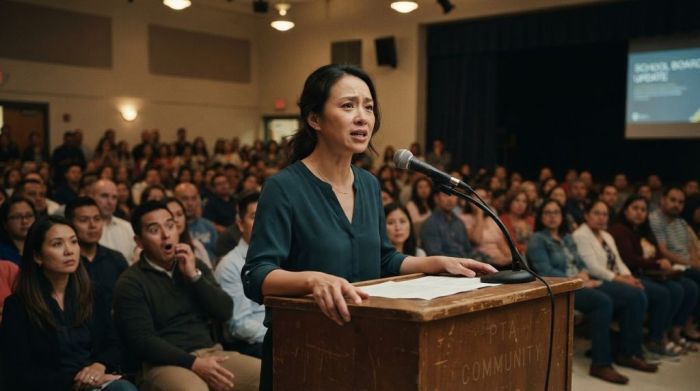
The microphone at the podium was still on from Principal Morrison's announcement. Diana walked toward it, her legs feeling like they belonged to someone else. She could feel eyes on her. She could feel the weight of every silent moment she had ever endured pressing down on her shoulders.
She reached the podium and gripped the edges so tightly her knuckles turned white.
"Excuse me," she said.
Her voice came out smaller than she wanted. A few people turned to look. Others kept talking.
She cleared her throat and tried again.
"Everyone, please. I have a plan."
This time, the room slowly quieted. Karen Mitchell stopped mid-sentence. Lori Patterson turned around in her seat. Principal Morrison looked at Diana with surprise, as if noticing her for the first time.
Diana had printed copies of her proposal that morning. Forty-seven pages of research, analysis, and step-by-step execution. She had calculated everything down to the last dollar. But she didn't open the folder. She didn't look at her notes.
She just spoke.
"Three weeks ago, when the district first announced the potential cuts, I started looking into high-yield fundraising models across the state. There are five schools in Ohio that have faced similar shortfalls in the last two years and successfully exceeded their goals. I contacted all five of them."
She paused, her heart still racing, but something else was growing inside her now — something that felt like oxygen.
"Here's what they all told me. A single event won't work. We need multiple revenue streams running simultaneously. A community-wide crowdfunding campaign targeting alumni. A matching gift partnership with local businesses. A student-sponsored pledge drive where kids commit to reading books or completing chores for donations. And a benefit concert featuring the school band and choir — the very program we're trying to save, performing to show the community what they'd be losing."
She continued for another ten minutes, laying out the numbers, the timelines, the volunteer assignments. She had thought of details that no one else had considered: the tax-deductible donation structure, the social media strategy, the role each PTA member would play based on their strengths rather than their willingness to volunteer.
When she finished, the auditorium was completely silent.
Then Principal Morrison started clapping.
Then Lori Patterson stood up and clapped.
Then the entire room rose to their feet.
Diana stood frozen at the podium, her hands trembling, her eyes blurred with tears she refused to let fall. For thirty years, she had believed that staying quiet was the only way to be accepted. She had believed that her voice was not wanted, not needed, not worth hearing.
But she had been wrong.
That night, the PTA voted unanimously to adopt Diana's plan. Over the next seven weeks, the community came together in ways no one had anticipated. The alumni campaign alone raised twenty-three thousand dollars. The matching gift from a local manufacturing company added another fifteen thousand. Students collected over nine thousand dollars in pledges. And the benefit concert — held on a warm June evening in the school gymnasium, with Mrs. Grayson conducting the choir herself — raised the final eighteen thousand.
When the final total was announced, Diana was not at the podium. She was standing at the back of the gymnasium, watching her daughter Lily sing in the choir, her small face radiant with joy.
But people found her anyway. They found her to shake her hand. To thank her. To tell her she had saved the music program.
And more importantly, they found her to ask questions they had never asked before.
"Where did you learn to put something like this together?" asked Karen Mitchell, who had never looked at Diana as anything more than the quiet woman with the spreadsheets.
Diana smiled.
"My parents taught me that if you want something, you don't wait for someone to give it to you," she said. "You figure out how to build it yourself."
Karen nodded slowly, and something shifted in her expression — a recognition that she had been looking at Diana without truly seeing her for years.
After that night, something changed in Oakwood Elementary. Parents started including Diana in conversations that didn't start with a spreadsheet. They invited her to coffee, to dinner, to weekend picnics where she was asked to bring her famous dumplings. They asked about her parents, about her childhood, about what it had felt like to move across the world at nine years old.
And Diana — slowly, hesitantly, one word at a time — began to tell them.
She talked about the laundromat and how she had learned to fold fitted sheets before she learned long division. She talked about her mother's hands, cracked and red from detergent, that had held her every night when she cried because the kids at school wouldn't say her name right. She talked about the college acceptance letter that her father had laminated and carried in his wallet for eight years, until the plastic peeled and the paper turned yellow.
She talked about her voice, and how she had lost it, and how she had found it again.
And the people of Oakwood listened.
Years later, when Diana's daughter Lily graduated from high school, the music program that Diana had saved was still thriving. Mrs. Grayson had retired, but she came back for the ceremony, sitting in the front row with tears streaming down her face as Lily performed a solo that brought the entire auditorium to its feet.
After the ceremony, Diana stood in the lobby surrounded by people. Parents she had known for years, teachers who had taught her children, friends she had finally learned to call friends.
Lily found her in the crowd and hugged her.
"Thank you, Mama," she whispered.
"For what?" Diana asked.
"For showing me that it's never too late to be seen."
Diana held her daughter and thought about the Chinese proverb her mother had told her when she was a small girl, sitting on a stool in the back of the laundromat, watching steam rise from the pressing machines.
The best time to plant a tree was twenty years ago. The second best time is now.
She had spent thirty years waiting for the right time to speak. She had waited for permission, for courage, for the fear to disappear. But the courage never came before the action. It came after.
It always came after.