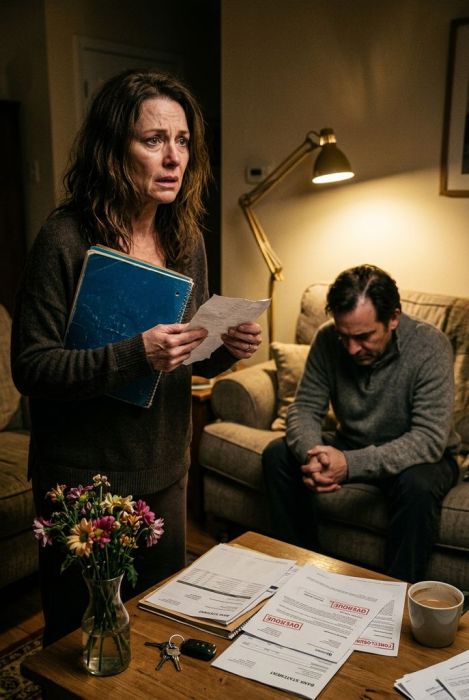
Eleanor Vance was eighty-one years old when she finally agreed to move into the Silver Pines Nursing Home in Boise, Idaho. Her daughter, Patricia, had begged her for months after finding her mother wandering the kitchen at three in the morning, confused and disoriented. The early stage Alzheimer's diagnosis was still new, still terrifying, and Patricia had decided that Eleanor needed round-the-clock care she could no longer provide.
"But your brother comes every weekend," Patricia had said, trying to soften the blow. "Mark will visit you every single Saturday. He promised."
And Mark did.
Every Saturday morning at exactly nine-thirty, Mark Vance walked through the front doors of Silver Pines with a bouquet of fresh flowers and a warm container of homemade soup. He was forty-three years old, a high school history teacher with a kind face and a gentle voice. The nursing home staff adored him. He knew every nurse by name. He asked about their children, remembered their birthdays, and always brought extra cookies for the break room.
"He is the most devoted son I have ever seen," said Brenda, the head nurse on the second floor. "Some families visit once a month if you are lucky. This man comes every single week."
Mark would sit with his mother for two hours, holding her hand, showing her old photographs, and telling her stories about her grandchildren. Eleanor's face would light up when she saw him. Even on her worst days, when she could not remember where she was or what year it was, she always remembered Mark.
"There's my boy," she would say, her wrinkled hands reaching for his face. "There's my sweet boy."
Patricia lived in Portland and could only visit twice a month. Every time she called, Mark reassured her. "She is doing great, Pat. I have everything under control. You focus on your job and the kids."
Patricia trusted him completely. They had always been close, especially after their father passed away from a heart attack ten years earlier. Mark had been the one to handle the funeral arrangements. He had been the one to help their mother sell the family home and move into a smaller apartment. He had been the one to manage her finances after the Alzheimer's diagnosis.
"I don't know how to balance a checkbook," Patricia had admitted when their mother's care became complicated. "Numbers have never been my thing."
"Don't worry," Mark had said. "I'll take care of everything."
The trouble began in the middle of December, when Eleanor had a particularly bad fall in her room at Silver Pines. She broke her hip and was rushed to Saint Alphonsus Regional Medical Center. Patricia flew in from Portland immediately.
She arrived at the hospital to find Mark already there, sitting in the waiting room with paperwork spread across his lap.
"She is going to be okay," Mark said. "The surgery went well. But she is going to need extra care. The nursing home said they can handle it, but it will cost more."
"How much more?" Patricia asked.
"About two thousand a month," Mark said. "I already talked to her bank. She has enough in her checking account to cover it for another year or so. After that, we will need to sell the house."
"What house?" Patricia asked. "She sold the house years ago."
Mark's face went still for a fraction of a second. Then he smiled. "No, Pat. She kept the rental property on Elm Street. Remember? The one Dad bought as an investment. She has been renting it out for the past eight years. I've been managing it for her."
Patricia remembered nothing about a rental property. She remembered their father's small real estate portfolio — two houses, one of which was their childhood home. But she had been twenty-two when her father died, living across the country, and Mark had handled everything.
"I didn't know she still had that house," Patricia said slowly.
"That's okay," Mark said, his voice warm and reassuring. "You have enough to worry about. I handle the finances so you don't have to. That is what brothers do."
Patricia nodded and let it go. Her mother was in recovery. There were more important things to focus on.
But something did not sit right.
Later that evening, while Mark went to get coffee from the hospital cafeteria, Patricia sat in her mother's room and watched her sleep. The oxygen machine hummed softly. The heart monitor beeped in a steady, reassuring rhythm. On the bedside table, next to a half-empty cup of water, lay her mother's old leather purse.
Patricia had seen that purse a thousand times. It was worn and cracked, held together by duct tape on one corner. Eleanor refused to replace it because, she said, "it still works fine."
Patricia opened the purse carefully. Inside, she found a wrinkled receipt from a pharmacy, a rosary, and a small spiral notebook.
The notebook was filled with her mother's shaky handwriting. Recent entries, from the past six months. Lists of appointments, reminders about medications, and notes about phone calls she had received. Toward the back of the notebook, Patricia found something that made her blood run cold.
A list of bank account numbers.
There were five accounts listed. Patricia knew about two of them — a checking account and a savings account that had been in their family for decades. But three of the accounts had names she did not recognize. One was at a different bank entirely.
Patricia took a photograph of the page with her phone and put the notebook back exactly where she had found it.
The next morning, she called the bank.
After two hours of phone transfers, security questions, and a frustrating conversation with a manager who could not tell her anything because she was not listed as a signatory, Patricia finally got a partial answer.
The three unknown accounts existed. They had been opened four years earlier, in the name of Eleanor Vance. And over the past twelve months, a total of sixty-eight thousand dollars had been transferred out of Eleanor's primary savings account and into these new accounts.
The manager could not tell her who had authorized the transfers, but Patricia did not need a formal investigation to know.
She drove straight to Mark's house.
The drive from the hospital to Mark's home in the North End neighborhood took twenty minutes. Patricia spent every minute replaying memories through a new, darker lens. The way Mark had insisted on handling all of their mother's paperwork. The way he had discouraged her from asking too many questions. The way he always had an answer ready before she could finish forming the question.
She remembered how, two years ago, Mark had bought a brand new SUV and taken his family to Disney World. She remembered how he had renovated his kitchen last summer. She remembered how his wife had started wearing expensive jewelry that Patricia had never seen before.
"Teacher salaries must be better than I thought," she had joked at the time.
Mark had laughed. "We saved up. Years of pinching pennies."
But now, looking back, the timeline did not match. The renovations, the vacations, the new car — they had all happened in the past three years. Right around the time their mother's Alzheimer's had progressed to the point where she could no longer manage her own affairs.
Mark opened the door with a smile that faltered the moment he saw Patricia's face.
"Pat? What are you doing here? Is Mom okay?"
"Open the door, Mark."
He hesitated, then stepped aside.
Patricia walked into the living room and stood in the center of the Persian rug — a rug she had never seen before, one that looked like it cost more than her monthly mortgage payment.
"I found the accounts," she said.
Mark closed the front door slowly. His face cycled through several expressions — surprise, calculation, and then a strange, almost relieved calm.
"Which accounts?" he asked.
"All of them. The three you opened at Idaho Central. The transfers. The rental property you said she owned, but that I have a feeling does not actually exist."
Mark sat down on the couch. He did not look guilty. He looked tired.
"Patricia," he said, his voice soft. "You do not understand the full picture."
"Then explain it to me."
He took a long breath. "Mom's care is expensive. The nursing home, the medications, the specialists. It costs more than her pension and Social Security combined. I had to find a way to keep her there. I did not want to put her in a state facility. You know what those places are like."
"So you stole from her?"
"I managed her money," Mark said, his voice rising. "I made decisions. Yes, I moved funds around. Yes, I opened accounts in her name. But everything I did was to make sure she had the best care possible. The extra money in those accounts — I used some of it to cover expenses. Administrative fees. Legal costs. Things that come up."
"Sixty-eight thousand dollars in one year?" Patricia's voice cracked. "That is more than her care costs, Mark. I checked."
Mark's face hardened. "You checked? You went behind my back?"
"Someone had to. You made sure no one else could."
The argument that followed was loud, bitter, and painful. Mark accused Patricia of abandoning their mother for years. Patricia accused Mark of preying on a vulnerable woman who could not defend herself. Mark said he had sacrificed weekends and holidays while Patricia lived her life in Portland. Patricia said that did not give him the right to steal.
In the end, Mark made a confession that turned Patricia's blood to ice.
"It is not just me," he said quietly. "I am not the only one who needed help."
Patricia stared at him. "What are you talking about?"
Mark's wife, Karen, had been diagnosed with multiple sclerosis two years earlier. The medical bills were enormous. Their insurance did not cover everything. Mark had been drowning in debt, and he had seen their mother's savings as a lifeline.
"I know it was wrong," Mark said, tears finally filling his eyes. "I know. But I did not know what else to do. I thought I could pay it back. I thought I had time."
Patricia stood in the middle of the living room, surrounded by furniture she knew her brother could not afford on a teacher's salary, and felt the crushing weight of two impossible truths.
Her brother was not a villain. He was a desperate man who had made terrible choices.
But he had also stolen their mother's future.
Patricia filed a police report the next morning.
The investigation took five months. Mark was charged with financial exploitation of a vulnerable adult, a felony in the state of Idaho. The court ordered him to repay the full amount he had taken. He lost his teaching license. His marriage crumbled under the weight of the legal proceedings and the exposure of his lies.
Eleanor Vance never fully understood what had happened. In her confused mind, her son still visited every weekend. She still smiled when he walked through the door. But after the charges were filed, Mark's visits were supervised by a social worker. He was not allowed to handle any of her finances ever again.
Patricia moved back to Boise. She took over her mother's care, learned to navigate the complex world of Medicare and long-term care insurance, and discovered that her mother's remaining savings — what Mark had not taken — would be enough for another four years of quality care.
She visited her mother every single weekend, just like Mark used to.
And every time she walked through the doors of Silver Pines, she thought about how easy it had been for her brother to hide the truth. How simple it had been for a trusted family member to drain an elderly woman's accounts while the system looked the other way. How many other families were living through the exact same nightmare, unaware that the person they trusted most was stealing their loved one's future.
Eleanor Vance passed away peacefully in her sleep eighteen months later, at the age of eighty-three. She never knew what her son had done.
And in a way, Patricia was grateful for that.
Because some truths, she realized, are too heavy for a mother's heart to carry.
The nurse at Silver Pines, Brenda, later told Patricia that financial abuse of the elderly happens more often than anyone wants to admit. It is rarely a stranger. It is almost always a family member — the son, the daughter, the nephew, the cousin who shows up with flowers and sweet words and a perfectly reasonable explanation for every missing dollar.
"Love makes us blind," Brenda said. "But when money is involved, love can also make us fools. The best thing any family can do is have two people watching the accounts. Never leave one person in charge."
Patricia thought about those words every day. She thought about the flowers Mark brought, the soup he carried, the gentle way he held their mother's hand. She thought about how easy it is to mistake attention for affection, and how devastating it is to discover the difference.
She told her mother's story at senior centers and church groups around Boise. Not to shame her brother, but to warn others. She told them to check their accounts. To ask questions. To never sign over power of attorney to a single person without oversight.
"Trust your family," Patricia would say at the end of every talk. "But verify everything. Because the people who love you the most are sometimes the ones who hurt you the worst."