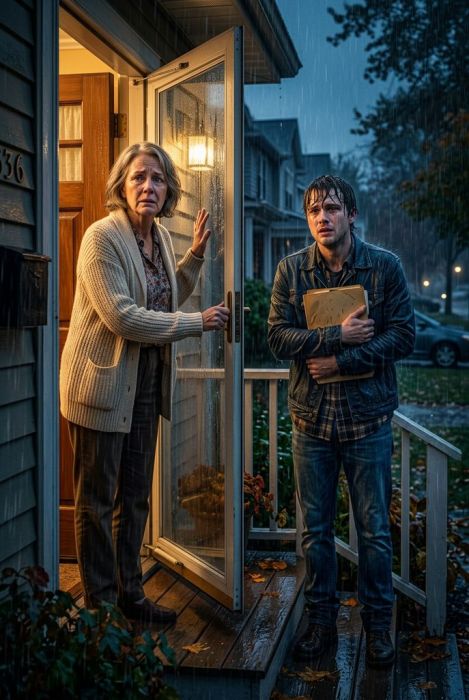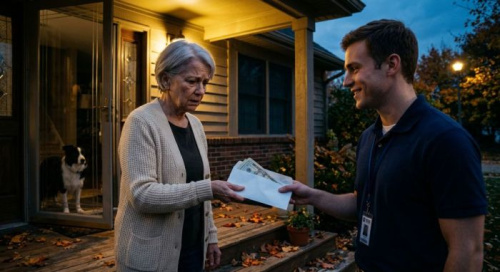
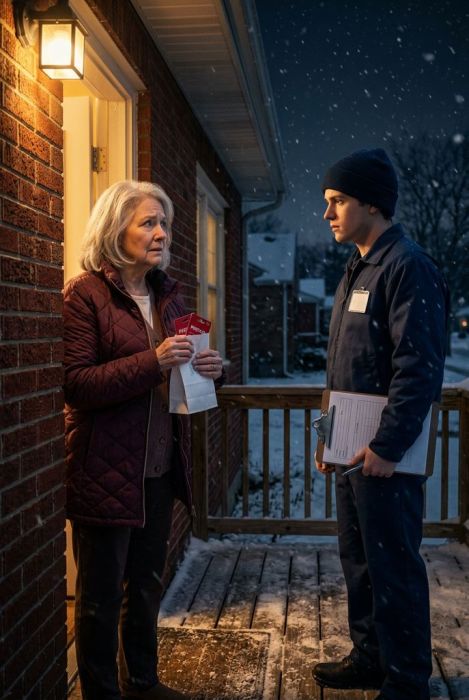
The doorbell rang at 4:47 on a Tuesday in January, when the cold in Omaha had teeth and the daylight had already gone gray. Rose Hargrove was in the kitchen checking the pot roast she'd put in for her bingo-night supper, and she almost didn't answer. Nobody came calling at dusk in weather like that unless something was wrong. When she finally opened the door, the man on her porch was already talking, already pulling a laminated badge from inside his coat. "Ma'am, sorry to bother you," he said. "But we've got a problem with your gas line."
He was young — twenty, maybe — with a clean face and cold-reddened cheeks, and his navy uniform carried a small patch on the shoulder that read Metro Utilities in letters she had to squint to see. He was polite. That was the thing Rose would remember later, how polite he was, how he took his cap off before he stepped inside and wiped his boots on the mat, the way her mother had always said a boy should. He explained that a service crew had flagged a safety notice on her account that afternoon, an overdue balance tied to an address mix-up from years before she ever bought the house. "It's a paperwork thing," he said, "but the system flagged it for shutoff tonight. You'll have no heat by 5:30 unless we clear it now."
Rose was seventy-four years old. She had lived in the little brick bungalow on Cuming Street for forty-one years, first with her husband Walter and then alone after the stroke took him in 2016. She paid her gas bill the way she paid everything in her life, with a checkbook and a stamp, on the first of every month, and she had never once been late. So she told the young man that, plainly and with a little heat of her own. She told him she didn't owe a cent.
That was when he showed her the paper.
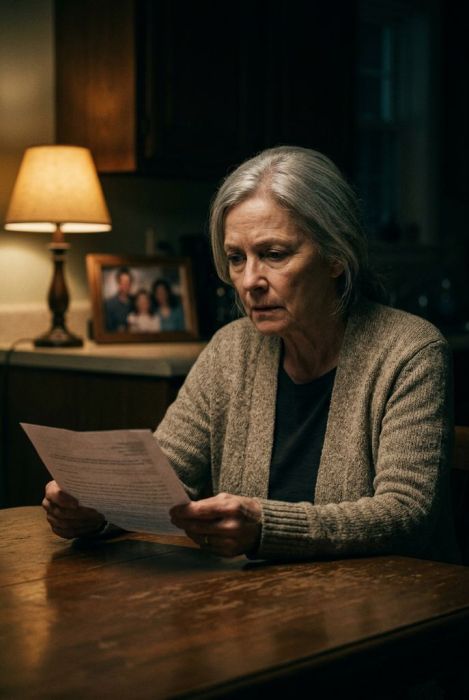
It was an official-looking notice, gray and white, with her address printed at the top and a balance of six hundred and forty-two dollars in bold black type. Her account number was there too, all twelve digits, along with the date of her last payment and a string of service codes that meant nothing to her but looked terrifyingly real. "Sometimes these mix-ups happen when a property changes hands," the young man said. "The people who owned this place before you had an old balance that never got cleared, and it's been sitting on your file ever since." He frowned at the paper like he was on her side. "I know it ain't right, ma'am. But the field tech already red-tagged the meter this afternoon. I can't un-tag it from here."
In the kitchen, over the smell of roasting beef, Rose felt her chest tighten. January in Nebraska was not a season you survived without heat. The forecast called for fifteen below with wind chill by morning. Her pipes had frozen once, back in 2009, and it had cost eleven hundred dollars and a week of cold water. And Abby, her granddaughter, her heart, the girl who looked so much like Walter it hurt, was driving home from college on Friday for the long weekend. Rose had already bought the fancy hot chocolate and the fuzzy socks and the cinnamon candles. She could not tell that girl to sleep in a freezing house.
Truth be told, she had been waiting for trouble all month. Her reading glasses had snapped at church a week ago, and Benji, the boy from across the street, had read her latest gas bill to her over the porch railing while she fed the birds. "They raise the rates every single year, swear to God," he'd said, and she'd laughed and told him somebody had to pay for the roads. He had read her mail to her before. He had helped her with the furnace in 2021, finding Valentine Heating and Air in the yellow pages when the pilot light went out in a cold snap. He was a good kid. Everyone said so.
"Can I just pay it over the phone, right now?" she asked.
The young man shook his head, apologetic. "The billing system is down for scheduled maintenance tonight. It's the same for everybody across the whole county." He paused, and his voice went softer, almost kind. "That's why they sent us out in the field with paper notices, ma'am. So folks aren't left in the cold with no way to pay." He looked at her like a grandson would, steady and reassuring. "You've got two options tonight. You can drive down to the office, but they closed at five. Or, and this is what most folks do, you can get a prepaid gift card, load it for the amount, and call the number on the back of the notice."
Rose had watched the local news segments about people being cheated out of their savings by smooth strangers. But this boy was standing in her living room. He had a badge. He had a truck parked out front with a yellow beacon light on the roof. He had a paper with her real account number, the exact number from the bill she kept in the silverware drawer. It was the details that made it true. So when he wrote an 800-number on the back of his business card and told her a supervisor was standing by, Rose did the arithmetic the way she'd done it her whole life, and she decided that the risk of being fooled was smaller than the risk of a cold house.
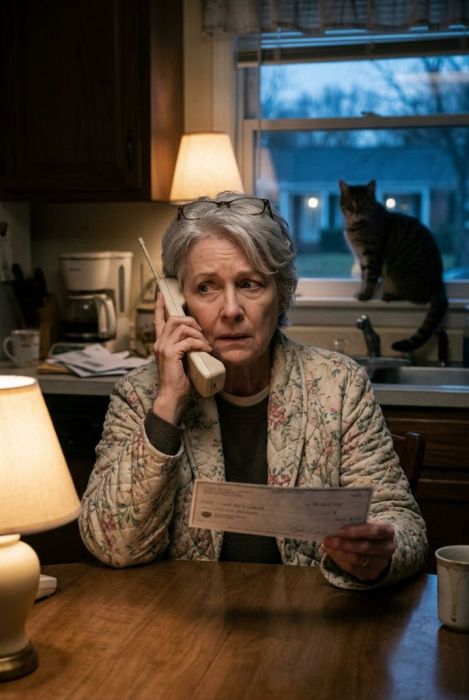
The supervisor answered on the second ring. His name was Tom, and he had one of those smooth, professional voices you heard on every customer service line in America. "Mrs. Hargrove, I'm looking at your account right now," he said, "and I can see exactly what happened." He read back her address. He read back her account number. He told her when she'd moved in, and he told her the name of the furnace company that had serviced her old boiler. Valentine Heating and Air, he said, right as rain. "It's all in the service history, ma'am," he said when she asked how he knew. "Every visit the HVAC company logged is attached to your file."
It sounded so organized. So official. So safe.
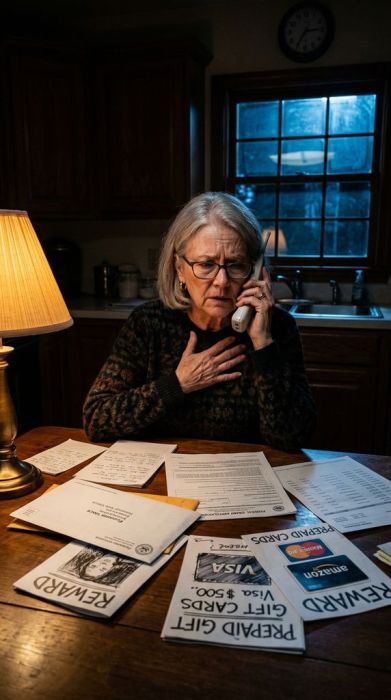
Tom apologized for the inconvenience. He thanked her for her patience. He told her that once she loaded the cards and called back with the numbers, the emergency flag would lift in ten minutes and her heat would stay on all night. And somewhere in her mind a small, tired voice tried to speak up, the voice that remembered a different world, where people didn't pay their heat with plastic cards from the drugstore. But fear is louder than suspicion. When you are seventy-four and alone and the weather report says fifteen below, you don't weigh the evidence. You just want the heat to stay on. The red flags were everywhere — the pressure, the gift cards, the stranger in her home — but she walked right past every one of them.
The nearest store that sold the cards was the CVS down on Dodge Street, and Rose drove there in her old Buick with the heater that only worked on high. Inside, she picked up six cards, four hundred-dollar ones and two fifties, and she was halfway to the register when a young cashier named Maya looked at the stack and went very still. "Ma'am," Maya said quietly, "just checking — is this for a gas bill?" Rose said it was. Maya's eyes flicked to the door, then back. "You're sure nobody's making you buy these?" she asked, with the careful calm of someone who had asked that exact question too many times before. Rose smiled. "No, honey. I'm just an old lady with a cold house. This is for the gas company." Maya scanned the cards, folded the bag, and handed it over with a receipt and a long look that Rose did not understand until much later.
It was fully dark by the time she turned back onto Cuming Street, the snow coming down harder, the porch light of the old bungalow glowing like a harbor light. The young man was where she'd left him, standing by the hydrant across the street, stamping his boots in the frozen slush. When he saw her headlights he walked up the driveway to meet her. "All set?" he asked, and she held up the bag. "Good," he said. But something in his face had changed, a tightness around the mouth, a quick glance at the mailbox, a hurry that hadn't been there before. And then the porch light caught his boots as he reached for the bag, and Rose's heart stopped.
They were the boots she'd bought him for Christmas, two years ago. Steel-toed work boots with a split in the right toe, scuffed from a summer of mowing and a winter of shoveling. She'd written his name inside them with a Sharpie, B. Coltrane, so the other boys in his shop class wouldn't swipe them, and there it was, faded now, at the heel where the light caught it.
The man taking the gift cards from her hands was Benji Coltrane. The boy next door. The kid who had shoveled her walk at six o'clock that very morning, same as he'd done every snow since he was fourteen. The boy she'd watched grow up from a gap-toothed thing on a bicycle into a quiet, hardworking senior saving money for welding school in Iowa. The boy whose mother worked nights at Methodist Hospital and never once asked for help, so Rose just left an envelope under her welcome mat every Christmas with "for Debra" written on it and never said a word. He wasn't twenty. He was eighteen. Under the navy cap and the padded uniform and the polite, practiced voice was the kid whose hand she'd held at his father's funeral.
Rose didn't scream. She couldn't. She stood there on the porch with her hand out, the bag of cards between them, and said his name. "Benji."
His face went the color of the snow. "It's not what you think, Miss Rose —"
The truck turned the corner at the end of the street. It was Jake, her only son, Abby's father, coming to fix the garbage disposal like he'd promised. He saw the uniform, saw his mother's face, saw the boy's arm jerk back, and he was out of the car and up the driveway before Benji could take three steps. Benji dropped the bag. The cards scattered across the frozen porch like red confetti. He bolted into the dark, and Jake would have chased him, but Rose put her hand on his arm. "Let him go," she said. "I know where he lives."
The police came within the hour. A detective named Karen Ruiz from the financial crimes unit sat at Rose's kitchen table, drinking the coffee Rose insisted on making, and listened to the whole story without interrupting once. Then she said the words Rose would replay for months. "Ma'am, this wasn't random. Whoever did this knew your account number, your payment date, your furnace company, even what time your grandson comes by on Tuesdays. They didn't guess. They had you." Rose looked at the silverware drawer, still open, and understood.
The CVS cameras caught Benji's face in the checkout line. The 800-number pinged to a prepaid phone with no name attached, but the phone's location records told a different story, and within three weeks detectives in Chicago arrested a twenty-four-year-old named Andre Robinson who ran a gift card crew across three states, paying teenagers a cut to knock on doors and reel in the frightened and the lonely. Benji was the smallest piece of the machine. He was also the only piece Rose had ever loved.
At the juvenile hearing in March, Rose sat in the second row, across the aisle from Debra, who hadn't slept in weeks and looked like a woman made entirely of grief. Benji had been charged with theft by deception and had taken a plea, so there was no trial, only a sentencing hearing, and the judge asked if the victim wished to speak. Rose walked to the podium in her best church coat, and the courtroom went quiet.
She told the judge she didn't want him in detention. She told the court that Benji's mother was a good woman who worked double shifts and deserved better than this. Then she turned to look at Benji, and her voice didn't shake. "I bought you those boots. I watched you grow up. And I will forgive you, because I learned a long time ago that a boy can do a bad thing and still be a good boy. But you need to understand what you were carrying tonight. You were going to sell my winter to strangers."
The judge ordered restitution, community service, and a fraud education program that Benji would attend every Saturday for a year. Debra wept. Benji could not look at her. And Rose, walking out into the March wind, felt lighter than she had in months, though she never left a fifty under the mat again.
She tells the story now, every Thursday at bingo, and she has a rule she repeats until the younger women roll their eyes. If a bill collector calls, or a worker knocks, she closes the door and dials the number printed on her actual bill — not the number on the flyer, not the number on the card in his hand — and she asks for a call back the next morning, because real companies don't mind waiting. She shredded the old bills, bought a small home safe, and moved her emergency cash to the bank, because Benji had known about the ceramic rooster on the mantel too. She'd told him once, years ago, laughing at herself, that she kept her grocery money in a bird so she'd never be stranded. It was a harmless story, a sign of trust, and he'd turned it into a key.
The last thing she tells Abby is this: the scariest person in the world isn't the stranger in the dark alley. It's the boy you've known since he was five, standing on your porch, reading your mail back to you. Never hand your life to someone just because you recognize their face. And never, ever pay a bill with a gift card — no real utility, bank, or government agency will ever ask for one. It's the one lesson Rose Hargrove paid six hundred dollars to learn, and she will spend the rest of her life teaching it for free.