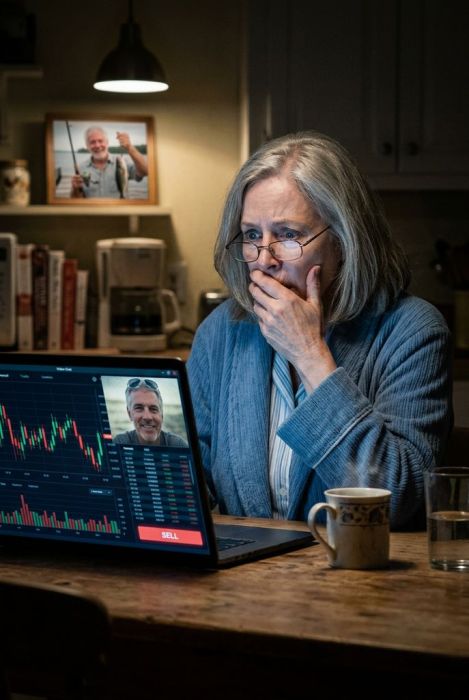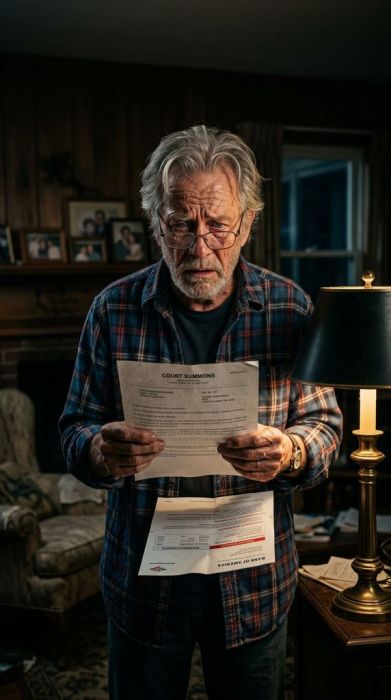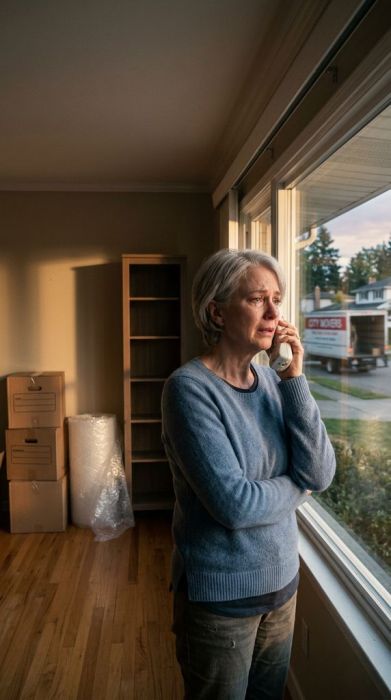
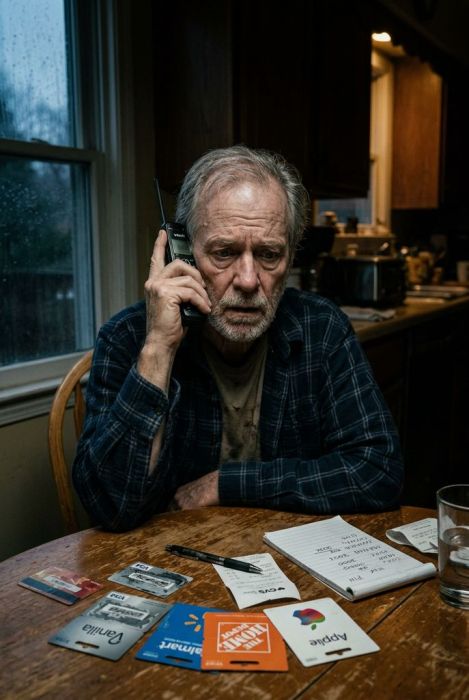
The call came at 2:17 on a Tuesday afternoon, when the house on Hayes Street was so quiet that Frank Delgado could hear the ice maker drop a cube into the bin two rooms away.
The voice on the line was flat and official. "Am I speaking with Franklin Delgado?"
Frank had almost let it go to voicemail. The screen showed an 800 number, and he had spent sixty years believing that people who called from 800 numbers were either selling something or about to deliver bad news. He answered anyway. Old habits.
"This is Thomas Reiner with Northwest Legal Recovery. I'm calling regarding judgment 2025-CV-4417, in the matter of the estate of Dorothy Anne Delgado."
Frank's hand went cold. Dorothy Anne. His Dotty. Sixteen months dead, and somebody was saying her name out loud like she was a file folder.
"I'm sorry," he said. "My wife passed away. Last year. Who did you say you were?"
The voice didn't soften. That was the first thing he would remember later, when he told the story at the senior center. A real human being, hearing that a woman had died, would have said something kind. This voice just kept going, like a machine reading a script.
"Mr. Delgado, I understand this is difficult. Your late wife maintained a joint credit account with Universal Consumer Finance, opened in November of 2021. The balance at the time of her passing was fourteen thousand seven hundred twelve dollars. A judgment was entered against the estate in Multnomah County Circuit Court on March fourteenth. That judgment is now in the collection phase."
Frank sat down hard on the kitchen stool. "She never had a card like that. Dotty paid cash for everything. She wouldn't even use the debit card I gave her."
"That's what most people say, Mr. Delgado. It doesn't change what the records show."
And then the man said the words that changed everything.
"The last four digits of the social security number on the account are 4412. Your wife's maiden name was Whitfield. She passed at Sacred Heart Medical Center on the nineteenth of June. I know this is painful. But you need to understand what happens next if we don't resolve this today."
Frank couldn't breathe. Nobody outside the family knew those numbers. Nobody knew the date or the hospital unless they had read Dotty's file — or unless they had known Dotty.
"How do you know all that?"
"We hold the full account history, Mr. Delgado. We're a licensed recovery firm. The question is whether you'd like to resolve this quietly, before we're forced to take further action."
Further action had a price. Settlement today: seven thousand three hundred dollars. Cash, wire, or certified payment — the judge's office only accepted certified forms for same-day settlements, Mr. Reiner explained. And if Frank didn't settle by five o'clock, Northwest Legal Recovery would petition to garnish his Social Security check, attach the family home, and file a contempt motion for the estate's failure to respond.
Frank heard "garnish" and "attach" and stopped listening to everything else.
"Where am I supposed to get seven thousand dollars by five o'clock?" His voice came out small, the way it hadn't sounded since the morning Dotty's oncologist had used the word "aggressive."
"That's your responsibility, Mr. Delgado. But I'll do you a favor. The judge will accept gift cards from recognized retailers as certified payment. You can purchase them at any CVS or Target, scratch the PINs, and provide them to our office by phone. We'll apply the full amount to the judgment and issue a satisfaction of judgment by morning."
Gift cards. Even through the fog of fear, something in Frank blinked. But Mr. Reiner was already explaining that this was standard practice for the court's electronic payment portal, that thousands of estates settled this way every year, and that the alternative — garnishment, the home, the contempt motion — would cost Frank far more than seven thousand dollars in the long run.
He hung up with a list of instructions and a deadline that felt like a countdown.
The senior center on Willamette Street was where Frank had been going since February, when his daughter Dana had finally stopped tiptoeing around the subject and said, "Dad, you can't sit in that house alone anymore. You're forgetting to eat."
He had resisted at first. The center smelled like instant coffee and floor wax, and the first three times he walked in, he felt like everyone was watching him, waiting for him to fall apart. Then Kayla Bennett had come bouncing over with a name tag and a smile so wide it seemed to use her whole face.
"Mr. Delgado! I'm Kayla, I run Coffee and Computers on Thursday mornings. You're going to love it. We teach you how to video call your grandkids and not cry."
Frank had laughed, the first real laugh in months. Kayla was twenty-six, with a sunflower tattoo on her wrist and a habit of remembering everyone's birthday. She was the one who helped him set up his new tablet after the old one died. She helped him move his bills to autopay so he wouldn't miss a payment. She helped him organize Dotty's papers into a single accordion folder, because the stack on the dining room table had gotten so tall it was blocking the window.
"You're like my granddaughter," Frank told her once, and Kayla had beamed.
"Like a granddaughter who can also reset your router," she said.
She was the one who noticed he was limping in June and drove him to the pharmacy. She was the one who called him on the anniversary of Dotty's death and said nothing, just listened, for eleven minutes. Everyone at the center loved Kayla. The director, Ruth Anne, called her "our sunshine."
So when Frank's hands were shaking so bad on that Tuesday that he couldn't type, and he needed help figuring out how much cash he could pull before the bank closed, he did what he always did. He called Kayla.
She picked up on the second ring. "Mr. D! What's wrong?"
Frank told her about the call, stumbling over the words — judgment, garnishment, seven thousand three hundred, gift cards, five o'clock. He left out nothing, because Kayla was the one person he trusted to fix things.
"Oh, honey," Kayla said, and her voice went soft in a way that Frank later realized he'd never actually heard before. "Okay. Deep breath. This happens more than you'd think. Estates are messy. But you do NOT want a garnishment — they can take forty percent of your check. And they can absolutely go after the house if the judgment is recorded."
"You know about this?"
"My aunt went through something similar in Idaho," Kayla said. "She had to pay a settlement or lose her trailer. It's horrible, but the good news is, if you pay the settlement, it's over. Done. They can't touch you again."
That was all Frank needed to hear. He had never felt more alone than he did standing in his kitchen that afternoon, holding a pen over a list of numbers. Dana was in Spokane. Dotty was gone. And the only voice in his ear telling him what to do was a sunflower-tattooed girl he trusted like family.
At the CVS on West Eleventh, Frank bought nine hundred dollars in gift cards — the cashier had to call a manager for approval, and the manager, a heavyset woman named Pearl who had known Frank for years, leaned across the counter.
"Frank. You okay?"
"Yeah, Pearl. Estate stuff. Paperwork."
"You buying nine hundred bucks of gift cards for paperwork?"
"It's for the court. Certified payment."
Pearl's face did something complicated, but Frank was already walking out with the bag, and the clock on the wall said 4:12, and Mr. Reiner had said five o'clock, and there was no time for questions.
He made three more trips that afternoon — the Target on Gateway, the Rite Aid on Centennial, the Walmart out by the freeway. Seven thousand three hundred dollars in plastic, all of it scratched and read into the phone, one number at a time, while Mr. Reiner said "next" and "next" and "that's correct."
At 4:58, Mr. Reiner said, "Settlement received. Satisfaction of judgment will be mailed to you. Goodbye, Mr. Delgado."
The line went dead.
Frank sat on the floor of his living room with the empty gift card sleeves around him like fallen leaves, and for the first time all day, he felt the silence. The house was so quiet. And in the quiet, a small voice that had been buried under the panic finally got through.
Real courts don't take gift cards.
He called the 800 number back. Disconnected.
He called it again. Disconnected.
He called Dana in Spokane, and when she picked up, he was crying so hard he could barely say his own name. "Dad? Dad, what happened? Dad, talk to me."
He told her. Everything. The judgment. The garnishment. The gift cards. The five o'clock deadline. And Dana, who worked in banking and had heard a hundred versions of this story, went very quiet.
"Dad. There's no judgment. There's no Northwest Legal Recovery. There's no judge who takes CVS gift cards. You've been scammed."
"I know," Frank whispered. "I know. I just figured it out. I just — I gave them everything, Dana. Seven thousand three hundred dollars."
The police came that night. A young detective with kind eyes and a worn-out notebook, whose name was Marisol Okafor. She wrote down the number, the time, the phrases Mr. Reiner had used, the details he had known. And when Frank got to the part about the social security number and the maiden name and the hospital where Dotty died, Detective Okafor stopped writing and looked up.
"Mr. Delgado. Who has access to your wife's personal information?"
"Nobody. I mean — the paperwork. The accordion folder. I gave it to Kayla to organize."
"Kayla?"
"Kayla Bennett. She helps me with my computer. She's like a granddaughter to me. She's the one who —" Frank stopped. The room went very still. "She's the one who told me what to do. After the call. She said her aunt went through the same thing in Idaho. She said to pay the settlement."
Detective Okafor didn't say anything for a long moment. Then she wrote a name in her notebook.
The gift cards had been redeemed that same evening, every single one of them, at a Walmart in Springfield, twenty minutes down the road. The store's security footage showed a young woman in a gray Honda Civic with a sunflower keychain dangling from the rearview mirror. The footage was good enough to see the tattoo on her wrist.
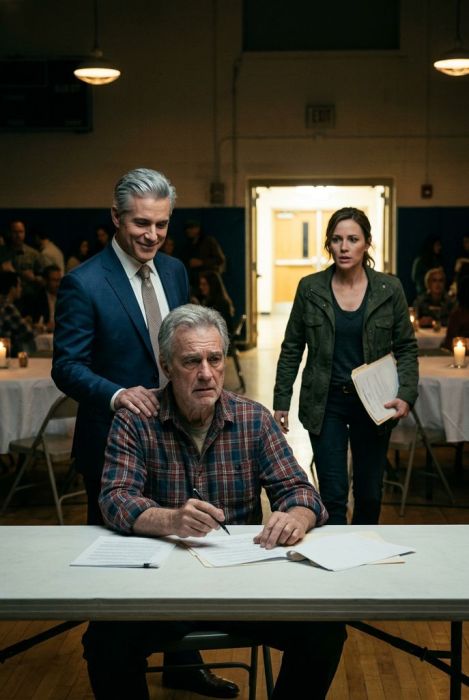
They arrested Kayla Bennett at the senior center's annual Christmas party, in front of everyone — Ruth Anne, the volunteers, the widowers at the poker table, the ladies at the craft table. Frank was standing by the punch bowl when the uniformed officers walked in, and Kayla looked at him, and for one second her face did something he had never seen on it before.
"You don't understand," she said. "You don't understand what I've been going through."
Detective Okafor's report would later show what Kayla had been going through: forty-one thousand dollars in credit card debt, a gambling habit she'd hidden from everyone, and a previous complaint from a senior center in Medford that had never been prosecuted because the victim, a ninety-year-old man, had been too ashamed to press charges. Kayla had been harvesting Frank's information for months — his passwords, his bank, Dotty's documents — while sitting at his kitchen table, while he made her tea, while he told her she was like a granddaughter.
The part that broke Frank wasn't the money. It was the eleven-minute phone call on the anniversary of Dotty's death. He kept turning that over in his hands like a stone.
"She listened to me cry," he told Dana on the phone that night. "And she was already planning to take everything I had."
Frank got two thousand dollars back — the card company had frozen part of the Walmart redemption before it could be drained, and the judge in Kayla's case ordered restitution. The rest was gone, scattered into cash withdrawals and online transfers that would take years to chase. The house on Hayes Street stayed his. The Social Security check stayed his. Those were the two things that mattered.
He didn't go back to the senior center for three weeks. When he finally did, Ruth Anne met him at the door and hugged him without a word, and the widowers at the poker table nodded at him like he was a soldier coming home. He started a new class that winter. Not Coffee and Computers. Something else.
They called it "The Five O'Clock Club," named for the deadline that almost cost him everything. Frank taught the other seniors what he had learned: that a real debt collector must mail you a written validation notice within five days, that no court on earth accepts gift cards, that your Social Security can only be garnished for a very short list of government debts, and that anyone who knows your birthday and your mother's maiden name can still be a stranger.
"The worst ones already know everything about you," Frank would say, standing at the front of the room with a stack of gift card sleeves in his hand, holding them up so everyone could see. "That's the trick. They don't need to break into your house. You invite them in, one kind word at a time."
He still keeps Dotty's accordion folder on the dining room table, but now it lives in a lockbox, and no one touches it but him. When a new volunteer with a bright smile offered to help him with his tablet last month, Frank thanked her politely and asked to see her identification first.
She laughed and handed it over, no problem at all.
That's how you know, Frank tells the Five O'Clock Club. The real ones don't mind the questions. The real ones don't need your money by five.