Marge Delaney was not the kind of woman who panicked easily. Thirty-one years of teaching high school English had prepared her for every kind of human chaos — broken lockers, broken hearts, fire drills in January. So when her sister Beth called from the hospital at six in the morning, her voice thin and apologetic after a fall on the ice, Marge moved with the calm, practical certainty she had built a life on. She packed a small bag, fed the cat, and drove into Columbus on a Tuesday that would change everything and nothing at once.
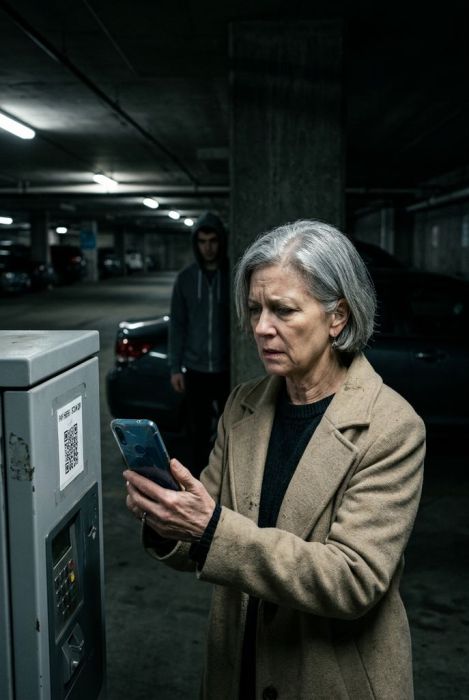
The parking garage attached to Midtown Methodist Hospital was all hollow concrete and humming fluorescent light. Marge circled to the third level, found a spot near the stairwell, and walked to the payment kiosk, where a white laminated sign sat taped to the machine. SCAN TO PAY, it read in crisp black letters, with a QR code beneath it and a little drawing of a phone. The old machines had taken coins and cards. This one, apparently, had gone modern. She pulled her phone from her purse — a model her granddaughter Chloe called "ancient," though it worked fine — and opened the camera. The screen had been cracked since a fall at the farmer's market the previous fall, and she tilted it twice before the fuzzy square finally locked into view.
"You need a hand with that, ma'am?" A young man in a gray hoodie was passing by with a takeout bag. "That sticker's the city's new pay system. Real easy once you get the angle." Marge laughed at herself and let him steady the phone. "Old ones do the job," he said easily, angling it until the chime came. "It'll ask for your plate and a phone number for the receipt. Takes about a minute." He smiled, nodded when the page loaded, and went on toward the elevator. Marge typed in her license plate, her cell number, and her debit card, paid the eight dollars, and forgot him completely by the time she found the stairwell.
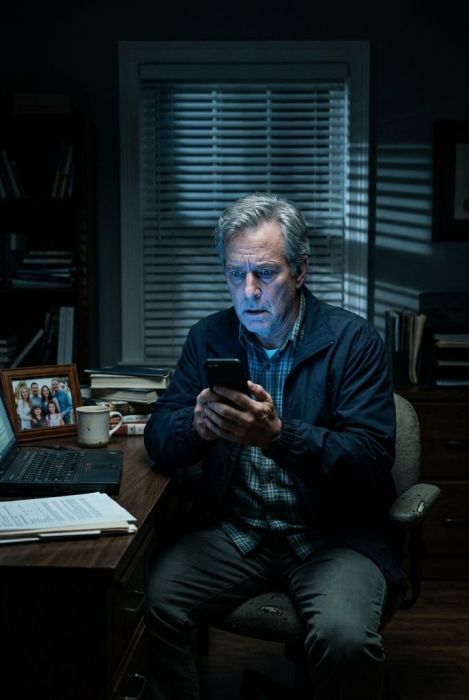
Her sister looked small in the curtained room, under get-well balloons and the particular smell of hospitals that no cleaner has ever defeated. They talked about Beth's hip, about the ice storm, about nothing important, because that was what sisters did when the world got loud. At 10:52, Marge's phone rang, and the number on the screen was the eight-hundred line printed on the back of her debit card for twenty-three years. "Mrs. Delaney? This is the fraud department at Midwest Community Credit Union. We're seeing a charge of four thousand, one hundred twenty-six dollars at an electronics store in Toledo. We need to verify your identity before we can block it." The woman's voice was pleasant, professional, faintly southern. Marge's stomach went cold.
"Oh, that's not mine," Marge said. "Please, that's not mine." Her mind flashed to Ray, her husband, gone six years — how he'd handled all of this, how he'd have made a dry joke and fixed the problem before the coffee cooled. The caller walked her through it gently. A security code had been texted to her phone to confirm her identity, the woman explained. Would Marge please read it back so they could close the account before any more damage was done? Marge's thumb hovered over the message from her bank. She could hear Chloe's voice from a hundred dinners — Nana, never read the code to anyone. The bank will never ask you for that. And somewhere in the hallway, a nurse's voice cut through the static: "Family of Beth Rampling? Your sister is moving to recovery."
"I'm sorry, I have to go," Marge said. "My sister is coming out of surgery."
The caller's tone sharpened, quick as a snapped rubber band. "Ma'am, if you hang up now, your entire account could be emptied by noon tomorrow." A beat of silence. Then the call ended. Marge stood in the hallway with the phone in her hand, heart hammering, and told herself the credit union would sort it all out. It was just money. Beth was the one who mattered.
But by lunch, her phone was drowning in alerts she'd set up years ago and completely forgotten. A charge of $2,600 at a big-box electronics store in Grove City. A charge of $4,100 at something called VASHTI TELECOM — phone credit, apparently. A Zelle transfer of $9,800 lingered in her queue, flagged and pending. She called the credit union for real, from the hospital corridor, and this time she reached Marcus Webb, a fraud investigator with a calm voice and half a sandwich in front of him. He froze everything within minutes. Then he asked, gently, whether she had entered her card anywhere unusual this week. Marge thought about the machine, the sticker, the helpful young man. "The parking garage," she said. "I paid for parking with my phone." There was a pause on the line. "Ma'am, did that machine take coins and cards before?"
Marcus explained it slowly, the way he explained it to every older customer who landed in his queue. The sticker was not city property. The credit union's security team had traced the landing page — a near-perfect clone of the garage's payment portal, hosted on a domain registered eleven days earlier. When Marge had typed in her plate, her number, and her card, she had handed a stranger the keys to her checking account. It had taken him seven minutes to start spending. Marge told him about the young man in the gray hoodie. He didn't say much, but she heard the keyboard moving on his end.
The rest of the week blurred. Columbus police opened a case, and Detective Len Calder came to her house, polite and tired, with a notepad and a small thermos of coffee. The hospital garage's cameras showed a figure in a gray hoodie at 3:12 a.m. the previous Monday, sliding stickers over three kiosks with a box cutter. The same figure surfaced on footage from a county courthouse garage, a downtown library, and a second hospital. Fourteen tampered codes across the city. Marge was fraud victim number six on record. The sticker man was also the helpful stranger — they knew that much now — but he wore the hood, and the cameras caught the back of his head, and no one had seen his face.
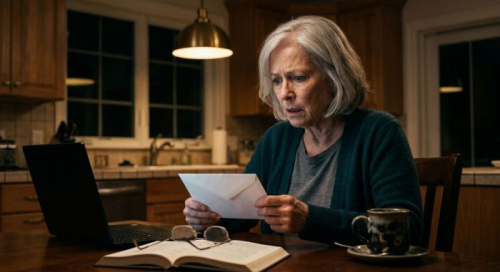
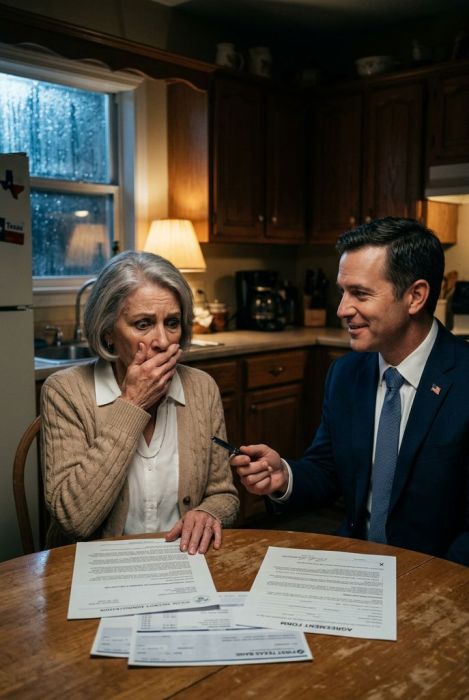
Getting the money back took Marcus Webb and a form called a Regulation E claim. Unauthorized electronic transfers from a consumer account were the credit union's risk, not hers, he said, and he repeated it carefully because he could see the shame sitting on her like a bruise. Marge had taught high school for thirty-one years, and she had handed her card number to a polite stranger with a laminated sign. The humiliation lived in her chest like something hot and heavy. Chloe, home from school, showed her how to pull her credit report and freeze it with a few clicks. "It wasn't you, Nana," the girl said. "It's a three-hundred-dollar printer and a sticker. It's not you."
The arrest came in November. Detective Calder had set up a decoy operation — officers taped their own marked codes to a garage on the south side and waited three nights — and at 3:40 in the morning, a man in a gray hoodie came to change them. Ryan Turner was twenty-five, a seasonal kiosk technician who had been fired from the very company that serviced the hospital garage two months earlier for skimming cash boxes. He knew the blind spots, the reset cycles, the maintenance log. He'd printed the stickers at a library branch, registered the fake domain with a gift card, and kept a burner phone in a gym bag under his bed.
The detective showed Marge a still from the arrest footage, then a frame from the garage camera on the morning she'd met him. Same hoodie, same pouch at the hem. Same gait, the slight hitch when he carried the takeout bag. "That's him," she said, and her voice came out thin. "He held my phone. He told me to type in my number. He watched me do it." Ryan Turner had not been passing through. He had been on that floor checking his work, making sure his stickers had survived the night, when he saw an older woman struggling with a cracked screen — and he had seized the moment like a gift. The small kindness Marge would have extended to anyone was field reconnaissance.
And here was the part that kept her awake at night. Ryan confessed to the stickers, to the camera trick, to selling the harvested card numbers online in batches of ten. But the woman on the phone with the southern accent, the one who had almost talked her into reading back the code, he described as a voice in his ear from a VoIP account he'd never seen, run by someone he'd met in a forum about gift cards. The ring pulled strings from a distance and burned its players as it went. One sticker, one helpful stranger, one eight-dollar parking fee — and behind it, a whole hidden machinery of strangers. The police believed him about the caller. Marge believed him too, and somehow that was worse.
In court, Ryan Turner pleaded guilty to five counts of organized fraud and identity theft and was sentenced to six years. Marge sat in the third row and watched him not look at her, and she felt something complicated — anger, and underneath it a strange small grief, the way you mourn anyone young who chooses the wrong machine. The credit union returned the money. The stores refunded what they could. The fourteen stickers came down, replaced by yellow notices: THIS MACHINE DOES NOT ACCEPT QR PAYMENTS. The hospital sent her a letter of apology thick with insurance language, and she almost threw it away.
But Marge kept it, because she kept everything now — receipts, statements, the little card with the fraud line number Chloe wrote on the back in permanent marker. She learned to pay cash at the farmer's market. She learned to look at the URL on any payment page, to check for the padlock icon she used to ignore, to call the number printed on the back of her card instead of the number some friendly voice gave her. She started a Tech Tuesday at the senior center, three tables and a borrowed projector, where she showed other retirees how to spot a tampered code, how to hold a thumb over the camera, how the kindest voices in the world sometimes wear gray hoodies.
On a wet Saturday in December, at the indoor market downtown, she stopped in front of a honey stand. A small white sticker sat next to the jars, with a QR code and the words SCAN FOR OUR STORY. Marge smiled, took out her wallet, and paid in cash. The beekeeper looked confused, and Marge didn't explain. Somewhere, deep in the concrete music of a parking garage, there are always more stickers. There always will be. But Marge Delaney knows now that a code is only a door — and she is the one who decides who holds the keys.