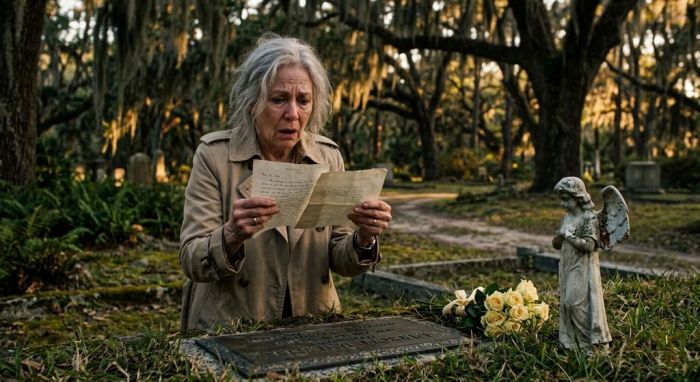
Dorothy Callahan noticed the flowers on a Tuesday morning in late March, when the dogwoods along the cemetery lanes were just beginning to blush white. She walked the same slow mile from the iron gate every week, past the soldier's monument, under the big oak where Spanish moss swayed, to the bronze marker that carried her husband's name. The bouquet was small and tasteful — pale yellow roses wrapped in brown paper, propped against the stone like a hand resting on a sleeping shoulder. What stopped her cold was this: the flowers were not on Frank's grave. They were on the plot beside it, the plot she had paid for in full thirteen months earlier, with a signed deed folded safely in the firebox in her bedroom closet.
Dorothy stood very still, the way she had learned to stand when the world tilted without warning. The last time she felt that exact sensation was in the cardiac waiting room at St. Joseph's, when a young doctor with old eyes told her Frank was gone. She crouched, knees cracking against the damp grass, and turned the bouquet over. A small white card, held by a plastic pick, carried a message in looping cursive: For Mama, thinking of you, always. No name. No date. Just flowers, left by someone who believed this piece of ground belonged to their mother.
She checked the marker again, running her fingers over the cold bronze. FRANK CALLAHAN, BELOVED HUSBAND AND FATHER, 1949–2022. Beside him, empty, lay the plot she thought of as hers — plot 1187, Section C, two spaces to the right under the oak, according to the deed. For the first time in thirteen months, someone else had stood exactly where she intended to rest one day, and left flowers.
That evening she called her daughter Karen in Atlanta. Karen was a nurse, brisk and practical, and she handled her mother's worries by asking questions until the fear had nowhere left to hide. "Maybe somebody got the wrong grave, Mom. It happens all the time." Whoever left those flowers probably had a relative a few rows over and simply picked the wrong marker.
Dorothy wanted to believe it. But she had spent forty years as a school librarian, and a school librarian knows that a card with no name is not an accident; it is a riddle. She woke the next morning with the deed in her purse and drove the six miles to the cemetery office, determined to ask one simple question: was there any confusion about plot 1187?
The office manager's name was Ray Whitfield. Dorothy remembered him from the day she bought the plot — a soft-spoken man in his early sixties with the unhurried manner of a church deacon. He had been at the cemetery for almost thirty years, everyone said, and he knew the families of Section C the way a parish priest knows his congregation. When Dorothy explained about the yellow roses, Ray set down his reading glasses and listened, nodding slowly, his face arranged in the perfect shape of sympathy.
"Now, Dorothy, don't you worry yourself about that," he said, reaching for a ledger the size of a dictionary. "People get confused every spring. Landscaping crew moves plantings around. Could be a family visiting the Hargrove plot two rows over. I'll have the groundsman keep an eye on it."
That should have been the end of it. But a retired librarian does not confuse comfort with an answer. She asked to see the record for C-1187. Ray's hand paused over the ledger for a fraction of a second — she noticed, because she had spent decades noticing children's small deceits — and then he smiled and turned the heavy book toward her. "Right here. Callahan. Paid in full, March of last year. See? You're all taken care of."
The ledger matched her deed. Everything matched. She drove home feeling foolish, and for two weeks she told herself the flowers had been a fluke, a stranger's mistake, nothing more. Then, on a Sunday afternoon in April, she found the angel — a small figure carved from cheap concrete, no taller than her hand, standing at the head of plot 1187 with a cluster of daffodils at its feet. The sight made her chest tighten. Someone was tending her grave like a garden.
Dorothy sat on the stone bench across the lane and waited, patient and watchful, the way she had once waited for Frank outside the VA clinic. She did not have to wait long. The woman came shuffling up the lane just after four o'clock, small and stooped, with a cane in one hand and a trowel in the other. She wore a lavender cardigan and white orthopedic shoes, and she moved to plot 1187 with the unthinking familiarity of a person arriving at her own front door.
"I'm sorry," Dorothy said. "I didn't mean to frighten you. That plot — well, it belongs to me." The woman's face went through a series of small convulsions: surprise, confusion, and then something harder, something like fear. "Belongs to you? That can't be right, dear. My husband bought that plot for me, nearly six years ago now. Paid in full. It's in my name."
And then, slowly, as the April sun slid behind the oak, they did the only sensible thing: they compared paperwork. Mary Hargrove, seventy-nine, produced from her purse a folded receipt from the same cemetery office, dated five years before Dorothy's deed, for the same plot number. C-1187. Paid in full. Two widows, two receipts, one piece of ground. Mary's daughter had been leaving the flowers — a daughter honoring what her mother believed for years was her final resting place. Only now, neither of them knew whose grave it really was.
They drove back to the office together that same afternoon. Ray Whitfield was behind his desk, locking up for the day, and the smile he offered them did not quite reach his eyes. Dorothy laid both documents on the glass counter, side by side, and asked the question that hung in the dusty air: "Ray, whose plot is this?"
What followed was a masterpiece of gentle confusion. Ray studied the papers, clucked his tongue, and explained there must have been a bookkeeping error, a computer glitch, a mix-up from the old files. He promised to sort it out within the week. He was so calm, so reasonable, that Dorothy almost believed him. But Mary Hargrove was older and wiser, and she had spent thirty years reading people from behind the counter of a hospital gift shop. In the parking lot she told Dorothy: "That man didn't look surprised, dear. He looked tired. There's a difference."
They began asking around. At the bridge club, at the church, at the senior center, the question was the same, simple and devastating: "Did you or someone you know buy a plot at Forest Lawn?" And one by one, like a terrible harvest, the answers came back. Gloria Sandoval, a widow from the condos on Abercorn Street, had purchased C-1187 four years ago, in cash, promised "the shade of the big oak" by the friendly office manager. Edna Pemberton had signed for the same plot eighteen months back and paid an additional eleven hundred dollars in "perpetual care fees." Three women. Three receipts. One grave.
Dorothy did the math — the plots Ray had sold them were worth more than sixty thousand dollars at the prices he quoted — and then she made the call she should have made the day she found the flowers. She called the number on the county tax office website, and within the hour a clerk named Patricia confirmed what no one at the cemetery had ever told them: the property records for Forest Lawn showed plot C-1187 had never been transferred to anyone. As far as the government of Chatham County was concerned, that plot of ground still belonged to the cemetery itself. The cemetery's records were a fiction, alive only in Ray Whitfield's careful handwriting.
What they learned next came not from Ray's mouth but from the young woman who arrived at the cemetery two weeks later with a moving truck and a cardboard box of office files. Kara Pendergast was the granddaughter of the cemetery's elderly owner, Howard Pendergast, now eighty-six and living in a memory-care facility in Macon. For years, Kara explained, Ray had been the only person who ran the office, the only person who touched the money, the only person who answered the phone. Her grandfather's old-fashioned trust had been Ray's most valuable tool. When she asked Ray to open the locked filing cabinet in his office, he refused; when she insisted, he produced a key and stood stone-faced as she pulled out the evidence of eleven years of his work.
The notebook was small and black, the kind a traveling salesman might carry, and its pages were filled with code: initials, dates, plot numbers, amounts. Beside each entry, in Ray's neat script, a single word: DONE or PENDING. Eleven years. Forty-seven plots, sold twice and sometimes three times to grieving families who never checked the county records. More than two hundred thousand dollars, admitted at last, buried in accounts his wife knew nothing about, funneled out to cover a gambling habit that began with a single bet on the Masters and ended with him remortgaging his own house to stay afloat. He had smiled his gentle smile and sold the same dirt to widows. He had watched them cry at funerals, and then he had written their names in his black book.
The confrontation happened, fittingly, in the little office where he had deceived them all. Kara stood behind the desk. Two county detectives filled the doorway. Mary Hargrove wept. Gloria Sandoval sat in silence, holding the receipt that had cost her the savings she meant to leave her grandchildren. Dorothy stood with her deed in her hands and felt a strange, cold pity rise in her chest as Ray Whitfield, sixty-three years old, thirty years at Forest Lawn, put his head in his hands and said, very quietly: "I didn't think anyone would ever check."
Ray was arrested that afternoon on charges of theft by deception, forgery, and interference with a deed of conveyance. He pleaded guilty in June and was sentenced to eight years — a sentence that felt to all of them both too short and somehow beside the point. Kara Pendergast, who had inherited the cemetery when her grandfather's illness overtook him, spent the summer auditing every record, re-registering every legitimate plot, and writing letters of apology and refund checks to every family she could find.
Dorothy's plot became real that September, when she stood in the clerk's office at the Chatham County Courthouse and watched a young woman stamp her name into the public record. Property records, the clerk told her kindly, are the only deeds that count. Anything else is a piece of paper and a promise. Today she still walks to the oak every week, and often she stops by Mary's plot on her way out, and Gloria's, and sometimes she brings flowers of her own — not for the dead, but for the living, for the three women who learned the same terrible lesson: grief makes us trusting, and trust is a door that scoundrels know how to open. Frank's marker still bears his name. And beside it, now, there is a second marker, small and simple, engraved with the name Dorothy M. Callahan and the year of her birth — truly hers at last, waiting beneath the oak for the day she needs it.