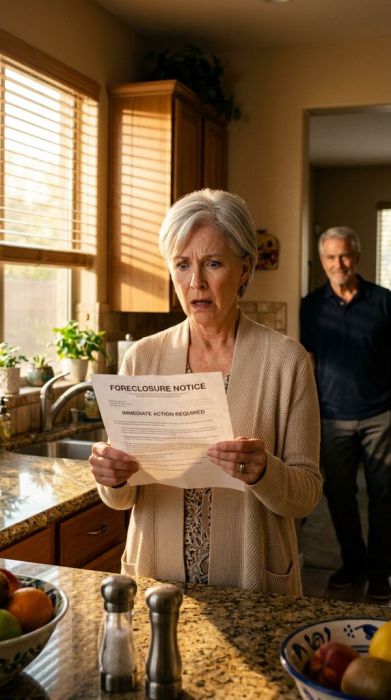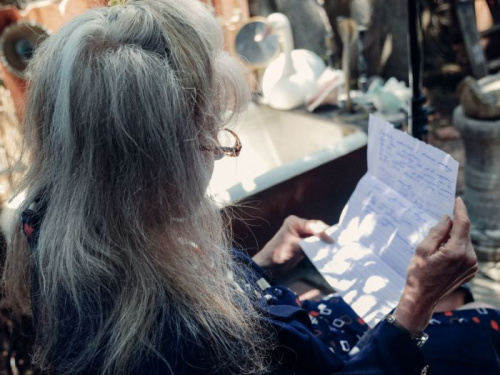
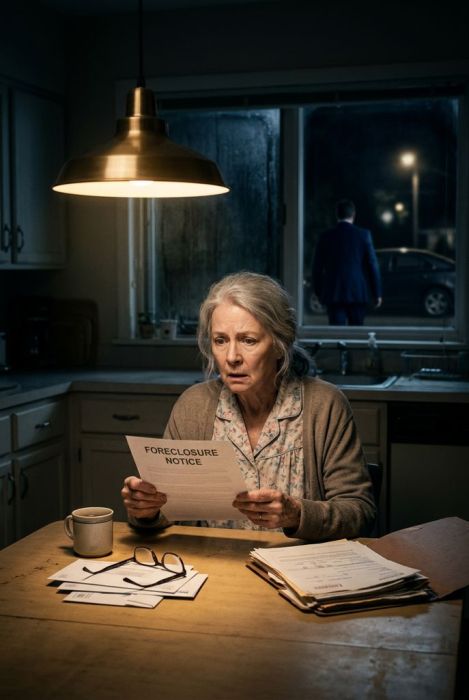
The certified envelope was the color of weak tea, and Marge Delaney almost did not open it. It was a hot September afternoon in Greenville, South Carolina, and she had been kneading dough for the church bake sale, hands dusted with flour, when the mail truck left the thick envelope on her porch. Frank always said never to let certified mail sit. Even so, she ignored it for a day and a half, because Frank had been gone four years now and some habits only hurt to keep. When she finally slid a butter knife under the flap, expecting a coupon book or a notice from the electric co-op, what fell out made the kitchen go silent.
A Notice of Foreclosure Sale, stamped with the seal of the county clerk. Her house on Jasmine Court — the little brick ranch she and Frank had finished paying off in 2008 — was scheduled to be sold on the courthouse steps in twenty-one days. The loan listed against the property was a reverse mortgage. One she had signed eleven months earlier. The signature at the bottom, in careful blue ink, was hers.
She read it three times. The ceiling fan turned, the radio by the window played the same old song, but Marge felt cold in a way the Carolina humidity could not explain. She thought about the nice young man with the laminated badge and the cinnamon donuts from the bakery on Augusta Road. She thought about the woman on the video call, the counselor who had smiled and rushed through her rights in eleven minutes. She thought about the stack of papers she had signed without reading, because the young man had been so patient, so kind, and because Frank had always handled this kind of thing, and because being alone at sixty-seven meant learning a whole new kind of bravery — the bravery to trust someone else with the things you do not understand.
His name was Caleb Whitfield. He had come to her through Phyllis Rankin, her pew-mate at First Methodist, a woman Marge had known for nineteen years. Phyllis had mentioned, over coffee cake after the ten o'clock service, that a wonderful young man had helped her get a reverse mortgage. "It's like the government pays you to stay in your house," Phyllis had said, eyes bright. "You don't make a single payment, and the house stays in your name." She had pressed his card into Marge's hand, the kind of heavy card stock that feels expensive, with a gold embossed line that read: Certified Reverse Mortgage Specialist.
For eight weeks after Frank died, Marge had watched her savings shrink like ice in a tea glass. There were the funeral expenses, the credit card balance Frank had kept from her, the roof repair the insurance company had denied. Her pension covered the bills, barely, but there was nothing left for the leak in the hallway ceiling or the brakes in her Buick. When Caleb Whitfield sat across from her in her own living room, wearing a pressed navy suit and a smile that never quite reached his eyes, he told her exactly what she needed to hear. "You've worked your whole life, Marge. Your house is your nest egg. A reverse mortgage lets you use it without ever leaving it. No payments. No stress. Tax-free cash every month, and when you pass, the house is still your family's — the loan gets settled from the estate." It was a federal program, he said, backed by HUD. And the government required counseling to protect her. "That's how safe this is," he told her. "They make you talk to a counselor first."
The counseling happened over a video call eleven days later. The counselor introduced herself as Ms. Rivera and appeared on the screen with a generic office background and a headset. She asked Marge for her date of birth and her address, then clicked through a slideshow of terms so fast Marge felt dizzy — interest rates, equity, loan-to-value, remaining principal. "You understand that this is a loan, not a sale of your house, correct?" Ms. Rivera asked. Marge said yes. "And you understand you never have to make monthly payments?" Marge said yes again, grateful that she understood at least that much. "Great," Ms. Rivera said, "then we're done — I'll send your certificate to Mr. Whitfield." The call lasted eleven minutes by the clock on Marge's microwave. In real HUD counseling, Marge would later learn, the session is supposed to take at least ninety minutes, and the counselor is never allowed to work for the lender. Nothing about that call was ever supposed to happen that way.
The closing happened at a title company Caleb chose, in a conference room that smelled like lemon furniture polish. There were so many pages. Marge remembers asking, around page nine, whether she should have her daughter look at the papers. Caleb's smile did not waver. "Any time you want, Marge — but Amy's been so busy with her new job in Charlotte, and this mortgage is really about you and your independence. We don't want to worry the kids, right?" That was the line that worked. Marge had spent four years trying not to worry Amy. She signed page after page, hearing the pen scratch against the table, feeling the small thrill of taking care of herself. On page fourteen, there was a paragraph she did not read — a clause, in dense legal print, stating that the loan did not carry federal insurance, that it was a proprietary product offered by a private fund, and that the lender could declare the loan due and payable in full if the borrower failed to maintain the property to the lender's satisfaction.
For the first few months, the money felt like salvation. A thirty-eight-thousand-dollar initial payment appeared in her checking account, and Marge paid off Frank's old balance, replaced the hallway ceiling, and put new tires on the Buick. Monthly checks of eleven hundred dollars arrived like clockwork, and she started sending a small envelope of cash to her granddaughter every birthday, the way she had always wanted to. She told herself she had been so smart, so brave — not like the women who let their fear make decisions for them. Phyllis was right. Caleb was right. She was aging in place with dignity, and she had never felt more in control of her life.
The first crack appeared in February, when a man with a clipboard showed up at her door and said he was there for the annual property inspection. Marge had not scheduled any inspection. The man was polite and took photos of her hallway, her kitchen, her roof from the street. Two weeks later, a letter arrived from the loan company — Fieldstone Equity Services, a name she did not recognize — stating that the inspection revealed deferred maintenance on the property, specifically the roof, and that under section fourteen of her loan agreement she was required to escrow eighteen thousand four hundred dollars for repairs within thirty days. If she failed, the letter warned, the company reserved the right to accelerate the loan. Marge called the number on the letter and got a recording. She called Caleb. His phone went straight to voicemail, and the mailbox was full.
She did what any frightened woman does. She called her daughter. Amy drove down from Charlotte on a Thursday night, found her mother sitting at the kitchen table with the letter in her lap and the radio playing low, and felt her stomach drop. "Mom, I went to school for this," Amy said. She was a paralegal at a firm in Charlotte, and she knew one thing about reverse mortgages for certain: they are supposed to be federally insured HECMs, and they are supposed to be impossible to spring on anyone without real counseling. She pulled up her phone and started reading the loan documents her mother had saved in a brown folder. It did not take long to find the problem.
It was not page one, or page five, or page nine that had destroyed her. It was page fourteen — the clause Marge never read — and the false name at the top of the counseling certificate. The loan was not a HUD-backed HECM at all. It was a proprietary reverse mortgage issued by Fieldstone Equity Services, a privately held fund, and it carried a clause allowing them to call the entire balance due for failure to maintain the property. The four-hundred-thousand-dollar appraisal Caleb arranged had inflated the fees and the interest. The counseling certificate was signed by Ms. Rivera, a name that belonged to a shell company in a strip mall in Spartanburg, three doors down from the title company that had closed the loan. And Caleb Whitfield? His real name was Carl Whitaker, and he had been fined and stripped of his mortgage license in three other states for preying on elderly homeowners with the exact same playbook.
Amy called the South Carolina Attorney General's consumer protection division, and they put her in touch with a senior-scam investigator named Detective Renee Sparks, who had been tracking a string of suspicious reverse mortgages across five counties. Sparks met them at the house on a Tuesday. She photographed the kitchen, the letter, the brown folder, and then she told Marge what would happen next. "We're going to take him down at the church," Sparks said. Caleb had started holding retirement wealth seminars in the fellowship hall of a different church across town, and Phyllis had agreed — reluctantly, in tears — to wear a wire. She had not known, she insisted. She had only shared what a friend had shared with her, and she had taken a four-thousand-dollar referral bonus she believed was simply gratitude.
The seminar was in the fellowship hall of Grace Community Church, a Tuesday evening in early April, folding chairs and coffee urns, thirty-one seniors with their checkbooks in their purses. Caleb was on a stool by the whiteboard, drawing circles and arrows, when Marge walked in on the arm of Detective Sparks. The room went silent. "Hello, Caleb," Marge said, her voice steadier than it had been in months. "I believe you know my daughter. She's the one who read page fourteen." The detective flashed her badge. Phyllis sat in the third row, crying silently into a handkerchief. Two county deputies came through the side door. Caleb — Carl Whitaker — tried to walk out past the coffee urn, and a deputy was already there, hand on his elbow, reading him his rights while the seniors watched in stunned silence. Somewhere in the back row, an old man named Harold lifted his phone and filmed the whole thing.
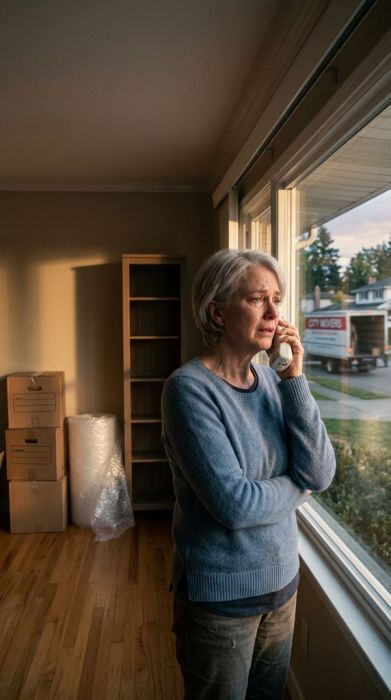
Fieldstone Equity, facing a state investigation and evidence of a fraudulent counseling scheme, quietly released its lien on Marge's house. The foreclosure sale was canceled. Marge got to keep her camellia bushes and her crooked mailbox and the bedroom she had shared with Frank for forty-one years. But she never got back the twelve thousand dollars in fees and closing costs, and she never forgot the sound of the pen scratching across page fourteen, and she never again signed anything with a pen she had not brought herself.
Six months later, at the senior center on Church Street, Marge Delaney stood at a lectern in front of forty chairs and told the story. Not to hold the room, but to hold the truth. When she gets to the end of it, she holds up a photocopy of page fourteen and lets it speak for itself. "I'm not here to scare you," she tells them. "But if that man had been honest, Amy would have read this page before I signed anything. Honest people aren't afraid of a second pair of eyes." Then she passes out her daughter's one-page checklist — choose your own HUD counselor, verify the license number, let a family member read every page — and the room gets very quiet. The quiet does the teaching. Detective Sparks says the operation took more than a million dollars from widows across those five counties. Amy likes to say her mother got off cheap: twelve thousand dollars and a story that could still save someone else's house. Marge says it differently. She says the most dangerous word in a reverse mortgage is proprietary, and the safest word is no. You can always say no. And you should — until a stranger who has nothing to gain from your signature explains every single page.