Walt Brennan was the kind of man who had spent forty-one years doing exactly what he was told. As a branch operations manager at a mid-sized bank in Scottsdale, Arizona, he had balanced ledgers and handled other people's money with a reverence most men reserved for scripture. When he retired at sixty-four, six months after his wife Diane lost her battle with ovarian cancer, he discovered that the silence of a too-quiet house was a far more dangerous thing than any unbalance in a monthly statement.
The dog helped, a scruffy golden retriever mix named Gus that Diane had insisted on rescuing a year before she got sick. Gus slept at the foot of the bed, followed Walt from the kitchen to the living room, and seemed to understand that his human had become a man adrift. On the worst nights, Walt would sit in Diane's chair, the consignment-shop one she had argued over for an hour, and he would talk to her about nothing at all. The house answered him with its usual indifference.
It was on one of those nights, scrolling through job boards on a tablet Diane had bought him for Christmas, that Walt found the listing. "Customer Support Associate — Fully Remote. $28 per hour. Full Benefits. Immediate Start." The company was called Meridian Logistics Group, and its website was clean and professional, with smiling employees and a logo that looked like a stylized wave. Walt had no business applying for jobs—he had a decent pension, a paid-off house, and savings—but he ached for purpose. He ached to be needed. He applied on a whim, the way lonely people do things they would never do when they are happy.
The response came faster than he expected, less than an hour later, in a text message from an unrecognized area code. "Congratulations, Walt! We reviewed your application and we'd love to move forward. I'm Marcus, from Human Resources. You're exactly the kind of experienced professional we need." Walt's chest swelled with a warmth he had not felt in years. He texted back, and Marcus replied almost instantly, praising his decades of banking experience and asking about his hobbies, his dog, his late wife. It felt like making a friend. Marcus remembered that Gus was a golden retriever. Marcus remembered that Diane had loved yellow roses. Nobody had remembered things like that about Walt in a very long time.
The "interview" was not really an interview. It was a series of written questions sent over instant message. Walt answered them earnestly, the way he had answered bank auditors for four decades. By the end of the week he received an official-looking offer letter and instructions to complete an online onboarding form. He was thrilled. He texted his daughter, Rachel, who lived in Denver, and she replied with a single thumbs-up and a message that read, "Dad, are you sure? You're retired." Walt typed back that he was sure, that this was exactly what he needed.
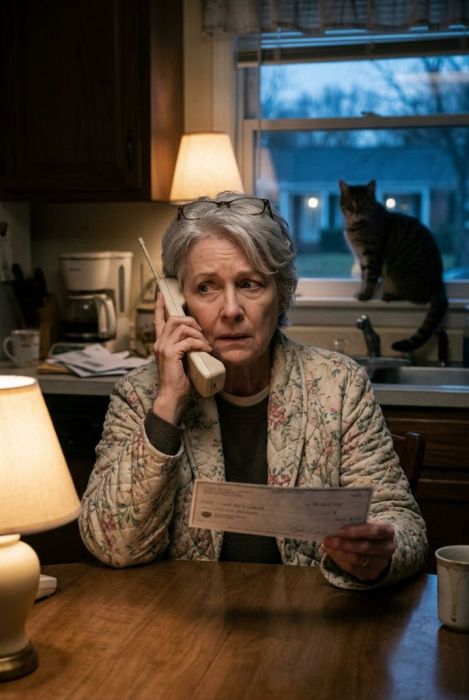
He did not tell Rachel that the onboarding required his Social Security number and his bank routing information, because that seemed normal, like any job's paperwork. He did not tell her that his first assignment was to receive a check and forward the money to a "regional vendor." There was no video call, no phone call, no real human face. Marcus explained that Meridian was expanding rapidly across the Southwest and needed trusted, experienced people to handle client payments quickly. Walt's job was simple: when a client payment arrived, he was to deposit it, keep his small commission, and wire the rest to approved vendors. It was called payment processing, and Marcus assured him it was routine.
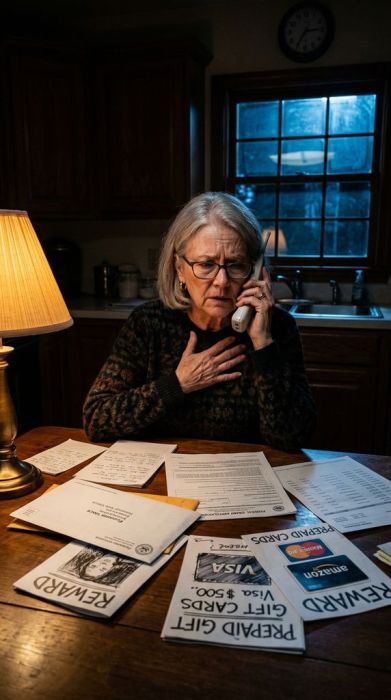
The first check was for four hundred dollars. Walt deposited it, wired out three hundred and fifty, and kept fifty as his processing fee. It felt good to be making money again, to have a purpose, to be part of something. The checks got bigger. Eight hundred. Twelve hundred. Three thousand. With each one Marcus's praise grew warmer. "You're the best hire we've made all year," he would type, and Walt would lean back in his chair feeling ten years younger. One afternoon Marcus asked him to buy three thousand dollars in gift cards from a large retail chain and send photos of the cards, because a client needed to be reimbursed quickly. Walt hesitated for only a moment, then thought about how much he wanted Marcus's approval, and he drove to the store and bought the cards.
When his old colleague Priya, who had taken over his job at the bank, called to ask if his account was doing well, Walt mentioned his new remote job. There was a long pause. "Walt," she said carefully, "be careful. Nobody legitimate asks you to buy gift cards." Walt laughed it off. "Meridian's a real company, Priya. I checked." The truth was, he had not checked anything. The entire relationship—the warmth, the kindness, the friendship—had happened in text messages with a man who always seemed to know exactly what a lonely old man needed to hear.
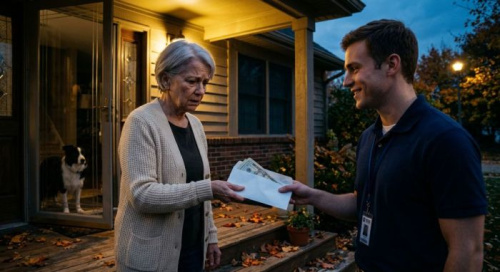
Then came the big one. A payroll advance check for fourteen thousand eight hundred dollars, sent by courier with Meridian's logo across the top. Marcus said a major client had overpaid and needed an immediate wire of eleven thousand dollars to a vendor account, and that Walt's share would be a full fifteen hundred dollars. Walt stared at the check for a long time. Fourteen thousand dollars was more than his monthly retirement income. He thought about it for exactly one evening, then deposited the check, and the next morning he wired eleven thousand dollars to the account Marcus provided. He felt powerful. He felt needed. He felt like a young man again.
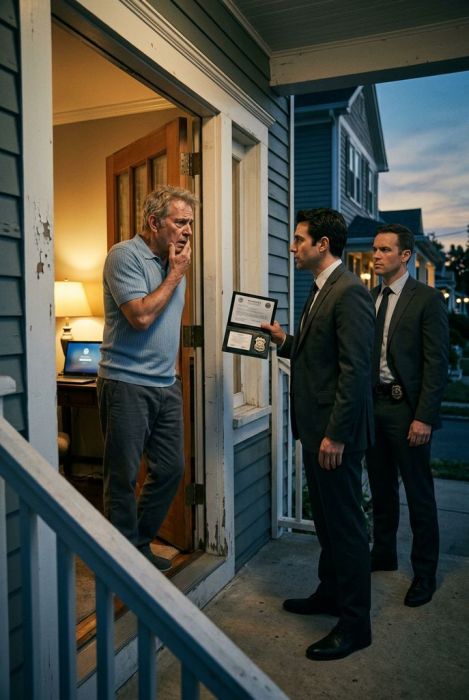
Seventeen days later, everything came apart. Walt was watering the bougainvillea by his front door on a Thursday afternoon when a black SUV pulled into his driveway. Two men in dark suits climbed out, badges clipped to their belts, and a woman in a gray blazer followed. Walt's first thought was that someone had hit his car, or that Rachel had been in an accident. When the lead agent said the words "federal warrant," Walt's knees buckled and he gripped the porch railing to keep from falling.
They told him he was suspected of money laundering and wire fraud. They told him the fourteen-thousand-eight-hundred-dollar check was counterfeit, drawn on a stolen account, and that the eleven thousand dollars had vanished into a network of accounts controlled by a criminal enterprise. They told him he had been receiving stolen funds, moving them at the direction of a fraud ring, and that his name was now on a federal indictment. Walt's hands shook so badly he could barely hold the paper they handed him. He kept saying the same thing over and over. "I didn't know. I didn't take anything. I didn't know."
Over the following weeks his lawyer, a sharp young public defender named Elena Vasquez, walked him through the evidence. There were transcripts of every text between Walt and Marcus, every instruction, every friendly inquiry about his dog and his dead wife. There were records of every check he had deposited, every wire he had sent, every gift card he had bought. It painted a picture of a man who had, perhaps unwittingly, become a cog in a machine that had stolen millions from people across three states. And then Elena showed him the file on Sylvia.
Sylvia Hargrove was a senior processing manager in the Meridian chat, a warm grandmotherly presence who had joined Walt's group in the second week. She had called him her work buddy. She had sent encouraging messages, had told him which tasks to prioritize, had guided him through the confusion of his first large wire transfer. When Walt had told her about Priya's warning, Sylvia had written back sweetly, "Oh sweetie, don't let people scare you. Banks don't understand how fast-growing companies work. You're doing a great job." Walt had trusted her completely.
Sylvia was not a colleague. She was not even a woman. Sylvia was a persona used by one of the ring's senior operators—an account traced to a run-down shared office in Tampa, Florida, where the entire Meridian Logistics Group existed only as a series of prepaid phones and virtual mailboxes. Sylvia's entire purpose was to be the reassuring voice that kept nervous money mules like Walt in line. Every time Walt had almost pulled back, it was Sylvia who talked him into going forward. Walt sat in his lawyer's office, staring at the photograph of a building in Tampa, and understood with sickening clarity that the warmth he had craved had been the weapon used against him.
Elena kept Walt out of prison. Faced with a sixty-four-year-old first-time offender with a spotless record who had been demonstrably deceived, the prosecution agreed to a plea deal for a lesser charge and probation, on the condition that Walt cooperate fully with the investigation. But cooperation meant admitting, on the record, that he had been a fool. It meant the local news picked up the story of the retired bank manager who laundered money for a phantom company. It meant his neighbors, who had waved to him for twenty years, suddenly did not meet his eyes. His pension was safe, but his savings were gone, spent on the lawyer and on restitution for the gift cards.
He lost the trust of his daughter, not because Rachel stopped loving him, but because she could not understand how a man who had spent his whole life guarding other people's money could be so careless with his own. "You taught me to check everything, Dad," she said once, her voice thick, and Walt had no answer, because it was true. The one thing he still had was Gus, who slept at the foot of his bed and followed him from the kitchen to the living room and did not care that his human had been arrested by the FBI.
Months later, Walt sat at his kitchen table with a cup of coffee gone cold, scrolling through job boards again out of a stubborn old habit. This time he knew what to look for. He knew that no legitimate company hires someone through text messages alone, that no employer asks you to receive checks and forward money, that no real job pays you to buy gift cards. He knew that the friendliest voice in the room is sometimes the most dangerous one. He also knew something he had not known before: loneliness makes us vulnerable in ways we never see coming. The scammers had not stolen his money because he was stupid. They had stolen it because he was lonely, and they had figured that out in a single day of careful, patient conversation.
Walt never pressed charges, because there was no one to press them against—the ring had scattered like roaches when the FBI closed in. But every time he told his story, to the fraud-prevention class the court made him attend, to a support group for other victims, to Rachel on a long, healing phone call, he found that the telling made his shame a little lighter. The dog still slept at the foot of his bed. His daughter was slowly coming back to him. And Walt had learned the hardest lesson of his life: that the thing he thought had saved him—the warm voice of a stranger who cared about his dog and his dead wife—was the very thing that had almost destroyed him.