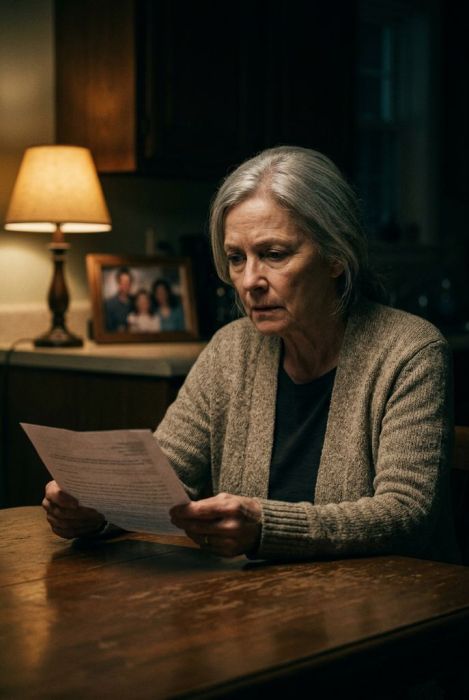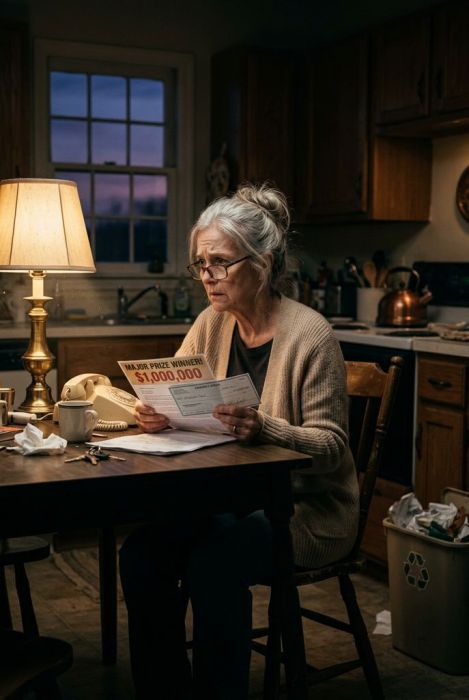
The call came at 4:17 on a Tuesday afternoon, the loneliest hour of the day in the Calloway house. Ruth sat at the kitchen table in Clintonville with a cup of tea going cold beside a stack of medical bills she had read so many times the paper had gone soft at the creases. When her phone rang with a number she did not recognize, she almost let it go to voicemail.
"Good afternoon," the voice said, warm and unhurried. "This is the Federal Grant Assistance Program calling for Mrs. Ruth Calloway. Do I have the pleasure of speaking with the retired second-grade teacher?"
Ruth nearly hung up. Strangers did not call with good news, not in her experience of sixty-seven years. But then the man said her late husband's name, Tom, and the year she retired from Winterset Elementary, and he mentioned, gently, that her daughter Emily had recently been in a hospital out in Dublin. Only family knew that. Only family and a few kind people at St. Mark's Lutheran Church.
"We have some wonderful news," the man said. "You've been approved for a government grant in the amount of fourteen thousand, eight hundred dollars."
Ruth gripped the phone so hard her knuckles went white. That exact number had been living in her head for months. Fourteen thousand, eight hundred dollars was what remained of Emily's surgical bills after the insurance company had stopped covering the treatment her thyroid condition required. Emily, thirty-nine years old, a single mother working the front desk at a dental office, had cried on the phone the night the second collection letter arrived. Ruth had promised her, the way mothers do, that somehow they would figure it out.
The man on the phone introduced himself as Daniel Reeves, a program officer with something he called the United States Grant Assistance Program. He spoke for fifteen minutes about a federal initiative meant to support retired educators and their families. He knew that Tom had been a CPA, that Tom had passed away six years ago, that Ruth lived alone now with a garden she could not keep up with anymore. He knew about Lucas, her ten-year-old grandson, and his upcoming science fair.
"How do you know all of this?" Ruth asked, her voice thin.
"We're a federal program, ma'am," Daniel said smoothly. "We're thorough. We match applications against public records, employment history, state pension rolls. Everything you're telling me checks out, which is why you've been selected."
Ruth wanted to believe him. That was the part that would haunt her later. She wanted to believe that a stranger cared, that some benevolent agency had looked at her family's wreckage and decided to send help. She told Daniel she would think about it and call back. Then she hung up, and for the first time in six years, she allowed herself to feel a small, foolish bloom of hope.
She mentioned it at church that Sunday. Not to everyone, just to a couple of women in the fellowship hall, because it felt like bragging about a miracle and she was afraid to jinx it. Walter Briggs was standing nearby, pouring coffee, and he heard her. Walter was seventy-one, a retired warehouse supervisor who survived on a modest pension that had been eaten thin by his wife Doris's long illness before she passed. He volunteered three mornings a week driving elderly members to appointments, and everyone at St. Mark's considered him the gentlest soul in the congregation.
"Ruthie," Walter said, setting down the coffee pot, "you should call them back. I know it sounds too good to be true. My Doris got a grant like that back in 2011 for her prescriptions, and I swear it kept us afloat for a year. Government programs don't advertise, that's the thing. They just call people."
Ruth felt her shoulders relax. A real person, someone she trusted, had just confirmed her hopes. She decided to make the call.
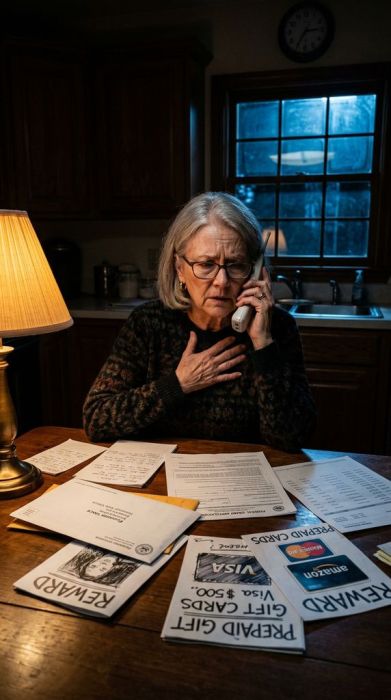
Daniel Reeves answered on the second ring, as if he had been waiting by the phone. The certification process, he explained, required a small processing fee of two hundred and forty-nine dollars, payable by gift card because the program's payment portal was undergoing a routine security update. Ruth hesitated. She had read enough news stories to know that legitimate organizations did not ask for gift cards. But Daniel anticipated exactly that objection.
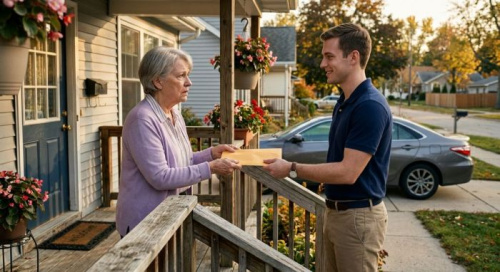
"I understand your hesitation completely," he said, sounding almost hurt. "That's why we send every approved applicant a confirmation packet. You'll receive an official letter, a certificate of enrollment, and your personal grant coordinator's contact information." The letter arrived two days later in a crisp white envelope with a gold seal printed on it. It had her full legal name, her address, even her Ohio teacher retirement ID number. It looked exactly like the government mail she remembered from decades of tax refunds and pension statements.
So Ruth bought the gift cards. She walked into the Target on High Street, bought two cards of one hundred and fifty dollars, and read the numbers over the phone to a cheerful young woman who introduced herself as Daniel's assistant, Karen. She felt a flicker of embarrassment doing it, standing in the checkout line with her reading glasses on, but the voice on the phone was so warm, so patient, that she told herself she was being old-fashioned.
The second fee came five days later. A tax certification charge of three hundred and seventy-five dollars, because grant disbursements over ten thousand dollars required an IRS clearance document. Then a federal insurance bond of five hundred and twenty dollars to protect the transfer. Then an account activation fee of one thousand two hundred dollars, because the grant would be routed through a "secured federal depository." Every fee was presented the same way, with the same calm certainty, and every fee was followed by a new promise: this was the final one, the grant would release within seventy-two hours.
Ruth stopped mentioning the calls to her daughter. Emily would have seen the pattern immediately, but Emily was exhausted, working double shifts and picking Lucas up from aftercare, and Ruth did not want to worry her. So she drove to the Chase branch on North High Street and withdrew careful amounts of cash, telling the teller, a young woman named Marisol, that she was paying for home repairs. Marisol smiled and asked if Ruth felt comfortable with the amount. Ruth said yes. She told herself it was true.
The money was going somewhere real, she reasoned. Walter Briggs had said the program was real. And every time she felt doubt creeping in, Daniel said something kind, something personal, something that told her he saw her as a person and not a transaction. Once, when she mentioned she had been feeling dizzy, he prayed with her over the phone. A complete stranger, praying for her. She cried a little and told herself that no fraudster would ever do that.
The final requirement came on a Thursday afternoon, six weeks after the first call. The grant amount had grown, Daniel explained, because of accumulated interest in the federal depository: eighteen thousand three hundred dollars. But before disbursement, Ruth needed to complete the "direct deposit enrollment." That required her checking account number, her routing number, and a verification code that would be texted to her phone as a standard security measure.
"Read me the code, Mrs. Calloway, and your account will be linked, and the funds will arrive by tomorrow morning."
Ruth wrote down her account numbers on a scrap of paper without really thinking. She read them aloud carefully, the way she had read spelling words to generations of second graders. Then she read him the six-digit code that arrived in her text messages. Daniel thanked her warmly and told her to have a blessed evening.
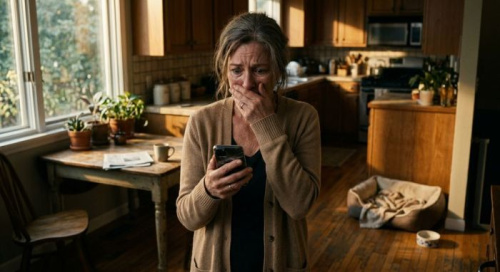
The money did not arrive Friday morning. Ruth checked her phone at the kitchen table, tapping the bank app with a shaking finger, and found that her checking account balance had dropped by six thousand four hundred dollars, transferred out in three outgoing Zelle payments to accounts she had never seen. Her phone buzzed with a fraud alert from the bank, too late to stop anything.
She sat there in the silence, staring at the number, and felt the whole year collapse inside her. The hope, the miracle, the kind voice that had prayed with her, all of it had been a machine built to take what she had. She called Daniel's number and it was disconnected. She called Karen's number and it was disconnected. The crisp white envelope with the gold seal sat on her table, and the website printed on it, usgapprograms.org, now returned a blank white page.
Emily came over that night, summoned by a voicemail so broken she had assumed her mother had fallen. Ruth told her everything, sitting at the same kitchen table, and Emily did not scream. She held her mother's hand while Ruth wept into her sleeve, and then she called the police.
Detective Sarah Okafor from the Columbus Division of Police financial crimes unit took the report with the quiet patience of someone who had seen this exact story forty times that year. The gift card purchases, the wire-style Zelle transfers, the disappearing website, the voice that knew every private detail of a family's life. It was textbook, she said, except for one thing. Most victims never knew how the scammers had learned so much about them. Ruth knew, because she had told only one person about the call before it ever began.
The detectives pulled the registrations for usgapprograms.org. The domain had been purchased with a prepaid debit card two years earlier, but the reset email on the account was [email protected]. The phone numbers Ruth had called were prepaid burners, activated at a store in Dayton where, records showed, a man matching Walter Briggs's description had redeemed a series of gift card withdrawals matching Ruth's payments almost to the dollar. Detective Okafor did not need a warrant to see the pattern. She asked Ruth if she wanted to be present when Walter was brought in.
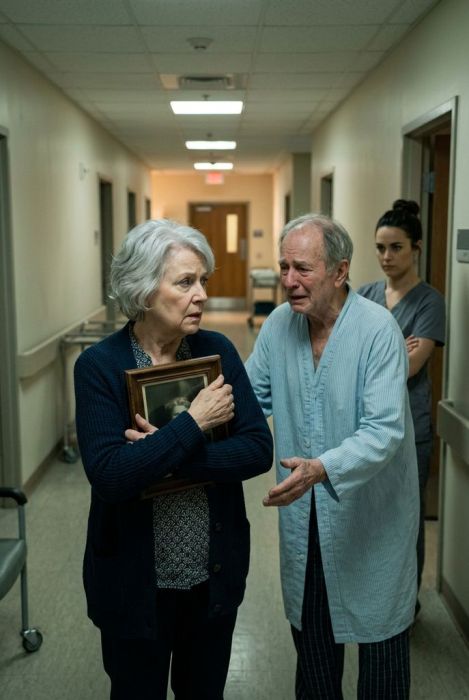
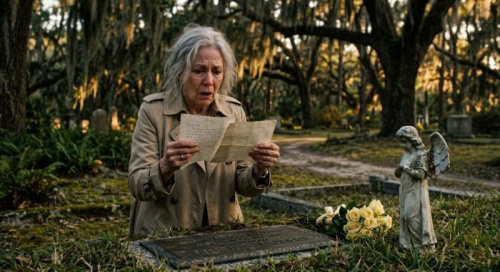
The confrontation happened in the fellowship hall at St. Mark's, among the folding chairs and the smell of old coffee. Ruth stood across from the man who had poured her coffee every Sunday for four years, the man who had driven her to her husband's grave on anniversaries she could not face alone. Walter's face crumpled before the detective even finished speaking.
"I lost everything when Doris died," he whispered. "The medical bills ate the pension. Then a bad land investment ate the rest. I didn't mean for it to go this far. I just saw that you had savings, Ruth, and I told myself you could spare it, and once it started, the only way out was to keep going."
Ruth listened to him cry into his hands, and she felt something harder than anger settle in her chest. She thought about the six thousand four hundred dollar transfer, the gift cards, the prayer he had let her believe was genuine. She thought about Emily's bills, still unpaid because the miracle had evaporated. She did not scream at him. She simply said, "You prayed with me, Walter. You prayed with me while you were stealing from me," and then she walked out into the cold October air.
Walter Briggs was charged with theft from an elderly person, a felony in Ohio, and pleaded guilty to a reduced count rather than put the congregation through a trial. The judge ordered restitution, which meant Ruth received forty dollars a month for the rest of her life, a figure so absurd it made her laugh the first time she read it. The bank recovered a small fraction of the transfer from two of the receiving accounts before they were drained. The gift cards were gone forever. That was the arithmetic of the whole cruel machine: fourteen thousand three hundred dollars lost, roughly four hundred of it returned.
The deepest loss was harder to count. Ruth found herself checking her phone at odd hours, listening to the silence where Daniel's warm voice used to be. She caught herself studying the faces of friendly strangers and wondering what they wanted. Emily moved her and Lucas into a smaller apartment just so Ruth would not have to sit alone at that table anymore. Slowly, painfully, they found a new rhythm. They argued about money the way families do, and then they made spaghetti and watched Lucas's science fair video, and Ruth understood that her daughter had never needed the grant in the first place. She had needed her mother to stop carrying the weight alone.
Six months later, Ruth started a Tuesday morning group at the senior center. She called it the Morning Coffee Club, and she invited anyone who had received a strange call to come talk about it before they acted on it. She kept a folder on the table filled with printouts: a real federal grant application costs nothing, real government agencies never ask for gift cards or wire transfers, no legitimate program will ever ask for your banking code or a code texted to your phone. She told the story of the gold seal and the prayer, not to shame herself but because she had learned that shame was exactly what the scammers counted on.
"Here's the test I use now," Ruth told the group, pouring coffee the way Walter used to. "If a stranger needs me to keep a secret from my family to receive help, it is not help. Real help doesn't ask you to hide it."
The group grew to forty regulars. Some of them had almost paid, some had paid and were too ashamed to admit it until Ruth told them how much she had lost. One woman drove in from Westerville because her caller had claimed to be from the same "federal depository." Ruth sat with her for an hour, holding her hand, and showed her the folder.
The awareness did not come from a lecture. It came from a paper trail of gift card receipts and a crumpled prayer and a sixty-seven-year-old woman who had to learn, in the most expensive way possible, that the warmth of a stranger's voice was not proof of his goodness. The real federal government never called to offer Ruth Calloway a miracle. But every Tuesday morning, she made sure that someone who had been called by a liar could sit across from her at a folding table and hear the truth out loud, in a room full of people who had nearly believed it too.
That is what the scammers never counted on, Ruth would say. They banked on her being too embarrassed to tell anyone. They were wrong. And every time she told the story, a little more of the power they had taken from her came back, one coffee cup at a time.