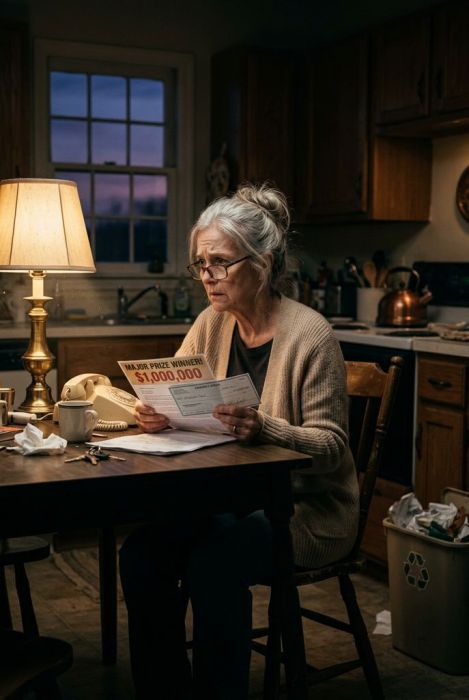
The envelope was the color of a promise. Dottie Callahan noticed it the moment she pulled the mail from the box, because nothing else in the Tuesday stack glittered like that. Gold, embossed, with her name written in a script so elegant it looked like a wedding invitation. Inside, a letter on thick paper announced that Dorothy R. Callahan had been selected as the second-place winner of the National Prize Bureau's annual sweepstakes, with a prize of two million five hundred thousand dollars. She had, according to the letter, been entered automatically through her years of loyal participation in charitable giving.
Dottie read it twice on the porch, and the words didn't change. She laughed a little, the way she laughed at her own reflection in the hallway mirror these days — a polite, hollow sound that had become her companion since Frank died three years ago. Frank would have called it junk mail before the screen door finished closing behind him. Dottie wasn't so sure. She had given to the Children's Leukemia Fund. She had bought magazine subscriptions, responded to a mailing from the Disabled Veterans Alliance, sent ten dollars to a panther rescue in Florida. None of them had ever written back to tell her she was special. Not like this.
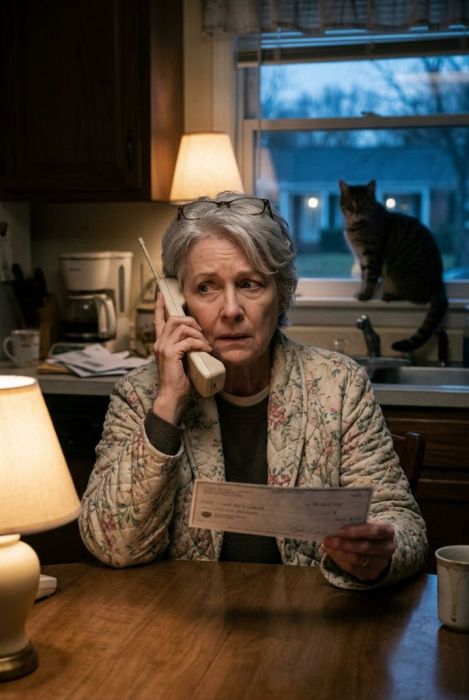
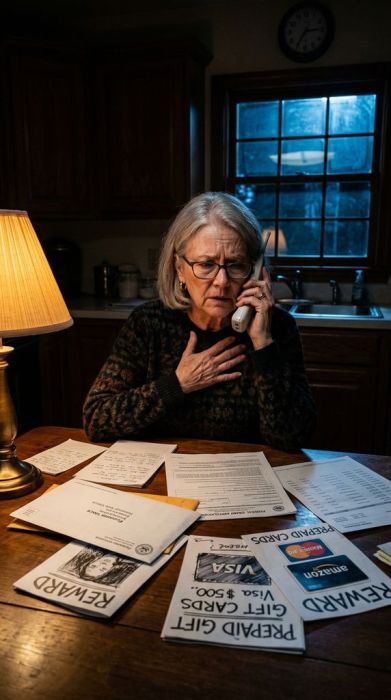
The check sealed it. A small, provisional check made out to Dorothy R. Callahan for nine thousand eight hundred fifty dollars, described in the letter as her "advance congratulations payment," issued to confirm both eligibility and good standing before final processing. The letter explained, in patient, numbered paragraphs, that before the full prize could be released, federal transfer protocols required her to remit a one-time processing fee of one thousand eight hundred fifty dollars. The check was proof, they said, that the Bureau honored its commitments. Her name was on it. Her address was on it. It looked exactly like the payroll checks Frank used to bring home from the mill.
Dottie stared at that check for a long time. She turned it over and found a phone number printed on the back in that same elegant script, with a note that a live claims agent was available Monday through Friday, nine to five, Eastern Standard Time. She didn't call right away. She put the envelope in the drawer of her nightstand and tried to forget about it, the way she tried to forget about the empty side of the bed. But the envelope was a warm, golden weight in her mind, and on Wednesday morning, after her coffee, she called the number. Because the check had to be deposited before the offer expired, and she didn't want to lose nine thousand dollars over laziness.
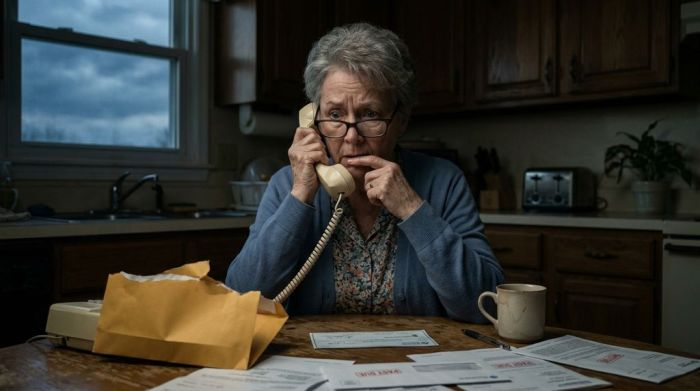
A man answered on the second ring. Marcus Webb, claims administrator. His voice was warm and unhurried, the voice of a man who had all the time in the world and chose to spend it on her. He congratulated her as though she had just won an Olympic medal. He walked her through the paperwork, praised her for being a careful woman who asked questions, and gently explained that the processing fee had to be wired before the Bureau's fiscal year closed on Friday. "It's just a formality, Mrs. Callahan," he said. "Every state lottery does the same thing. The fee isn't profit. It's protocol."
She asked him if this was a scam. He laughed, not unkindly, the way a patient teacher laughs at a good question from a favorite student. "That's exactly the right question, and I'm glad you asked it," he said. "Real winners ask. The people who get burned are the ones who send money and never ask a single question." He told her to verify him, proudly, even, like a man with nothing to hide. And she did. The National Prize Bureau had a website with photographs of past winners holding oversized checks, testimonials with full names and hometowns, a Better Business Bureau badge her daughter had once told her to look for. The website looked real. So Dottie went to her bank and wired the fee, and the young teller with kind eyes, a girl named Maribel, asked her — twice — if she was absolutely sure. Dottie said she was.
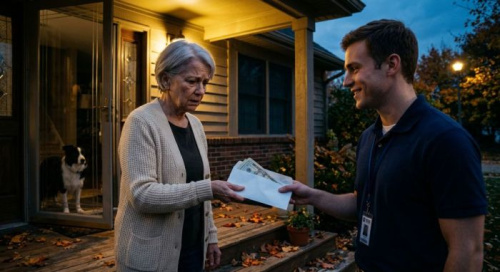
Over the next three weeks, the process continued to feel official. There were more forms, more phone calls, more fees: a federal insurance bond of six thousand seven hundred fifty dollars, a courier fee of nine hundred dollars to deliver the certified check, a notarization requirement that produced more paperwork than her mortgage had. Each time Dottie hesitated, Marcus Webb had an explanation, and each explanation was patient and polite and laced with that particular gentle disappointment that made her feel like a fool for doubting. He remembered small things. He asked about her garden, about the cardinal that nested in her magnolia tree. He told her he had lost his own father and understood how hard it was to manage alone. Her daughter Rachel, a labor and delivery nurse in Charlotte, called every Sunday, and Dottie stopped mentioning the money. She didn't want Rachel to worry. She didn't want Rachel to be right.
The first time she saw the word "fraud" on paper, it was a bank statement. The Bank of Cary had flagged one of the wire transfers, and by the time the branch manager, a tall, worried man named Mr. Osei, sat her down in his office, Dottie had already sent nearly twenty-four thousand dollars. Mr. Osei didn't raise his voice. He showed her the deposit timeline for her nine-thousand-dollar check — the check that had bounced, because the account it was drawn on had been opened forty-one days earlier and closed eleven days later. "This office gets calls like this every month, Mrs. Callahan," he said softly. "Most people are too ashamed to come in. That's what they're counting on." Dottie nodded, and smiled her bright, hollow smile, and walked out of the bank feeling like she weighed three hundred pounds.
She drove home in a fog and sat in the dark living room, and she did not allow herself to cry, because crying would mean it was real. The golden envelope sat on the coffee table, glittering at her like an accusation. Frank's face floated in her memory, the way he would look at her across the dinner table when she bought something foolish — not angry, just disappointed in that quiet way of his. She had been strong for so long. She had paid the mortgage alone, changed the furnace filter alone, learned to sleep alone. And now, in one stupid month, she had handed a stranger more money than Frank had saved in his final five years of double shifts.
And that was when the second call came.
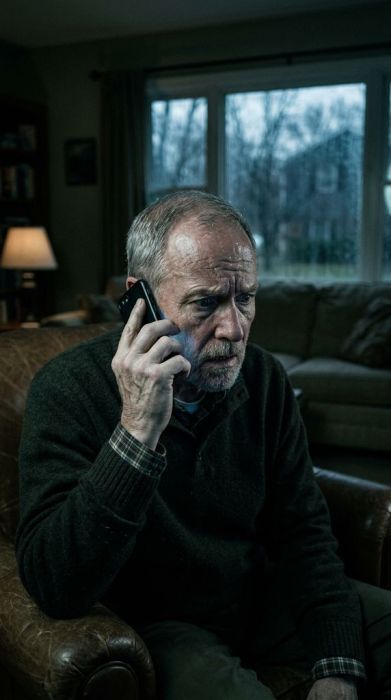
A woman this time, crisp and businesslike, identifying herself as Agent Colleen Reyes of the Federal Prize Protection Unit. Her voice had the clipped, official cadence of true authority, and she told Dottie, in tones of grave concern, that an internal audit had flagged irregular disbursements in the Bureau's processing records. "Mrs. Callahan, you've been scammed," the agent said. "And we have a narrow window to claw the money back before these people vanish with it." Dottie clutched the phone, her hand shaking. "I knew it," she whispered. "I knew it, I knew it." She had told no one, not even Rachel. The shame had been too heavy. But now a federal agent was on the phone, telling her she was a victim, not a fool. It was the kindest thing anyone had said to her in years.
Agent Reyes explained that the Protection Unit had frozen the Bureau's assets pending investigation, but that existing claims had to be moved into a federally protected trust account within seventy-two hours or they would be liquidated. Moving the funds required a verification deposit — a filing fee of four thousand nine hundred dollars, fully refundable at the conclusion of the audit. She gave Dottie a case number. She gave her a confirmation line to call, which connected to a recorded message announcing that all authorized personnel were presently assisting other victims. Dottie called it three times. The recording was identical every time, and somehow that made it feel more real, not less. She drove to the bank in the rain and moved her savings out of the certificates of deposit Frank had started forty years ago. Forty-eight thousand dollars, gone into the "protected trust."
Rachel came home that weekend for her mother's sixty-ninth birthday. She found Dottie on the porch, on the phone, with a stack of bank envelopes in her lap. Rachel was a nurse, trained to read the signs of trauma in a person's body long before the words came out, and her mother's voice — bright and brittle as old glass — told her everything. "Mom, who are you talking to?" Rachel asked. "The federal protection unit," Dottie said cheerfully. "They're helping me get the money back." Rachel took the phone from her mother's hand, the way you take a steak knife from a toddler, and Dottie began to cry. Not the polite laugh-cry of the porch. A real cry, from a place that had not been touched since the funeral. And through her tears, Rachel heard the man on the other end of the line, the so-called federal agent, patiently explaining that if they hung up now, the case would close and every dollar would be lost forever.
Rachel ended the call and dialed the Cary Police Department.
Detective Ana Beltrán was a woman who had seen it all and forgotten nothing. She listened to Rachel, then to Dottie, with the patience of someone who knew that shame was the scammer's best accomplice, sharpening the knife while the victim sharpened their own silence. The numbers didn't take long to connect. Beltrán traced the wires, and found that the claims administrator and the federal agent had routed every payment through a single third-party processor in Nevada. When the subpoena came back, the accounts carried a name that made Dottie's teacup rattle against its saucer: Marcus Hale.
Marcus Hale. The young man with the easy smile who had given the free seminar at her church last spring, standing at the front of the fellowship hall in a crisp blue suit with a slideshow about protecting retirement savings from exactly the kind of predators everyone was afraid of. He had signed Dottie's name on his sign-in sheet himself, touched her hand, called her ma'am in that warm, unhurried voice. Marcus Webb and Agent Colleen Reyes were both Marcus Hale — two manufactured voices, one real criminal. He had been scouting senior centers, churches, and community halls for two years before he ever mailed a single golden envelope, collecting the faces and names and weaknesses of his future victims in a neatly labeled client list.
The climax came on the third Tuesday in October, in a rented conference room that smelled of lemon air freshener. Beltrán's team had set it up as a recovery office, and Dottie, wired with a recording device, sat across the table from Marcus Hale while he reached for her bank bag with the same patient smile she had heard on the phone a hundred times. Her voice was steady when she asked him, "Do you remember my husband's name, Marcus?" He blinked at her, confused. "Do you remember anything I told you, or just the numbers?" And when he looked up and saw the detectives filling the doorway, Dottie was already crying — but this time the tears were hers, not his. Marcus Hale had a rap sheet stretching back fifteen years across three states, and a parole violation older than the magnolia tree in her yard. The arraignment made the local news.
It took eleven months to recover a small fraction of her money. The bank's fraud unit returned some of the wired amounts; restitution hearings returned the rest, in thin payments that arrived quarterly and felt almost insulting. When the first restitution check came, Dottie didn't cash it. She framed it in a shadow box on her living room wall, right next to the golden envelope — a reminder of the difference between the promise and the price. Then she went to work.
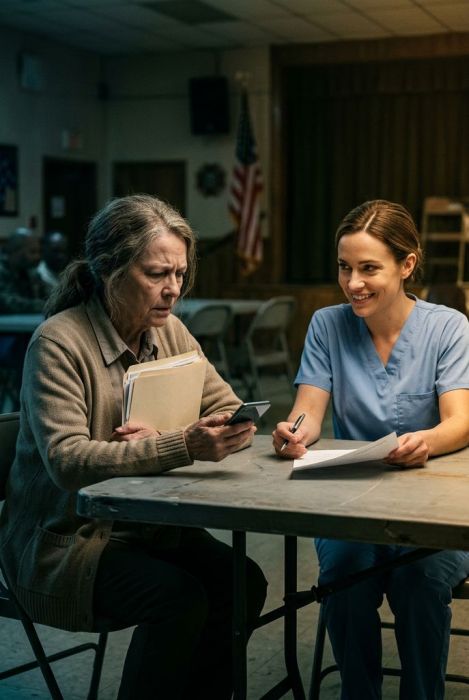
The church gave her the fellowship hall on Thursday nights. The senior center gave her a microphone. She stood exactly where Marcus Hale had stood, in a blue suit that was hers, and told them, in her bright, brittle voice, about a golden envelope that arrived on a Tuesday. She taught them the questions to ask, the numbers to skip, the sound of a voice that is too patient with your doubt. Kind words were not proof of safety, she told them. Official-looking mail could come from a rented room. Legitimate lotteries never ask you to pay to collect your winnings. And the people who love you will always be harder to fool — if you let them in.
Rachel sat in the back row of every class. And when Dottie finished her talk and the room filled with applause and trembling questions and clasped hands, Rachel saw her mother stand a little straighter. Not because the money came back. It didn't, not all of it. But because Dottie Callahan had stopped being a victim and started being a warning. Somewhere tonight, another golden envelope is sliding into another mailbox, glittering like a promise. But the woman who used to believe in them is the one teaching everyone else how to see them coming.