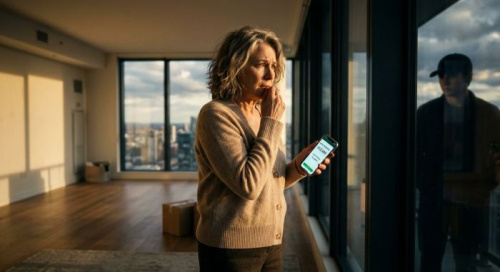
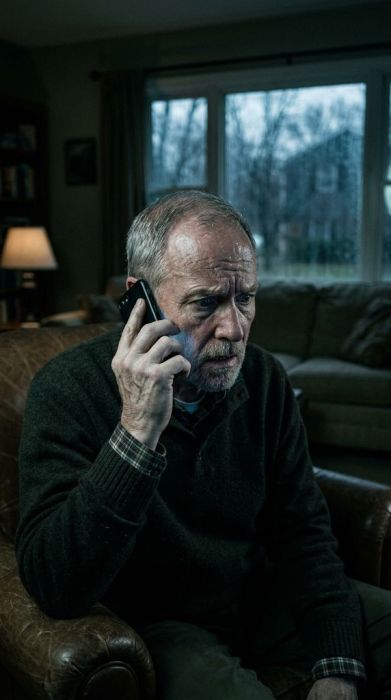
The call came at 1:47 on a rainy Thursday afternoon, on a phone Arthur Boone had owned for nine years and rarely heard ring twice in a week. No caller ID. Just an out-of-state number and a breath of open air on the line, like a microphone waiting. Arthur almost didn't answer. He was sixty-seven, a retired electrician from Dublin, Ohio, and he had learned long ago that an unknown number was usually one of two things: a wrong number, or somebody trying to sell him a roof he didn't need.
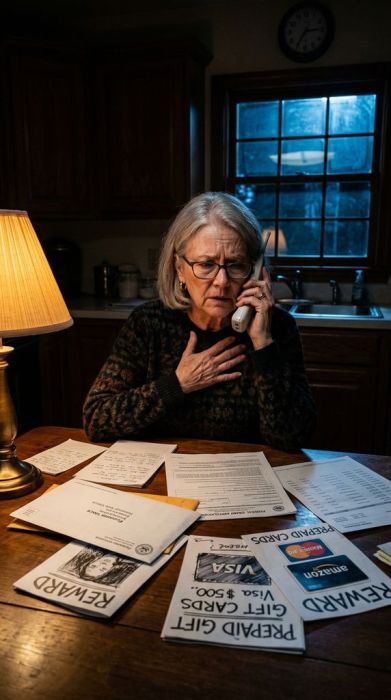
The voice that spoke was calm, almost polite, the way men sound when they are about to tell you something you cannot take back. "Arthur Boone," the man said, using his full name, the way a bill collector does. "We have your daughter. Do not hang up. Do not call the police. Listen." There was a click, and a recording began to play. Megan's voice, high and breaking, the way it had sounded when she was eight and scraped her knee at the county fair. "Dad. Dad, they have me. Please, Dad, please help me. They're going to hurt me." Arthur's knees gave out. He sat down hard on the arm of the couch, and the phone shook in his hand.
For a long moment he could not breathe. He could not move. The man came back on the line with the flat efficiency of someone reading a script he had read a hundred times. "You have ninety minutes, Arthur. Twenty-eight thousand dollars. Half cash, half crypto. Or we make this permanent. Your granddaughter Sophie is very pretty, Arthur. We know where she goes to school." Then the hum returned, and Arthur understood that the man was waiting, patient, the way a spider waits.
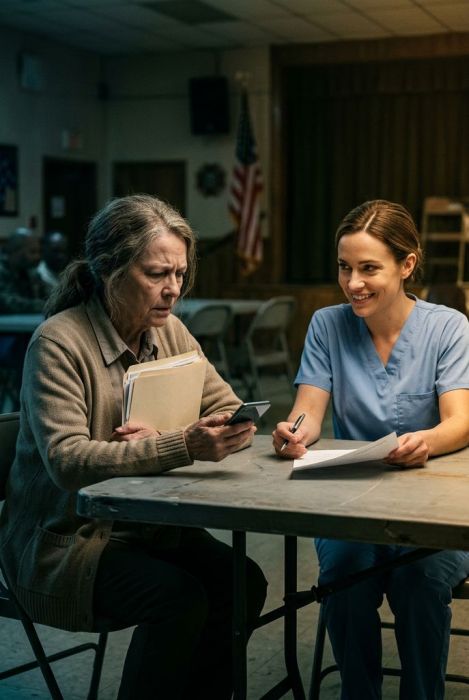
The story Arthur tells now, at the front of a senior center with a PowerPoint he cannot quite operate, is about everything he almost did in the next two hours. It is not a comfortable story. It has no heroes, except maybe a mall security guard, a patient detective, and a third-grade teacher who answered her phone on the second ring. But it is a real story, and it is a common one, and that is the whole reason he tells it at all.
Carol came in from the grocery store twenty minutes later and found him sitting in the dark of the living room with the blinds drawn and the phone white-knuckled in his fist. He told her everything in a voice he did not recognize as his own. She dropped the bag of groceries on the floor and did not pick it up. For a while they just held each other, two people trying to be brave in a room that suddenly felt very small. "We have to call the police," she said, and Arthur shook his head. "He said he'd hurt her. He knows her name. He knows Sophie's name. Carol, how does a stranger know Sophie's name?" She had no answer. Terror does not think. Terror only runs.
Arthur had a rule, one he had drilled into his kids and later into his grandkids, back when rules felt like something a father could actually control. If a stranger ever calls and says they have your family, you ask for the word. It started when Megan was a teenager, a simple agreement between father and daughter, the word being "maple," because of the tree in the backyard where she used to sit and read on summer evenings. Carol had laughed at him for it, called it overprotective nonsense, but Arthur believed in simple systems that worked. You ask for the word. If they don't have it, they don't have your daughter. He never expected to need it. He had never once, in twenty-five years, had to ask another man for the word.
He did not ask for it that afternoon. The man offered to play the recording again, and Arthur, desperate, said yes.
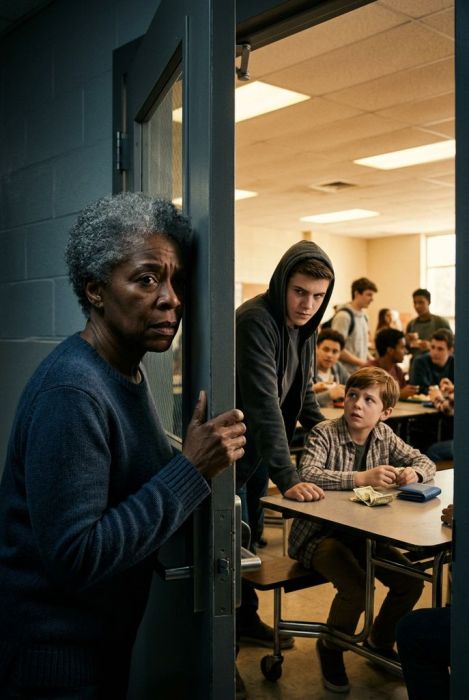
The second time, he listened with his eyes closed and his mind on fire, and something in his chest went cold. The screaming was wrong. Not the words — the words were Megan's, no question, the exact cadence of her voice when she panicked, the way she dragged the word "please" into two syllables. But the sound was too clean. No room echo. No background noise. No hum of a car, no wind, nothing but a voice floating in a void, the way a voice sounds when it has been polished on a computer and laid over silence. Carol heard it too and whispered, "That's not where she is. She'd be at school. There'd be hallway noise. There'd be kids." Arthur called the school.
The phone rang six times. Seven. On the eighth, the secretary answered, put him on hold, and Arthur stood in the kitchen with the refrigerator humming and his entire life hanging on whether a third-grade teacher in Dublin, Ohio, had walked into her afternoon art block. Then the man's voice cut back in — the scammer had stayed on the other line, listening. "You're wasting time, Arthur. Every time you doubt me, I add ten thousand to the price." Arthur hung up on the school and called the number back.
The Bitcoin ATM was inside the Meijer on Sawmill Road, which is where the man told him to go, in a tone that suggested he had driven this exact route with other fathers before. Arthur had never bought bitcoin in his life. He had read about it in the newspaper and decided it was either the future or a racket, and at his age he did not have time to find out which. Now he stood in front of a glowing machine with a QR code on the screen, trying to remember his own bank PIN, while a voice in his pocket told him every forty seconds that his daughter was dying.
He told Carol to stay home, because the man said the house was watched, and Arthur believed him, because when you are drowning in fear you will believe anything that keeps your family alive. He drove the nine miles at thirty-five miles an hour, hands locked on the wheel, the phone on speaker, the man's voice filling the car like a second passenger. "You're doing good, Arthur. The ATM will take the cash first. Then the QR code. Then we send her home." The phone buzzed with a text: a photograph of the outside of Megan's school, pulled from Google Maps, with a red circle drawn around the front door. Arthur glanced at it and nearly drove off the road.
He got to nine thousand eight hundred dollars, which was the daily limit, and the machine kept spitting the bills back because his hands were shaking too hard to feed them straight. A security guard named Ray — a retired cop in his sixties, eleven years working the same parking lot — walked over and asked if Arthur was all right. Arthur, through gritted teeth, said he was buying a gift. Ray looked at the ATM, looked at the phone, looked at the tears on a sixty-seven-year-old man's face, and said the words that probably saved the Boone family: "Sir, that is a scam."
The phone buzzed immediately, as if the man could see them, and for one terrible moment Arthur believed he could. "We see you with the guard, Arthur. Finish the transaction or we finish her." Arthur looked across the parking lot, sweating, and saw a black sedan with tinted windows idling two rows over, and his stomach dropped. It was the man. It had to be the man. He moved toward the Meijer doors, heart slamming, and Ray's hand closed on his arm — gently, the way you hold a man who is about to walk into traffic.
And then Arthur's phone rang, and the caller ID belonged to his daughter.
"Megan?" he said, and his voice cracked like a boy's. "Megan, where are you?" There was a long pause, and Megan said, "Dad, I'm at school. The kids just finished their art projects. Why are you calling me crying?" Arthur sat down on the curb in the parking lot with the phone pressed to his ear and the afternoon sun burning his face, and he could not find the words, because the words were: your voice just begged me to save you, and I almost paid a stranger nine thousand dollars to rescue you from a man who has never held you.
Megan was not just safe. She had been safe the entire time — thirty-two miles away, standing at a whiteboard with a marker in her hand and a classroom full of nine-year-olds making paper turkeys, unaware that her father was simultaneously emptying his bank account to a ghost. The detective who took the case, a patient woman named Lena Ortiz, laid it out while Arthur sat in the back of the mall's security office with a bottle of water he could not open. "Virtual kidnapping," she said. "One of the oldest tricks we see, and it's getting worse. They don't need to take your daughter. They just need you to believe they took her."
She held up a printout of a TikTok video. Sophie, thirteen, had posted it the month before — footage from the school talent show, where Megan, flushed and laughing, had sung "Take Me Home, Country Roads" into the gymnasium microphone for two minutes and fourteen seconds. Fifty-eight seconds of that clip was clean, clear, usable audio of Megan Boone's voice. Arthur had watched that video a dozen times, smiling at his granddaughter's editing, never understanding what he was watching. "This is all they need now," Ortiz said. "There are programs that take a minute of someone's voice and make them say anything. Your daughter never said a word on that call. The screams, the begging — all of it was built from a talent show."
Arthur refused to hang up. That was the part of the afternoon he is proudest of. He sat in the security office with the scammer still on the line — a man now almost bored, reading his script like a telemarketer — and Arthur, following Ortiz's instructions, told him the money was going through, gave him a wrong wallet address, asked him questions to keep him talking long enough to trace numbers and sub-numbers and servers, all the way to a rented office in a Florida strip mall where eleven men answered phones for a living. The recording of that final conversation is why the operation fell. Arthur, calm for the first time in two hours, asked the scammer one question. "What's the word?" Silence. Then: "What word?" And Arthur, who had his daughter on the line, alive, said the only thing that made sense: "The one you'd know if you really had her."
The call center fell two weeks later. Ortiz called on a Tuesday night to say they had arrested eight people and were looking for three more. On the desk of the man who had called Arthur — a twenty-four-year-old who had run scripts from that office for nearly a year — police had found a list. Sixty-one names. Arthur Boone was near the top, with notes in neat handwriting: "Retired electrician. Daughter Megan, teacher. Three grandkids, one posts TikTok. Paid fast." Below Arthur's name sat fifty-nine other families, some of them already wired away their retirements. Below all of them, written in the same neat hand, was a name the detective read twice before she understood it: the scammer's own grandmother, listed as a future target, because nobody on that floor was clean.
The Boones put a laminated card on the refrigerator that fall. In Carol's handwriting, three lines: Ask for the word. Hang up and call the real number. Never pay a man who tells you not to tell anyone. Arthur handed in his union card and let himself become the kind of volunteer he used to make jokes about — the one who stands at the front of the senior center on Tuesday mornings with a clicker, telling his neighbors that the call that changed his life started with a number they did not recognize and a voice he could not place. "Your daughter's voice on a voicemail is a tool now," he tells them. "Your granddaughter's TikTok is a weapon. A minute of audio is all it takes for a stranger to make your family beg for a rescue that was never real."
Sophie's account is private now. Megan has a new voicemail greeting, recorded in a deliberately silly voice, laughing, because a criminal cloning that voice is exactly why it is safe. The family keeps the word. Maple. Arthur asks for it every time the phone rings late at night, even when it is Megan calling from the grocery store, even when it is Carol calling from the garage about the umbrellas. Carol says it has made him paranoid. Arthur says paranoia is the price of having something to lose.
The man who called him is serving eleven years in federal prison, which gives Arthur a complicated feeling he cannot fully name, because the man was twenty-four and had his own grandmother on a target list and was somebody's son once. But Arthur thinks less about that than about what he tells the room every Tuesday, the only part of the story he tells without the PowerPoint: "The whole time he screamed into my ear that he had my Megan, my Megan was two miles from a school full of nine-year-olds making paper turkeys. And I almost believed him. I almost paid him. The only reason I'm standing here is a security guard who saw a grown man crying at an ATM and decided it wasn't a gift."
He pauses there, every time, and lets the room sit in it. Then he says, quietly, the sentence that has become the Boone family's whole creed: "If a stranger calls and says they have your family, don't ask them what they want. Ask them for the word. If they can't give it, hang up, and call the people you love, and ask them to say the word too. Because the scariest call you will ever take is the one where the voice on the other end sounds exactly like your daughter. And the bravest thing you will ever do is ask that voice if it knows the name of the tree."