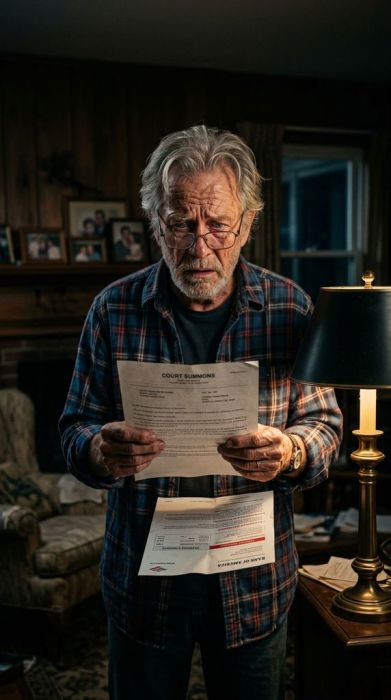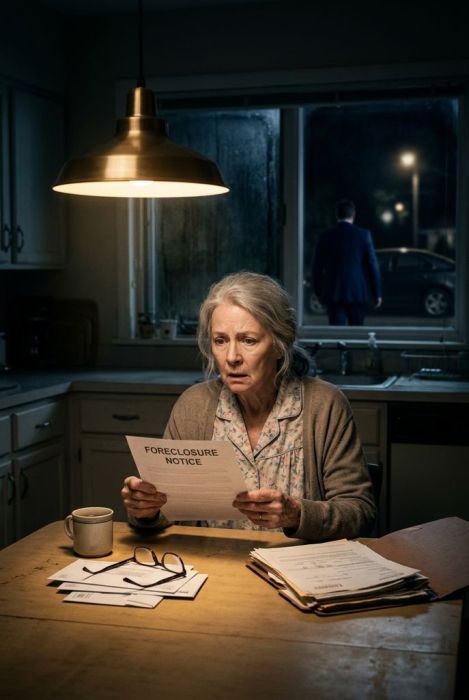
The hail came down like thrown rocks that June night in Wichita, and Martha Ellison lay awake in the house her late husband had paid off in 1998, listening to it hammer the roof he had shingled with his own hands. She was sixty-seven, a retired school librarian with a bad knee and a stubborn streak. When the storm finally moved east around four in the morning, she fell asleep promising herself she would check the gutters at first light. She had no idea her house was already a target.
The knock came at nine o'clock. A young man stood on her porch holding a clipboard and a smile that could have sold tires to a man without a car. His truck idled at the curb, a white F-250 with Oklahoma plates and a magnetic sign that read Crown Point Roofing, LLC. He introduced himself as Dale Whitfield, thirty-two years old and friendly as a golden retriever.
"Ma'am, I'm sorry to bother you," he said, "but I pulled over because I saw daylight through your shingles from the street. That roof is hurt worse than it looks."
Martha stepped onto the porch and squinted up at the ridge line. She could not see daylight in anything, but she appreciated the concern. Her husband's tools still hung in the garage, and the thought of the roof failing felt like a betrayal of his memory.
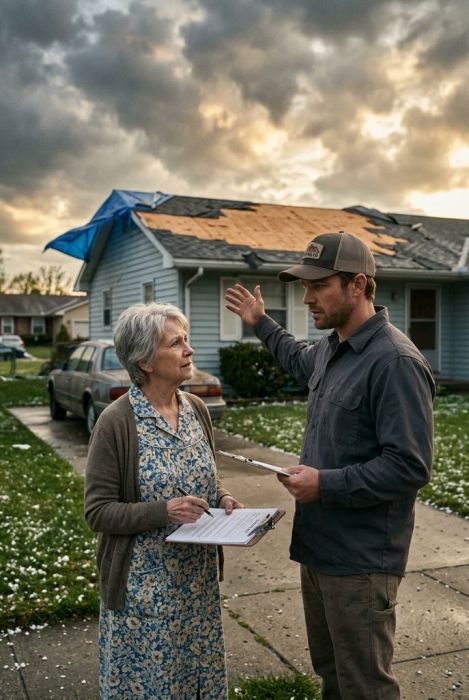
"Let me take a look. No charge, no pressure," Dale said, and he was already walking around the side of the house with the easy confidence of a man who had done this a thousand times. He climbed her ladder without asking, tapped at the gutters with a rubber mallet, and came back down with a piece of dark asphalt in his palm.
"Hail this size does damage you can't see from the ground," he explained, holding the torn shingle out to her. "I counted eleven soft spots up there. If we don't fix it before the next storm, you're looking at fifteen, maybe twenty thousand in water damage inside."
Martha felt her chest tighten. Her husband had handled every repair, every invoice, every decision about this house for forty-one years. Now he was gone, her daughter Nora lived in Denver, and the roof was suddenly her problem. Dale seemed to read the panic on her face.
"Look, ma'am, here's what I'll do. Your insurance will cover most of this. I'll come back tomorrow with an estimate and the paperwork, and I'll handle your claim start to finish. You won't have to lift a finger."
He brought her iced tea the next afternoon, and the afternoon after that. He listened to her stories about the library, about Nora's childhood, about the maple tree her husband had planted the year they moved in. He borrowed her garden hose to rinse the hail off her flowers. He called her "ma'am" in a way that sounded like respect instead of condescension, and when he finally sat down at her kitchen table with the estimate, Martha trusted him completely.
The bid was forty-one hundred dollars. Dale explained that her insurance would reimburse her, but the crew needed half up front to order the shingles before the manufacturer's price increase hit on the first of the month. It was an urgency she recognized from every hard-sell she had ever read about, but somehow it sounded different coming from him. He had been so kind. Kindness had a way of making urgency feel like care.
Her neighbor Frank Delgado had used Crown Point the year before, after the tornado warning that had shredded half the block's fences. Frank's new roof had held through two winters and a hailstorm, and Frank swore by the young man. "He's a good kid," Frank said over the fence that evening, gesturing with his coffee mug. "Did mine under what the other bids were quoting, and he even swept my driveway when he was done. You can't go wrong."
That was the detail that sealed it. Martha had watched Frank's roof go up herself, had seen the crew working at seven in the morning and noticed how clean they left his yard. A man who swept a widow's neighbor's driveway was not a man who would hurt her. She wrote the deposit check for twenty-one hundred dollars, made out to Crown Point Roofing, LLC, and handed it over with a feeling of relief she had not felt in months.
The crew arrived on a Tuesday. Dale came with them, wearing a hard hat and carrying a binder of paperwork that made Martha feel like everything was handled. She signed the work order without reading past the first page, because the first page was all friendly language about warranties and quality materials. She did not notice the cancellation clause on page three, the line that said Kansas law allowed her three days to change her mind. Nobody had ever told her that door-to-door contractors were required to give her that right, and Dale never mentioned it.
By noon the crew had stripped the entire north side of her roof down to bare plywood. Martha stood in the yard with her iced tea, watching them work, feeling the strange pride of a woman who was finally taking care of her own house. Her daughter called at two and Martha mentioned the roof, and Nora's voice went sharp on the other end of the line.
"Mom, did you get three bids? Did you check his license?"
"Nora, I'm not a child," Martha said, a little too quickly. "Frank used him. The roof is already half off. Do you want me to live with a tarp?"
There was a pause, then Nora's voice softened. "I just worry about you," she said. "That's all."
The crew stopped work at four o'clock, abruptly, like someone had flipped a switch. Dale walked over with a look on his face that Martha had never seen before, all the warmth drained out of it.
"Bad news, ma'am," he said. "The shingles we ordered got double-booked. Factory won't have them for three weeks. The material supplier can hold them if we put the balance down today, but I can't pay that out of my own pocket with the crew already here."
Martha stared at the half-naked roof and thought about rain. Weather.com showed a line of storms moving in by Friday. "How much?"
He looked at his clipboard. "Another twenty-two hundred. And I'll be honest, if we can't secure the material, I've got to pull the crew to a job in Andover that's ready to go. Otherwise I'm paying men to sit in a truck."
There it was. The trap that had been built for her since the moment she opened her front door. Martha wrote the second check with trembling hands, and this time she did not feel relieved. She felt like she was buying her own roof back from a stranger, a feeling she could not explain and did not want to examine too closely.
The storms came Friday, right on schedule. As the first drops hit her bare plywood, Martha stood in her kitchen and watched the water pool on the plastic sheeting Dale had promised to lay down. There was no plastic. There was no tarp, no crew, no Dale. His phone went straight to voicemail. The office number on his paperwork rang into silence, and when she drove to the address on the invoice, she found a UPS store with a row of mailboxes and a clerk who had never heard of Crown Point Roofing.
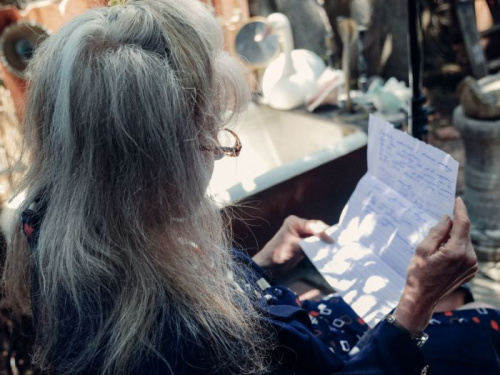
Nora flew in the next morning. She found her mother sitting at the kitchen table with a stack of receipts and the worst of the water damage already staining the ceiling of the spare bedroom, her father's letters from the attic scattered across the floor where the rain had soaked through the boxes. Martha was not crying. She was past crying. She kept smoothing the wet pages with her fingers, trying to press the ink back into the paper as if it could be saved, and Nora saw for the first time that her mother was not stubborn at all. She was terrified.
"Mom, we're going to fix this," Nora said, kneeling beside her. "And we're going to find him. But first, we have to be smart. Do you still have the paperwork?"
They called the insurance company together. Martha expected sympathy, maybe a lecture. What she got was a woman from the fraud department whose voice flattened when Martha gave her the name of the company and the claim number.
"Ma'am, we've never received a claim from you," the woman said. "The only thing we have on file is an inquiry from an adjuster named Robert Ellis from a company called Great Plains Adjustment Services. He submitted a preliminary estimate to us under your policy. I need to ask you directly: did you hire him?"
Martha closed her eyes. "He came out after the storm. He said he was from the insurance company."
"He wasn't," the woman said. "He's not affiliated with us. And I'm going to be straight with you, ma'am — the estimate he submitted was inflated by about twelve thousand dollars, and it would have been paid out to a roofing company you've never heard of if a claims reviewer hadn't flagged the licensing numbers. You would have been on the hook for fraud on top of everything else."
The word hung in the air like smoke. Fraud. Martha Ellison, who had returned an extra quarter to a cashier in 1987, who had never bounced a check in her life, had come within days of being swept into a criminal scheme because a handsome young man had brought her iced tea and called her ma'am.
That was when Nora found the photograph. It was in the business card folder Dale had left behind, a glossy trade-show flyer from a roofing expo in Tulsa, and in the corner of the crowd shot was a man in a suit shaking hands with the mayor of a small Oklahoma town. Nora magnified the image on her phone, then she magnified it again. The man in the suit was the same man who had come to her mother's door the week after the storm, the professional adjuster with the kind eyes and the laminated badge. Robert Ellis. Except in the photo, his arm was around a younger man in a work shirt who was laughing at something off camera.
Dale Whitfield. Robert Ellis. Two names, two faces, one brotherly arm around each other's shoulders.
"They're brothers," Nora whispered. "Mom, the adjuster and the roofer are brothers. He wasn't just scamming you for the deposit. He scammed you twice."
The confrontation happened on a Tuesday, exactly three weeks after the first knock. Martha was in the backyard hanging her husband's salvaged shirts out to dry when a car pulled into the driveway, and Dale Whitfield climbed out wearing the same golden smile she had trusted. He had a ladder with him, and a roll of blue tarp, and a story about a family emergency in Tulsa that sounded almost rehearsed.
"Ma'am, I am so sorry," he said, walking toward her with his hands spread wide. "My grandmother passed. We had to shut everything down. But I'm here now, and I'm going to make this right. I'll finish the roof myself if I have to."
Behind him, the door of his truck opened, and Robert Ellis stepped out in a pressed shirt that did not match the moment at all. Martha looked at them, these two men who had rehearsed kindness until it became a costume, and she thought about the letters in the attic, the ones she had dried page by page with a hair dryer.
"You're going to finish the roof," she said, and her voice did not shake. "Or you're going to explain to the district attorney why you filed a false claim under my policy number. Which one is it, boys?"
Dale's smile flickered. "Ma'am, I don't know what—"
"Your brother's grandfather was Dale Whitfield's grandfather too," Nora said, stepping onto the porch with her phone held up, the flyer glowing on the screen. "I called the Tulsa expo. Robert Ellis uses the name of the company he used to work for. And there's a detective in Andover who has been waiting for somebody to connect you two since March."
It was over in six minutes. Two marked units pulled into the driveway, and the young man who had carried her groceries listened to his rights in the same voice he had used to tell her about his fictional grandmother. Robert Ellis did not look at her at all. He looked at his brother, and whatever passed between them made Dale's face crumple into something Martha almost felt sorry for, until she remembered the wet letters and the ceiling in the spare room.
The restitution was slow and partial, the way these things always are. Crown Point Roofing had a bank account that was already empty, and the brothers had done the same dance in three other Kansas towns before they found her. But the district attorney did recover a little, and the state insurance fraud unit did press charges against both men, and a real licensed roofer from a company with a physical address and a phone number that a human being answered did finally finish Martha's roof in October.
The lesson did not come from a lecture. It came from the way Frank Delgado stopped mowing his own lawn when she walked past, because he had vouched for a con man and the shame had settled into his bones. It came from the new rule Nora printed on a card and taped to the inside of Martha's kitchen cabinet: call me before you pay anyone. It came from the afternoon Martha stood in the newly dry attic, holding the letters she had saved page by page, and realized that the only thing the brothers had truly stolen was the one thing she had been too proud to ask for help protecting.
These days, a laminated card sits on the table at the Wichita senior center where Martha volunteers. It lists the questions she asks every contractor who knocks on her door now: What is your physical address? What is your Kansas license number? Can I call your last three customers? And below the questions, in her own handwriting: The nice ones are the dangerous ones. The men who brought her iced tea every afternoon taught her that kindness is the easiest mask in the world to wear, and the hardest one to see through.
The roof above her head is sound now, installed by a company whose truck has Kansas plates and a phone number she actually called back. But Martha still keeps the torn shingle Dale handed her on that first June morning, the one he said came from her own roof, the one the real contractor later identified as a shingle from a different house entirely. It sits in a glass jar on her mantel, next to her husband's photo, a reminder of the difference between the damage a storm can do and the damage a smile can do.