Nico Reyes never expected to find the meaning of teaching in the silence of an eight-year-old girl who had stopped speaking. But that is exactly what happened on a gray September morning in San Francisco, when a child named Zoe walked into his art classroom with eyes that held a thousand words she could not say aloud.
He was twenty-six years old, a first-year art teacher at Garfield Elementary in the Mission District. The school was a place of bright colors and loud hallways, of children who spoke Spanish and Tagalog and Cantonese and the universal language of childhood. Nico had grown up in a family of nurses and engineers, the only one who had chosen paintbrushes over stethoscopes. His mother, a Filipina immigrant who had worked double shifts at a nursing home for thirty years, had never understood why he wanted to teach art. "What kind of job is that?" she had asked. "A necessary one, Ma," he had replied. She had not been convinced.
Zoe Martinez was eight years old, small for her age, with dark hair that fell across her face like a curtain she could hide behind. She had been diagnosed with selective mutism at age six — a condition of severe anxiety that made it impossible for her to speak in certain environments, even though she could talk perfectly well at home. At school, she was a ghost. She moved through the hallways without sound, ate lunch alone, and answered questions by nodding or shaking her head. The other children had stopped trying to include her months ago. The teachers had learned to accept her silence as a permanent feature of the classroom.
But Nico had not accepted it. He had noticed something about Zoe that the other adults had missed. He had noticed the way she looked at colors.
It was the second week of school when Nico assigned a project that would change everything. He gave each student a blank canvas and asked them to paint "a place where they felt safe." The room filled with the sound of brushes against canvas, of children chattering about their ideas. Zoe sat at her desk in the back corner, her brush hovering over the white surface, her face unreadable.
Nico walked past her desk several times, careful not to hover, not to pressure her. He was learning that silence required a different kind of attention — the kind that waited without expectation. By the end of the period, most students had finished their paintings. Zoe's canvas was still blank.
He did not say anything. He simply wrote a note on a sticky note and placed it on the corner of her desk: "Take it home. Bring it back when you're ready. There's no deadline for feeling safe."
The next morning, Nico arrived early to find Zoe standing outside the art room door, holding her canvas. She held it up without a word. The painting showed a bedroom at night, illuminated by the soft glow of a galaxy lamp on the nightstand. A figure lay in the bed — a child, curled up with a cat. The window was open, and through it, a stream of golden light poured in, as if something beautiful was trying to enter the room.
Nico looked at the painting for a long time. The proportions were slightly off. The perspective was imperfect. But the emotion in it — the longing, the safety, the quiet hope — was so powerful that it took his breath away.
"Zoe," he said softly, "this is the most beautiful painting I have seen in a very long time."
She looked at him with her dark, watchful eyes. She did not smile. But something in her posture shifted — a relaxation of the shoulders, a softening of the jaw. She had been heard.
That was the beginning of a language that did not need words.
Nico started leaving small art supplies on Zoe's desk before she arrived — a new set of watercolors, a pack of charcoal pencils, a notebook with blank pages. She started leaving paintings on his desk in return — a bird in flight, a tree with roots that stretched deep into the earth, a hand reaching toward a light source he could not identify. They communicated through images, through colors, through the particular language of people who understood that some things could only be said with a brush.
He learned about her life through her art. He saw the small apartment she shared with her mother, a restaurant worker who left before dawn and returned after dark. He saw the cat she loved, a calico named Mochi who slept on her pillow every night. He saw the anxiety that lived in her chest like a second heartbeat, and the courage it took for her to walk into a loud classroom every single morning.
In October, Nico announced a school-wide mural project. The theme was "Our Neighborhood, Our Stories." Every class would contribute a section of a large mural that would be installed in the main hallway. The art room buzzed with excitement. Students sketched their ideas — the taqueria on Mission Street, the mariachi band that played in the park, the murals that already covered the walls of the neighborhood, telling stories of immigrants and workers and dreamers.
Zoe did not submit a sketch. She sat at her desk, her hands in her lap, watching the other children with the quiet intensity of someone who had learned to be a spectator in her own life.
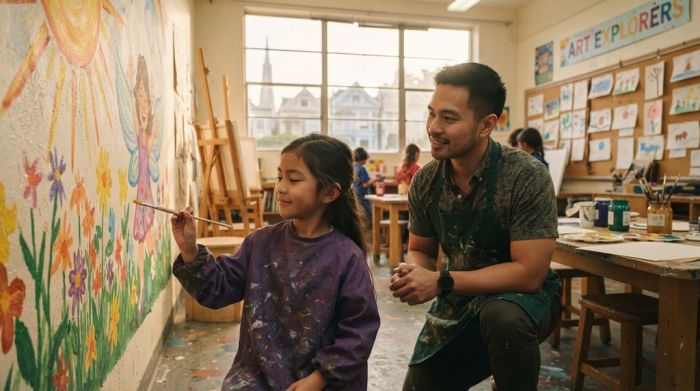
Nico approached her desk. He knelt down so he was at her eye level. "Zoe, I want you to paint something for the mural. Something only you can paint."
She looked at him. Her eyes asked a question without words.
"I know you have something inside you," he said. "I have seen it in everything you have painted. The mural is not complete without your voice."
She did not respond. But that afternoon, Nico found a small sketch on his desk. It showed a figure — a girl with dark hair and wide eyes — standing at the edge of a crowd. She was holding a paintbrush, and above her head, the sky was filled with stars that she had painted herself.
Nico understood. She was afraid of being seen. But she was even more afraid of being forgotten.
The mural took three weeks to complete. Students worked on it during art class, during lunch, during the after-school program that Nico ran for free because he believed that every child deserved a place to create. The mural grew day by day — a tapestry of the Mission District, its people, its colors, its stories. There were portraits of grandmothers and graffiti artists. There were images of the taqueria and the bodega, of the Pentecostal church and the public library.
And in the corner, on a section that Nico had saved for her, Zoe painted the night sky.
It was a corner of the mural that faced the main entrance, the first thing visitors would see when they walked into the school. She painted it in secret, after school, when the hallways were empty and the only sound was the hum of the fluorescent lights. Nico stayed with her, organizing the supply closet, giving her space. He did not watch her work. He did not ask to see it before it was finished. He trusted her, the way you trust someone who has shown you who they are through the colors they choose.
On the morning of the mural unveiling, the entire school gathered in the main hallway. The principal made a speech. The students cheered when the cloth was pulled away. And there it was — the neighborhood, alive in paint. The children pointed at their contributions, their faces bright with pride.
And in the corner, Zoe's sky glowed. It was not just a night sky. It was a sky full of constellations that spelled something in a language only she understood. In the center, a single figure stood — a girl with a paintbrush, her hand raised, a trail of stars following her brush like a river of light.
The principal, a woman named Ms. Kowalski who had been at Garfield for thirty years, looked at Zoe's section and went very quiet. She called Nico to the side. "Who painted this?" she asked.
"Zoe Martinez," Nico said.
Ms. Kowalski's eyes filled with tears. She walked to where Zoe was standing, at the back of the crowd, half-hidden behind a pillar. She knelt down and said, "Zoe, this is the most beautiful thing I have ever seen in this school."
Zoe looked at her principal, at the mural, at Nico, who was watching her from across the hallway with the steady, patient gaze of someone who believed in her completely. And then, in a voice so soft that only the people standing closest could hear, Zoe said two words.
"Thank you."
It was not much. It was two syllables, barely audible above the noise of the crowd. But it was the first time she had spoken at school in two years.
Her mother, who had taken the morning off work to attend the unveiling, heard it. She covered her mouth with her hand and began to cry. Nico crossed the hallway and knelt beside Zoe, the way he had knelt beside her desk on that first day, the way he had knelt beside her every day since.
"You did it, Zoe," he said, his voice thick. "You found your voice."
She looked at him. She did not say anything else. But she reached out and took his hand, and she held it, the way you hold something you are afraid to let go of.
The mural is still there, on the wall of Garfield Elementary School in the Mission District of San Francisco. The night sky is the first thing visitors see when they walk through the main entrance. The girl with the paintbrush stands at the center, her hand raised, creating light out of darkness.
Zoe Martinez is ten now. She still has selective mutism — it is not something that can be cured with a single mural. But she speaks more than she used to. She has friends. She eats lunch at a table with other children. She still paints, and her paintings hang in the hallways of the school, a reminder that some voices do not need words to be heard.
Nico Reyes is twenty-eight. He still teaches art at Garfield Elementary. He still stays after school for children who need extra time, extra space, extra grace. His mother came to the mural unveiling and saw Zoe's painting. She held her son's hand and said, "I understand now. This is why you teach."
Nico nodded, unable to speak, the way Zoe had taught him that sometimes the most important things cannot be said aloud. They have to be painted. They have to be created. They have to be offered to the world in colors, in silence, in the quiet courage of a girl who found her voice not in a spoken word, but in a brushstroke across a dark sky.