Henry Vargas never expected to find a reason to open his heart again in a twelve-year-old girl with a scowl and a phone glued to her hand. But that is exactly what happened on a sweltering July afternoon in Lancaster County, Pennsylvania, when a battered minivan pulled into the driveway of the house next door and unloaded a girl who looked like she had been sent to prison instead of summer vacation.
Henry was forty-five years old, and he had been keeping bees for twenty-two years. He had started when he was a young man, fresh out of a marriage that had ended before it really began, looking for something that would require his attention without demanding his heart. The bees had been perfect. They asked for nothing except patience and consistency, and they gave back honey that was the color of amber and tasted like the wildflowers that grew in the meadow behind his house.
He lived alone in the farmhouse where he had grown up, a white clapboard building with a wraparound porch and a roof that needed replacing every ten years like clockwork. His parents had passed away within six months of each other in 2014 — his father from a heart attack, his mother from what the doctors called a broken heart. Henry had inherited the house, the land, and a silence that had settled into the walls like dust. He had not minded the silence. He had learned to fill it with the hum of his bees, the creak of the porch swing, and the occasional book borrowed from the library in town.
Olivia Patterson was twelve years old, and she had been angry for as long as she could remember. She was angry at her father, who had walked out when she was seven and now lived in Arizona with a new wife and a new baby. She was angry at her mother, who had sent her to stay with her grandmother for the summer because she was "too much to handle." She was angry at the world for being unfair, and she expressed that anger through slammed doors, rolled eyes, and a vocabulary of sarcasm that would have impressed a stand-up comedian.
Her grandmother, a retired schoolteacher named Doris, lived next door to Henry. Doris had been widowed for ten years and had the patient, weathered kindness of someone who had raised three children and taught thirty classes of fifth graders. She was not intimidated by Olivia's anger. She had seen it before, in a hundred different faces, and she knew that underneath the armor was a child who was desperately afraid of being abandoned again.
The first time Olivia saw Henry, she was sitting on her grandmother's porch, scrolling through her phone, looking at photographs of her friends back in Philadelphia having fun without her. Henry was walking back from the apiary, his veil pushed up, his hands stained with propolis. He nodded at her the way neighbors nod — a brief, respectful acknowledgment. Olivia ignored him.
That was the pattern for the first week. Henry would tend his bees. Olivia would ignore him. He would walk past her porch. She would look at her phone. It was a dance of mutual disinterest, and it might have continued all summer if not for the bee.
It happened on a Thursday afternoon. Olivia was walking to the mailbox at the end of the driveway — a rare excursion from the porch — when she stepped directly into the flight path of a honeybee returning to its hive. The bee, confused and threatened, stung her on the ankle. Olivia yelped, dropped the mail, and started hopping on one foot, which only made the situation worse. She had never been stung before. The pain was sharp and immediate, and she started to cry — not because it hurt, but because it was the final insult in a summer that had already felt like a punishment.
Henry heard her yelp from the apiary. He walked over, his steps unhurried, and knelt beside her. He examined the sting with the practiced eye of someone who had been stung hundreds of times. "You're not allergic," he said, "or your throat would be closing up by now. Come with me. I have something that will help."
She followed him, limping, to his farmhouse. He led her to the kitchen, a room that smelled like wood smoke and dried herbs. He opened a drawer and pulled out a small jar of dark, thick liquid. "Raw honey," he said. "Put this on the sting. It'll draw out the venom and stop the swelling."
Olivia looked at the jar, then at him. "You're putting honey on a bee sting? That's weird."
Henry almost smiled. "Bees are the only creatures that produce medicine for their own stings. It's ironic, but it works."
She applied the honey. Within minutes, the pain began to fade. She sat at his kitchen table, her leg propped up on a chair, and looked around the room. There were jars of honey on every surface. A framed photograph of a woman in her twenties — Henry's ex-wife, though Olivia did not know that — hung on the wall. A stack of books on the counter included a worn copy of "The Secret Life of Bees."
"Do you know what that book is about?" Henry asked, noticing her gaze.
"No," she said.
"It's about a girl who runs away from home and finds a family of beekeepers. She learns that bees are not just insects. They are a community. They work together, they protect each other, and they communicate through dances."
Olivia looked at him with an expression that was equal parts skepticism and curiosity. "Bees dance?"
"They do. A honeybee, when she finds a good source of nectar, returns to the hive and performs a waggle dance. She moves in a figure-eight pattern, and the angle of her dance tells the other bees exactly where to find the flowers. It's a language. A beautiful, complicated language that scientists are still trying to fully understand."
Olivia was quiet for a long moment. Then she said, "Can you show me?"
That was the crack in the wall.
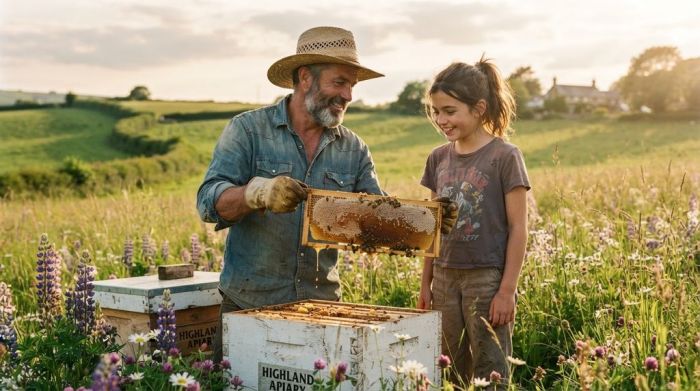
Henry took her to the apiary the next morning. He gave her a veil and showed her how to approach the hives slowly, without sudden movements. He taught her that bees could smell fear, and that if she was calm, they would be calm too. He opened a hive and pulled out a frame, covered in thousands of bees, their wings humming with the collective energy of the colony. He pointed to the queen, larger and darker than the others, moving slowly through the honeycomb.
Olivia was transfixed. She had never seen anything like it. She had spent her whole life in Philadelphia, surrounded by concrete and noise, and she had never imagined that a world like this existed — a world of order and purpose and quiet, ancient rhythms.
She started coming to the apiary every day. She helped Henry check the hives, smoke the bees, and harvest the honey. She learned that each hive had its own personality — some were calm, some were aggressive, some were lazy. She learned that the drone bees did not have stingers and spent their entire lives waiting for a chance to mate with a queen. She learned that worker bees lived for only six weeks in the summer, flying themselves to death in service of the colony.
And somewhere in the middle of all that learning, Olivia stopped being angry.
It was not a dramatic transformation. There was no single moment when she put down her armor and declared herself healed. But the scowls became less frequent. The sarcasm softened. She started calling her mother without being reminded, and the conversations that had once been tense and short became longer and warmer. She told her mother about the bees, about the queen, about the waggle dance. Her mother listened, and Olivia could hear her crying on the other end of the line — not sad tears, but the kind of tears that come when you realize that your child is going to be okay.
Henry noticed the change too. He noticed the way she talked to the bees now, in a soft, gentle voice, as if she was speaking to old friends. He noticed the way she handled the frames with confidence, the way she had stopped flinching when a bee landed on her arm. He noticed that she was no longer a girl who had been sent away. She was a girl who had found a place where she belonged.
At the end of August, Olivia's mother came to pick her up. She stood in the driveway, watching her daughter say goodbye to Henry. Olivia hugged him — the first hug she had initiated in years — and whispered something in his ear. Henry nodded, his eyes bright.
As they drove away, Olivia's mother asked what she had said.
"I told him that the bees taught me something," Olivia said. "They taught me that even the smallest creatures can change the world, as long as they work together. And I told him that he was the first adult who ever made me feel like I was worth teaching."
That was two years ago.
Henry Vargas is forty-seven now. He still keeps bees. He still lives alone in the farmhouse on the edge of Lancaster County. But he is not as solitary as he used to be. He volunteers at the local middle school, teaching a workshop on beekeeping and pollination. He has a waiting list of students who want to learn.
Olivia is fourteen. She is a freshman in high school. She started a beekeeping club at her school in Philadelphia, and twelve students have joined. She calls Henry every Sunday evening, and they talk about the hives — about the new queens, the honey flow, the challenges of keeping bees in the city. Last spring, she came back to Lancaster for a weekend, and she helped Henry install two new hives. She wore her old veil, which was now too small for her, and she moved through the apiary with the confidence of someone who had found her place in the world.
There is a photograph on Henry's mantle, next to the picture of his ex-wife. It shows a twelve-year-old girl in a beekeeper's veil, holding a frame of honeycomb, her face split by a grin so wide that it seems to contain all the light in the world. Henry looks at it every morning before he goes out to check the hives.
He thinks about the girl who arrived angry and afraid, and the bees that taught her to be patient and brave. He thinks about the summer he thought he would spend alone, and the unexpected gift of a neighbor who needed exactly what he had to give. He thinks about the waggle dance, and the way that love, like honey, finds its way to the places that need it most — carried by small, determined creatures who refuse to give up.
The bees are still humming in the meadow behind the farmhouse. The honey is still golden. And somewhere in Philadelphia, a teenage girl is learning that the world is full of things worth protecting — and that the smallest acts of kindness, like the waggle dance of a single bee, can lead an entire colony home.