Marcus Brooks never expected to find a legend hiding in his neighbor's garage. But that is exactly what happened on a humid July afternoon in Austin, Texas, when a fourteen-year-old boy with a broken skateboard knocked on the door of a house that everyone on the block said belonged to "the quiet old man."
Marcus was fourteen, with a mop of curly hair that refused to be tamed and a pair of sneakers that had more duct tape than canvas. He had been skateboarding for exactly two years, three months, and eleven days — not that he was counting. He had learned on a hand-me-down board his mother had found at a garage sale for five dollars, and he had practiced every single day on the cracked sidewalk in front of their rental house on Ponderosa Street.
His mother, a home health aide who worked twelve-hour shifts at a hospice facility, had bought him his first real skateboard for his thirteenth birthday — a used board from a resale shop, but to Marcus, it had felt like winning the lottery. He had treated that board like a treasure. He cleaned the bearings every week, replaced the grip tape when it wore thin, and waxed the edges until they were smooth as glass.
And then, on a Thursday afternoon in late June, a crack appeared in the deck. A hairline fracture, right behind the front trucks, the kind of injury that meant the board could snap at any moment. Marcus had stared at it for an hour, running his finger over the thin line, feeling his heart sink into his stomach. He did not have the money for a new board. His mother did not have the money either. And asking her would only add to the weight he already saw pressing down on her shoulders every night when she came home from work.
So Marcus did the only thing he could think of. He walked his broken board to the one house on the block that might have the tools to fix it — the house with the garage that was always open, where an old man with silver hair and paint-stained hands spent his days building things Marcus could not identify from the sidewalk.
The old man's name was Leon Henderson. He was seventy years old, and he had been a professional skateboarder in the 1970s, back when skateboarding was not a sport but a rebellion, back when the first urethane wheels were changing everything and kids were carving empty swimming pools across Southern California. He had been sponsored by a company called Hang Ten, had his photograph in Skateboarder Magazine, and had once been invited to compete in the first professional skateboarding contest in California in 1975.
But that was a lifetime ago. Now Leon lived alone in a small house in East Austin, surviving on Social Security and the occasional carpentry job. His wife of forty-two years, Dolores, had passed away five years ago. His daughter lived in Seattle and called once a month. He spent his days in the garage, building custom furniture that no one bought, and trying not to think about the past.
He had not touched a skateboard in thirty-four years.
When Marcus knocked on the open garage door, Leon was sanding a wooden chair leg. He looked up, his eyes adjusting to the afternoon light, and saw a gangly kid holding a broken skateboard like it was a wounded bird.
"Excuse me, sir," Marcus said. His voice cracked on the last word. "I'm sorry to bother you. But I heard you build things. And my board is broken. And I don't have money for a new one. And my mom —" He stopped, swallowing hard. "I just need to know if it can be fixed."
Leon set down the sandpaper. He walked over and took the skateboard from Marcus's hands. He turned it over, examining the crack with the practiced eye of someone who had broken a hundred boards in his youth. He looked at the trucks — old, rusted, but still functional. He looked at the wheels, worn smooth from months of pavement. He looked at the grip tape, peeling at the edges.
And then he looked at the boy — at the desperate hope in his eyes, at the way he was holding his breath, at the familiar ache of wanting something so badly it hurt.
"You know," Leon said slowly, "the deck is done. You can't fix a cracked deck. It'll snap the first time you land a trick."
Marcus's face fell. He reached for the board, ready to walk away.
"But," Leon continued, "I have some maple plywood in the back. And I have a jigsaw. And I haven't shaped a deck in thirty-four years. But I remember how."
Marcus stared at him. "You know how to shape a deck?"
Leon almost smiled. "I used to shape my own boards. Back when nobody sold them off the rack. You had to build them yourself if you wanted them to feel right."
"Why did you stop?"
The question hung in the air. Leon looked at his hands — hands that had once gripped the rails of a vert ramp, hands that had signed autographs for kids who looked up to him, hands that had held Dolores's face when she told him she was sick.
"Because life got in the way," he said quietly. "And I forgot how much I loved it."
That was the beginning of something neither of them could have predicted. Marcus started coming to Leon's garage every day after school. They measured, cut, and sanded the new deck together. Leon showed him how to shape the nose and tail, how to drill the holes for the trucks, how to apply the grip tape without leaving bubbles. Marcus watched, asked questions, and learned that the old man knew more about skateboarding than anyone he had ever met.
One afternoon, while they were waiting for the paint to dry, Marcus asked the question that had been forming in his mind for weeks. "Mr. Henderson, did you ever compete? Like, professionally?"
Leon wiped his hands on a rag. He was quiet for a long moment. Then he walked to a dusty cabinet in the corner of the garage, opened it, and pulled out a cardboard box. He set it on the workbench and lifted the lid. Inside were photographs — yellowed, faded, the edges curled with age. A younger Leon, shirtless and suntanned, launching off a ramp in a parking lot. A younger Leon holding a trophy, surrounded by a crowd of people. A younger Leon, grinning at the camera, holding a skateboard that he had shaped with his own hands.
"I used to be pretty good," Leon said, his voice rough. "I made it to the nationals in 1976. I finished fourth. It was the best day of my life." He paused, touching the edge of the photograph. "I quit a year later. Dolores got pregnant. I needed a real job. And I never looked back."
Marcus looked at the photographs, then at the old man, and felt something shift in his chest. "You were a legend," he whispered. "You were a real skateboarding legend."
Leon shook his head. "I was a kid who could ride a piece of wood. That's all."
"No," Marcus said, his voice firm. "You were a legend. And you still are. You just forgot."
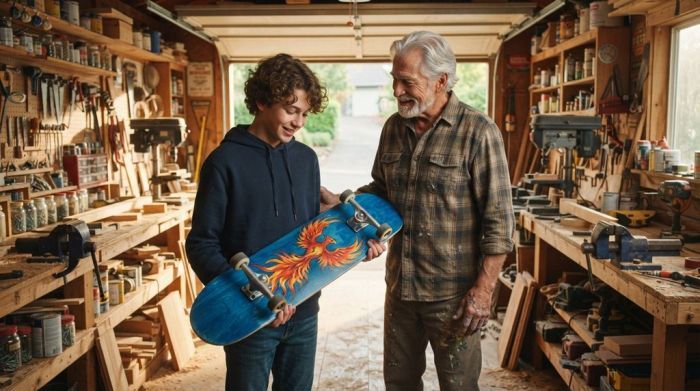
The board was finished on a Saturday morning in August. It was beautiful — a shape that felt perfect under Marcus's feet, painted a deep blue with a hand-drawn design of a phoenix on the bottom. Leon had insisted on the phoenix. "Rising from the ashes," he had said. "That's what this summer was. That's what you are."
Marcus held the board in his hands, feeling the weight, the balance, the craftsmanship that had gone into every curve. He looked at Leon, and he did not try to hide the tears in his eyes.
"I don't know how to thank you," he said.
Leon put a hand on his shoulder. "You thank me by using it. By learning every trick you can. By never letting anyone tell you that you're too young or too poor or too anything to be great."
Marcus nodded. He set the board on the driveway, stepped onto it, and pushed off. The wheels rolled smoothly over the asphalt. The board felt alive underneath him. He carved a turn, picked up speed, and ollied over a crack in the pavement — the first trick he had been able to land since the old board broke. He landed clean, rolled to a stop, and turned around to face Leon.
Leon was standing at the edge of the driveway, his arms crossed, his face split by a grin that he had not worn in thirty-four years.
"Not bad, kid," Leon said. "Not bad at all."
That was the moment Leon Henderson stepped back into the world. It started small — Marcus asked him to demonstrate a trick, then another, then another. Leon's body remembered what his mind had tried to forget. The muscle memory was still there, buried under decades of dust and regret. He started skating again, just in the driveway at first, then at the local park, then at the skatepark across town where the younger skaters gathered.
Word spread. The old man at the skatepark was a legend from the 1970s. The old man could still skate. The old man was teaching a kid named Marcus how to ride. People started coming to watch. They brought cameras. They asked questions. Someone posted a video of Leon dropping in on a halfpipe — his first time in thirty-four years — and it got over a million views.
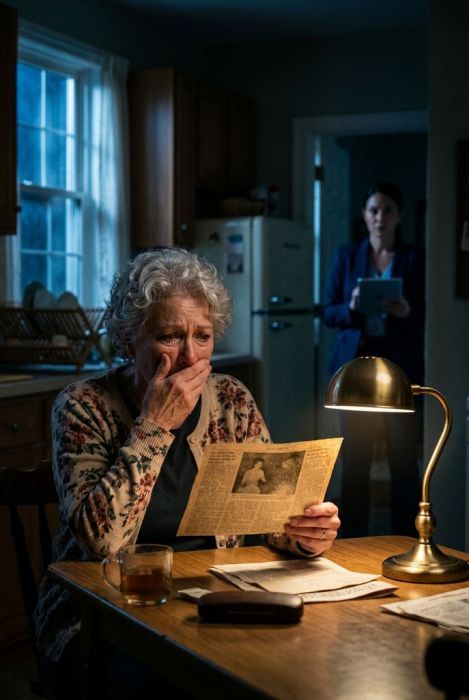
In September, Leon received a letter from a skateboarding museum in California. They wanted to feature his original boards in an exhibition about the golden age of skateboarding. He packed up the boards he had kept in the back of his closet, including the one he had ridden in the 1976 nationals, and shipped them to California. He did not tell Marcus about it, but Marcus found out when he saw the article in the local newspaper.
"You're famous," Marcus said, holding up the paper.
"I'm seventy years old," Leon said. "I'm too old to be famous."
"You're never too old to be famous. Look at Betty White."
Leon laughed — a real laugh, full and warm, the kind that had been buried in his chest for too long. He had not laughed like that in years. He had not done a lot of things in years. But the boy with the broken skateboard had changed all of that.
That was two years ago. Marcus Brooks is sixteen now. He is one of the best young skateboarders in Austin. He has been approached by two sponsors, but he has turned them down because he wants to finish high school first. He still practices every day on the board that Leon built for him, the blue one with the phoenix on the bottom. The grip tape is worn. The wheels have been replaced twice. But the deck is still solid, still perfect, still the most beautiful thing he owns.
Leon Henderson is seventy-two. He is a volunteer coach at the local skatepark. He teaches a free clinic every Saturday morning, and forty kids show up every single week. He shaped his first new deck in thirty-four years last spring. He sold it to a collector for five hundred dollars. He donated the money to the youth skateboarding program at the community center.
And every Saturday afternoon, after the clinic is over, Marcus and Leon sit on a bench at the skatepark and talk. They talk about tricks and technique and the physics of a perfect ollie. But they also talk about other things — about Leon's wife Dolores, about Marcus's mother who works too hard, about the strange way that life brings people together at exactly the right moment.
"You know," Marcus said one afternoon, as they watched the younger kids practice their kickflips, "I used to think that the only thing that mattered was getting good enough to go pro. But now I think the only thing that matters is having someone who believes in you."
Leon nodded. He looked at the boy beside him — the boy who had knocked on his garage door with a broken board and a desperate hope — and he realized that he had been wrong all those years. He had not quit skateboarding because life got in the way. He had quit because he had lost the belief that what he did mattered. Marcus had given that belief back to him. Not by being a great skater, but by being a kid who refused to give up, who showed up every day, who believed that an old man in a dusty garage still had something worth sharing.
There is a photograph that hangs on the wall of Leon's garage. It shows two people — a fourteen-year-old boy with curly hair and a seventy-year-old man with gray hair and paint-stained hands. They are standing in the driveway, holding a freshly painted skateboard between them. They are both smiling, the way people smile when they have just discovered that the best part of their lives is not behind them. It is right here, in this moment, in this garage, in the space between a boy who was looking for a way to keep going and an old man who had forgotten how to begin again.
The skateboard under the porch was never just a skateboard. It was a bridge between two generations, built one plank at a time. It was the proof that the things we love never leave us — they just wait for someone to remind us why we loved them in the first place.
Marcus Brooks found a legend in his neighbor's garage. Leon Henderson found a reason to pick up his tools again. And together, they proved that it is never too late to start rolling — whether you are fourteen and just learning, or seventy and remembering. All you need is a board, a patch of pavement, and someone who believes you can fly.