Sam Kowalski never expected to find a reason to hope again in a pile of undelivered mail. But that is exactly what happened on a rainy Tuesday in October, when he discovered a letter that had been lost in the postal system for twenty-two years and decided to deliver it himself.
Sam was thirty-five years old, and he had been a mail carrier for the United States Postal Service in Clearfield, Ohio, for twelve years. He was a quiet man, the kind who nodded instead of waved, who knew every dog on his route by name and every driveway that needed to be cleared of snow in the winter. He had been married once, to a woman named Diane who had left him five years ago because, she said, he had stopped being present. She was not wrong. After his daughter Emily moved to Columbus with her mother, Sam had retreated into a life of routines that required no vulnerability and promised no pain.
Every morning, he arrived at the Clearfield Post Office at 5:30 AM, sorted his mail, and hit the road by seven. He walked the same streets, delivered to the same houses, ate the same turkey sandwich on the same park bench at exactly the same time. His daughter called him every Sunday evening, and those calls were the only color in a world that had faded to shades of gray.
The letter was in a bin of undeliverable mail that had been sitting in the back of the post office for decades. Sam had been tasked with clearing out the storage room — a job no one wanted, which was why it had been assigned to the newest employee, except the newest employee had been there for three months and had already learned to say no. So it fell to Sam, who never said no to anything.
The bin was filled with catalogs from the 1990s, expired coupons, and envelopes that had been returned to sender so many times they had grown soft and worn. Sam was about to dump the entire bin into a recycling bag when a single envelope caught his attention. It was different from the others — cream-colored, slightly heavier, addressed in handwriting that was elegant and slightly unsteady, as if the writer had been very tired or very afraid.
The postmark was dated October 14, 2003.
The letter was addressed to a woman named Olivia Hartwell, at an address on Cherry Street in Clearfield. The return address said "Rebecca Hartwell, University of Michigan Hospital, Ann Arbor, Michigan."
Sam turned the envelope over in his hands. Twenty-two years. This letter had been sitting in a dark bin for twenty-two years, waiting to be delivered to a woman who had probably moved on, who had probably never known that someone had written to her, who had probably spent two decades wondering about the letter that never arrived.
He should have put it in the recycling. He knew that. The post office was not in the business of delivering twenty-two-year-old mail. But the name — Hartwell — was familiar. There was a Hartwell family that lived on the edge of his route, an elderly couple who had passed away a few years ago. And there was a young woman who had inherited the house, a woman in her early twenties who Sam had seen gardening in the front yard on summer evenings. He did not know her name. But he knew where she lived.
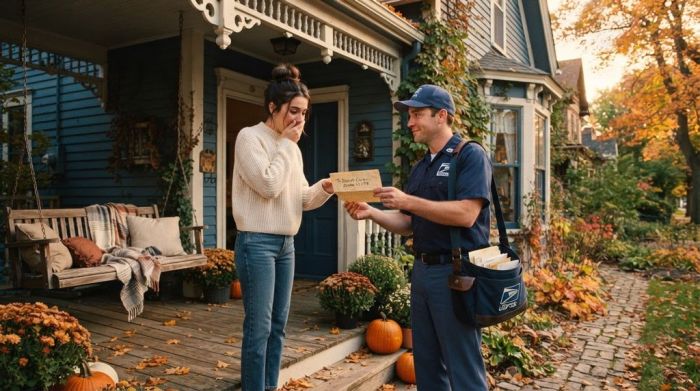
That evening, Sam drove to the house on Cherry Street. It was a small Victorian cottage, painted pale blue, with a porch swing and a garden full of wildflowers that had clearly been planted with care. He stood on the sidewalk for a long time, holding the envelope, wondering if he was about to do something incredibly stupid or incredibly right.
The door opened before he could knock. A young woman stood in the doorway, wiping her hands on a dish towel. She was maybe twenty-two years old, with dark hair pulled into a messy bun and eyes that held the particular warmth of someone who had learned to find joy in small things. She looked at Sam, at the envelope in his hand, and her expression shifted from curiosity to something more guarded.
"Can I help you?" she asked.
"My name is Sam Kowalski," he said. "I work at the post office. I found something that belongs to you."
She took the envelope. She looked at the postmark — 2003 — and the color drained from her face. She opened the door wider. "You should come inside."
Her name was Olivia Hartwell. She was twenty-three years old, the daughter of the Olivia Hartwell the letter had been addressed to. Her mother had passed away in 2018, when Olivia was nineteen. She had been raised by her grandmother, who had passed away three years ago. The letter was from someone named Rebecca Hartwell — a name Olivia did not recognize.
She opened the envelope with trembling hands. Inside was a single sheet of paper, the ink faded but still legible. Sam watched her read it, watched her hand fly to her mouth, watched the tears start before she had even finished the first paragraph.
The letter was from Rebecca Hartwell — Olivia's biological mother. She was writing from University Hospital in Ann Arbor, where she was being treated for cancer. She had given Olivia up for adoption twenty-two years ago, when she was nineteen years old and too sick to raise a child. She had spent the past two years searching for the family who had adopted her daughter. She had found them — the Hartwells of Clearfield, Ohio. And she was writing to introduce herself, to explain why she had let her go, to tell Olivia that she had loved her from the moment she was born, even though she had never held her.
The letter ended with a postscript: "I do not know how much time I have left. But if you are reading this, I want you to know that giving you up was the hardest thing I have ever done. I did it because I wanted you to have a life — a whole life, with parents who could be there for every birthday, every school play, every scraped knee. I hope you are happy. I hope you have flowers in your garden. I hope someone tells you every single day that you are loved. I love you. I have always loved you. — Rebecca."
Olivia finished reading. She sat in her grandmother's armchair, holding the letter against her chest, and she wept the way people weep when a door they did not know was closed suddenly swings open.
"She died," Olivia whispered. "She must have died. The postmark is October 2003. She wrote this and she died, and I never knew. I never knew she existed. My grandmother never told me. My parents never told me. I grew up believing I was theirs, that I had always been theirs. And all this time, there was a woman in Ann Arbor who loved me enough to let me go, who wrote me a letter that never arrived."
Sam sat across from her, his hands clasped between his knees. He did not know what to say. He was not good with words, had never been good with words. But he knew loss. He knew the particular ache of a love that had been interrupted.
"I'm sorry," he said. "I'm sorry it took twenty-two years for this letter to reach you."
Olivia looked at him, her eyes red and swollen. "You found it," she said. "You could have thrown it away. No one would have known. But you brought it here. You brought me my mother's last words."
"I couldn't let it stay in the dark," Sam said. "It didn't belong there."
That was the beginning of something neither of them had expected. Sam started stopping by Olivia's house on his mail route, just to check on her. She started leaving him cups of coffee on the porch, with a note that said "Thank you" in careful handwriting. Over the following weeks, they talked — about the letter, about her mother, about the man who had spent twelve years delivering mail but had never delivered anything that mattered until now.
Olivia found Rebecca's obituary online. She had died on November 2, 2003, eighteen days after writing the letter. She was twenty-one years old. She had never held her daughter. She had never known if the letter arrived.
On the first anniversary of the letter's delivery, Olivia planted a rose bush in her front yard. She invited Sam to help her dig the hole, and they worked together, two people bound by a piece of paper that had traveled through time to find them.
"She would have liked you," Olivia said, packing soil around the roots. "She would have liked that you don't give up on things."
Sam smiled, a rare and fragile thing. "I almost gave up on this letter. I had it in my hand, ready to throw it away. But something stopped me."
"What?"
"I don't know. Hope, maybe. I had forgotten what it felt like."
The rose bush bloomed the following spring — deep red blossoms that caught the morning light like stained glass. Olivia named it Rebecca. She wrote a letter to her mother, telling her everything — that she had grown up loved, that she had flowers in her garden, that she had finally received the letter that had been traveling toward her for twenty-two years.
And Sam? He started delivering the letter's story instead of just envelopes. He told the other mail carriers about it. He told his daughter, Emily, during one of their Sunday calls, and she listened without interrupting, and when he finished, she said, "Dad, that's the most beautiful thing you've ever told me."
He still works the same route in Clearfield. He still knows every dog by name. But when he passes the blue cottage on Cherry Street, he slows down. He looks at the rose bush, at the young woman who waves from the porch, at the garden that grows wilder and more beautiful every year. And he remembers that the most important deliveries are not the ones we are paid to make. They are the ones we choose to make, even when the ink has faded, even when the address is old, even when everyone else would have thrown the letter away.
Sam Kowalski never expected to find a reason to hope again in a pile of undelivered mail. But hope, he learned, does not arrive on schedule. It arrives when it is ready. Sometimes it arrives twenty-two years late. But it always, always arrives.
If you ever find yourself in Clearfield, Ohio, look for the blue cottage on Cherry Street. The rose bush in the front yard is called Rebecca. The mail carrier who delivers to that street will probably slow down when he passes it. And if you ask him about the letter he delivered twenty-two years late, he might tell you the story. He might tell you that some deliveries are not about the destination. They are about the journey — the long, winding, improbable journey of a letter that refused to stay lost, and the man who refused to let it disappear.